

TL;DR — When people ask about food processor and blender in one, they are usually trying to make a buying or care decision without wasting money. This guide keeps the focus on what changes day-to-day use. For product picks, the closest next steps are best air fryer, best blender, and best instant pot.
Our view is based on product specs, material trade-offs, and repeated owner feedback — not one-off kitchen anecdotes or brand claims. For appliance topics, we pay close attention to capacity, controls, cleanup, storage, reliability complaints, and whether the machine saves enough effort to justify the space.

Save $35.13
Pros & Cons
Pros
- Eleven functions cover blending, chopping, slicing, shredding, grinding, kneading, whipping, pureeing and salad spinning.
- Dual-lock protection and a suction-cup base support safer, more stable operation.
- Two large bowls provide practical capacity for family portions and weekly meal preparation.
- Three speed settings offer more control than a basic single-speed food chopper.
Cons
- The 600W motor may be less suitable than a higher-powered processor for frequent heavy dough batches or very hard ingredients.
- The two bowls, grinder cup and processing attachments require more cabinet space than a basic blender or compact chopper.
Details
This Sangcon appliance combines a smoothie blender, food processor, vegetable chopper, grinder, dough mixer and salad spinner to reduce the need for separate prep tools.
Its 600W motor provides Low, High and Pulse settings, helping users control texture when chopping salsa, blending smoothies, shredding cheese or kneading pizza dough.
Two 2L bowls support family-size batches, while BPA-free components, stainless steel cutting discs and a suction-cup base address food contact, cutting performance and stability. Product weight is not specified.
The 600W power rating may not meet the needs of buyers who regularly process very hard foods or mix dense dough in large quantities.
Best for families and meal preppers seeking broad food-preparation capability without purchasing several separate appliances.
How to Use
Lock the selected bowl onto the base, install the appropriate blade or disc and secure the lid before starting. Use Low for gentler mixing, High for faster processing and Pulse for controlled chopping.
Use the main bowls for vegetables, cheese, dough, smoothies and salad greens. Choose the 200ml grinder cup for smaller batches of coffee beans, dried herbs or spices.
After processing, disconnect the appliance and remove the attachments carefully. Place the dishwasher-safe BPA-free components in the dishwasher and wipe the motor base separately.

Pros & Cons
Pros
- BlendSense automatically creates custom blending programs, removing the trial and error from getting smooth textures with different ingredients.
- The system replaces a blender, food processor, and single-serve blender in one footprint, freeing up significant counter and cabinet space.
- The 1800-watt motor powers through frozen fruit, ice, and tough vegetables without stalling or leaving chunks behind.
- Dishwasher-safe parts make cleanup fast, even after processing sticky dough or thick nut butters.
Cons
- The base unit is large and heavy at 1800 watts, so it requires permanent counter space rather than easy storage in a cabinet.
- The feed chute on the processor bowl is narrower than standalone food processors, requiring you to cut larger vegetables before adding them.
Details
The Ninja TB401 is a combination blender and food processor that solves the problem of juggling multiple appliances for blending, chopping, slicing, and dough mixing.
BlendSense technology automatically adjusts blending time and speed based on the ingredients you add, delivering smooth smoothies and frozen drinks without manual intervention. The 1800-watt motor crushes ice and frozen fruit in the 72-ounce pitcher for family-sized batches.
The motor base is heavy and designed for permanent countertop placement. The 8-cup processor bowl includes a chopping blade, dough blade, and slicing/shredding disc. All containers and blades are top-rack dishwasher safe.
The processor feed chute is narrower than dedicated food processors, so larger vegetables need pre-cutting before processing.
Best for home cooks who make frequent smoothies and want food processing capability without buying and storing separate machines.
How to Use
For smoothies and frozen drinks, add ingredients to the pitcher, turn the dial to the BlendSense setting, and the system will automatically run a custom program. The liquid detect feature on the single-serve cup alerts you if your blend needs more liquid to process properly.
For food processing, attach the 8-cup bowl and select the appropriate blade. Use the chopping blade for salsa and dips, the dough blade for pizza and bread dough up to 2 pounds, and the slicing/shredding disc with the feed chute for prepping vegetables and cheese.
When you need precise control over texture, use the variable speed dial to manually select from 10 speed settings in the full-size pitcher. This works well for chunky salsas, thick sauces, or when you want a coarser blend instead of a fully smooth result.

Pros & Cons
Pros
- One 800-watt motor unit supports both food-processing and countertop-blending tasks.
- The glass blender jar and BPA-free processor components offer different vessel options for daily prep.
- Manual controls provide two speeds plus pulse operation for adjusting texture.
- A three-year warranty and stated 12/7 brand support add post-purchase coverage.
Cons
- Manual two-speed control offers fewer preset programs than automated countertop appliances.
- The product data does not provide the unit's weight or countertop dimensions, which may matter for storage planning.
Details
The VegeNutrix combines an 88-ounce food processor and 70-ounce glass blender to reduce the need for separate appliances when preparing meals, smoothies and sauces.
An 800-watt motor reaches up to 25,000 RPM, while two manual speeds and pulse mode help adjust texture for dough, vegetables, ice and frozen fruit.
The set includes BPA-free processing components, a glass jar, stainless steel blades and a 12-cup bowl. Exact unit weight and countertop dimensions are not provided.
Its manual controls require more hands-on adjustment than appliances with automatic programs.
Best for cooks who want one appliance for batch food prep, blending and dough work.
How to Use
Secure the bowl or glass jar and lid until the interlocking safety system engages. Add ingredients within the stated capacity limits before selecting speed 1, speed 2 or pulse.
Use speed 1 for dough, mincing, slicing and shredding. Choose speed 2 for meats, sauces and dips, and use pulse for ice, nuts and frozen fruit.
Switch off and unplug the motor before changing blade assemblies or removing the vessel.
Pros & Cons
Pros
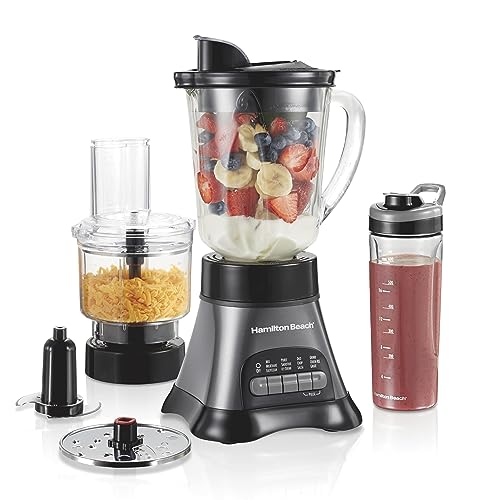
- The combination of a 40-ounce glass jar, travel cup and chopper attachment covers several common kitchen tasks.
- The glass jar is designed to withstand extreme temperatures, allowing hot and cold blending.
- The Wave~Action system is specifically designed to improve ingredient circulation around the blades.
- The chopper attachment adds slicing, shredding and chopping functions to a countertop blender.
Cons
- The 40-ounce jar may require multiple batches when preparing drinks or mixtures for larger groups.
- The glass jar is heavier and more breakable than a comparable plastic blending jar.
Details
The Hamilton Beach 58163 combines a blender, travel cup and 3-cup food chopper to reduce the need for separate appliances during drink and ingredient preparation.
Its 700-watt peak motor and Wave~Action system help process frozen ingredients and leafy greens into smoother shakes and smoothies.
The 40-ounce glass jar handles hot and cold liquids and includes a drip-reducing pour spout; the listed data does not provide total appliance weight.
The glass jar adds durability and temperature flexibility but is heavier and more breakable than plastic.
Best for households wanting one appliance for smoothies, shakes and small-batch food prep.
How to Use
Add liquids and softer ingredients first, then add leafy greens, frozen ingredients or ice to support smoother blending.
Use the 40-ounce glass jar for family-size drinks, the 20-ounce travel jar for portable servings and the 3-cup attachment for chopping, slicing or shredding.
Use the pour spout for controlled serving or streaming in oil while blending.

Pros & Cons
Pros
- Multiple jars, blades, and processing functions consolidate blending, chopping, grinding, slicing, shredding, and dough mixing into one appliance.
- One-touch presets make common processor tasks more approachable for users who do not want to choose settings manually.
- The lid-lock interlock and motor overheat protection add practical safeguards during frequent kitchen use.
- The glass blending pitcher resists food odors and provides a family-sized 1.5L capacity.
Cons
- The specified 1300W figure is max power, while the continuous operating wattage is not provided.
- The motor requires a two-minute cool-down after processing cycles, which may slow larger batch-prep sessions.
Details
The HoninJoy FP12 combines a countertop blender, food processor, grinder, dough mixer, and slicer-shredder, reducing the need to store and clean several separate appliances.
Its 1300W max-power motor supports ice crushing and smoothie blending, while CHOP, PUREE, DOUGH, and DISC presets simplify common meal-prep tasks.
The kit includes a 1.5L glass pitcher, 2L processor bowl, 80g grinder jar, and 24oz sport bottle. The compact base is intended for countertop use, but product weight is not specified.
Buyers planning long processing sessions should note that the manufacturer calls for a two-minute motor cool-down after cycles.
Best for meal preppers and space-conscious home cooks who want blending, chopping, slicing, shredding, grinding, and dough mixing in one system.
How to Use
Choose the 1.5L glass pitcher for smoothies, soups, and ice; the 2L bowl for chopping, pureeing, dough, slicing, or shredding; and the grinder jar for small dry ingredients.
Lock the selected container and lid securely before choosing CHOP, PUREE, DOUGH, or DISC. The safety interlock prevents operation when the lid is not properly secured.
Allow the motor to cool for two minutes after each cycle. Place detachable jars, lids, and blades on the dishwasher’s top rack, then wipe the motor base with a damp cloth.
What To Look For
Judge a appliance by how it feels in normal use, how easy it is to clean, and whether it solves the job you bought it for. Those are the variables that decide whether it earns a spot in your kitchen or ends up unused. Ignore cosmetic upgrades until the fundamentals check out.
When It Is Worth Paying More
Spending up pays off when you use the appliance often enough to notice better easier cleanup every week. If it only comes out occasionally, a mid-range pick is the smarter call. Match the money to frequency of use, not marketing.
Who Benefits Most
This matters most for families cooking in volume, and small-kitchen owners. If that is you, treat motor or heating-element power, and storage bulk as non-negotiable. Casual users can relax the requirements and prioritize price and storage instead.
Why It Matters
Small differences in build quality of seals, motor or heating-element power, and cleaning access change the result more than most buyers expect. That is why two appliances that look alike can feel completely different in use — one saves time, the other quietly adds friction to every task. If you are shopping, our best air fryer and best blender guides are the fastest way in.
The Short Answer
Cut through it and food processor and blender in one is a fit question — the appliance has to match how you cook. The practical takeaway is that build quality of seals matters more day to day than headline features. For product picks, compare best air fryer, best blender, and best instant pot.
Related Product Guides
If this topic is part of a buying decision, these are the HomeWhisk guides most closely tied to it:
Frequently Asked Questions
Who is this most useful for?
Mainly meal-preppers batching food, and small-kitchen owners. If that is you, treat cleaning access as a requirement rather than a nice-to-have.
What should I avoid?
Avoid buying by brand alone, ignoring letting the motor rest between heavy loads, and oversizing for your space. Each invites lingering odors down the line.
What is the bottom line?
Match the appliance to your real habits: buy for durability if it is daily, for value and storage if it is occasional.
What matters most for food processor and blender in one?
Focus on speed under load, noise level, and build quality of seals first. Those decide real performance; the rest is secondary. Compare best air fryer and best blender for options that get the basics right.
Is a premium appliance worth it?
Only if you use it enough to notice better control, durability, or cleanup regularly. Occasional users are well served by a mid-range pick like those in best instant pot.
The Bottom Line
The simplest takeaway: buy for your real routine, not the most impressive feature list. Match the food processor and blender in one to your cooking frequency, cleanup habits, and storage, then use best air fryer, best blender, and best instant pot to compare actual products.

Write Your Review
No reviews yet. Be the first to share your experience!