

TL;DR — When people ask about expensive blender, they are usually trying to make a buying or care decision without wasting money. This guide keeps the focus on what changes day-to-day use. When this turns into a purchase decision, compare best air fryer, best blender, and best instant pot before narrowing your shortlist.
The HomeWhisk approach is research-first: compare construction, usability, cleaning, and long-term complaints before recommending a direction. For appliance topics, we pay close attention to capacity, controls, cleanup, storage, reliability complaints, and whether the machine saves enough effort to justify the space.

Save $44.95
Pros & Cons
Pros
- The 48 oz Tritan jug is shatter-resistant and light enough to pour one-handed, unlike comparable glass pitchers.
- Preset cycles and pulse cover both hands-off and hands-on blending without a complicated control panel.
- Die-cast aluminum housing and a built-in cord wrap make it a countertop appliance you do not need to hide.
- Blades detach for cleaning, so pulp and seeds do not build up under the blade assembly.
Cons
- At 600W, the motor sits well below high-performance blenders, so dense nut butters and fibrous greens may need extra liquid and longer run times.
- You pay a significant premium for the retro styling relative to the blending performance the wattage delivers.
Details
The BLF03 is a 600W countertop blender built for daily smoothies, blended soups, and crushed ice in households that keep the appliance out on display.
Four presets handle Ice Crush, Smoothie, and self-cleaning, while Smooth Start eases the motor up to speed so frozen fruit does not slam the blades on startup.
The die-cast aluminum base and TritanRenew 48 oz jug are dishwasher-safe and shatter-resistant, and the 7 by 16 by 8 inch footprint clears most upper cabinets.
The 600W motor is modest for thick frozen blends and nut butters, so expect to add liquid and scrape down more often than with a high-wattage machine.
Best for buyers building a retro or design-forward kitchen who blend daily but do not need commercial-grade power.
How to Use
Load liquids first, then soft ingredients, then ice or frozen fruit on top. This lets the blades catch liquid immediately and pull the frozen items down.
Use the Smoothie or Ice Crush preset for standard batches and reserve the three manual speeds and pulse for chunky salsas or controlled chopping.
For cleanup, fill the jug partway with warm water and a drop of soap, run the self-cleaning mode, then rinse. Detach the blades for a deeper clean weekly.

Pros & Cons
Pros
- 1800 watts of power handles tough frozen and fibrous ingredients that stall weaker blenders.
- Runs notably quieter than comparable high-power blenders thanks to proprietary sound dampening.
- The capacitive touch interface is illuminated and wipes clean with no buttons or crevices to trap food.
- Blunt blade design removes the sharp-edge risk during loading and cleaning.
Cons
- It sits at the top of the countertop blender price range, which is hard to justify for occasional blending.
- The 90oz jar is tall and wide, so it may not fit under standard upper cabinets and needs dedicated counter space.
Details
A full-size countertop blender for households that blend daily and want power without the noise that typically comes with it.
The 1800-watt motor with blunt blade technology liquefies frozen fruit, nuts, and fibrous greens, while friction heat lets the hot soup cycle bring ingredients to serving temperature.
The matte black jar base, 90oz WildSide+ jar, and illuminated capacitive touch panel wipe down with a damp cloth; the wide jar footprint needs open counter space.
The tall jar profile means it likely will not clear standard upper cabinets, so plan on storing it out or on an open counter.
Best for home cooks making large batches in open-plan kitchens where blender noise is a daily annoyance.
How to Use
Load liquids first, then soft ingredients, then frozen items and ice last. The WildSide+ jar shape pulls contents down without a tamper on most loads.
Choose a preprogrammed cycle for batters, mixed drinks, smoothies, frozen treats, whole juices, or hot soup, then walk away; the cycle ramps speeds and stops on its own.
Clean immediately after use by filling the jar partway with hot water and a drop of dish soap, running a short blend, then rinsing and wiping the base.

Pros & Cons
Pros
- Ultra heavy duty 3.75 HP motor is rated for high-volume commercial output, not occasional home use.
- One-gallon stainless container with handles moves safely between station and sink when loaded.
- Electronic keypad with three speeds and MAX PULSE gives repeatable results across different recipes.
- Assembled in the USA with global components.
Cons
- A one-gallon stainless container is oversized and awkward for single-serving home batches.
- The opaque stainless jar hides your blend, so you have to stop and check consistency by eye.
Details
A commercial countertop blender for kitchens that lose time refilling small jars during a rush. It handles gallon batches of smoothies, purees, and sauces in one run.
The 3.75 HP motor is built for continuous high-volume work. Three speeds plus MAX PULSE cover everything from coarse chopping to fully smooth drinks.
The one-gallon container is stainless steel with handles and a stackable profile, so it survives daily impact and stores flat in tight kitchens.
The stainless container is not see-through, so you cannot monitor texture while blending the way a clear jar allows.
Best for restaurant, cafe, and smoothie shop operators blending large volumes throughout service.
How to Use
Load liquids first, then soft ingredients, then ice or frozen fruit on top. This keeps the blades moving freely and protects the motor on startup.
Start on low to break down the load, then step up through the speeds. Use MAX PULSE in short bursts for salsas and chunky textures.
Stop and check consistency by eye since the stainless container is opaque. Rinse the container immediately after each batch so residue never dries on.
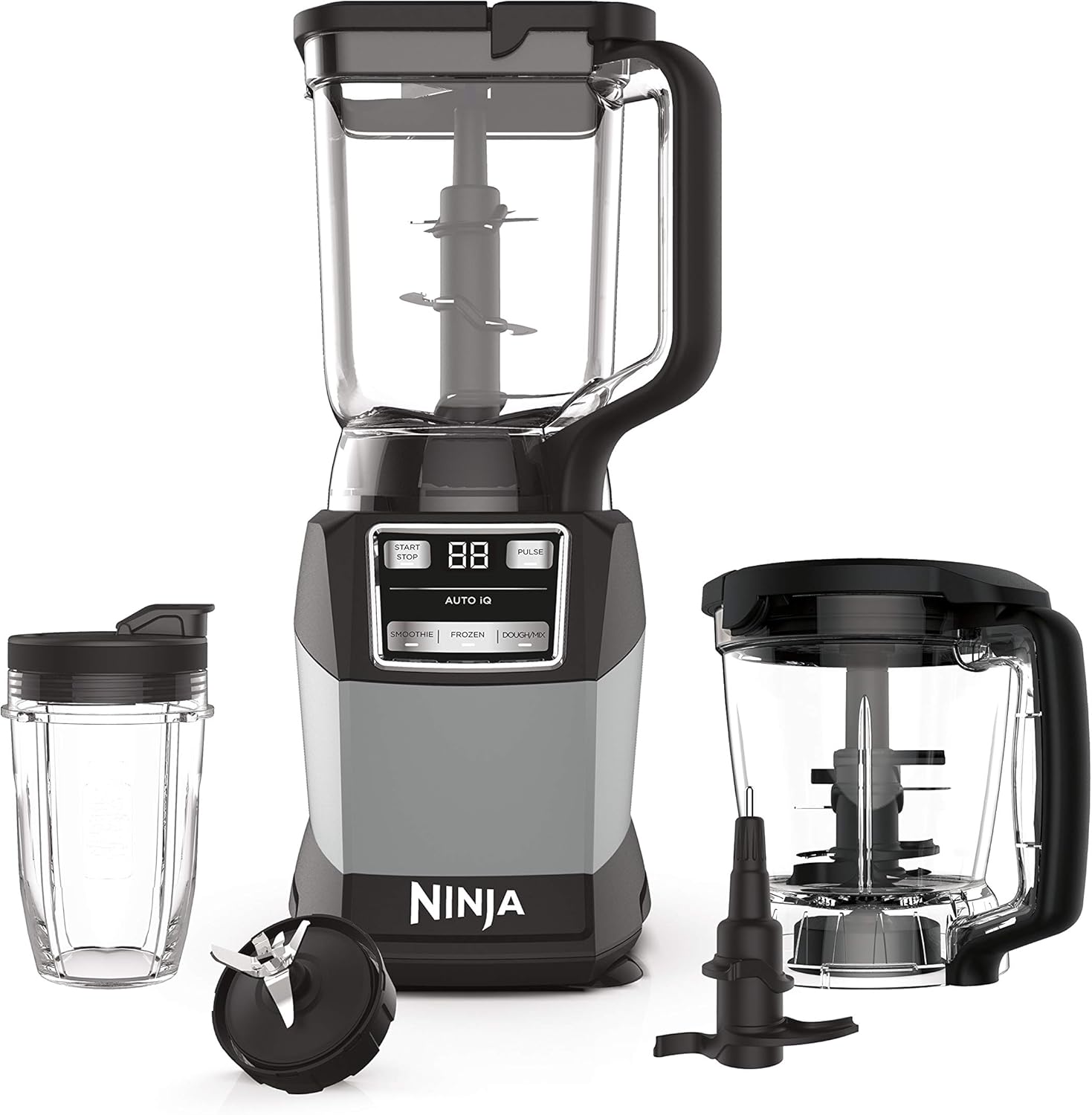
Pros & Cons
Pros
- 1200 watts powers through frozen fruit and ice without stalling or leaving chunks, based on consistent performance across 8000+ reviews.
- Three blade assemblies handle different textures from crushing ice to kneading dough to chopping vegetables in the processor bowl.
- Compact footprint fits under standard cabinets while still offering 64-ounce liquid capacity for family-sized batches.
Cons
- The motor base stays on the counter since swapping between pitcher, processor bowl, and single-serve cup requires keeping it accessible.
- Auto-iQ programs are preset and cannot be customized if you prefer manual control over blend time and speed.
Details
This system replaces three separate appliances by combining a 72-ounce blender, 5-cup food processor, and 18-ounce single-serve blender on one 1200-watt motor base. It solves the counter space problem for kitchens that need blending, food processing, and quick smoothie capability without room for multiple machines.
Auto-iQ technology runs preset programs that pulse, blend, and pause in timed patterns, removing the need to babysit the machine or guess when your smoothie or dough is ready. Total Crushing blades and 1200 watts handle frozen strawberries, ice cubes, and whole vegetables without pre-chopping.
The motor base measures roughly 15 inches tall with the pitcher attached and weighs about 9 pounds. All containers and blades are BPA-free plastic and dishwasher safe. The stacked blade assembly stays sharp through repeated ice crushing.
The processor bowl works for chopping and dough but does not replace a stand mixer for whipping or creaming tasks. Single-serve cups are 18 ounces, smaller than some competitors’ 24-ounce options.
Best for households that make smoothies daily, occasionally need food processing, and want to consolidate three appliances into one system without spending over $200.
How to Use
For smoothies, load frozen fruit and liquid into the pitcher, lock the lid, and press the Auto-iQ Smoothie button. The program runs for about 60 seconds with automatic pulsing. For thicker blends, use the Frozen Drink setting instead.
When food processing, place ingredients in the 5-cup bowl and use the Chopping Blade for vegetables or the Dough Blade for bread and pizza dough. Pulse manually or run Auto-iQ programs depending on the recipe. Avoid overfilling past the max line.
For single servings, blend directly in the 18-ounce cup with the extractor blades, then swap the blade assembly for the spout lid without transferring. Rinse blades immediately after use or run a quick blend with soapy water before placing in the dishwasher.
What To Look For
The keeper is the one you reach for without thinking; the drawer occupant is the one that asks too much for too little payoff. Those are the variables that decide whether it earns a spot in your kitchen or ends up unused. Ignore cosmetic upgrades until the fundamentals check out.
Common Misconceptions
The biggest myth is that the most expensive appliance is automatically the best for you. In reality, the right choice depends on noise level, and motor or heating-element power — plus your own habits. Another trap is buying by brand alone — the same maker sells both excellent and forgettable lines.
Why It Matters
You feel preset controls, digital versus dial controls, and build quality of seals in the results far more than the price tag suggests. That is why two appliances that look alike can feel completely different in use — one saves time, the other quietly adds friction to every task. If you are shopping, our best air fryer and best blender guides are the fastest way in.
When It Is Worth Paying More
Spending up pays off when you use the appliance often enough to notice better day-to-day handling every week. If it only comes out occasionally, a mid-range pick is the smarter call. Match the money to frequency of use, not marketing.
The Short Answer
Expensive blender usually comes down to one thing: matching the appliance to how you actually cook rather than to a spec sheet. The practical takeaway is that speed under load matters more day to day than headline features. For product picks, compare best air fryer, best blender, and best instant pot.
How To Get It Right
Think through the whole workflow: descaling water-based units, letting the motor rest between heavy loads, and checking the seals and gaskets. A appliance that fits your routine and cleanup habits beats a technically superior one you fight with. We cover specific models in best air fryer, best blender, and best instant pot.
Related Product Guides
If this topic is part of a buying decision, these are the HomeWhisk guides most closely tied to it:
Frequently Asked Questions
What is the bottom line?
Match the appliance to your real habits: buy for durability if it is daily, for value and storage if it is occasional.
What should I avoid?
Avoid buying by brand alone, ignoring cleaning removable parts by hand, and oversizing for your space. Each invites trapped residue in seams down the line.
Is a premium appliance worth it?
Only if you use it enough to notice better control, durability, or cleanup regularly. Occasional users are well served by a mid-range pick like those in best instant pot.
Who is this most useful for?
Mainly busy weeknight cooks, and gadget-minimalists who want one do-it-all unit. If that is you, treat noise level as a requirement rather than a nice-to-have.
What matters most for expensive blender?
Focus on motor or heating-element power, storage bulk, and build quality of seals first. Those decide real performance; the rest is secondary. Compare best air fryer and best blender for options that get the basics right.
The Bottom Line
For most home cooks, the best choice is the one that removes friction without adding maintenance you will ignore. Start with your use case, then cross-check best air fryer, best blender, and best instant pot.


Write Your Review
No reviews yet. Be the first to share your experience!