

TL;DR — When people ask about dimensions of a half sheet pan, they are usually trying to make a buying or care decision without wasting money. This guide keeps the focus on what changes day-to-day use. For product picks, the closest next steps are best baking sheets, best mixing bowls, and best kitchen scale.
Our view is based on product specs, material trade-offs, and repeated owner feedback — not one-off kitchen anecdotes or brand claims. For baking tools, sizing, material, accuracy, cleaning, and storage usually decide whether a tool stays useful or gets replaced.
Save $1.80
Pros & Cons
Pros
- Commercial-grade stainless steel with no coating to peel, chip, or degrade over time.
- Racks and pans share the same 18×12 footprint, so they nest correctly without gaps or wobble.
- Dishwasher safe, and hand cleanup needs only soapy water and a light scrub when grease is removed after each use.
- Doubles for BBQ prep, picnic serving, jelly rolls, and cheesecake beyond standard sheet pan baking.
Cons
- Bare stainless steel is not truly nonstick, so delicate cookies and sticky glazes still need parchment or a light oil coating.
- The lightweight build helps with handling but offers less thermal mass than heavy aluminum pans, so dark or thin batters can brown faster at the edges.
Details
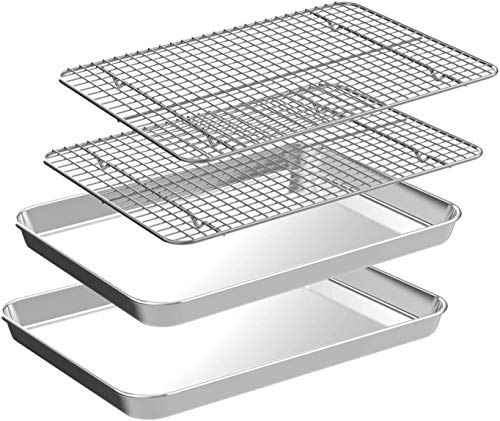
A four-piece bakeware set of two half sheet pans and two matching cooling racks, built for cooks tired of nonstick coatings flaking off cheap trays.
The racks drop inside the pans to lift food above rendering fat, which crisps bacon and chicken wings on all sides instead of leaving soggy undersides.
Each piece measures 18x12x1 inches in uncoated commercial-grade stainless steel with rolled edges for grip, staying flat under heat and stacking thin for storage.
Bare steel is not a nonstick surface, so sticky doughs and sugary glazes need parchment paper or oil to release cleanly.
Best for home bakers and meal preppers who want a coating-free set that survives metal utensils and years of oven use.
Cooking Tips
Line the pan with parchment for cookies and roasted vegetables. Skip the liner when you want browned fond for pan sauces, and deglaze the steel directly with stock or wine.
Set the rack inside for bacon, wings, and meatballs so fat drains below and every side crisps. Use the second rack on the counter to cool baked goods without steaming their bottoms.
Wipe grease off while pans are still warm to prevent baked-on residue. For stubborn spots, soak in soapy water or scrub with baking soda paste rather than abrasive pads.

Pros & Cons
Pros
- Made in America from aluminum that never rusts, so the pans outlast coated bakeware that chips and peels.
- The reinforced rolled rim gives the half sheets enough rigidity to lift a loaded roast without flexing in the middle.
- Built to standard half sheet dimensions, so common cooling racks, parchment sheets, and silicone mats drop straight in.
- One purchase covers both full dinners and small side tasks by pairing two large pans with a compact tray.
Cons
- Hand washing is recommended, since dishwasher detergent dulls and darkens bare aluminum.
- The surface is not nonstick and will discolor with use, so parchment or a mat is needed for sticky doughs and glazed foods.
Details
A three piece commercial style bakeware set: two 17.9 by 12.9 inch half sheets and one 10.7 by 7 inch eighth sheet, built to replace flimsy pans that buckle and brown unevenly.
Pure aluminum moves heat fast, so cookies color evenly across the tray and vegetables caramelize instead of steaming. The encapsulated galvanized steel rim holds the half sheets flat during high heat roasting.
Uncoated aluminum will not rust, and the reinforced rim adds enough stiffness to carry a full pan one handed. Interior space runs 17.1 by 12.1 inches, matching standard parchment and silicone mats.
The bare surface is not nonstick and darkens with use, and hand washing is recommended, so plan on parchment for sticky or sugary bakes.
Best for home bakers and weeknight roasters who want warp resistant pans they will not need to replace.
Cooking Tips
Line with parchment for cookies, sugary bars, and glazed proteins. Skip the liner for potatoes and vegetables, since direct contact with hot aluminum is what builds the browned crust.
Keep tomatoes, citrus, and vinegar based marinades off the bare surface for long bakes, because aluminum reacts with acids. Use parchment or foil as a barrier for those recipes.
Wash by hand with warm water and a nylon pad, then dry right away. The darkened patina that develops is cosmetic and does not change how the pans bake.

Save $5.60

Pros & Cons
Pros
- The 12-pack supports high-volume baking for businesses and households.
- Food-grade, NSF-certified aluminum alloy is rust-proof and designed for durable repeated use.
- The pans work in both ovens and refrigerators and tolerate temperatures up to 500°F.
- Deep sides and smooth curved edges improve handling and help contain liquids.
Cons
- Hand washing is required because automatic dishwasher detergents can discolor the aluminum.
- The large 18 x 13-inch size may require substantial storage space between baking sessions.
Details
This 12-pack solves the need for multiple sturdy pans when baking bread, cakes, biscuits, or other foods in batches.
Deep edges help contain juices, while the mirror-polished surface reduces sticking during baking and release.
Each 18 x 13-inch pan uses food-grade aluminum alloy, with a moderate weight and curved edges for daily handling.
These pans require hand washing because dishwasher detergents may discolor the aluminum.
Best for bakeries, commercial kitchens, and households that regularly bake multiple batches.
Cooking Tips
Use the deep sides for foods that release juices, such as roasted ingredients or filled baked goods, to help keep the oven cleaner.
Arrange multiple pans with enough space for air circulation, and confirm your oven can accommodate the 18 x 13-inch dimensions.
Wash by hand after cooling, then dry thoroughly to help preserve the aluminum finish.
Sizing It Right
Size is the make-or-break spec for a dimensions of a half sheet pan: too big and it wastes space or heats unevenly, too small and you work in frustrating batches. Match capacity to your household and your storage, and check it against warp resistance before committing. For product picks, compare best baking sheets, best mixing bowls, and best kitchen scale.
When It Is Worth Paying More
Spending up pays off when you use the baking tool often enough to notice better less frustration during prep every week. If it only comes out occasionally, a mid-range pick is the smarter call. Match the money to frequency of use, not marketing.
Why It Matters
The variables that decide the outcome — warp resistance, measurement accuracy, and release performance — are the ones buyers most often overlook. That is why two baking tools that look alike can feel completely different in use — one saves time, the other quietly adds friction to every task. If you are shopping, our best baking sheets and best mixing bowls guides are the fastest way in.
The Short Answer
Dimensions of a half sheet pan usually comes down to one thing: matching the baking tool to how you actually cook rather than to a spec sheet. The practical takeaway is that material and gauge matters more day to day than headline features. For product picks, compare best baking sheets, best mixing bowls, and best kitchen scale.
Related Product Guides
If this topic is part of a buying decision, these are the HomeWhisk guides most closely tied to it:
- best baking sheets
- best mixing bowls
- best kitchen scale
- best cutting board
- best food storage containers
Frequently Asked Questions
What size dimensions of a half sheet pan should I get?
Match it to your household and storage, not the biggest option. Weigh it against material and gauge; best baking sheets covers the common sizes.
What gear pairs well with it?
Start with a reliable core piece, then add as needs appear. Compare best baking sheets, best mixing bowls, and best kitchen scale for related choices.
What is the bottom line?
Match the baking tool to your real habits: buy for durability if it is daily, for value and storage if it is occasional.
What matters most for dimensions of a half sheet pan?
Focus on rim and edge design, nonstick or bare finish, and warp resistance first. Those decide real performance; the rest is secondary. Compare best baking sheets and best mixing bowls for options that get the basics right.
Is a premium baking tool worth it?
Only if you use it enough to notice better control, durability, or cleanup regularly. Occasional users are well served by a mid-range pick like those in best kitchen scale.
The Bottom Line
The simplest takeaway: buy for your real routine, not the most impressive feature list. Match the dimensions of a half sheet pan to your cooking frequency, cleanup habits, and storage, then use best baking sheets, best mixing bowls, and best kitchen scale to compare actual products.






Write Your Review
No reviews yet. Be the first to share your experience!