

Dehydrator sizes explained simply: the size that matters is total tray area, not the outside footprint, and most households do well with a 5 to 9 tray machine. A small 4-tray unit handles a weekly snack batch. An 8 to 10 tray model handles a garden harvest or a big jerky run.
This guide shows you how to read tray counts, how to match capacity to what you actually dry, and where the counter space goes. You’ll also see three real options from the site’s product database so the numbers aren’t abstract.
What “size” really means on a dehydrator
Manufacturers describe size three different ways: number of trays, total drying area, and overall dimensions. They don’t always agree. An 8-tray round unit and an 8-tray rectangular unit can hold very different amounts of food, because a round tray with a center hole wastes space that a flat rectangle doesn’t.
Start with the tray count, then ask how deep the trays are and whether you can add more later. Some stackable models start with a handful of trays and let you expand. That’s a flexible way to buy small and grow.
Tray count versus drying area
Tray count is the number everyone quotes, but it’s only a proxy. Drying area is tray count multiplied by the usable surface of each tray. Two machines with 10 trays can differ by a third in real capacity. If a listing gives square inches, compare those. If it doesn’t, assume round trays hold less than their count suggests.
Footprint and height
A stacked round unit is tall and narrow. A box-style unit with slide-out shelves is wide and shallow. Measure the shelf or counter you plan to use, including the clearance above it. Warm, moist air leaves through vents, so don’t tuck the machine under a low cabinet.
Small dehydrators: 4 to 5 trays
Small machines suit one or two people who dry fruit chips, herbs or a single tray of jerky now and then. They’re cheap to run, easy to store, and quick to clean. The limit is obvious: once you slice a whole bag of apples, you’re running three batches back to back.
Small units also dry unevenly more often when packed full, since air has less room to move. If you buy small, plan to load it lightly and rotate the trays halfway through.
Medium dehydrators: 6 to 9 trays
This is the sweet spot for most home kitchens. Eight trays covers roughly a pound or two of sliced fruit or a few pounds of jerky meat per run, depending on thickness. It’s enough for a family without needing a dedicated shelf.
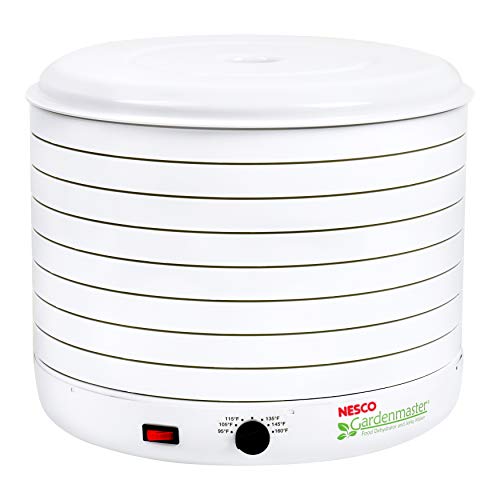
One well-known example in this range is the NESCO FD-1018A Gardenmaster Pro, an 8-tray white unit. It’s a round, stackable design, which is why it fits the “expandable” idea above. At the listed price of about $177 and a 4.5-star rating, it sits at the upper end of home machines but isn’t priced like a commercial one.
NESCO
Home Food Preservation with the NESCO FD-1018A Gardenmaster Pro 8-Tray Dehydrator
The NESCO FD-1018A dehydrates fruits, vegetables, herbs, and jerky with 1000 watts of power and even Converga-Flow airflow without tray rotation. It suits gardeners, hunters, and bulk-food shoppers who need expandable capacity for larger preservation batches.
Pros and Cons
Pros
- The 1000-watt heating system provides substantial drying power for repeated food-preservation batches.
- Converga-Flow airflow eliminates the need for routine tray rotation.
- The 8-tray starting capacity can expand to 30 trays as batch sizes increase.
- The included accessories and 52-page guide help users make fruit rolls, jerky, and other dried foods.
Cons
- The provided data does not mention a timer or digital controls, so users may need to monitor drying manually.
- The 30-tray expansion capability can require substantial counter or storage space when fully scaled.
NESCO Home Food Preservation with the NESCO FD-1018A Gardenmaster Pro 8-Tray Dehydrator
NESCO
Home Food Preservation with the NESCO FD-1018A Gardenmaster Pro 8-Tray Dehydrator
The NESCO FD-1018A dehydrates fruits, vegetables, herbs, and jerky with 1000 watts of power and even Converga-Flow airflow without tray rotation. It suits gardeners, hunters, and bulk-food shoppers who need expandable capacity for larger preservation batches.
Check price on AmazonThe NESCO FD-1018A preserves fruits, vegetables, herbs, and jerky, solving the problem of processing garden harvests, hunted meat, or bulk groceries in repeated small batches.
Its 1000-watt system and Converga-Flow airflow dry food evenly without tray rotation, while the adjustable 95°F to 160°F thermostat supports different ingredients.
The unit includes 8 BPA-free trays and can expand to 30 trays. Its weight is not provided, so confirm counter and storage requirements before purchase.
The supplied data does not mention a timer or digital display, which may require closer attention during long drying cycles.
Best for gardeners, hunters, and bulk-food shoppers who need expandable home-preservation capacity.
Large dehydrators: 10 trays and up
Ten trays or more is for people who dry in bulk. Think hunting-season jerky, a vegetable garden that all ripens in one week, or a side business making dog treats. Big machines need real counter space and draw more power, but they cut the number of runs sharply.
The Magic Mill Pro is a good illustration. Its title lists 10 stainless steel trays, a keep-warm function, a digital timer and temperature control, and ETL approval. Stainless trays are easier to wipe down than plastic ones, and a digital timer means you aren’t guessing when to check on a batch. It lists at about $200 with a 4.5-star rating.
The trade-off is size itself. A 10-tray box is heavy and bulky. If you only dry once a month, it’ll live in a cupboard and annoy you every time you pull it out.
Magic Mill Pro Food Dehydrator Machine | 10 Stainless Steel Trays | Dryer for Jerky, Dog Treats, Herb, Meat, Beef, Fruit | Keep Warm Function, Digital Timer and Temperature Control, ETL Approved

Magic Mill
Pro Food Dehydrator Machine | 10 Stainless Steel Trays | Dryer for Jerky, Dog Treats, Herb, Meat, Beef, Fruit | Keep Warm Function, Digital Timer and Temperature Control, ETL Approved
Check price on AmazonHow to match size to what you dry
Think in batches per year, not in gadgets. Ask how much you want to dry at once and how often. A weekly snack habit and a once-a-season harvest need very different machines.
Jerky and meat
Meat strips go on the tray in a single layer, so jerky eats tray area fast. A pound of meat can fill several trays once sliced thin. If jerky is your main use, lean toward 8 trays or more.
Fruit and vegetables
Fruit slices shrink a lot as they dry, but they still need a single layer with small gaps. Apples, bananas and tomatoes are bulky when fresh. Plan for the fresh volume, not the finished volume.
Herbs and small items
Herbs dry at low heat and take little room, so even a small machine works. The catch is that tiny leaves can fall through open tray mesh. That’s where fine mats come in.
Dog treats
Treats are usually sliced meat or sweet potato, so they behave like jerky. Batch size is the main factor. A bigger unit saves you from running the machine all weekend.
Accessories that change how much fits
Tray accessories don’t add capacity, but they change what the trays can hold. Solid sheets keep sticky fruit puree from dripping and stop small pieces from falling through the mesh. They also make fruit leather possible.
The Blulu set is a pack of 8 round silicone sheets, described as non-stick, reusable and meant for fruit dryers. It’s about $10 with a 4.5-star rating. Check that your trays are round and the right diameter before you buy, since the listing doesn’t tie the sheets to any one dehydrator brand.

Blulu
Fruit Dehydrating Made Easier: Blulu 8-Piece Round Silicone Dehydrator Sheets
Blulu's reusable silicone sheets keep fruit, vegetables, grains, fruit rolls, and jerky from sticking while making cleanup easier. Buy them if you want flexible 13 x 13-inch mats that can be washed, rolled, and cut to fit your dehydrator.
Pros and Cons
Pros
- BPA-free silicone provides a durable, heat-resistant surface for dehydrating and steaming.
- The sheets support multiple foods, including fruit, vegetables, grains, fruit peels, fruit rolls, and beef jerky.
- Hand washing or dishwasher cleaning gives buyers two practical cleanup options.
- Eight reusable sheets provide multiple liners for batch preparation.
Cons
- The 13 x 13-inch sheets may need cutting for smaller dehydrator trays.
- Product weight and compatibility with specific dehydrator models are not provided.
Blulu Fruit Dehydrating Made Easier: Blulu 8-Piece Round Silicone Dehydrator Sheets
Blulu
Fruit Dehydrating Made Easier: Blulu 8-Piece Round Silicone Dehydrator Sheets
Blulu's reusable silicone sheets keep fruit, vegetables, grains, fruit rolls, and jerky from sticking while making cleanup easier. Buy them if you want flexible 13 x 13-inch mats that can be washed, rolled, and cut to fit your dehydrator.
Check price on AmazonThese reusable silicone mats line dehydrator trays to reduce sticking when drying fruit, vegetables, grains, fruit rolls, and beef jerky.
The non-stick surface supports easier food release, while the -40 to 220 degree Celsius range also suits steaming applications.
Each BPA-free sheet measures 13 x 13 inches, can be cut to size, rolls for storage, and is washable by hand or dishwasher. Weight is not listed.
Smaller trays may require trimming, and the product data does not identify specific compatible dehydrator models.
Best for home cooks who dehydrate varied foods and want reusable liners that simplify release and cleanup.
Use the mats for fruit slices, vegetables, grains, fruit peels, fruit rolls, and beef jerky in a dehydrator.
Trim a sheet to match a smaller tray, then roll it after washing for compact storage.
The silicone mesh can also be used as a reusable steaming mat when its size and shape suit the cookware.
Thinking about tray spacing and airflow
Capacity on paper and capacity in practice are different things. Air has to move across every tray, and food needs a little gap around each piece. A tray that looks full of overlapping slices is really overloaded, and the pieces in the middle will stay soft long after the edges turn leathery.
A good rule is to treat about three quarters of the printed tray area as usable. That margin keeps airflow steady and makes drying times more predictable. It also means a machine that seems a touch too small for your plans may be just right once you leave room to breathe.
Fan placement matters too. Units with a fan at the back push air across each shelf evenly, while stacked units rely on air rising through the column. Neither is wrong. Stacked designs are simply more sensitive to how full the upper and lower trays are, so rotating them is part of the routine.
Common mistakes when choosing a size
The first mistake is buying on tray count alone. The second is buying too big “just in case.” A machine you dread hauling out gets used less. The third is forgetting about power: bigger units usually run at higher wattage, so check your outlet and don’t daisy-chain extension cords.
Another one: overloading trays. Food that touches dries unevenly and can stay damp in the middle. Spacing beats stuffing every time.
When to size up
If you’re running the same machine more than twice a week, or you keep splitting one harvest across several days, it’s time to go bigger. Stackable models make this easy. Box-style units don’t, so think about growth before you commit. For more options, browse our guides to the best dehydrator and the best home food dehydrator.
On a budget? See the best dehydrator under 100 or the best cheap dehydrator. If you have a specific project, there are picks for the best dehydrator for herbs and the best dehydrator for dog treats.
FAQ
What size dehydrator do I need for a family of four?
An 8-tray machine is a solid starting point. It handles a few pounds of fruit or jerky meat per run, so you can fill a snack jar or two without running multiple batches. If you dry in bulk, step up to 10 trays.
Is a bigger dehydrator always better?
No. Bigger units hold more but take more space and power, and they can be wasteful for small loads. Pick the size that fits your normal batch, not your biggest one.
How many trays does a dehydrator need?
Most home users are fine with 5 to 9. Fewer than 5 gets cramped fast. More than 10 is mainly for hunters, gardeners and anyone drying for sale.
Do round or square trays hold more?
Square or rectangular trays usually hold more per tray, since round trays lose space to the center hole and curved edges. Compare listed square inches when you can.
Can I add trays to my dehydrator later?
Only on stackable models designed for it. Check the product page for add-on trays before you buy. Box-style units with fixed shelves generally can’t be expanded.









Write Your Review
No reviews yet. Be the first to share your experience!