

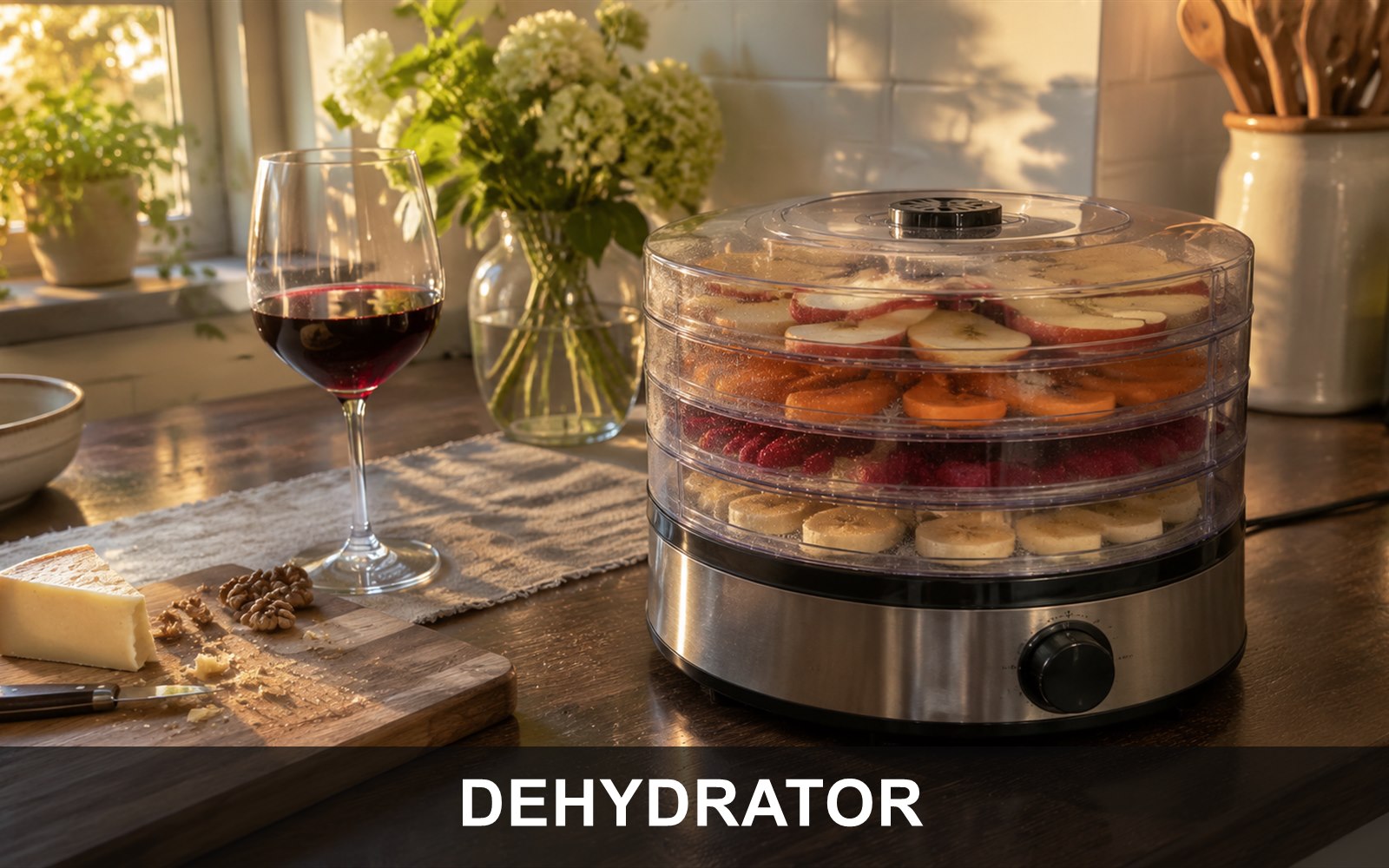
TL;DR — The best dehydrator for most home kitchens is the option that balances reliable construction, realistic capacity, easy cleanup, and a price that matches how often you will use it. HomeWhisk prioritizes documented specifications, material choices, and repeated owner-review patterns rather than marketing claims. If you are still comparing nearby categories, start with best 4 qt air fryer and best 6 qt air fryer before narrowing your final pick.
The HomeWhisk editorial team researches kitchen equipment by comparing manufacturer specifications, material details, dimensions, warranty language, retailer listings, and aggregated owner reviews. For best dehydrator, we looked for patterns that matter after the return window closes: repeated complaints, praised design details, compatibility limits, and maintenance habits that determine whether a product stays useful.
This is a commercial buying guide, so the goal is practical selection rather than a broad encyclopedia entry. Use this page alongside best affordable air fryer and best affordable air fryer toaster oven if your purchase overlaps adjacent tools or a larger kitchen setup.
Editor’s Picks
| Category | Pick Type | Why It Makes Sense |
|---|---|---|
| Best Overall | Balanced dehydrator | Strongest mix of construction, usability, cleanup, and owner satisfaction |
| Best Value | Practical dehydrator | Keeps the core performance features while avoiding unnecessary upgrades |
| Best for Most Home Kitchens | Use-case focused option | Prioritizes the size, controls, material, or workflow that matters most for this search |
At a Glance: Comparison Table
| Pick Type | Capacity | Controls | Best For | Trade-Off |
|---|---|---|---|---|
| Best Overall | Balanced build | Everyday size | Most homes | Not the lowest price |
| Best Value | Core materials | Practical capacity | Budget buyers | Fewer premium details |
| Best Upgrade | Heavier construction | Frequent use | Serious cooks | Higher cost |
| Best Compact | Space-saving design | Smaller batches | Small kitchens | Less capacity |
| Best Specialty | Focused feature set | Niche use | Specific needs | Less universal |
How We Evaluated These Products
We evaluated dehydrator options by starting with the product job: what the item must do well for most home kitchens, what trade-offs buyers usually accept, and which features are often overstated. From there, we compared visible specifications such as materials, dimensions, capacity, heat or power ratings where relevant, included accessories, warranty terms, and care instructions.
Aggregated owner feedback was used to identify repeated patterns rather than isolated anecdotes. A single dramatic review can be misleading, but repeated comments about weak motors, noisy operation, cracked plastic, confusing controls, awkward cleaning, overheating, or capacity claims that feel inflated are useful signals. We gave more weight to recent reviews because product lines, coatings, accessories, and manufacturing details can change over time.
We also considered how the product fits into a full kitchen workflow. A Dehydrator can look excellent on a spec sheet and still be frustrating if it is too large to store, too slow to clean, incompatible with common accessories, or poorly matched to the buyer’s cooking habits. That is why this guide connects the main recommendation to related guides like best 4 qt air fryer, best 6 qt air fryer, and best affordable air fryer.
What Actually Matters:
Capacity, wattage, and real counter footprint
Usable capacity and footprint rarely match the marketing number, so read the real dimensions. A model rated for a large batch can still cook unevenly if the basket or bowl is cramped, and a “compact” unit can still hog the counter once you account for lid clearance and cord. For most home kitchens, compare interior usable space and the space it claims when open, not just the headline quarts or watts. For a related option, compare best 4 qt air fryer before you commit.
Controls, presets, and repeatability
Controls and repeatability separate an appliance you trust from one you fight. Check whether presets map to things you actually cook, whether the dial or panel gives fine control, and whether it remembers or resets between uses. A machine that hits the same result every time is worth more than one with a long feature list you set once and never touch again. For a related option, compare best 6 qt air fryer before you commit.
Cleaning design and removable parts
Cleaning design makes or breaks how often the dehydrator earns its counter space. Look for removable, dishwasher-safe parts, smooth interiors without food traps, and a lid or basket that rinses without disassembly gymnastics. A powerful appliance that is a chore to wash gets used less, so treat easy teardown as a core spec rather than a bonus. For a related option, compare best affordable air fryer before you commit.
Noise, heat, and everyday usability
Noise, heat, and everyday usability are the frictions you only notice after purchase. A loud motor or a unit that vents heat across the counter changes when and where you are willing to run it. Check cord length, how far controls sit from a wall, and whether the exterior stays touch-safe — small ergonomics decide whether a dehydrator lives on the counter or in a cupboard. For a related option, compare best affordable air fryer toaster oven before you commit.
Durability, warranty, and value
Durability and value show up in the parts you cannot see on the box. Weigh the warranty length, the reputation of the motor or heating element, and whether replacement baskets and seals are sold at all. For most home kitchens, the better buy is often the model with a proven track record and available parts over a cheaper one that fails just past the return window. For a related option, compare best affordable blender before you commit.

Frequently Asked Questions
What should I look for in the best dehydrator?
Start with fit for your routine: capacity, materials, cleaning, storage, and compatibility. Then compare owner-review patterns for repeated praise or complaints. For best dehydrator, avoid buying only by star rating; the right dehydrator should match most home kitchens and the way you actually cook.
Is a more expensive dehydrator worth it?
It can be, but only when the upgrade improves something you will notice often: durability, control, cleaning, capacity, or comfort. If the higher price only adds accessories or cosmetic finish, a value pick may be smarter. Spend more when the category is used weekly or daily.
What size dehydrator is best for most home kitchens?
The best size is the one that handles your normal use without making storage and cleanup annoying. Product photos can hide scale, so check exterior dimensions as well as usable capacity. For small kitchens or occasional use, a slightly smaller dehydrator is often the better long-term choice.
How long should a good dehydrator last?
A good dehydrator should last long enough to justify its price when cared for according to the manufacturer instructions. Lifespan depends on materials, heat exposure, cleaning habits, moving parts, coatings, and storage. Repeated owner complaints about early failure are more important than one isolated review.
What mistakes should I avoid when buying dehydrator?
The biggest mistake is buying the most feature-heavy option without checking whether those features solve your actual problem. Also avoid ignoring dimensions, care requirements, replacement parts, and compatibility. If maintenance sounds unrealistic for your household, choose a simpler product.
How does best dehydrator compare with nearby options?
Nearby options can overlap, so use intent to decide. If your need is broad, start with the main dehydrator category. If your need is specific, compare related guides such as best affordable blender for smoothies and best 4 qt air fryer to avoid buying a product that is good generally but wrong for your setup.
Our Top Pick
For most shoppers, the best dehydrator is the balanced option that gets the fundamentals right before adding extras. Prioritize the product with clear specifications, enough capacity for your normal routine, materials that match your maintenance habits, and repeated owner feedback showing reliable everyday use. The shortcode above contains the product set for this page; use the decision tree below to choose the right type within that set.
- Choose the Best Overall type if you want one safe dehydrator for regular use.
- Choose the Best Value type if price matters more than premium finish.
- Choose the Best for Most Home Kitchens type if your use case is specific and frequent.
- Choose an upgrade only if better materials, controls, capacity, or durability will matter every week.
Magic Mill
Make Beef Jerky and Fruit Snacks with the Magic Mill Premium Food Dehydrator Machine
The Magic Mill Premium Food Dehydrator dries beef jerky, fruits, vegetables, herbs, and dog treats across 10 extra-large stainless steel trays, with rear-mounted airflow as its biggest advantage. It suits home cooks who batch-preserve foods and want precise temperature control, a 48-hour timer, and dishwasher-safe trays.
Pros and Cons
Pros
- Ten extra-large stainless steel trays provide substantial capacity for batch dehydration.
- The rear-mounted fan is designed to distribute air evenly across all trays.
- Automatic shut-off and overheat protection add useful safety controls during long drying cycles.
- BPA-free materials and food-grade stainless steel support regular food preparation.
Cons
- The 95°F to 167°F temperature range may not suit recipes requiring higher heat.
- The product data does not list the machine's dimensions or weight, so buyers cannot assess counter and storage space in advance.

Cosori
Large-Batch Food Dehydrator for Homemade Snacks, Cosori CP267-FD with 6 Stainless Steel Trays
The Cosori CP267-FD dehydrates food across six stainless steel trays, with 6.5 ft² of drying space as its biggest advantage. It suits home cooks who want precise, long-duration drying with dishwasher-safe trays and included accessories.
Pros and Cons
Pros
- Six stainless steel trays provide substantial capacity for batch drying.
- The 95 to 165 °F temperature range supports precise control for different foods.
- The stainless steel exterior and dishwasher-safe trays are suited to repeated kitchen use.
- A mesh screen, fruit roll sheet, and 50-recipe cookbook are included.
Cons
- The product data does not specify dimensions or weight, so counter-space requirements and portability are unclear.
- Drying cycles can run for up to 48 hours, requiring advance planning for some foods.

OSTBA
5-Tray Food Dehydrator for Homemade Jerky, Fruit Snacks and Pet Treats
The OSTBA food dehydrator preserves meat, fruit, herbs and vegetables with 360° airflow, while its 72-hour timer enables unattended drying. It suits home cooks and pet owners who want compact countertop drying with adjustable temperatures and dishwasher-safe trays.
Pros and Cons
Pros
- The responsive LED touchscreen clearly displays temperature, remaining time and settings.
- Five trays support multiple batches of snacks, herbs or pet treats in one compact appliance.
- The included recipe book provides ideas for fruit roll-ups, jerky, flower tea and other homemade foods.
- Adjustable temperature control supports both low-temperature herbs and higher-temperature meat drying.
Cons
- The 95°F to 158°F temperature range may not suit recipes requiring higher heat.
- The product data does not specify its weight, which may matter when moving it between storage and the countertop.

MasterChef
Make Beef Jerky and Dried Fruit at Home: MasterChef Digital Food Dehydrator with 5 Large Trays and Temperature Control
This MasterChef dehydrator dries jerky, fruit, vegetables, and even flowers across five large stacked trays, with adjustable time and temperature settings that let you match the drying cycle to each food type. It suits home cooks who want to batch-process a full harvest or a whole jerky marinade in one run instead of drying in shifts.
Pros and Cons
Pros
- Five-tray capacity handles mixed loads, letting you dry fruit, vegetables, and jerky together.
- Digital time and temperature controls give you repeatable results on foods that need different drying profiles.
- The LCD panel makes settings easy to read and adjust mid-cycle.
- Handles non-food projects like drying flowers, extending its use beyond the kitchen.
Cons
- Stacked tray designs dry unevenly from top to bottom, so you will need to rotate trays partway through longer runs.
- Five trays fills up fast if you are processing a large garden harvest in one weekend.

Majosta
Home Canning Reference for Safe Water Bath and Pressure Processing: Majosta Complete Guide to Home Canning, USDA Bulletin No. 539 (Revised 2015)
This is the current printing of USDA Bulletin No. 539, covering tested boiling water and pressure canning times, altitude corrections, and headspace rules for fruits, tomatoes, vegetables, meats, pickles, and jellies. Buy it if you preserve low acid foods and want the authoritative processing tables in a printed copy you can keep open beside the canner instead of on a phone.
Pros and Cons
Pros
- The text is the official USDA bulletin, the same standard extension offices and canner manufacturers cite.
- This is the 2015 revision, so the processing tables reflect the current USDA testing rather than older editions.
- Content is organized by food type, making it fast to find one vegetable or fruit while jars are already heating.
- Both boiling water and pressure methods sit in one volume, so no separate low acid reference is needed.
Cons
- The identical text is public domain and downloadable free from the USDA, so you are paying for the bound physical copy.
- It reads as a technical reference with minimal photography and little recipe variety, not a browsable flavor driven cookbook.

WorldsRival.com
Home Freeze Drying for Beginners: WorldsRival.com Guide to Machine Choice, Setup, First Runs and Accessories
This guide walks a first time owner through picking a home freeze dryer, setting it up in a working kitchen, running the first batches, and choosing accessories that actually get used. Buy it if you are researching a freeze dryer before committing to the purchase and want the sizing, placement, and first run decisions settled in advance.
Pros and Cons
Pros
- Covers the whole path from buying decision to finished batch in one document instead of scattered forum threads and videos.
- Focuses on the two decisions that cost the most money, machine choice and accessories, rather than recipes.
- Digital format is searchable, so you can jump straight to the setup or first run section while working.
- Short enough to finish before your freeze dryer is delivered.
Cons
- This is a written guide, not hardware, so the freeze dryer, pump, bags, and sealer are all separate purchases.
- Scope is deliberately introductory, so owners already running batches will find little on advanced troubleshooting or throughput tuning.
The Best Deals This Week*
-
Large-Batch Food Dehydrator for Homemade Snacks
$143.99
($159.99)Save $16.00 -
OSTBA 5-Tray Food Dehydrator for Homemade Jerky
$49.99
($59.99)Save $10.00
*Deals are selected by our commerce team
Magic Mill Make Beef Jerky and Fruit Snacks with the Magic Mill Premium Food Dehydrator Machine
Magic Mill
Make Beef Jerky and Fruit Snacks with the Magic Mill Premium Food Dehydrator Machine
The Magic Mill Premium Food Dehydrator dries beef jerky, fruits, vegetables, herbs, and dog treats across 10 extra-large stainless steel trays, with rear-mounted airflow as its biggest advantage. It suits home cooks who batch-preserve foods and want precise temperature control, a 48-hour timer, and dishwasher-safe trays.
$169.99 at AmazonEditors' Favorite
Color: Black Size: 10 XL Stainless Steel Trays Dimensions: 18 x 14 x 13 inches Weight: 20.5 pounds Product Group: Kitchen Binding: Kitchen
Shop NowCosori Large-Batch Food Dehydrator for Homemade Snacks, Cosori CP267-FD with 6 Stainless Steel Trays
Cosori
Large-Batch Food Dehydrator for Homemade Snacks, Cosori CP267-FD with 6 Stainless Steel Trays
The Cosori CP267-FD dehydrates food across six stainless steel trays, with 6.5 ft² of drying space as its biggest advantage. It suits home cooks who want precise, long-duration drying with dishwasher-safe trays and included accessories.
$143.99 at AmazonGreat Value
Color: Black Size: 6 Trays(6.5ft² Drying Space) Dimensions: 13.5 x 17.8 x 12.2 inches Weight: 18.1 pounds Product Group: Kitchen Binding: Kitchen
Shop NowOSTBA 5-Tray Food Dehydrator for Homemade Jerky, Fruit Snacks and Pet Treats
OSTBA
5-Tray Food Dehydrator for Homemade Jerky, Fruit Snacks and Pet Treats
The OSTBA food dehydrator preserves meat, fruit, herbs and vegetables with 360° airflow, while its 72-hour timer enables unattended drying. It suits home cooks and pet owners who want compact countertop drying with adjustable temperatures and dishwasher-safe trays.
$49.99 at AmazonColor: Black, Clear, Silver Size: 5-Tray Electronic Control Dimensions: 9.45 x 10.24 x 8.27 inches Weight: 4.14 pounds Product Group: Kitchen Binding: Kitchen
Shop NowMasterChef Make Beef Jerky and Dried Fruit at Home: MasterChef Digital Food Dehydrator with 5 Large Trays and Temperature Control
MasterChef
Make Beef Jerky and Dried Fruit at Home: MasterChef Digital Food Dehydrator with 5 Large Trays and Temperature Control
This MasterChef dehydrator dries jerky, fruit, vegetables, and even flowers across five large stacked trays, with adjustable time and temperature settings that let you match the drying cycle to each food type. It suits home cooks who want to batch-process a full harvest or a whole jerky marinade in one run instead of drying in shifts.
$59.49 at AmazonColor: White Size: 8 Liter Product Group: Kitchen Binding: Kitchen
Shop NowMajosta Home Canning Reference for Safe Water Bath and Pressure Processing: Majosta Complete Guide to Home Canning, USDA Bulletin No. 539 (Revised 2015)
Majosta
Home Canning Reference for Safe Water Bath and Pressure Processing: Majosta Complete Guide to Home Canning, USDA Bulletin No. 539 (Revised 2015)
This is the current printing of USDA Bulletin No. 539, covering tested boiling water and pressure canning times, altitude corrections, and headspace rules for fruits, tomatoes, vegetables, meats, pickles, and jellies. Buy it if you preserve low acid foods and want the authoritative processing tables in a printed copy you can keep open beside the canner instead of on a phone.
$19.77 at AmazonDimensions: 8.25 x 0.64 x 11 inches Product Group: Book Binding: Hardcover
Shop NowWorldsRival.com Home Freeze Drying for Beginners: WorldsRival.com Guide to Machine Choice, Setup, First Runs and Accessories
WorldsRival.com
Home Freeze Drying for Beginners: WorldsRival.com Guide to Machine Choice, Setup, First Runs and Accessories
This guide walks a first time owner through picking a home freeze dryer, setting it up in a working kitchen, running the first batches, and choosing accessories that actually get used. Buy it if you are researching a freeze dryer before committing to the purchase and want the sizing, placement, and first run decisions settled in advance.
$2.99 at AmazonFormats: Kindle eBook Product Group: Digital Ebook Purchas Binding: Kindle Edition
Shop Now


Write Your Review
No reviews yet. Be the first to share your experience!