

TL;DR — A good dehydrator buying decision starts with how you cook, how much space you have, and which trade-offs you will actually notice. If you are comparing products, start with best air fryer, best blender, and best instant pot; those guides give the model-level context behind this advice.
We looked at manufacturer details, material behavior, recurring owner-review patterns, and where this topic overlaps with related buying guides. For appliance topics, we pay close attention to capacity, controls, cleanup, storage, reliability complaints, and whether the machine saves enough effort to justify the space.

Pros & Cons
Pros
- Stainless steel trays are removable, easy to scrub, and hold up better than plastic under repeated jerky runs.
- 600 watts across eight trays keeps drying times reasonable on full loads.
- Digital temperature and timer controls give repeatable results batch after batch.
- Compact enough to store in a cabinet between seasonal drying projects.
Cons
- The 167°F ceiling sits below the 160°F internal temperature target margin many jerky recipes want, so raw meat is safest pre-cooked or oven-finished.
- At 12 pounds with eight fixed trays, it is heavier to move than plastic stackable models and the tray count cannot be expanded.
Details
An eight-tray countertop dehydrator for people whose oven runs too hot and too long to dry produce or meat without cooking it.
The 48-hour digital timer handles the real problem with dehydrating: dense apple slices and thick jerky strips need overnight runs, and this one powers down on its own.
Heat is adjustable up to 167°F, low enough for basil and kale, high enough for banana chips and marinated beef.
Stainless steel trays, a 600-watt element, and a 13.9 x 11.3 x 8.9 inch body at 12 pounds mean it stays put on the counter and cleans up under hot water.
Built for gardeners, hunters and bulk meal-preppers who dry in volume and want metal trays over plastic.
How to Use
Slice food to a uniform thickness, around a quarter inch, and leave gaps between pieces on each tray so air moves. Overlapping is the main cause of uneven batches.
Set 95°F to 115°F for herbs and greens, 125°F to 135°F for fruit and vegetables, and the top of the range for jerky. Start the timer long and check early.
Cool pieces before testing: fruit should be leathery with no wet center, jerky should crack but not snap. Store in sealed jars and shake daily for a week to catch residual moisture.

Pros & Cons
Pros
- Automatic cool-down starts one minute before the timer ends and overheat protection cuts power, both useful for unattended overnight drying.
- Ships with a drip tray, six silicone pads, a non-stick sheet, a hanger, twelve hooks, and silicone gloves, so fruit leather and hanging jerky need no extra purchases.
- Double-row vents speed water vapor discharge, which shortens cycle times on high-moisture loads like melon and zucchini.
- Runs under 50 decibels, quiet enough to leave going in a kitchen or utility room overnight.
Cons
- The 120V 60Hz, 1200W design only works in the US and Canada, so it is unusable abroad without a transformer.
- A 12-tray stainless cabinet takes real counter or shelf space and is heavy to move, making it a poor fit for small kitchens with limited storage.
Details
A cabinet-style dehydrator built for people whose batches outgrew a stackable unit. Twelve trays handle a garden harvest or a hunting season’s jerky in one load.
Horizontal airflow from a rear fan dries every tray at the same rate, so you skip rotating trays. Temperature spans 70 to 190 degrees, from herbs to poultry jerky.
Food-grade stainless steel construction with a glass front door and 15.75 inch square trays. The steel cleans up after fatty meat far better than plastic and holds shape under repeated heat cycles.
It only runs on 120V 60Hz North American power, and the footprint demands dedicated counter or shelf space rather than a cupboard.
Best for jerky makers, gardeners with large yields, and small food businesses drying by the case.
How to Use
Slice food to a uniform thickness and spread it in a single layer with space between pieces. Use the silicone pads for small items and the non-stick sheet for fruit leather.
Set temperature by food type: around 95 to 115 degrees for herbs and flowers, 125 to 135 for fruit and vegetables, and 155 to 165 for meat and jerky.
Slide in the drip tray before greasy meat runs, set the timer in 30-minute steps up to 24 hours, and let the automatic cool-down cycle finish before unloading.
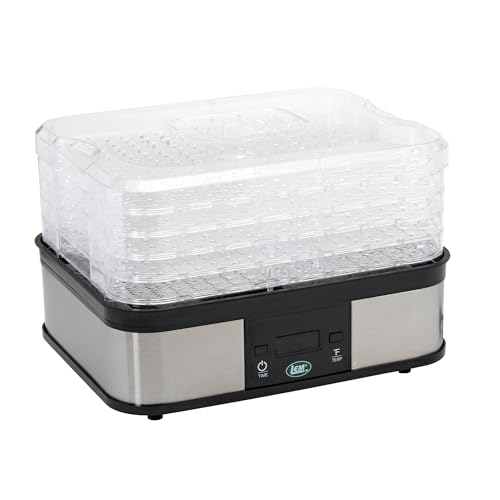
Pros & Cons
Pros
- Digital display and preset temperatures make repeatable results easy across different foods.
- Diamond-shaped 3/8 inch tray holes support airflow while holding small items like herbs and berry slices.
- Countertop footprint with stackable trays stores more compactly than boxy cabinet-style dehydrators.
- Lifetime customer support and replacement part availability from the brand.
Cons
- Five trays and 3.5 square feet fill up fast if you process large garden harvests or whole deer batches.
- Fixed temperature presets mean you cannot fine-tune between steps, such as setting 135 degrees F.
Details
A five-tray countertop dehydrator built for home jerky making and small-batch produce drying without a full-size cabinet unit.
The center chimney and diamond-cut tray holes move air vertically through the stack, so edge trays dry at the same rate as center trays.
Trays are clear and measure 12 by 9.13 by 0.63 inches, stacking to 3.5 square feet of surface that breaks down for storage.
Preset-only temperature control limits you to seven steps between 104 and 158 degrees F, with no custom settings in between.
Best for hunters and home cooks making regular jerky batches who want digital timing over manual dial guesswork.
How to Use
Slice meat to a consistent thickness and leave space between pieces on each tray. Crowding blocks the vertical airflow the chimney design depends on.
Set 158 degrees F for jerky and other meats, 131 to 140 for fruit and vegetables, and 104 for herbs to preserve oils and color.
Use the 48-hour timer rather than checking constantly, and let auto shut-off end the cycle. Check doneness through the clear trays before opening.
Features Worth Paying For
Spend where it counts on a dehydrator — better noise level, and cleaning access, and easier cleaning removable parts by hand. Be skeptical of bundled extras that solve no real problem. For most buyers the sweet spot sits in the middle of the market. If you are shopping, our best air fryer and best blender guides are the fastest way in.
Care And Longevity
The best-value dehydrator is one you maintain. Plan for checking the seals and gaskets, wiping the interior after use, and not overfilling past the max line from day one, and you avoid the lingering odors that sends cheaper gear to landfill early.
Budget Tiers
Entry appliances cover the basics; mid-range usually improves materials, control, and durability; premium buys refinement you only notice with heavy use. Decide which tier your cooking frequency justifies before you compare specific dehydrator models.
Sizing And Fit
The right dehydrator is the one that fits your counter, your storage, and your typical quantities. Oversized gear that stores badly is a false economy, and undersized gear forces extra batches. Consider the way it fits your real kitchen, not an ideal one.
How To Avoid The Wrong Pick
Brand is a weak signal for a dehydrator; the same label covers great and forgettable lines alike. Watch for repeated complaints in reviews, then match size, material, and care needs to your actual habits. We cover specific models in best air fryer, best blender, and best instant pot.
What Actually Matters
The smart way to shop for a dehydrator is to start from your routine and work back to features. Weigh it by the things you will notice every week: control, cleanup, fit, and durability. For product picks, compare best air fryer, best blender, and best instant pot.
Related Product Guides
If this topic is part of a buying decision, these are the HomeWhisk guides most closely tied to it:
Frequently Asked Questions
Who is this most useful for?
Mainly meal-preppers batching food, and families cooking in volume. If that is you, treat digital versus dial controls as a requirement rather than a nice-to-have.
Is a premium appliance worth it?
Only if you use it enough to notice better control, durability, or cleanup regularly. Occasional users are well served by a mid-range pick like those in best instant pot.
What gear pairs well with it?
Start with a reliable core piece, then add as needs appear. Compare best air fryer, best blender, and best instant pot for related choices.
What is the bottom line?
Match the appliance to your real habits: buy for durability if it is daily, for value and storage if it is occasional.
What should I avoid?
Avoid buying by brand alone, ignoring checking the seals and gaskets, and oversizing for your space. Each invites lingering odors down the line.
The Bottom Line
Dehydrator features to look for comes down to fit: how often you use the tool, how much care it needs, and whether it solves a real kitchen problem. If you are buying, compare best air fryer, best blender, and best instant pot before you spend.








Write Your Review
No reviews yet. Be the first to share your experience!