

Can you put a bench scraper in the dishwasher? Usually yes, if the whole tool is stainless steel or the maker says it’s dishwasher safe. If the handle is wood, wash it by hand.
This guide helps you sort out which scrapers can take the machine, how to load them safely, and how to keep the edge and handle in good shape for years.
The short answer: it depends on the handle
A bench scraper is a simple tool. A flat rectangle of metal, a straight edge, and a grip along the top. The blade is almost always stainless steel, and stainless handles heat and detergent well. The handle is the part that decides things.
An all-metal scraper, or one with a plastic grip rated for the dishwasher, is generally fine on the top rack. A scraper with a wooden handle is a different story. Hot water, long wet cycles and strong detergent dry wood out, and the grain can crack or lift over time. Check the listing or the box before you load it.
The Ourokhome 2 Pack Bench Scraper Dough Cutter is a clear example of the easy case. Its listing calls out a stainless steel blade, a laser-etched scale, a conversion chart and a non-slip handle, and it states plainly that it’s dishwasher safe. At $9.99 for two, it’s a low-stress tool to run through the machine.

Ourokhome
Dough Cutting and Portioning Made Precise: Ourokhome 2-Pack Stainless Steel Bench Scraper with Laser-Etched Scale
This 430 stainless steel bench scraper divides dough, chops vegetables, and clears a floured board in one motion, with a laser-etched ruler that keeps portions even without reaching for a tape measure. Home bakers who portion rolls, pizza dough, or pastry regularly will get the most from the two-pack, since a second scraper stays clean while the first handles sticky dough.
Pros and Cons
Pros
- Straight steel edge cuts cleanly through dough and scrapes a work surface flat in a single pass.
- Etched markings and conversion chart stay legible instead of fading like printed scales.
- Handle hole allows hook storage rather than taking up drawer space.
- Two-color pair makes it easy to keep one scraper for dough and one for produce.
Cons
- The plastic handle is not designed for high heat, so it should stay away from hot pans and oven surfaces.
- 430 stainless steel is softer than higher-grade alloys, so the edge can nick if used against stone or metal countertops.
Ourokhome Dough Cutting and Portioning Made Precise: Ourokhome 2-Pack Stainless Steel Bench Scraper with Laser-Etched Scale
Ourokhome
Dough Cutting and Portioning Made Precise: Ourokhome 2-Pack Stainless Steel Bench Scraper with Laser-Etched Scale
This 430 stainless steel bench scraper divides dough, chops vegetables, and clears a floured board in one motion, with a laser-etched ruler that keeps portions even without reaching for a tape measure. Home bakers who portion rolls, pizza dough, or pastry regularly will get the most from the two-pack, since a second scraper stays clean while the first handles sticky dough.
Check price on AmazonA two-piece bench scraper set for bakers who need to divide dough into even portions and clear sticky residue from a work surface.
The laser-etched scale lets you measure and cut dough on the board itself, while the conversion chart handles unit swaps mid-recipe.
Blades are 430 stainless steel for rust and bend resistance, paired with a textured plastic handle that grips through flour and oil.
The plastic handle limits it to cold prep work and should not contact hot cookware.
Best for home bread and pastry bakers who portion dough by weight or size on a regular basis.
Dividing bread dough, cutting pizza slices, and portioning pastry using the etched scale as a cutting guide instead of eyeballing sizes.
Chopping firm vegetables and scooping the pile straight into a pan, using the wide blade as a transfer tool.
Smoothing frosting on cake sides and scraping dried flour and dough off boards or countertops before washing.
How to tell if yours is dishwasher safe
Don’t guess. Three quick checks settle it.
Read the product page or packaging
Most makers say it outright, either “dishwasher safe” or “hand wash only.” If it’s silent, treat that as a maybe and lean toward hand washing.
Look at the handle material
Wood, bamboo and some composite grips are the usual trouble. Plastic and silicone grips tend to survive. A one-piece stainless tool has no weak spot at all, apart from the printed or etched markings.
Check for markings and finishes
Laser-etched scales are cut into the metal, so they hold up well. Printed or painted markings can fade after many cycles. If you rely on the ruler for dough, that’s worth knowing.
Wooden handles: hand wash only
The Misen Stainless Steel Bench Scraper pairs a stainless blade with a walnut handle. It’s a handsome tool, and at $24 with a 4.7 rating it’s the premium option here. But walnut and a dishwasher don’t mix well. Wash it by hand, dry it right away, and the wood should stay smooth.
That’s not a flaw in the scraper. It’s how wood behaves around heat and constant moisture. If you’d rather never think about it, pick an all-steel model instead.

Misen
Dough Cutting and Countertop Cleanup Made Simple: Misen Stainless Steel Bench Scraper with Walnut Handle
The Misen Bench Scraper divides dough, clears flour and scraps off a work surface, and slides chopped ingredients straight into a pot without a second tool. It suits home bakers and anyone who preps on a cutting board daily and wants one durable stainless blade instead of a plastic scraper that flexes and stains.
Pros and Cons
Pros
- Stainless steel construction resists staining and warping that plastic scrapers develop over time.
- Walnut handle adds warmth and comfort compared to all-metal scrapers that get slippery with wet hands.
- One tool covers dividing, scraping, and transferring, cutting steps out of everyday prep.
Cons
- The walnut handle needs hand washing and occasional oiling, so this is not a dishwasher tool.
- Misen does not publish a measurement scale on the blade, so bakers who portion by marked increments will still reach for a scale.
Misen Dough Cutting and Countertop Cleanup Made Simple: Misen Stainless Steel Bench Scraper with Walnut Handle
Misen
Dough Cutting and Countertop Cleanup Made Simple: Misen Stainless Steel Bench Scraper with Walnut Handle
The Misen Bench Scraper divides dough, clears flour and scraps off a work surface, and slides chopped ingredients straight into a pot without a second tool. It suits home bakers and anyone who preps on a cutting board daily and wants one durable stainless blade instead of a plastic scraper that flexes and stains.
Check price on AmazonA flat stainless steel blade with a walnut handle, built for the messy middle of prep: dough stuck to the counter, chopped onion scattered across a board.
The straight edge cuts dough into portions and clears a work surface in one sweep. The blade face doubles as a scoop for moving ingredients into a hot pan.
Stainless steel keeps the edge rigid against boards and countertops. The walnut handle gives grip when you press down through stiff bread dough.
The wood handle rules out the dishwasher and needs oiling now and then to avoid drying out.
Best for home bakers and daily cooks who want one lasting scraper rather than a drawer of plastic ones.
Bread and pizza baking: divide bulk dough into rolls or portions, lift sticky dough off the counter during folding, and scrape the bench clean before shaping.
Everyday prep: sweep chopped vegetables, herbs, and garlic off the cutting board and into a pot without spilling half of it on the stove.
Cleanup: push crumbs, peels, and flour into a bowl or bin, and lift dried dough off butcher block that a sponge cannot budge.
How to load a bench scraper safely
Even a dishwasher-safe scraper needs a bit of care. The edge is straight and flat, and it can scratch or bruise other items.
Use the top rack, blade down or flat
Lay it flat or stand it in the cutlery area with the edge pointing down so nobody reaches into a sharp tip. Keep it away from nonstick pans and delicate glassware that it could rub during the cycle.
Don’t crowd it
A scraper pressed against a pot can trap dough residue in the contact point. Give it space so water reaches both faces of the blade.
Rinse off dough first
Dried flour paste is stubborn. A quick rinse under cool water before loading helps the detergent do its job. Hot water can cook flour into a gummy film, so start cool.
Hand washing is still the safest habit
Honestly, a bench scraper takes about 20 seconds by hand. Warm water, a drop of dish soap, a sponge on both faces, and a dry towel. That’s it. No loading, no waiting for a cycle.
Hand washing also protects the edge. Dishwasher racks can knock a thin blade against other metal, and over many cycles that can dull or nick it. If you use your scraper for chopping and portioning dough, keeping the edge clean and smooth makes the work easier. The same logic applies to your best chef knife, which most cooks wash by hand for the same reason.
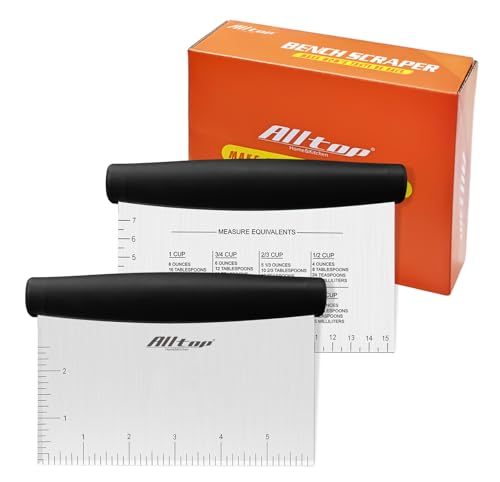
A two-pack makes this practical. The ALLTOP Bench Scraper & Chopper comes as a set of 2 and costs $8.98, rated 4.7. One can sit in the drawer while the other is drying or waiting for a wash. Its listing describes a stainless steel blade for baking, meal prep, bread, pasta, pastry and cake work. It doesn’t state dishwasher safety, so hand washing is the cautious choice.
ALLTOP
Dough Cutting & Countertop Cleanup Made Easy: ALLTOP Stainless Steel Bench Scraper and Chopper, 2-Pack with Measurement Markings
This two-piece stainless steel bench scraper cuts and portions dough while clearing flour and scraps off your counter, with laser-engraved measurement markings that let you divide dough evenly without reaching for a ruler. Home bakers making bread, pasta, or pastry will get the most from it, since the second scraper means one stays clean for cake smoothing while the other handles sticky dough.
Pros and Cons
Pros
- Food-grade stainless steel construction holds up to repeated washing and dough scraping without bending or staining.
- Etched measurement scale and conversion chart stay readable because they are laser engraved rather than printed.
- Contoured olive handle reduces hand strain during long portioning sessions compared to flat-handled scrapers.
- Getting two identical scrapers means a backup is always clean and ready.
Cons
- The 6-inch blade is narrower than bakery-style scrapers, so clearing a large floured countertop takes more passes.
- Stainless steel edges can scratch soft surfaces, so it should be kept off nonstick griddles and coated bakeware.
ALLTOP Dough Cutting & Countertop Cleanup Made Easy: ALLTOP Stainless Steel Bench Scraper and Chopper, 2-Pack with Measurement Markings
ALLTOP
Dough Cutting & Countertop Cleanup Made Easy: ALLTOP Stainless Steel Bench Scraper and Chopper, 2-Pack with Measurement Markings
This two-piece stainless steel bench scraper cuts and portions dough while clearing flour and scraps off your counter, with laser-engraved measurement markings that let you divide dough evenly without reaching for a ruler. Home bakers making bread, pasta, or pastry will get the most from it, since the second scraper means one stays clean for cake smoothing while the other handles sticky dough.
Check price on AmazonA two-pack stainless steel bench scraper that divides dough, lifts sticky pastry off the counter, and clears flour and trimmings into the bin without gouging your work surface.
The double-sided laser-engraved ruler is the standout feature. When splitting dough into eight rolls or measuring pasta sheets, you cut against the marks instead of hunting for a tape measure.
Food-grade stainless steel blade measures 6.0 x 3.15 inches with an olive-shaped ergonomic handle that grips better than flat plastic when you press down hard. Dishwasher safe.
At 6 inches wide it handles smaller than commercial bakery scrapers, so clearing a large marble slab means extra strokes.
Best for home bakers who portion dough regularly and want a second scraper on hand for frosting work.
What a bench scraper actually touches
Think about what ends up on the blade. Flour, sticky dough, butter from pastry work, chopped onions, garlic, herbs. Some of that is greasy and some is starchy, and each needs a different approach. Starch rinses best in cool water. Grease needs warm water and soap.
Raw meat or fish is the other case. If you’ve used the scraper to move raw protein around a board, a full hot wash is the right call, whether by machine or by hand. Either way, make sure the entire surface, including the edge and the spot where the blade meets the grip, gets properly scrubbed or rinsed clean.
Common mistakes to avoid
Most damage comes from a few repeated habits, not from one bad wash.
Leaving the scraper wet in the sink is the big one. Standing water can leave spots on stainless and soak a wooden handle. Another is using abrasive pads or steel wool, which scratch the face and give dough something to cling to. And soaking a wooden-handled tool overnight is the fastest way to loosen the joint.
Skipping the dry step matters too. Even stainless steel can develop water spots if it air-dries wet in a humid kitchen. A quick wipe fixes that.
Watch what else you wash with it. Acidic leftovers, like tomato sauce or citrus, are best rinsed off promptly, not left to sit on the blade.
When to replace your scraper
A bench scraper can last for years, but it isn’t forever. Replace it if the blade bends, the edge is nicked enough to catch on a cutting board, or the handle has cracked or come loose. A wobbly grip is a safety issue, since your hand is close to the edge.
Etched markings that have worn away are another sign. If you measure dough with the scale, a fresh tool is a cheap fix. Because these scrapers cost less than a take-out dinner, most home cooks keep a spare.
If you’re also upgrading other gear, our guides to the best cookware and best nonstick cookware cover pans that work well with a scraper for moving chopped ingredients. For long-term material choices, see the best nontoxic cookware and best titanium cookware roundups.
Dishwasher detergent and your scraper
Modern dishwasher detergents are built to cut grease and lift baked-on food, and many contain bleach-like oxidizers or strong alkaline salts. Stainless steel handles them far better than most materials, but a long, hot, heavy-duty cycle still dulls the shine of a polished blade. Pods and powders that sit against metal for a while can leave a hazy film.
If you run the machine often, pick a normal or eco cycle for the scraper instead of the sanitize setting. Lower heat is gentler on handle glue, plastic grips and etched markings. And always pull the tool out soon after the cycle ends, because steam trapped in a closed machine keeps the metal wet longer than you’d think.
Hard water adds another wrinkle. Mineral spots show up on flat steel faces more than on curved pieces. A rinse aid helps, and so does a quick wipe with a dry towel when you unload.
Cleaning tips by material
Stainless steel
Warm soapy water is enough. For stuck-on dough, soak briefly and wipe with a soft sponge. Dry it and put it away.
Wood handles
Wipe the handle, don’t soak it. Every few months, a light coat of food-safe mineral oil keeps the wood from drying out. Don’t use cooking oils that can turn rancid.
Plastic handles
These usually handle the machine, but check the label. High heat on the bottom rack can warp lower-grade plastic.
For anyone building out a baking drawer with copper or other specialty pans, the best copper cookware guide is worth a look. Those pieces are hand wash only too.
FAQ
Can you put a bench scraper in the dishwasher?
Yes, if it’s all stainless steel or the manufacturer says it’s dishwasher safe. Skip the machine for wooden handles. When in doubt, hand wash. It takes seconds.
Will the dishwasher dull a bench scraper?
It can, over time. Blades knocking against other metal in the rack can nick the edge. Placing the scraper flat on the top rack and giving it space cuts the risk.
Can a wooden-handled bench scraper go in the dishwasher?
No. Heat and long exposure to water can dry out and crack wood. Wash it by hand, dry it right away, and oil the handle now and then.
Does the dishwasher remove the measurement markings?
Laser-etched marks are cut into the metal and usually hold up. Printed markings may fade after repeated cycles. Check how your scraper’s scale is made.
What’s the best way to clean dried dough off a bench scraper?
Rinse with cool water first, because hot water can set flour into a paste. Then soak briefly in warm soapy water and wipe both faces with a soft sponge.



Write Your Review
No reviews yet. Be the first to share your experience!