

TL;DR — There is no single best knife steel; there’s the right hardness for how you cook and how much you’ll sharpen. Harder steel (higher Rockwell, common in Japanese knives) holds a razor edge far longer and sharpens finer, but chips more easily and demands care. Softer steel (German knives) is tougher, more forgiving, and easier to sharpen, but dulls faster. The HomeWhisk team compared the common kitchen steels by hardness, edge retention, corrosion resistance, and toughness. This guide translates the alloy names on the box into what they mean at your cutting board.
The HomeWhisk editorial team researches kitchen equipment by analyzing manufacturer specifications, material compositions, construction methods, and aggregated user reviews from major retailers and cooking communities. Our recommendations are based on what the products actually deliver, not what brands promise.
For this guide, we compared blade steel compositions, hardness ratings, and real-world edge feedback from home cooks and enthusiasts. Here’s how to read a knife’s steel and pick the right one.
The Four Properties That Define Any Knife Steel
Every knife steel is a balancing act between four properties, and no steel maxes out all of them — improving one usually costs another. Understanding these four makes every spec sheet readable.
Hardness (measured on the Rockwell C scale, “HRC”) is how resistant the steel is to deforming. Higher HRC holds a sharper edge longer and can be sharpened to a finer angle. Kitchen knives run roughly 56-58 HRC (German) to 60-64 HRC (Japanese). But harder = more brittle.
Edge retention is how long the knife stays sharp in use. It tracks closely with hardness and with certain alloying elements. High edge retention means less frequent sharpening.
Toughness is resistance to chipping and cracking. It’s the trade-off against hardness — harder steel is generally less tough, so it chips if you hit bone, twist in dense squash, or drop it. Softer steel bends or rolls its edge instead of chipping, which is easier to fix.
Corrosion resistance is how well the steel resists rust and staining. Stainless steels have enough chromium (13%+) to resist rust; carbon steels don’t and will patina or rust without care.
Every steel below is just a specific compromise among these four. Your job is to pick the compromise that fits your habits.
Stainless Steels: Low-Maintenance Workhorses
Most kitchen knives use stainless steel because it resists rust and tolerates everyday neglect. Within stainless, hardness varies widely.
German stainless (X50CrMoV15) — used by Wüsthof, Zwilling, and most Western brands — sits around 56-58 HRC. It’s tough, corrosion-resistant, and easy to sharpen, but dulls faster than harder steels. This is the forgiving choice for the cook who wants a durable knife they don’t have to baby. It’s the standard steel in most best chef knife and best kitchen knife set options.
Japanese stainless (VG-10) is a popular mid-to-high-end steel around 60-61 HRC. It holds an edge notably longer than German steel and takes a finer edge, while still resisting rust well. It’s the sweet spot for many enthusiasts — sharper and longer-lasting than German steel without the fussiness of carbon steel. Common in mid-range best japanese knife offerings.
AUS-8 and AUS-10 are Japanese stainless steels; AUS-10 is higher-carbon and holds an edge better. Both are common in the affordable-to-mid range and offer good value.
Budget stainless (unspecified “high-carbon stainless”) in cheap knives is usually soft (under 55 HRC) and dulls quickly. If a knife doesn’t name its steel, that’s often a sign it’s using a low-grade alloy — a reason to be cautious below a certain price.
Premium Powder Steels: Maximum Edge Retention
At the high end, powder-metallurgy steels push edge retention and hardness further than conventional steels, for cooks who want the sharpest, longest-lasting edge.
SG2 / R2 (powder steel) runs around 62-64 HRC and holds an edge exceptionally long — many owners go months between sharpenings. It’s made by a powder process that creates an extremely fine, uniform grain, allowing a very sharp, very durable edge. The trade-off is brittleness and price: it chips if abused and costs more. It’s the steel of choice in premium best japanese knife lines for cooks who treat their knives carefully.
Blue Steel (Aogami) and White Steel (Shirogami) are high-end Japanese carbon (non-stainless) steels prized by enthusiasts for taking the sharpest possible edge. They rust easily and demand diligent care — strictly for people who enjoy maintenance.
High-carbon (non-stainless) steel in general takes a scary-sharp edge and holds it well, but will rust if left wet and patinas when cutting acidic food. It rewards ritual and punishes neglect — wonderful for the dedicated, frustrating for everyone else.
The pattern at this tier: you’re buying longer edge retention and finer sharpness, and paying for it in price, brittleness, and (for carbon steels) maintenance.
Hardness vs Toughness: The Central Trade-Off
This is the single most important concept, so it’s worth stating plainly: you cannot have maximum sharpness-retention and maximum chip-resistance in the same knife. Steel makers move a slider between the two.
A hard Japanese blade (62+ HRC) takes a finer, sharper edge and keeps it far longer — but that thin, hard edge is more likely to chip on bone, frozen food, or a hard cutting board, and it’s more delicate if dropped. It also requires a harder sharpening stone and more skill to sharpen well.
A softer German blade (56-58 HRC) won’t hold its edge as long and can’t take quite as fine an angle — but it’s forgiving. Its edge rolls rather than chips, which is easily corrected with a honing steel, and it tolerates rougher use, occasional bone contact, and less careful storage.
This maps directly onto cutting style and care level. If you push-cut carefully on a wood board, hone regularly, and want the sharpest edge, hard steel rewards you. If you rock-chop, occasionally hit a bone, and want a knife that survives a dishwasher-adjacent life, softer steel is the smarter buy. Neither is “better steel” — they’re different tools.
Steel Isn’t Everything: Geometry and Heat Treatment
A crucial caveat: the name of the steel matters less than what the maker does with it. Two knives with identical steel can perform very differently.
Heat treatment — how the steel is hardened and tempered during manufacturing — hugely affects the final hardness and toughness. A well-heat-treated “ordinary” steel can outperform a poorly-treated “premium” steel. This is why reputable brands with good heat-treatment processes matter more than the alloy label alone.
Edge geometry — how thin and at what angle the edge is ground — often affects perceived sharpness more than the steel itself. A knife ground to 15 degrees per side feels sharper than the same steel ground to 20 degrees, regardless of alloy. Japanese knives feel sharper partly because of harder steel and partly because they’re ground to finer angles.
The takeaway: don’t chase steel names in isolation. A best chef knife from a reputable brand with good heat treatment and geometry will outperform a no-name knife boasting an exotic steel. Steel sets the ceiling; heat treatment and geometry determine how much of that ceiling you actually get.
Frequently Asked Questions
What is the best knife steel for a home cook?
For most home cooks, a good Japanese stainless like VG-10 (around 60-61 HRC) hits the sweet spot: it holds an edge much longer than German steel, takes a fine edge, and still resists rust and tolerates normal use. If you prefer a tougher, more forgiving knife you rarely sharpen carefully, German stainless (X50CrMoV15) is excellent. Both are far better choices than unnamed budget steel.
Is harder knife steel always better?
No. Harder steel (higher HRC) holds a sharper edge longer, but it’s more brittle — it chips more easily on bone or hard boards and is harder to sharpen. Softer steel dulls faster but is tougher and easier to maintain. “Better” depends on whether you value long edge retention (hard steel) or durability and easy sharpening (softer steel). It’s a trade-off, not a straight upgrade.
What’s the difference between German and Japanese knife steel?
German steel (like X50CrMoV15) is softer (56-58 HRC), tougher, more corrosion-resistant, and easier to sharpen, but dulls faster — suited to rougher use and rocking cuts. Japanese steel (VG-10, SG2, and others) is harder (60-64 HRC), holds a finer edge much longer, but is more brittle and needs more care — suited to precise push-cutting. German is forgiving; Japanese is sharper but more demanding.
Does carbon steel make a better knife than stainless?
It makes a sharper edge that lasts longer, but it rusts and stains without diligent care. Carbon steel (and high-carbon Japanese steels like Blue and White) can take a keener edge than most stainless, which enthusiasts love. But it requires drying immediately, oiling, and accepting a patina. For most people, modern high-hardness stainless offers most of the performance without the rust risk, making stainless the more practical choice.
How do I know what steel a knife uses?
Good manufacturers list the steel in the product specs (e.g., “VG-10,” “X50CrMoV15,” “SG2”). If a knife only says “high-carbon stainless steel” with no specific alloy name, it’s usually a lower-grade steel — common in budget knives. Named steels from reputable brands are a reliability signal. When comparing knives, look for the specific alloy and the brand’s reputation for heat treatment.
Do I need expensive steel to get a sharp knife?
No. Edge geometry and sharpening matter as much as steel. A mid-priced knife in decent steel, kept sharp with regular honing and occasional sharpening, out-cuts an expensive knife that’s gone dull. Expensive powder steels hold their edge longer between sharpenings, which enthusiasts value, but any decent steel gets very sharp — staying sharp is about maintenance, not just the alloy.
Related buying guides: best knife sets and best bread knife.
The Bottom Line
The “best” knife steel is the one whose trade-offs match your habits. Want a forgiving knife you rarely fuss over? German stainless. Want a sharper edge that lasts longer and you’ll care for it? Japanese VG-10 or a powder steel. Love ritual and maximum sharpness? Carbon steel. But remember the bigger truth: a reputable brand’s heat treatment and edge geometry matter more than the alloy name on the box. Start with a quality best chef knife or explore the harder-steel options in our best japanese knife guide, and keep whatever you buy sharp.
The Best Deals This Week*
-
imarku 8 Inch Japanese Chef Knife
$39.99
($61.99)Save $22.00 -
imarku 7-Inch Santoku Knife for Precision Slicing
$39.99
($69.99)Save $30.00
*Deals are selected by our commerce team
Deeper Dive: Our Top Picks
Our Top Picks

MITSUMOTOSAKARI
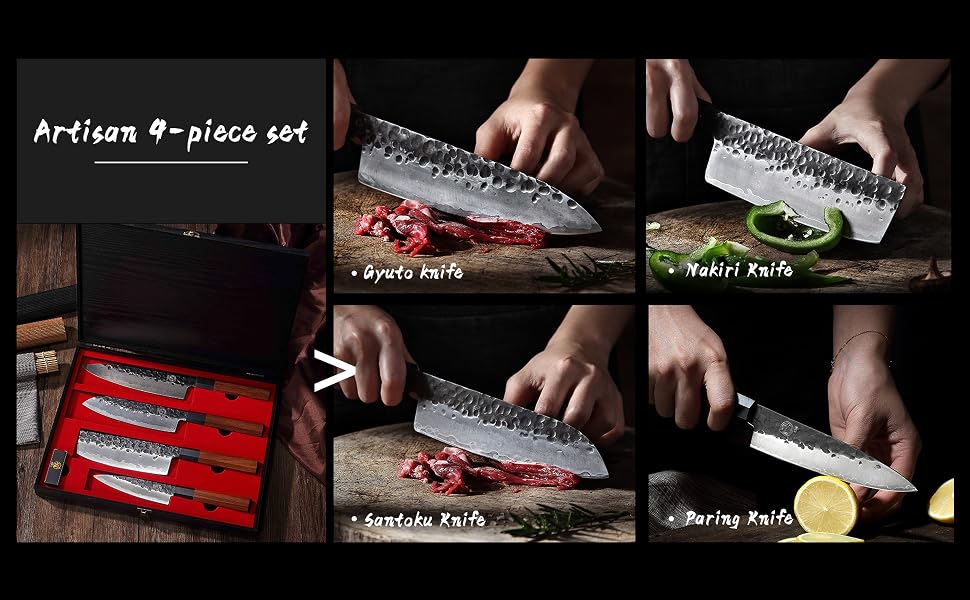
Japanese Hand-Forged Chef's Knife Set 4-Piece High Carbon Steel Rosewood
This 4-piece hand-forged Japanese knife set delivers precision cutting with 3-layer 9CR18MOV steel that stays sharp through hundreds of prep sessions, thanks to its 58±2 HRC hardness and ultra-thin 2.5mm blade. Buy it if you cook daily and want professional-grade knives without the professional price tag.
Pros and Cons
Pros
- Exceptional sharpness out of the box cuts through tough vegetables and delicate herbs without crushing or bruising.
- Balanced weight distribution in the rosewood handle reduces hand and wrist strain during long cooking sessions.
- Four complementary knives handle everyday tasks, eliminating the need to buy multiple single knives separately.
- Hand-forged construction with visible grain pattern creates a premium feel that justifies daily kitchen use.
Cons
- Requires hand washing and immediate drying to prevent corrosion; dishwasher use will damage the blade and handle.
- Rosewood handle needs occasional conditioning with food-grade oil to maintain appearance and prevent cracking over years of use.
imarku
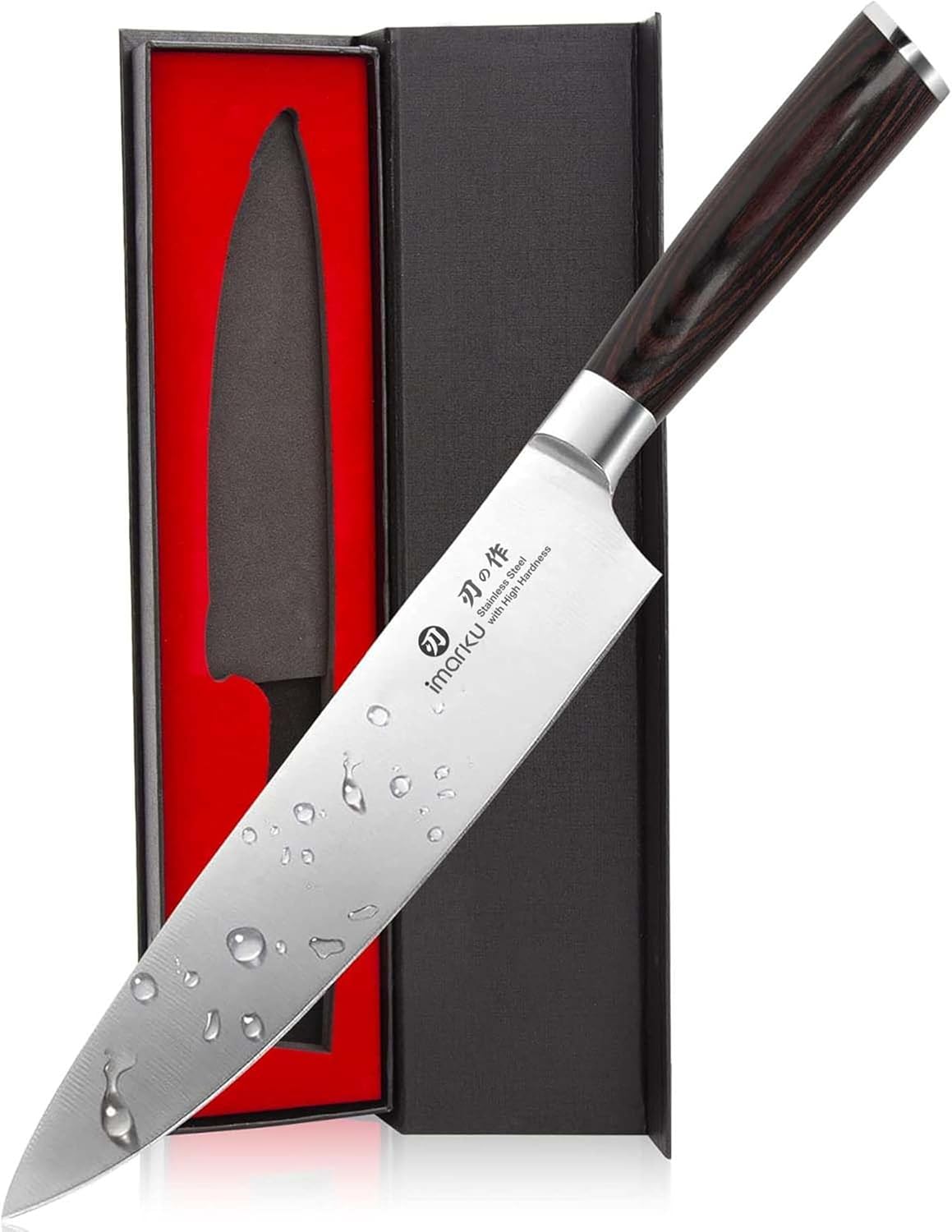
8 Inch Japanese Chef Knife | High-Carbon Stainless Steel Gyutou
This 8-inch gyutou knife delivers professional-grade sharpness for slicing, dicing, and chopping with a high-carbon stainless steel blade that stays sharp through tough kitchen tasks. Buy it if you prep vegetables and proteins regularly and want a durable, ergonomic knife that won't require constant sharpening.
Pros and Cons
Pros
- 32,768-layer blade construction from 108 traditional forging steps delivers exceptional durability and edge retention compared to mass-produced knives.
- At 8 inches, the blade length balances control for detail work with enough surface area for efficient slicing of larger cuts.
- FSC-certified African Pakka wood handle provides comfortable grip without slipping, even when wet or during repetitive cutting motions.
Cons
- Requires hand-washing and immediate drying to prevent water spots and maintain the stainless steel finish; dishwasher use will damage the blade.
- The high-carbon content means the blade can chip if used on hard surfaces like bone or frozen foods without proper technique.

Matsato
6.3 Inch Chef Knife Japanese Steel Blade for Home Cooking
This 6.3-inch Japanese stainless steel chef knife delivers razor-sharp precision for slicing, dicing, and chopping vegetables and meats with minimal effort and superior edge retention. Home cooks and meal preppers will appreciate the balanced ergonomic handle that reduces hand fatigue during extended kitchen tasks.
Pros and Cons
Pros
- High-carbon stainless steel blade resists dulling and chipping, maintaining sharpness through hundreds of cutting sessions.
- Ergonomic handle crafted from premium materials reduces fatigue during meal prep and makes controlled cuts feel effortless.
- Compact 6.3-inch size offers better maneuverability than larger chef knives while handling everyday kitchen tasks effectively.
Cons
- Requires hand washing and immediate drying to maintain blade quality and prevent water spots on the steel.
- At 6.3 inches, slightly smaller than traditional 8-inch chef knives, which may limit effectiveness for breaking down large cuts of meat.

SHANZU
SHAN ZU 8 Inch Damascus Chef Knife | 67-Layer Japanese Steel Professional Blade
This 8-inch Damascus chef knife delivers a 15° blade angle with 62 HRC hardness for precise, long-lasting cuts through proteins, vegetables, and herbs without frequent sharpening. Buy it if you prep daily and want authentic Damascus layering (not laser etching) with professional performance at mid-range pricing.
Pros and Cons
Pros
- Authentic Damascus construction with 67 folded steel layers delivers visible pattern depth and genuine durability, not cosmetic etching.
- G10 handle material resists moisture and bacterial growth better than wood, making it safer for high-volume kitchen prep.
- 62 HRC hardness rating keeps the edge sharp through 200+ cuts before noticeable dulling, reducing maintenance burden.
Cons
- No customer reviews yet on this specific ASIN, so you cannot verify real-world performance or edge retention claims from actual users.
- G10 handle requires hand-washing only; dishwasher use will degrade the material and void the warranty.
imarku
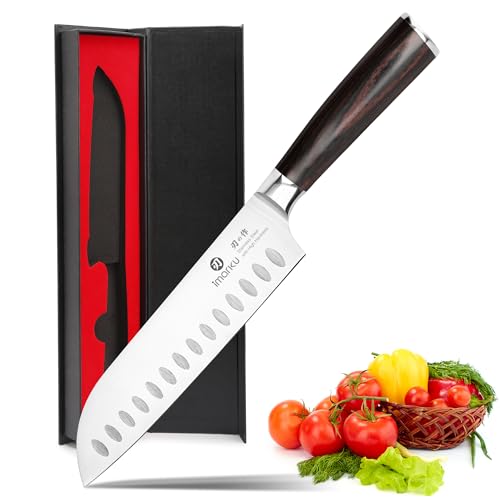
7-Inch Santoku Knife for Precision Slicing
The imarku 7-inch Santoku knife combines a hollow scalloped edge and 15-18 degree hand-polished bevel to reduce drag and prevent food from sticking during high-volume prep work. Home cooks and apartment dwellers who want a restaurant-capable knife without the steep price will find it covers meat, vegetables, and bread with a single blade.
Pros and Cons
Pros
- The 2.5mm blade thickness paired with the hollow edge design handles both delicate julienne cuts and heavier chopping without flexing or wedging.
- Pakkawood handle construction offers a more sanitary and dimensionally stable grip than standard composite or natural wood handles.
- The 15-18 degree edge angle matches professional Japanese knife geometry, giving it a noticeably sharper out-of-box performance than German-style knives at this price.
- Versatile enough for meat, vegetables, fruit, and bread, making it a practical single-knife solution for small kitchens with limited storage.
Cons
- With zero verified reviews available, long-term edge retention and handle durability under daily use remain unconfirmed by real buyers.
- The 3-month refund window is shorter than the lifetime guarantees offered by competing brands at the same price point.
Editors' Picks
MITSUMOTOSAKARI Japanese Hand-Forged Chef's Knife Set 4-Piece High Carbon Steel Rosewood
MITSUMOTOSAKARI
Japanese Hand-Forged Chef's Knife Set 4-Piece High Carbon Steel Rosewood
This 4-piece hand-forged Japanese knife set delivers precision cutting with 3-layer 9CR18MOV steel that stays sharp through hundreds of prep sessions, thanks to its 58±2 HRC hardness and ultra-thin 2.5mm blade. Buy it if you cook daily and want professional-grade knives without the professional price tag.
$195.99 at AmazonEditors' Favorite
Brand Name: MITSUMOTO SAKARI Manufacturer: MITSUMOTO SAKARI UPC: 016392249606 Model Number: MS-2680 Item Type Name: Japanese Chef Knife Unit Count: 4.0 Count Included Components: Sandalwood Box, knife blade oil Best Sellers Rank: #43,835 in Kitchen & Dining (See Top 100 in Kitchen & Dining) #108 in Chef's Knives ASIN: B0D31NBLH2 Customer Reviews: 4.6 4.6 out of 5 stars (223) 4.6 out of 5 stars Blade Edge: Plain Construction Type: Forged Blade Material Type: Carbon Steel Handle Material: Rosewood Is the item dishwasher safe?: No Material Type: Carbon Steel BladeLength: 8 Inches Item Weight: 800 Grams Item Length: 14 Inches Size: 4 Japanese Chef's Knives Set Color: Gray Blade Color: Gray Blade Material: Carbon Steel Brand: MITSUMOTO SAKARI
Shop Nowimarku 8 Inch Japanese Chef Knife | High-Carbon Stainless Steel Gyutou
imarku
8 Inch Japanese Chef Knife | High-Carbon Stainless Steel Gyutou
This 8-inch gyutou knife delivers professional-grade sharpness for slicing, dicing, and chopping with a high-carbon stainless steel blade that stays sharp through tough kitchen tasks. Buy it if you prep vegetables and proteins regularly and want a durable, ergonomic knife that won't require constant sharpening.
$39.99 at AmazonGreat Value
Brand Name: imarku Manufacturer: imarku UPC: 667673934065 604753870875 652129610679 Global Trade Identification Number: 00667673934065 Model Number: 8-inch chef knife Manufacturer Part Number: SC10-01 9inch Item Type Name: Ergonomic Equipment Unit Count: 1.0 Count Included Components: 1 pc chef knife Best Sellers Rank: #963 in Kitchen & Dining (See Top 100 in Kitchen & Dining) #1 in Gyutou Knives ASIN: B01DDBJF12 Customer Reviews: 4.6 4.6 out of 5 stars (10,340) 4.6 out of 5 stars Blade Material Type: High Carbon Stainless Steel Handle Material: Pakkawood Is the item dishwasher safe?: No Material Type: stainless steel BladeLength: 8 Inches Item Weight: 0.41 Pounds Item Length: 13 Inches Size: 8" Color: brown and silver Blade Color: Silver Blade Edge: Plain Construction Type: Forged Blade Material: High Carbon Stainless Steel Brand: imarku
Shop NowMatsato 6.3 Inch Chef Knife Japanese Steel Blade for Home Cooking
Matsato
6.3 Inch Chef Knife Japanese Steel Blade for Home Cooking
This 6.3-inch Japanese stainless steel chef knife delivers razor-sharp precision for slicing, dicing, and chopping vegetables and meats with minimal effort and superior edge retention. Home cooks and meal preppers will appreciate the balanced ergonomic handle that reduces hand fatigue during extended kitchen tasks.
$39.99 at AmazonBrand Name: Matsato Manufacturer: Matsato Model Number: Matsato Manufacturer Part Number: Matsato Item Type Name: Knife Unit Count: 1.0 Count Included Components: Knife Best Sellers Rank: #3,455 in Kitchen & Dining (See Top 100 in Kitchen & Dining) #4 in Chef's Knives ASIN: B0CLVMXH3Y Customer Reviews: 4.5 4.5 out of 5 stars (9,153) 4.5 out of 5 stars Blade Edge: Plain Construction Type: Forged Blade Material Type: Stainless Steel Handle Material: Wood Is the item dishwasher safe?: No Material Type: 1.4116 Japanese Stainles, Wood BladeLength: 6.3 Inches Item Weight: 176 Grams Item Length: 10.8 Inches Size: 6.3" Color: Brown, Silver Blade Color: Silver Blade Material: Stainless Steel Brand: Matsato
Shop NowSHANZU SHAN ZU 8 Inch Damascus Chef Knife | 67-Layer Japanese Steel Professional Blade
SHANZU
SHAN ZU 8 Inch Damascus Chef Knife | 67-Layer Japanese Steel Professional Blade
This 8-inch Damascus chef knife delivers a 15° blade angle with 62 HRC hardness for precise, long-lasting cuts through proteins, vegetables, and herbs without frequent sharpening. Buy it if you prep daily and want authentic Damascus layering (not laser etching) with professional performance at mid-range pricing.
$89.99 at AmazonBrand Name: SHAN ZU Manufacturer: SHAN ZU UPC: 714757573303 Model Number: SZPCS-2017-002 Manufacturer Part Number: SZPCS-2017-002 Unit Count: 1.0 Count Best Sellers Rank: #13,584 in Kitchen & Dining (See Top 100 in Kitchen & Dining) #33 in Chef's Knives ASIN: B071JV1GDP Blade Edge: Plain Construction Type: Forged Blade Material Type: Alloy Steel Handle Material: G10 Glass Fiber Handle Is the item dishwasher safe?: No Material Type: resin BladeLength: 8 Inches Item Weight: 260 Grams Item Length: 8 Inches Size: 8" Color: Chef Knife Blade Color: Silver Blade Material: Alloy Steel Brand: SHAN ZU
Shop Nowimarku 7-Inch Santoku Knife for Precision Slicing
imarku
7-Inch Santoku Knife for Precision Slicing
The imarku 7-inch Santoku knife combines a hollow scalloped edge and 15-18 degree hand-polished bevel to reduce drag and prevent food from sticking during high-volume prep work. Home cooks and apartment dwellers who want a restaurant-capable knife without the steep price will find it covers meat, vegetables, and bread with a single blade.
$39.99 at AmazonColor: Brown and Silver Size: 7" Dimensions: 12 x 3 x 1 inches Weight: 0.43 pounds Product Group: Kitchen Binding: Kitchen
Shop NowHow We Evaluated These Picks
This guide is research-based, not a hands-on test. We did not buy, cook with, or measure the products above. What we did compare: manufacturer specifications, materials and construction, capacities and wattages, and the patterns that repeat across large volumes of verified owner reviews — especially the complaints that only surface after weeks of use, like coatings failing, motors weakening, controls drifting, or a design proving awkward to clean and store.
Where this page describes how something performs, it is reporting what the specifications state and what owners consistently report — not a result we produced ourselves. Prices and availability change constantly, so check the current listing before buying. We earn a commission on purchases made through links on this page, which never affects which products we include or how we rank them.

Write Your Review
No reviews yet. Be the first to share your experience!