

The fastest way to understand countertop dehydrators is to look at the price ladder, because what you pay maps almost perfectly to how the machine moves air and how much control it hands you over temperature. At the bottom sit stackable-tray units running roughly $50 to $80, the round Nesco and Presto-style towers you’ve seen at hardware stores. In the middle, around $150 to $250, you get box-style dehydrators with fixed shelves and a fan mounted on the back wall. And at the top, $300 and up, you reach prosumer gear like the Excalibur nine-tray, the kind of thing people who make jerky by the pound actually buy. Each jump up the ladder buys you better airflow, a real thermostat, and fewer excuses for uneven drying.
The entry tier: stackable trays for $50 to $80
The cheap towers work by pushing heat up from a fan and element in the base or lid, then letting it rise through a stack of round trays with a hole in the center. This is vertical bottom-fan airflow, and its weakness is obvious the first time you use it: the tray nearest the heat source dries faster than the one at the top. You end up rotating trays every couple of hours to even things out, which is fine on a lazy Sunday and annoying on a work night. Most units in this bracket give you five trays out of the box, often expandable to a dozen, but the usable drying area per tray is small once you account for that center hole. Herbs, apple rings, and single batches of fruit leather are where these shine. The better ones (the Nesco Gardenmaster, for instance) add a real adjustable thermostat spanning roughly 95 to 160°F, which matters more than any other feature at this price. Skip anything with a single fixed temperature or a vague “low/high” dial. Without a number to dial in, you’re guessing, and dehydrating is not a hobby that rewards guessing.
The middle tier: box units for $150 to $250
Spend a bit more and the whole architecture changes. Box-style dehydrators stack rectangular shelves in a front-loading cabinet with the fan and heating element mounted on the rear wall, so air blows horizontally across every tray at once. This horizontal rear-fan design is the single biggest upgrade you can make, because it drops most of the tray-rotation chore. Every shelf sits in roughly the same airflow, so a full load of banana slices finishes within an hour or two of each other instead of a full afternoon apart. Machines here usually run six to eight trays with a genuine square drying surface, meaning you fit far more per batch than the round towers suggest on paper. A Cosori or a Magic Mill in this range will give you a digital thermostat, a proper 24- or 48-hour timer with auto-shutoff, and a temperature ceiling around 165°F, which is the number you need for safe jerky. The trays are typically BPA-free plastic, sometimes stainless steel if you hunt. This is the tier I point most people toward. It handles the volume a real household generates without demanding countertop space you’ll resent.
The prosumer tier: $300 and up
At the top you’re paying for capacity, consistency, and a fan that doesn’t quit. The Excalibur nine-tray is the reference point here, with something like 15 square feet of drying space behind a horizontal rear-fan system Excalibur calls Parallexx. The practical result is that you can pack every tray edge to edge, run the machine for twelve hours, and pull out fruit leather and jerky that dried at the same rate front to back. The thermostat is adjustable across the full 95 to 165°F range, and the timer is reliable enough that you’ll trust it overnight. These units are also quieter relative to how much air they move, though “quiet” is relative, more like a bathroom fan than silence. The trade-off is footprint. A nine-tray Excalibur is roughly the size of a microwave and weighs a fair bit, so it wants a permanent home or a sturdy shelf. If you dry produce from a garden, make jerky in bulk, or preserve for camping trips, the cost per batch over a few years makes this tier the honest value pick, even though the sticker stings.
Airflow and temperature control are what you’re actually buying
Strip away the branding and two things decide whether a dehydrator is good: how evenly it moves air, and how precisely it holds heat. Horizontal rear-fan machines beat vertical bottom-fan towers on evenness every time, full stop. It’s the difference between rotating trays like a short-order cook and setting the machine and walking away. On the heat side, an adjustable digital thermostat with a real Fahrenheit readout is non-negotiable for me now. Different foods want different temperatures, and a machine that only offers two settings will scorch your herbs while under-drying your beef. A few degrees of drift also matters over a long run, so the units that hold their setpoint tightly are worth the premium. Pay attention to the temperature ceiling too. You need to reach 160 to 165°F to dry jerky safely, and plenty of budget models top out around 155°F, which quietly disqualifies them from the one job a lot of buyers want most.
Matching temperature to what you’re drying
Once you have a machine that actually holds a number, the recipes get simple. Herbs are the most delicate: 95 to 105°F keeps basil, oregano, and parsley green and aromatic instead of brown and papery, and they finish in two to four hours. Fruit, whether it’s apple rings, mango, or strawberries, dries best at 125 to 135°F over six to twelve hours depending on thickness and sugar content. Fruit leather sits in the same zone, poured a quarter-inch thick onto a solid sheet and given eight to ten hours until it’s tacky but not sticky. Jerky is the outlier and the reason people care about that high ceiling. You want to run beef or venison at 160 to 165°F so the meat reaches a safe internal temperature while it dries, usually four to six hours for quarter-inch strips. Vegetables like tomatoes and mushrooms land around 125 to 135°F. Keep a cheap notebook near the machine for your first month and you’ll dial in your own times fast.
The details that separate a keeper from a returns pile
Beyond airflow and heat, a handful of small things decide whether you’ll still be using the machine in two years. Noise is real: a dehydrator runs for hours, sometimes overnight, and a whiny fan in an open-plan kitchen becomes a reason to stop using it. Read reviews specifically for fan noise, not just drying results. Trays should be BPA-free plastic at minimum, and if you can find stainless mesh inserts, they clean up better and don’t hold onto jerky grease and marinade smell the way plastic does over time. A dishwasher-safe tray is worth a lot on cleanup night. Look for a solid fruit-leather sheet and a fine-mesh screen in the box, or budget to buy them, because they turn a produce dryer into a genuinely versatile tool. A transparent door or lid lets you check progress without dumping heat, and an auto-shutoff timer means you can start a batch at bedtime without setting an alarm. None of these are exciting features. All of them are the ones you notice when they’re missing.
Is a horizontal rear-fan dehydrator really worth the extra money?
For most people who dehydrate more than a couple times a year, yes. The horizontal rear-fan layout pushes air evenly across every tray, so you’re not rotating shelves halfway through and you’re not pulling out one tray of leathery fruit next to another that’s still damp. Vertical bottom-fan towers can absolutely make good food, and at $50 to $80 they’re a reasonable way to test whether you’ll stick with the hobby. But the first time you run a full box-style load and everything finishes together, the upgrade justifies itself. If you only ever dry herbs in small batches, save your money. If you’re doing fruit and jerky in volume, the airflow difference is the whole ballgame.
What temperature do I need to make jerky safely?
You want the machine to hold 160 to 165°F, and this is exactly why the temperature ceiling matters when you shop. Meat needs to reach a safe internal temperature during drying to handle any bacteria, and a dehydrator that tops out at 155°F leaves you cutting it close. Many food-safety guides recommend pre-heating marinated strips in a 275°F oven for about ten minutes, then finishing them in the dehydrator at 160°F, which covers the safety step even on machines that run a touch cool. Quarter-inch strips usually take four to six hours. If jerky is your main reason for buying, confirm the top temperature in the specs before anything else, because plenty of otherwise decent budget units simply can’t get there.
How many trays do I actually need?
More than you think, but not because you’ll fill them every time. Dehydrating is slow, often eight to twelve hours per batch, so the real constraint is how much you can process in one long run rather than how often you run the machine. A five-tray tower sounds generous until you notice the center holes and small round surface cut the usable area down. A six- to eight-tray box unit with square shelves gives you far more real space for the same nominal count. If you’re preserving a garden harvest or making jerky for a group, the nine-tray prosumer machines earn their footprint. For a couple drying occasional fruit and herbs, six square trays is plenty, and you’ll appreciate the smaller unit on your counter the rest of the year.
Deeper Dive: Our Top Picks
Our Top Picks
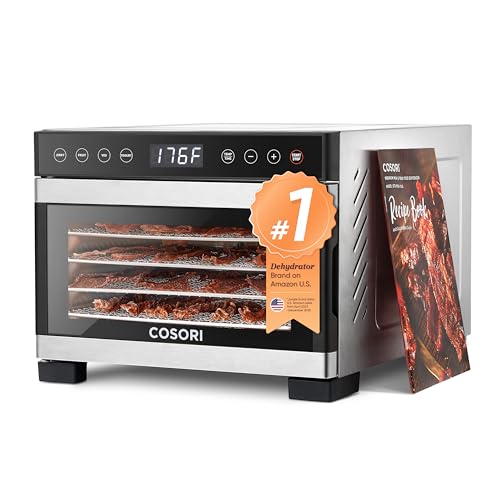
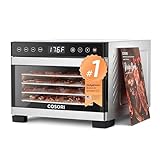
Cosori
Best Food Dehydrator for Jerky & Snacks: Cosori 5-Tray Stainless Steel with 176°F Max Temp
The Cosori food dehydrator reaches 176°F with precise 1°F increments across 5 stainless steel trays, hitting the USDA-recommended 165°F threshold for safe beef jerky every time. Home cooks who regularly make jerky, dried fruit, or dog treats will appreciate the 48-hour timer and four dedicated presets that remove the guesswork from drying times.
Pros and Cons
Pros
- Temperature adjusts in 1°F increments from 95 to 176°F, giving precise control that cheaper dehydrators with fixed settings cannot match.
- Stainless steel trays are more durable and odor-resistant than plastic alternatives, which matters when drying strongly flavored foods like fish or garlic.
- Includes a mesh screen and fruit roll sheet out of the box, so you can dehydrate small or liquid-based foods without buying accessories separately.
- Four customizable presets store your preferred time and temperature combinations, saving setup time on repeat recipes.
Cons
- Five trays provide 3.1 square feet of total drying space, which may not be enough for large-batch processing without running multiple cycles.
- No review data is currently available to confirm real-world noise levels during extended overnight runs.
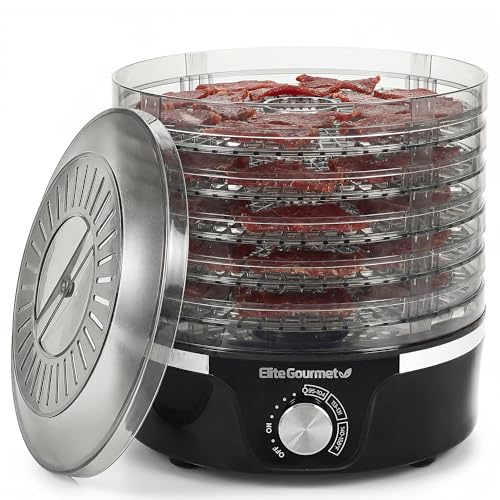
Elite Gourmet
Home Food Dehydrator for Jerky
The Elite Gourmet EFD319 dehydrates fruits, vegetables, herbs, and jerky across five expandable BPA-free trays with a base-mounted fan that circulates heat evenly without requiring tray rotation. Budget-conscious home snack makers who want preservative-free jerky and dried produce without a large countertop footprint will find this a capable entry-level option.
Pros and Cons
Pros
- Horizontal airflow from a base-mounted fan eliminates hot spots, producing consistent drying results across all five trays in a single batch.
- BPA-free, ETL-listed construction and dishwasher-safe components meet basic food-safety standards expected for daily snack preparation.
- The wide 95°F–158°F temperature range covers the full spectrum from delicate fresh herbs down to safe minimum temperatures for poultry-based jerky.
- Compact dimensions and a 1-year warranty with U.S.-based support reduce the risk for first-time dehydrator buyers.
Cons
- At 350W with five trays, drying times for dense foods like thick-cut beef jerky will run longer than higher-wattage units, often requiring overnight cycles.
- Five trays suit small-to-medium batches; households looking to process large harvests in a single run will outgrow the capacity quickly.

Cosori
Make Jerky, Dried Fruit & More Faster: Cosori 6-Tray Stainless Steel Food Dehydrator with 600W Motor
The Cosori food dehydrator delivers 6.5 ft² of drying space across 6 stainless steel trays, powered by a 600W rear-mounted fan that circulates air evenly without requiring tray rotation. Home cooks who batch-dry jerky, herbs, or fruit regularly will benefit from its 48-hour timer, precise degree-level temperature control, and sub-48dB operation that runs quietly overnight.
Pros and Cons
Pros
- The 6.5 ft² stainless steel tray surface handles large batch drying in a single run, reducing how often you need to cycle loads.
- Rear-mounted airflow technology distributes heat evenly across all six trays, so food on every level dries at the same rate.
- The digital control panel offers degree-level temperature precision between 95°F and 165°F, which matters for food safety with meat and poultry.
- Included accessories — mesh screen, fruit roll sheet, and a 50-recipe cookbook — mean you can start dehydrating a wide range of foods immediately.
Cons
- At 6 trays, the unit is physically larger than compact dehydrators, so counter space and cabinet storage should be measured before buying.
- The 600W power draw is higher than budget dehydrators, which adds up during 24- to 48-hour drying cycles for dense foods like thick-cut jerky.

Cosori
Make Beef Jerky and Dried Fruit at Home: Cosori 5-Tray Food Dehydrator with 165°F Max Temp and 48H Timer
The Cosori Food Dehydrator reaches 165°F — higher than most competitors — making it one of the safer options for homemade beef jerky while handling everything from herbs to dog treats across five BPA-free trays. Home cooks who want precise temperature control, quiet overnight runs, and room to expand to seven trays will get the most out of this machine.
Pros and Cons
Pros
- The 165°F maximum temperature meets USDA guidelines for safely drying meat, which most entry-level dehydrators cannot match.
- Fine-grained 1°F temperature increments give you precise control over delicate ingredients like herbs and thin fruit slices.
- Solid housing construction resists cracking and warping better than clear-shell models that can become brittle over time.
- The sub-47 dB operation makes it practical to run extended cycles in a home kitchen without noise disruption.
Cons
- Five trays may feel limiting for large households or bulk batches until the optional expansion trays are purchased separately.
- No digital display or app connectivity means monitoring requires manual checks rather than remote oversight.

Magic Mill
Best Food Dehydrator for Jerky & Fruit Leather: Magic Mill Pro 600W 7-Tray Stainless Steel Machine
The Magic Mill Pro dehydrates jerky, fruit, and herbs evenly across 7 full-size stainless steel trays using a rear-mounted 600W fan that eliminates hot spots without tray rotation. Home cooks who batch-dry large quantities overnight will benefit most from the 48-hour timer with auto shutoff and 24-hour keep-warm hold.
Pros and Cons
Pros
- Full stainless steel trays and interior eliminate the plastic taste and BPA concerns common in budget dehydrators.
- Rear-fan airflow design produces consistent results across every tray level, removing the guesswork from multi-tray batches.
- The 48-hour timer with auto shutoff handles overnight and all-day drying runs without requiring you to be present.
- ETL listing confirms the unit meets recognized safety standards, adding confidence for long unattended runs.
Cons
- At 7 trays and a full stainless build, this unit requires dedicated counter or cabinet space that compact dehydrators do not.
- No reviews are currently available to confirm real-world performance claims match the specifications listed.
Editors' Picks
Cosori Best Food Dehydrator for Jerky & Snacks: Cosori 5-Tray Stainless Steel with 176°F Max Temp
Cosori
Best Food Dehydrator for Jerky & Snacks: Cosori 5-Tray Stainless Steel with 176°F Max Temp
The Cosori food dehydrator reaches 176°F with precise 1°F increments across 5 stainless steel trays, hitting the USDA-recommended 165°F threshold for safe beef jerky every time. Home cooks who regularly make jerky, dried fruit, or dog treats will appreciate the 48-hour timer and four dedicated presets that remove the guesswork from drying times.
$119.99 at AmazonEditors' Favorite
Color: Bright-Silver Size: 5 Trays (3.1ft² Drying Space) Dimensions: 13.9 x 11.3 x 8.9 inches Weight: 10.8 Pounds Product Group: Kitchen Binding: Kitchen
Shop NowElite Gourmet Home Food Dehydrator for Jerky
Elite Gourmet
Home Food Dehydrator for Jerky
The Elite Gourmet EFD319 dehydrates fruits, vegetables, herbs, and jerky across five expandable BPA-free trays with a base-mounted fan that circulates heat evenly without requiring tray rotation. Budget-conscious home snack makers who want preservative-free jerky and dried produce without a large countertop footprint will find this a capable entry-level option.
$39.99 at AmazonGreat Value
Color: Black Size: 5 Trays Dimensions: 11.4 x 11.4 x 8.5 inches Product Group: Kitchen Binding: Kitchen
Shop NowCosori Make Jerky, Dried Fruit & More Faster: Cosori 6-Tray Stainless Steel Food Dehydrator with 600W Motor
Cosori
Make Jerky, Dried Fruit & More Faster: Cosori 6-Tray Stainless Steel Food Dehydrator with 600W Motor
The Cosori food dehydrator delivers 6.5 ft² of drying space across 6 stainless steel trays, powered by a 600W rear-mounted fan that circulates air evenly without requiring tray rotation. Home cooks who batch-dry jerky, herbs, or fruit regularly will benefit from its 48-hour timer, precise degree-level temperature control, and sub-48dB operation that runs quietly overnight.
$159.99 at AmazonColor: Silver Size: 6 Trays(6.5ft² Drying Space) Dimensions: 13.5 x 17.8 x 12.2 inches Weight: 18.1 pounds Product Group: Kitchen Binding: Kitchen
Shop NowCosori Make Beef Jerky and Dried Fruit at Home: Cosori 5-Tray Food Dehydrator with 165°F Max Temp and 48H Timer
Cosori
Make Beef Jerky and Dried Fruit at Home: Cosori 5-Tray Food Dehydrator with 165°F Max Temp and 48H Timer
The Cosori Food Dehydrator reaches 165°F — higher than most competitors — making it one of the safer options for homemade beef jerky while handling everything from herbs to dog treats across five BPA-free trays. Home cooks who want precise temperature control, quiet overnight runs, and room to expand to seven trays will get the most out of this machine.
$49.99 at AmazonColor: White Size: 5 Trays Dimensions: 11.62 x 11.62 x 8.74 Inches Weight: 4.85 pounds Product Group: Kitchen Binding: Kitchen
Shop NowMagic Mill Best Food Dehydrator for Jerky & Fruit Leather: Magic Mill Pro 600W 7-Tray Stainless Steel Machine
Magic Mill
Best Food Dehydrator for Jerky & Fruit Leather: Magic Mill Pro 600W 7-Tray Stainless Steel Machine
The Magic Mill Pro dehydrates jerky, fruit, and herbs evenly across 7 full-size stainless steel trays using a rear-mounted 600W fan that eliminates hot spots without tray rotation. Home cooks who batch-dry large quantities overnight will benefit most from the 48-hour timer with auto shutoff and 24-hour keep-warm hold.
$149.99 at AmazonColor: Stainless Steel Size: 7 Large Stainless Steel Trays Dimensions: 15.5 x 11.3 x 10.8 inches Weight: 15.99894635334 Pounds Product Group: Kitchen Binding: Kitchen
Shop Now

Write Your Review
No reviews yet. Be the first to share your experience!