

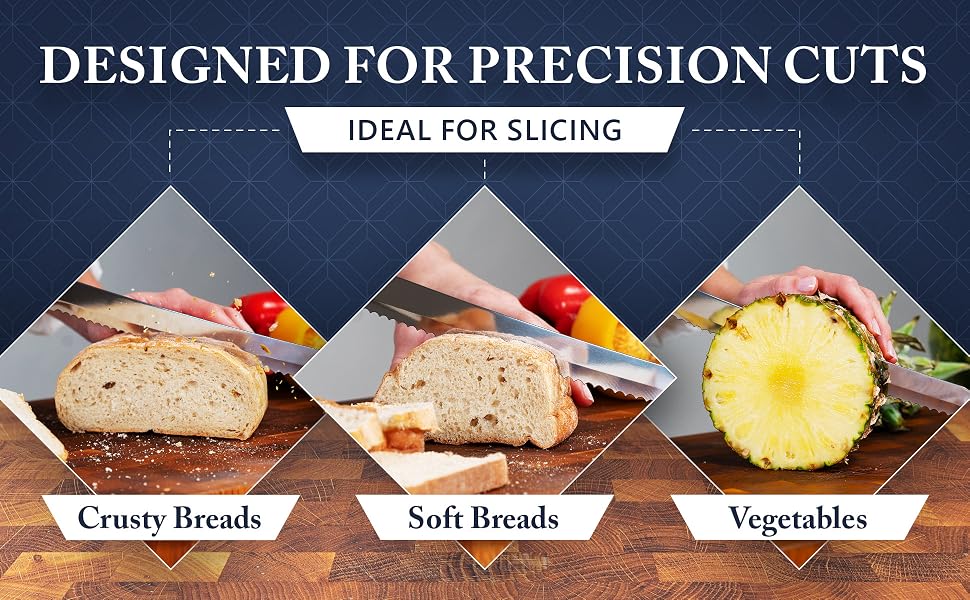
TL;DR — The honest answer is that a true chef knife is not the ideal tool for slicing bread; a serrated blade is. But if you want one versatile knife that can handle crusty loaves alongside everyday prep, choose a long serrated bread knife or a serrated slicer rather than a straight-edged chef knife, which crushes soft crumb and dulls fast on hard crust. Prioritize blade length, tooth pattern, and comfort. See the dedicated best bread knife and best chef knife guides for focused picks.
The HomeWhisk editorial team researches kitchen equipment by analyzing manufacturer specifications, steel and edge-geometry data, and aggregated user reviews from Amazon, Reddit communities like r/chefknives and r/Breadit, and long-term owner reports. For this guide we tackle a common search directly: people want a chef knife that can also slice bread, and the research shows the real solution is understanding why a straight edge struggles with bread and what blade type actually does the job.

The core problem is geometry. A chef knife has a straight, fine edge optimized for push-and-rock cutting on boards, while bread, especially a crusty artisan loaf, needs a sawing motion and teeth that bite through hard crust without compressing the soft interior. Our research compared blades across edge type, length, steel, and handle comfort to find the tools that genuinely slice bread cleanly. If your real need is a board knife, the best chef knife guide covers that; for loaves specifically, keep reading and see best bread knife for sourdough.

AlbertGrace
Albert&Grace 10.5-Inch Serrated Bread Knife – Clean Cuts, Minimal Crumbs
This serrated knife slices through crusty sourdough and soft bread with minimal crumbs thanks to sharp, pointed serrations and deeper gullets that reduce blade resistance. Buy it if you bake regularly or struggle with tearing and mess when slicing homemade loaves.
Pros and Cons
Pros
- Serrated design cuts sourdough and homemade bread cleanly without crushing the crumb structure.
- Included full-length sheath provides safe storage and drawer protection, a feature often missing on budget bread knives.
- Balanced construction and ergonomic handle make slicing large or crusty loaves easier and less tiring.
Cons
- Serrated blades cannot be sharpened at home; once dull, replacement is the only option.
- At 10.5 inches, the blade length may feel slightly short for very large artisan loaves over 12 inches wide.

Shun
Bread Slicing Without Tearing: Shun Sora 9-Inch Japanese Serrated Bread Knife
The Shun Sora 9-inch Bread Knife slices tender and crusty bread cleanly, with wide serrations that help prevent ripping, squashing, and tearing. It suits home cooks and professional chefs who want a balanced Japanese-made knife with a sharp VG10 edge.
Pros and Cons
Pros
- Wide serrations cut through both crusty and tender bread with less tearing.
- San Mai construction combines a VG10 edge with a 420J stainless steel upper blade.
- The full-tang handle and textured polymer grip support comfortable, controlled slicing.
- Free honing support helps owners maintain the knife's edge.
Cons
- Its serrated design is specialized for bread and is less versatile than a smooth chef's knife.
- The product data does not list the knife's weight, so buyers cannot assess its exact heft before purchasing.
The Best Deals This Week*
-
Albert&Grace 10.5-Inch Serrated Bread Knife
$15.99
($23.49)Save $7.50 -
Bread Slicing Without Tearing
$98.05
($109.95)Save $11.90
*Deals are selected by our commerce team
Mercer Culinary Millennia Color Handle Cutlery 10" Bread Knife (Wavy Edge Wide) Purple
Mercer Culinary
Millennia Color Handle Cutlery 10" Bread Knife (Wavy Edge Wide) Purple
Check price on AmazonFox Valley Traders Knife with Adjustable Slicing Guide by Chef's Pride

AlbertGrace Albert&Grace 10.5-Inch Serrated Bread Knife – Clean Cuts, Minimal Crumbs
AlbertGrace
Albert&Grace 10.5-Inch Serrated Bread Knife – Clean Cuts, Minimal Crumbs
This serrated knife slices through crusty sourdough and soft bread with minimal crumbs thanks to sharp, pointed serrations and deeper gullets that reduce blade resistance. Buy it if you bake regularly or struggle with tearing and mess when slicing homemade loaves.
Check price on AmazonA serrated bread knife designed to slice homemade and bakery loaves cleanly without crushing the interior or creating excessive crumbs on your counter.
The sharp, pointed serrations with deeper gullets reduce blade resistance and allow crumbs to fall away during cutting. This design delivers cleaner slices and better control than standard serrated knives.
The 10.5-inch blade is made from stainless steel with an ergonomic handle that balances weight for reduced hand fatigue. The full-length protective sheath covers the entire blade for safe storage and drawer protection.
Serrated blades cannot be resharpened at home, so eventual replacement is necessary with regular use.
Best for home bakers who slice bread daily and want clean cuts with minimal counter mess.
Shun Bread Slicing Without Tearing: Shun Sora 9-Inch Japanese Serrated Bread Knife
Shun
Bread Slicing Without Tearing: Shun Sora 9-Inch Japanese Serrated Bread Knife
The Shun Sora 9-inch Bread Knife slices tender and crusty bread cleanly, with wide serrations that help prevent ripping, squashing, and tearing. It suits home cooks and professional chefs who want a balanced Japanese-made knife with a sharp VG10 edge.
Check price on AmazonThe Shun Sora 9-inch Bread Knife solves the common problem of crushed or torn bread by using wide serrated teeth for cleaner slices.
Its VG10 steel edge and 16-degree geometry support precise cutting, while the serrations handle both crusty loaves and tender bread.
The full-tang design and textured PP/TPE polymer blend handle provide balance and a secure grip for either hand.
It is designed primarily for bread, so it will not replace a versatile smooth-edged kitchen knife.
Best for home cooks and professional chefs who want a handcrafted Japanese bread knife with controlled slicing performance.
Editor’s Picks
| Category | Pick | Why |
|---|---|---|
| Best Overall for Bread | Long serrated bread knife (9-10 in) | Pointed serrations saw through crust cleanly without crushing the crumb |
| Best Value | Mid-length serrated slicer (8 in) | Handles bread plus tomatoes and roasts at a lower price, versatile all-rounder |
| Best for One-Knife Kitchens | Serrated blade with offset or tall profile | Knuckle clearance and length for bread while doubling on general slicing |
At a Glance: Comparison Table
| Pick Type | Edge | Length | Steel | Handle | Best For |
|---|---|---|---|---|---|
| Best Overall | Pointed serrations | 9-10 in | High-carbon stainless | Ergonomic, secure grip | Crusty artisan loaves |
| Best Value | Wide serrations | 8 in | Stainless | Composite or wood | Bread plus tomatoes, roasts |
| One-Knife | Serrated, offset option | 8-10 in | Stainless | Offset for clearance | Doing everything with one blade |
| Chef-style hybrid | Straight with micro-serration | 8 in | High-carbon | Full-tang | Soft bread, general prep |
| Slicing / carving | Fine straight or granton | 10-12 in | Stainless | Balanced | Soft loaves, roasts, not hard crust |
How We Evaluated These Products
This guide is research-based. we synthesized manufacturer blade specifications, steel and edge-geometry documentation, retailer listings, and recurring patterns in aggregated owner reviews to determine which knives actually slice bread well and where a chef knife fits, or does not fit, into that job.
We weighted the factors that determine bread performance specifically. Edge type came first, because it is the single feature that decides whether a blade shears through crust or crushes the loaf. Blade length came second, since bread is sliced in a single long sawing stroke and a short blade forces awkward multiple passes that tear the crumb. Comfort and safety came third, because bread cutting involves force and a downward-and-across motion where a poor grip is genuinely hazardous.
We also read owner reviews for the complaints that reveal long-term reality: serrations that cannot be resharpened at home, handles that slip when hands are floury, and blades too short for large loaves. Knives with large review samples and years of ownership history were prioritized over newer entrants with thin data.
What Actually Matters:
Edge Type: Why Serrated Beats Straight for Bread
Edge type is where the whole question of slicing bread is settled, and it is why a conventional chef knife is the wrong tool for a crusty loaf. A chef knife has a straight, continuous edge honed to a fine angle for clean downward cuts on a board. That edge excels at onions and herbs, but on bread it behaves badly: pressing a straight edge into hard crust requires downward force that compresses the airy crumb beneath before the crust gives way, so a beautiful loaf ends up squashed and torn rather than cleanly sliced.
A serrated edge solves this through a completely different mechanism. Its pointed teeth concentrate force at each tip, biting through hard crust with minimal pressure, while the scalloped valleys between teeth do the cutting with a sawing motion that pulls through the soft interior without crushing it. This is why every professional kitchen reaches for a serrated knife on bread. The teeth also stay effective far longer on abrasive crust than a fine straight edge, which dulls quickly on the hard, sometimes gritty exterior of artisan loaves.
There is a middle ground worth knowing about. Some knives use a micro-serrated or scalloped straight edge that slices soft sandwich bread acceptably while still working on general prep. But for genuine crusty bread, pointed serrations are not optional. The best bread knife guide covers dedicated options in depth.
Blade Length and Loaf Size
Blade length matters more for bread than for almost any other cutting task, because bread is sliced in one continuous sawing stroke rather than a series of chops. The blade needs to be longer than the loaf is wide so a single pass clears the whole slice; if the blade is too short, you saw partway, then reposition and saw again, and each restart tears the crumb and leaves a ragged surface. This is a common frustration for people trying to slice a wide sourdough boule with an eight-inch chef knife.
For most home bread, a blade of 9 to 10 inches is the practical sweet spot. It spans a standard loaf and a good-sized round with room to spare, letting one smooth stroke produce a clean slice. Bakers who regularly make large artisan boules or long baguettes may prefer a 10-inch or longer blade, while someone slicing only sandwich loaves can manage with 8 inches. A chef knife’s typical 8-inch straight blade is technically long enough for a sandwich loaf but the wrong edge.
Length interacts with control. A longer blade slices bigger loaves in one stroke but is less nimble for small tasks, which is part of why a dedicated bread knife is a specialist rather than an everyday chef knife replacement. For sourdough specifically, the best bread knife for sourdough guide focuses on the length and tooth pattern those dense, thick-crusted loaves demand.
Steel, Serrations, and Sharpening Reality
Steel and serration design determine how long a bread knife keeps working and whether you can maintain it, and here the priorities differ sharply from a chef knife. On a straight-edged chef knife, buyers chase hard, high-carbon steels that take a keen edge and hold it. On a serrated bread knife, the teeth do the work, so extreme hardness matters less than corrosion resistance and durable tooth tips. A quality stainless with reasonable hardness resists the moisture and acidity of bread and tomatoes while keeping its points intact through years of use.
The critical practical fact is sharpening. A straight edge is easy to resharpen at home on a stone or pull-through. Serrations are not; each tooth is a tiny individual edge, and sharpening them requires a tapered rod worked into each scallop or professional service. Because serrated knives are hard to resharpen, tooth durability and initial quality matter more, and many owners simply replace an inexpensive serrated knife when it eventually dulls.
Serration pattern affects performance too. Deep, widely spaced pointed serrations bite aggressively into hard crust and suit artisan loaves, while finer serrations slice soft bread and tomatoes more delicately but struggle with thick crust. Some blades combine both. When choosing, match the tooth pattern to the bread you actually eat: aggressive points for crusty sourdough, finer teeth for soft sandwich loaves. A knife bought as part of a best chef knife set may include a serrated bread knife, which can be a sensible way to cover both jobs.
Handle Comfort, Balance, and Safe Sawing
Handle comfort and blade balance carry extra weight for bread because slicing a loaf uses more force and a different motion than board work, and that motion has genuine safety implications. Cutting bread involves a downward-and-forward sawing stroke, often steadying a round loaf with the other hand nearby, so a handle that slips when your hands are floury or greasy is a real hazard. A secure, ergonomic grip with some texture or contour keeps the knife controlled through the whole stroke.
Balance shifts the effort. A bread knife that is slightly blade-heavy lets the weight of the blade assist the sawing motion, reducing how hard you push, which matters on thick crust. Owner reviews frequently praise knives that feel effortless through a crusty loaf and criticize those that require sawing hard, which usually traces back to a combination of dull or shallow serrations and poor balance.
Blade profile is the final comfort factor unique to bread. An offset handle, where the handle sits raised above the blade line, gives knuckle clearance so your hand does not hit the board on the down stroke, which is useful when slicing to the bottom of a loaf. For a one-knife kitchen, an offset serrated knife is among the most versatile shapes. Those who want a matched kit should compare a best japanese chef knife for prep alongside a serrated blade for bread.
Frequently Asked Questions
Can I slice bread with a regular chef knife?
You can, but the results are poor, especially on crusty bread. A chef knife’s straight, fine edge presses down into hard crust and compresses the soft crumb beneath before the crust gives way, so the loaf gets squashed and torn. The fine edge also dulls quickly on abrasive crust. For soft sandwich bread a sharp chef knife manages, but for any crusty loaf a serrated bread knife with a sawing motion is dramatically better and is the tool professionals use.
Why is a serrated knife better than a chef knife for bread?
A serrated knife works by a different mechanism suited to bread. Its pointed teeth concentrate force at each tip to bite through hard crust with little downward pressure, while the sawing motion between teeth pulls through soft interior without crushing it. A straight chef knife edge instead needs downward force that compresses the airy crumb. Serrations also hold up far longer on gritty, hard crust that dulls a fine straight edge quickly. This is why every professional kitchen keeps a dedicated serrated knife for bread.
What length bread knife do I need?
Choose a blade longer than your loaves are wide, so a single sawing stroke clears each slice. For most home bread, 9 to 10 inches is the sweet spot, spanning standard loaves and good-sized rounds with room to spare. If you bake large artisan boules or long baguettes, consider 10 inches or more. If you slice only soft sandwich loaves, 8 inches suffices. A blade that is too short forces multiple passes that tear the crumb and leave a ragged, uneven surface.
How do I sharpen a serrated bread knife?
Serrated knives are much harder to sharpen than straight edges because each tooth is a separate small edge. You cannot use a standard stone or pull-through effectively; instead you work a tapered ceramic or diamond rod into each individual scallop, then lightly deburr the flat back side. It is tedious, so many owners send serrated knives for professional sharpening or simply replace an inexpensive one when it dulls. Because of this, tooth durability and initial quality matter more at purchase.
Is one knife enough, or do I need both a chef knife and a bread knife?
For the best results you want both, because they solve different problems. A chef knife handles chopping and fine board prep with its straight edge, while a serrated bread knife slices loaves, tomatoes, and roasts without crushing them. They are not interchangeable. If budget or space forces one choice, a long offset serrated knife is the more versatile single blade.
What should I look for in a knife that does both prep and bread?
If you truly want one versatile blade, prioritize a serrated edge over a straight one, since a serrated knife can slice soft foods acceptably while a straight chef knife cannot handle crusty bread at all. Look for a 9 to 10-inch blade for loaf coverage, an offset or tall profile for knuckle clearance, a corrosion-resistant stainless steel, and a secure, comfortable handle for the sawing motion. Accept that this compromise favors bread performance; for serious fine prep you will still want a dedicated best chef knife under 100.
Our Top Pick
After comparing edge type, blade length, steel and serration design, and handle comfort against the specific job of slicing bread, the best choice is a long serrated bread knife of 9 to 10 inches, not a straight-edged chef knife. The research is clear that geometry decides this: pointed serrations shear through hard crust with a sawing motion while a fine straight edge crushes the loaf.
Consider these decision points:
- If you eat crusty artisan bread, choose a long serrated bread knife of 9 to 10 inches with aggressive pointed serrations.
- If you want value and versatility, a mid-length serrated slicer handles bread, tomatoes, and roasts at a lower price.
- If you want a single knife for a small kitchen, an offset serrated blade gives knuckle clearance and doubles on general slicing.
- If fine board prep is your priority, keep a proper straight best chef knife for that work and add a serrated knife for bread, or explore a matched best chef knife set that includes both.
The best knife for slicing bread is a serrated one, full stop. Buy for the right edge and enough length, and clean slices of even the crustiest loaf become effortless.



Write Your Review
No reviews yet. Be the first to share your experience!