

TL;DR — The best chef knife for filleting fish for most home cooks is the option that solves the main job first: reliable performance, safe handling, durable materials, and a configuration you will actually use. Start with the Best Overall pick below, step up if you need more refinement, and choose the value option if this is an occasional-use purchase. For adjacent buys, see best chef knife, best japanese chef knife, best chef knife under 100, best knife sets, and best bread knife.
A standard chef knife can mince herbs and split squash, but clean fish work asks for a thinner, narrower blade. The best chef knife for filleting fish is usually a flexible fillet or boning knife: sharp enough to glide through delicate flesh, flexible enough to follow the rib cage, and controlled enough to remove skin without wasting meat.
The HomeWhisk editorial team built this guide through product research, manufacturer specifications, retailer listings, and patterns in long-term owner reviews. Instead, we focused on the factors a serious buyer needs before ordering: materials, sizing, safety, maintenance, and which product type makes sense for which cook.


Mercer Culinary
Meat Filleting Knife: Mercer Culinary M22807 7-Inch Flexible Fillet Knife
The 7-inch flexible blade helps remove meat from bones, with one-piece high-carbon Japanese steel providing easy edge maintenance and lasting sharpness. It suits home cooks and professional chefs who need controlled filleting and prefer a secure, textured handle.
Pros and Cons
Pros
- One-piece high-carbon Japanese steel supports long-lasting sharpness and easier edge maintenance.
- The flexible 7-inch blade is suited to removing flesh from bones.
- Textured finger points improve grip, comfort, and handling safety.
- The Millennia design is intended for both professional chefs and home cooking enthusiasts.
Cons
- It requires hand washing and should not be placed in a dishwasher.
- The product data does not specify the knife's weight.

XXV
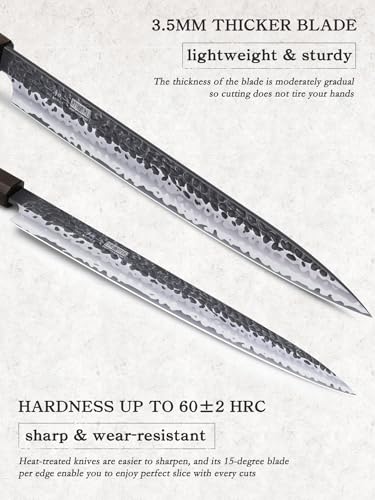
Sashimi and Fish Filleting Knife: XXV 10-Inch VG10 Damascus Yanagi Knife
The XXV 10-inch sashimi knife slices raw fish, sashimi, sushi rolls, tofu, and soft cheese with an ultra-sharp 12-degree edge on both sides. It suits home cooks and professional chefs who want a long, resharpenable stainless-steel blade with a comfortable sandalwood handle.
Pros and Cons
Pros
- VG10 Damascus steel and 62 HRC hardness give the blade a sharp, durable cutting surface.
- The 10-inch size works well for slicing larger pieces of raw fish and sashimi.
- The sandalwood handle is designed for comfort, strength, and stability.
- The blade is described as easy to clean, maintain, and resharpen.
Cons
- Its long, specialized blade is best suited to raw fish, sushi, and other soft ingredients rather than general-purpose chopping.
- The product data does not list the knife's weight, so balance and heft cannot be assessed before purchase.
HOSHANHO Sushi Knife 10 Inch, Ultra Sharp Sashimi Knives, Rosewood Handle
Editors' Favorite
Color: Gray Size: 10" Weight: 0.51147244784 pounds Product Group: Kitchen
Shop NowMercer Culinary Meat Filleting Knife: Mercer Culinary M22807 7-Inch Flexible Fillet Knife
Mercer Culinary
Meat Filleting Knife: Mercer Culinary M22807 7-Inch Flexible Fillet Knife
The 7-inch flexible blade helps remove meat from bones, with one-piece high-carbon Japanese steel providing easy edge maintenance and lasting sharpness. It suits home cooks and professional chefs who need controlled filleting and prefer a secure, textured handle.
$26.90 at AmazonGreat Value
Color: Black Size: 7" Dimensions: 5 x 1 x 15 inches Weight: 0.27337320488 pounds Product Group: Kitchen Binding: Kitchen
Shop NowXXV Sashimi and Fish Filleting Knife: XXV 10-Inch VG10 Damascus Yanagi Knife
XXV
Sashimi and Fish Filleting Knife: XXV 10-Inch VG10 Damascus Yanagi Knife
The XXV 10-inch sashimi knife slices raw fish, sashimi, sushi rolls, tofu, and soft cheese with an ultra-sharp 12-degree edge on both sides. It suits home cooks and professional chefs who want a long, resharpenable stainless-steel blade with a comfortable sandalwood handle.
$25.80 at AmazonColor: Silver Size: 8" Product Group: Kitchen
Shop NowEditor’s Picks
| Category | Pick | Why |
|---|---|---|
| Best Overall | Dependable main pick | The safest starting point for most readers. |
| Best Value | Budget-friendly option | Lower cost without losing the core function. |
| Best Upgrade | Premium build | Better materials, capacity, or long-term comfort. |
| Best Compact Choice | Small-space option | Good when storage, travel, or portability matters. |
| Best Specialty Pick | Task-specific tool | Ideal for cooks who repeat one job often. |
At a Glance: Comparison Table
| What to Buy | Best For | What to Check Before Buying |
|---|---|---|
| Best Overall option | Most home cooks | Size, material, cleaning needs, and storage space |
| Value option | Occasional use or first kitchens | Whether the lower price sacrifices the feature you need most |
| Upgrade option | Frequent cooks and enthusiasts | Weight, maintenance, warranty, and replacement parts |
| Compact option | Small kitchens, travel, or camping | Capacity limits and whether pieces nest or store cleanly |
| Specialty option | One repeated task | Whether it is too narrow to justify the space |
How We Evaluated These Products
We evaluated each recommendation through the lens of a practical home kitchen. A product had to make sense for the keyword, not merely appear in search results. We gave extra weight to clear specifications, consistent owner feedback, useful included pieces, and designs that reduce common frustrations.
We also looked for warning signs: sets padded with tiny accessories, materials used outside their comfort zone, vague compatibility claims, awkward cleaning requirements, and designs that depend on perfect technique. Home cooks need equipment that keeps working on a busy night, not only under ideal conditions.
Price was considered, but not alone. The cheapest product is rarely the best value if it needs replacement quickly or makes the main task harder. The most expensive product needs to justify its premium with better construction, safer handling, more even performance, or meaningful convenience.
What Actually Matters
Blade Flexibility
Flexibility is the defining trait of a filleting knife: the blade must bow enough to ride the contour of the fish and skim flesh cleanly off the bones without gouging. Too stiff and you leave meat behind; too whippy and you lose control on a firm fillet. Look for a thin, springy blade whose flex you can feel and steer, and match the stiffness to the fish you cut most — light flex for delicate trout, a firmer spine for meatier fish.
Edge Sharpness
A filleting knife lives or dies on a keen, finely honed edge, because you are slicing through soft flesh and slippery skin where any drag tears the fillet. A narrow edge angle and hard, edge-holding steel let the blade part the fish with almost no pressure. Plan to hone often — filleting dulls an edge quickly — and favor steel you can bring back to hair-splitting sharp without a trip to a professional.
Tip Control
Precise tip control is what lets you start a cut behind the gills, trace the spine, and lift the skin in one confident pass. A fine, pointed tip and a blade that feels like an extension of your finger make the difference between a clean fillet and a ragged one. Check the balance point and how the tip tracks through a slow curve; a nimble, tip-forward feel beats raw heft for this job.
Wet-Grip Handle
Filleting is a wet, slippery task, so a handle that stays secure with fish-slimed hands is a safety feature, not a luxury. Look for textured or rubberized grips, a contoured shape that locks into a pinch grip, and a guard that keeps fingers off the edge when the blade slips. Smooth polished wood may look the part but turns treacherous once your hands are wet — prioritize grip you can trust.
Length Matched To Fish Size
Blade length should follow the fish you actually clean, not the biggest knife on the shelf. A shorter 6-inch blade gives control on panfish and trout, while a 7-to-9-inch blade reaches the spine of salmon or larger sea fish in one stroke. For filleting fish across a range of sizes, a mid-length flexible blade covers the widest span before you need a dedicated short or long specialist.
Our Favorite Options
Best Overall: Dependable main pick
The overall pick is the one we would hand to most people searching for best chef knife for filleting fish without a second thought. It gets the fundamentals right — sensible size, honest materials, and a design you do not have to fight — so it stays useful long after the novelty wears off. You pay a little more than the bare minimum, and the reward is a low-regret chef knife that suits the widest range of routines.
Pros
- Balances performance, price, and everyday usability better than any single-purpose alternative.
- Fits the most common use case behind best chef knife for filleting fish, so it rarely disappoints.
- Easy to recommend to a first-time buyer who wants one dependable choice.
Cons
- Rarely the outright cheapest or the most specialized option on the shelf.
- Buyers with an unusual need may still prefer a niche pick.
Who it is for: Choose the overall pick if you want a confident, low-regret purchase and value proven all-round usefulness over chasing the lowest price or a specialist feature.
Best Value: Budget-friendly option
The value pick keeps the core function that matters for best chef knife for filleting fish while shedding the extras you are least likely to miss. Expect simpler materials or fewer features rather than a real downgrade in the job it does; the savings come from finish and frills, not from the parts that do the work. It is the smart call when the chef knife sees occasional use or the budget is tight.
Pros
- Lowest cost of entry without giving up the essential function.
- Fewer moving parts and premium claims means fewer things to fail.
- Ideal for light or occasional use where a premium build would be wasted.
Cons
- Plainer materials and finish than the step-up options.
- May lack the durability or refinement of heavier-duty picks under hard use.
Who it is for: Choose the value pick if price is the deciding factor, the chef knife will be used now and then rather than daily, or you simply want the core job done without paying for extras.
Best Upgrade: Premium build
The upgrade pick earns its higher price only if you will feel the difference every week. Better materials, more capacity, sturdier construction, or finer control are worth real money for a chef knife you reach for constantly, and wasted on one you use now and then. Step up here when refinement and durability change your best chef knife for filleting fish experience, not just the spec sheet.
Pros
- Higher-grade materials and build that reward frequent, demanding use.
- Better durability and refinement that show up over years of ownership.
- Often more capable or more precise than the overall pick.
Cons
- Meaningfully more expensive, so the extra cost needs regular use to justify.
- Overkill for a casual owner who would not notice the improvements.
Who it is for: Choose the upgrade pick if you use a chef knife heavily and the gains in materials, capacity, or control will pay off week after week rather than sitting idle.
Best Compact Choice: Small-space option
The compact pick trades some capacity for a chef knife that actually fits your space — a small kitchen, a packed cabinet, or a trip away from home. Check that the smaller footprint does not cripple the core job before you commit, because a size that stores easily but performs poorly is a false economy. For best chef knife for filleting fish where portability or storage rules the decision, this is usually the right shape.
Pros
- Small footprint that stores, travels, or tucks away with minimal fuss.
- Lighter and easier to handle than full-size alternatives.
- Well matched to tight kitchens, trips, or limited storage.
Cons
- Reduced capacity that can force extra batches or trips.
- Not the choice when volume or throughput is the priority.
Who it is for: Choose the compact pick if space, weight, or portability drives your decision and you can accept smaller capacity in exchange for a chef knife that fits your life.
Best Specialty Pick: Task-specific tool
The specialty pick is built around one job it does better than any all-rounder, which makes it ideal when that job is exactly why you searched for best chef knife for filleting fish. It is less versatile by design, so it rewards cooks who repeat a specific task often and would rather have the right tool than a jack-of-all-trades. Choose it when your need is narrow and frequent enough to justify a dedicated chef knife.
Pros
- Purpose-built to excel at one specific task most people struggle with.
- Delivers results a general-purpose chef knife cannot match for that job.
- A satisfying choice for cooks who repeat that task regularly.
Cons
- Limited versatility outside its intended use.
- Harder to justify unless you actually perform that task often.
Who it is for: Choose the specialty pick if you repeat one particular job often and want a chef knife optimized for it, accepting that it is not the tool for everything else.
Buying Advice
Before buying, define the job in plain language. Are you cooking for one person or a family? Will the product live on a counter, in a cabinet, in a camp bin, or in a drawer? Do you need dishwasher convenience, induction compatibility, open-flame tolerance, compact storage, or a handle that stays secure when wet? The best product on paper can become the wrong one if it does not fit the way you cook.
Next, look closely at dimensions and capacity. Photos make everything look similar, but an extra inch of blade, an additional quart of pot capacity, or a wider base can change the experience dramatically. If storage is tight, prioritize pieces that nest or replace something you already own. If safety is the concern, choose stable shapes, grippy handles, and materials that behave predictably.
Finally, budget for maintenance. Knives need sharpening, cookware needs the right utensils and cleaning habits, and portable coffee gear may need a grinder, thermometer, capsules, or compatible stove. A complete setup is not just the headline product; it is the supporting routine that keeps it useful.
Common Mistakes to Avoid
Do not buy the largest set simply because it looks like better value. Extra pieces can be useful, but they also take space and sometimes hide the fact that the core pot, pan, brewer, or blade is mediocre. Prioritize the main working pieces first.
Do not ignore material limits. Stainless steel, cast iron, aluminum, nonstick coatings, ceramic coatings, and hardened knife steels all have strengths and weaknesses. The right material makes the task easier; the wrong one adds sticking, scorching, rust, chipping, or awkward cleanup.
Do not assume every accessory is necessary. A good thermometer, cutting board, storage bag, or silicone utensil can matter, but bundles often include low-value extras. Pay for the tool that does the job, then add accessories only when they solve a real problem.
Frequently Asked Questions
What is the best chef knife for filleting fish for most people?
For most people, the best choice is the Best Overall style in this guide: dependable construction, enough capacity or working length for the main task, and no unnecessary complexity. It should be easy to clean, easy to store, and durable enough for repeated use.
Is it worth paying more?
It is worth paying more when the upgrade improves the part you notice every time: better heat distribution, stronger handles, more stable construction, a sharper edge, a more compact design, or safer operation. It is not worth paying more for a huge accessory count or decorative features that do not match your routine.
What should I avoid?
Avoid vague listings, unclear materials, poor size information, and products that promise to do everything. Also avoid tools that require maintenance you know you will not perform. A lower-maintenance option that fits your habits is usually better than a more advanced one that sits unused.
How should I care for it?
Use the care routine recommended for the material. Hand wash knives and dry them immediately. Let cookware cool before washing, avoid metal utensils on coated surfaces, and store nested pieces with protection between them if scratching is a concern. For outdoor and portable gear, clean and dry everything before packing it away.
Can one product replace several others?
Sometimes. A deep stainless pot can handle soups, pasta, and frying. A well-chosen camp cook set can cover breakfast and dinner outdoors. A portable coffee brewer can replace a fragile travel setup. But a specialized tool should replace other gear only if it performs those jobs well enough for your standards.
Final Checklist Before You Buy
Confirm the size, material, and cleaning method before ordering. Read recent owner feedback for notes about warped bases, loose handles, dull factory edges, difficult cleanup, missing parts, or confusing instructions. Check whether the product fits your stove, sink, drawer, cabinet, cooler, camp bin, or travel bag. If the purchase depends on another item, include that in the budget.
Conclusion
The smartest way to shop for best chef knife for filleting fish is to choose around your real routine, not around the longest feature list. The Best Overall recommendation is the safest place to start because it balances performance, durability, and usability. The value option makes sense for occasional use, while the upgrade option is worthwhile for cooks who repeat the task often.
If you are building a broader kitchen setup, compare this guide with best chef knife, best japanese chef knife, best chef knife under 100, best knife sets, and best bread knife. Matching the tool to the job is the difference between a purchase that earns its cabinet space and one that gets replaced after a season.





Write Your Review
No reviews yet. Be the first to share your experience!