

TL;DR — The best cake pan value should match how you actually cook, how often you will use it, and how much maintenance you want. Prioritize proven construction, practical usability, easy cleaning, and long-term owner feedback over flashy feature lists. For adjacent picks, compare best bundt cake pan, best baking sheets, best mixing bowls.
The HomeWhisk editorial team researches kitchen equipment by analyzing manufacturer specifications, construction details, and aggregated user reviews from major retailers and enthusiast communities. Our recommendations are based on what products actually deliver, not what brands promise.
For this guide, we reviewed cake pan value options through the lens of material, sizing, durability, cleaning, storage, accuracy, and home-baker feedback. If you are still comparing categories, see best bundt cake pan, best baking sheets, best mixing bowls, best kitchen scale, best cutting board, best food storage containers for related commercial guides.

Editor’s Picks
| Category | Pick | Why |
|---|---|---|
| Best Overall | Top researched option from the list below | Strongest balance of performance, durability, and owner satisfaction |
| Best Value | Value-focused pick | Good daily usability without overpaying for cosmetic extras |
| Best for Beginners | Easiest-maintenance option | Simple to use, clean, store, and maintain |
Save $7.61
Save $5.00
Save $2.00
Pros & Cons
Pros
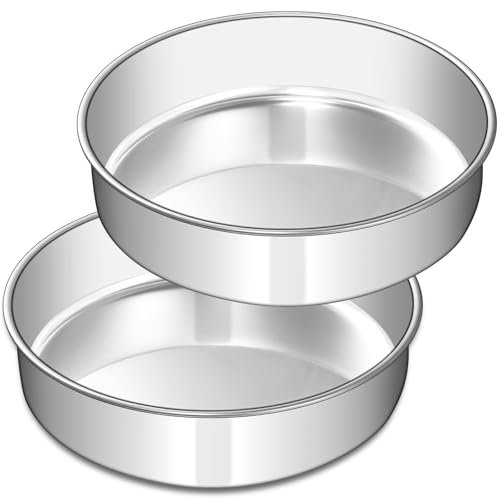
- Pure stainless steel provides a non-coated baking surface without harmful chemical concerns described for coated alternatives.
- The set includes two pans, allowing simultaneous layer baking for more efficient cake preparation.
- Fixed bottoms contain wet batter better than removable-bottom designs and simplify cleanup.
- The pans are dishwasher safe and suitable for high-temperature oven use according to the product listing.
Cons
- The manufacturer recommends parchment paper because food may stick to the stainless steel surface.
- Hand-washing is recommended to extend product life, despite the pans being dishwasher safe.
Details
This set provides two 8-inch round pans for baking matching cake layers without the leakage risk associated with removable bottoms.
Fixed enclosed bases contain wet batter, while the stainless steel construction supports even heating for layered cakes and other oven recipes.
Pure stainless steel avoids nonstick coatings, and the compact 8-inch size fits common home baking tasks. The listing does not provide a product weight.
Stainless steel can allow sticking, so the manufacturer recommends using matching parchment paper before baking.
Best for home bakers who regularly make layered cakes and want reusable, non-coated pans.
Cooking Tips
Line the pan with parchment paper before adding batter to reduce sticking and make cake removal easier.
Use both pans together when preparing stacked cakes, or reserve one for quiche, flan, cobblers, and deep-dish pizza.
Dishwasher cleaning is allowed, but hand-washing is recommended when you want to extend the pans’ service life.

Pros & Cons
Pros
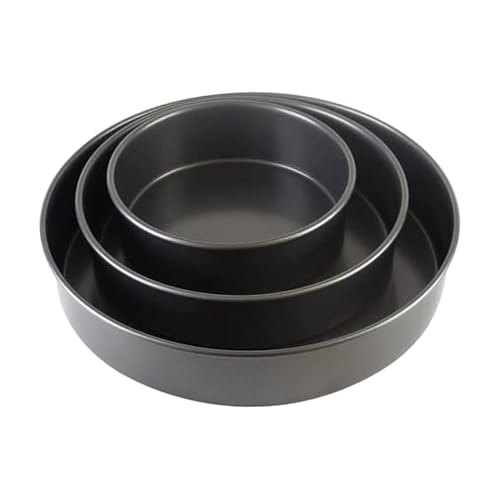
- The set includes three carbon steel pans and 100 parchment papers for repeated baking.
- Even heat conduction supports consistent cake texture and browning.
- Handles provide a steadier grip when moving hot pans.
- The product is labeled dishwasher safe, while parchment liners further reduce cleanup.
Cons
- The 8-inch size may be limiting for bakers who regularly make larger cakes.
- The listed 450°F maximum temperature rules out recipes requiring higher oven heat.
Details
This set addresses uneven cake layers, sticking, and repeated pan washing with three 8-inch pans plus 100 fitted parchment liners.
Carbon steel conducts heat evenly, while the liners help release chiffon cakes, cheesecakes, and other pastries with less damage.
Each pan is made from carbon steel and includes a handle. The pan diameter is 8 inches; product weight is not specified.
Its 450°F oven limit may exclude high-heat recipes, and the compact size is less suitable for large cakes.
Verdict: best for home bakers and small cake businesses making multiple 8-inch layers.
Cooking Tips
Place a parchment liner flat in each pan before adding batter. Divide batter evenly across the three pans to create more uniform layers.
Keep the oven at or below 450°F and use the handles carefully when removing hot pans. Allow cakes to cool before lifting them out.
Discard used liners and wash or wipe the pans after baking according to the care instructions.

Pros & Cons
Pros
- Coating-free stainless steel avoids the added concern of nonstick coatings contacting food.
- The mirror-finished surface supports cleaner release when lightly oiled or lined with parchment.
- The set handles cakes, cheesecakes, brownies, pies, tarts, savory dishes, steaming, and serving.
- Dishwasher-safe construction simplifies cleanup after baking.
Cons
- Hand washing is recommended to preserve the finish, despite being dishwasher safe.
- Oil or parchment is still advised because the pans do not have a nonstick coating.
Details
This three-piece set provides 8-inch round pans for layered cakes, brownies, cheesecakes, pies, and savory bakes, solving the need for matching pans with consistent dimensions.
Stainless steel construction supports even heating, while 2-inch straight sides help produce tall layers and the fixed bottom helps prevent leaks.
Each pan has a mirror-polished, coating-free stainless steel surface, one-piece construction, and an 8-inch by 2-inch format. Weight is not provided.
The pans withstand up to 400°F and are dishwasher safe, but hand washing is recommended to preserve the finish; oil or parchment improves release.
Best for home bakers making layered cakes who want durable, nestable pans without a nonstick coating.
Cooking Tips
Apply a thin layer of oil or use parchment before adding batter to improve release from the coating-free stainless steel surface.
Use the straight 2-inch sides for stacked layers, then cool cakes before removing them for cleaner edges and easier decorating.
Keep baking below 400°F, and hand wash the pans when preserving the mirror finish matters.

Pros & Cons
Pros
- Even heat distribution helps produce consistently baked desserts.
- The nonstick coating makes release and cleanup easier.
- Wide rims improve handling when taking the pan in and out of the oven.
- Heavy-duty steel construction is designed to resist warping.
Cons
- The 1.6-inch depth is better suited to standard round cakes than tall-layer bakes.
- The available product data does not specify whether the pan is dishwasher safe.
Details
The GoodCook Everyday 9-inch round cake pan handles cakes, pies, and desserts while addressing uneven baking and sticking.
Even heat distribution supports thorough baking, while the scratch-resistant nonstick coating helps desserts release and reduces cleanup.
Heavy-duty steel measures 10.75 x 9.7 x 1.6 inches and resists warping. Wide rims make oven handling easier with mitts.
Its 1.6-inch depth may not suit tall-layer cakes, and dishwasher safety is not specified.
Best for home bakers who need a durable, easy-release pan for standard round desserts.
Cooking Tips
Grease the nonstick surface lightly when a recipe calls for it, then spread batter evenly across the 9-inch pan for consistent results.
Use the wide rim to remove the pan safely with oven mitts. Let baked goods cool briefly before releasing them.
Use a metal spatula when serving, as the coating is designed to handle metal utensils.
Pros & Cons
Pros
- Superior heat conductivity promotes consistent baking and even browning.
- The encapsulated rim helps the pan retain its shape over time.
- Natural aluminum will not rust, supporting durable everyday use.
- Its 2.5-inch height provides useful depth for layer cakes.
Cons
- The 8-inch size limits the amount of batter compared with larger cake pans.
Details
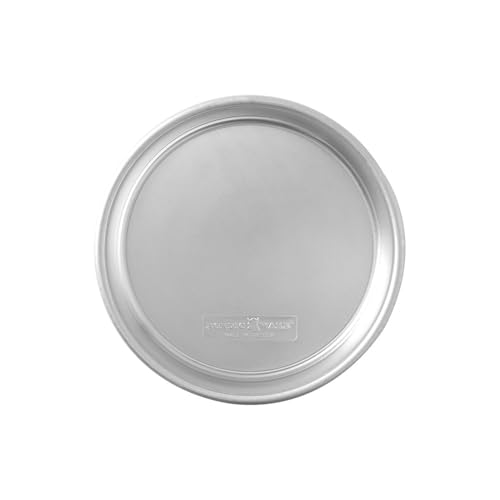
This 8-inch round cake pan helps home bakers produce evenly browned cakes without relying on inconsistent heat distribution.
Natural aluminum conducts heat efficiently, while the encapsulated rim helps prevent warping during repeated baking.
The pan has an 8-inch interior, 8.6-inch exterior diameter, and 2.5-inch height. Its weight is not listed.
Its compact capacity may not suit large cakes or recipes designed for bigger pans.
Best for home bakers and small bakeries needing a durable 8-inch cake pan.
Cooking Tips
Use the 8-inch interior dimensions when choosing recipes and portioning batter to avoid overfilling.
Allow space for the cake to rise, and check doneness according to your recipe’s baking guidance.
Use this pan when consistent browning and long-term durability matter more than large batch capacity.
At a Glance: Comparison Table
| Factor | Why It Matters | What to Look For |
|---|---|---|
| Build quality | Determines lifespan and reliability | Solid materials, good fit-and-finish, few recurring owner complaints |
| Daily workflow | Determines whether you actually use it | Easy setup, cleanup, storage, and repeatable results |
| Maintenance | Prevents premature replacement | Clear care requirements that match your habits |
| Size and fit | Prevents overbuying | Capacity or dimensions that fit your household and kitchen |
| Value | Keeps the purchase practical | Pay for performance, not just brand name or appearance |
How We Evaluated These Products
This guide is research-based. The HomeWhisk team reviewed product specifications, owner-review patterns, retailer listings, and community feedback to identify which cake pan value options show the strongest combination of usable performance and long-term satisfaction. We do not claim direct product testing; instead, we synthesize repeated signals across many sources.
We paid special attention to recurring complaints because they reveal what matters after the first week: warping, dulling, weak motors, awkward cleaning, unreliable controls, poor handles, storage problems, and whether a product feels worth the price after repeated use.
What Actually Matters:
Material and durability
Material and gauge drive how evenly a cake pan bakes and how long it lasts. Heavier aluminum and steel resist the hot spots and warping that plague thin, flimsy sheets, but they take longer to come up to temperature. Match the gauge to your oven and patience: thick pans reward slow, even bakes, while lighter ones heat fast at the cost of uniformity.
Sizing and capacity
Rim design and flatness decide whether the pan stays true through hundreds of hot-to-cold cycles. A rolled or encapsulated rim adds rigidity that fights the twist and buckle you hear as a bang in a hot oven. Set the pan on a flat surface and look for a dead-flat base — a rocking or bowed pan browns unevenly and never quite recovers.
Cleaning and storage
Surface finish and release govern the daily annoyance of sticking and scrubbing. Weigh bare aluminum and steel, which brown beautifully but need greasing or liners, against nonstick and ceramic coatings that release easily but wear and dislike metal tools and high heat. The right finish depends on what you bake most and how gentle you are willing to be with it.
Accuracy and consistency
Size, storage, and oven fit are easy to overlook until the pan does not fit. Measure your oven’s usable width with room for air to circulate, and think about how the pan nests or hangs in your cabinets. For value-focused buyers, a slightly smaller pan that fits comfortably and stores without a fight beats an oversized one that bakes poorly against the walls.
Price and practical value
Care routine and long-term value depend on how the cake pan ages under real use. Coated pans simplify cleanup but have a finite lifespan; bare metal is nearly immortal but wants drying and the occasional scrub to stay rust-free and non-sticky. Choose the maintenance story you will actually follow, because the pan you care for correctly is the one that lasts.
Frequently Asked Questions
What is the best cake pan value for most people?
The best choice is the one that fits your actual use case, maintenance habits, and budget. Start with the options in this guide, then compare related categories like best bundt cake pan and best baking sheets.
Is it worth paying more?
It is worth paying more when the upgrade improves durability, usability, or performance you will notice often. It is not worth it for cosmetic features you rarely benefit from.
What should beginners prioritize?
Beginners should prioritize easy cleaning, forgiving materials, simple controls or maintenance, and a size that fits their kitchen.
What should I avoid?
Avoid vague materials, poor owner feedback, oversized products, hard-to-clean designs, and bundles that add pieces you will not use.
How long should it last?
A well-chosen product should last years with normal care, though lifespan depends on material, maintenance, and frequency of use.
What is the buying takeaway?
Choose the product that solves the daily job cleanly and reliably. If you need broader context, compare best bundt cake pan, best baking sheets, best mixing bowls, best kitchen scale before deciding.
Our Top Pick
The best cake pan value is the one that balances performance, maintenance, and value for your kitchen. Buy for real workflow first: how you cook, how often you use it, how easily it cleans, and whether it fits your storage. For most readers, comparing best bundt cake pan, best baking sheets, best mixing bowls is the smartest next step.



Write Your Review
No reviews yet. Be the first to share your experience!