

Are oven thermometers safe? Yes. A standard dial oven thermometer made of stainless steel with a glass or clear lens is safe to leave inside a home oven while you bake or roast, as long as you keep it within its printed temperature range and don’t run it through a self-cleaning cycle. Modern dial models use a bimetal coil rather than mercury, so there’s no liquid inside that can leak into your food.
This guide explains what an oven thermometer is made of, where the real risks are, how to place and handle one, and which mistakes shorten its life. You’ll also see three inexpensive stainless steel models from our product database, so you can pick one that fits your oven and your budget.
Why a dial oven thermometer is safe to leave in the oven
Most oven thermometers sold today are simple mechanical gauges. A coiled strip made of two bonded metals sits behind the dial. As the oven heats up, the two metals expand at different rates, the coil twists, and the needle moves. No battery, no wiring and no mercury. That design is the main reason these gauges hold up so well inside a hot oven.
The housing is usually stainless steel, which doesn’t react with food, doesn’t rust easily and handles normal baking heat without warping. The face is covered by a heat-resistant glass or clear lens. Because the thermometer sits on a rack and never touches your food, there’s no food-contact concern the way there is with a probe you push into a roast. It simply hangs or stands next to your pan and reports the air temperature around it.
The other safety point is accuracy, and it matters more than people expect. Many home ovens drift 25 degrees or more from what the display says. That gap can leave chicken, casseroles and baked goods undercooked in the center. A separate gauge lets you see the real number and adjust. If you want a budget option with a wide range, the Koimsec in-oven thermometer reads from 100 to 600°F (50 to 300°C) and works in electric and gas ovens as well as grills and smokers, according to its listing.

Koimsec
Oven Thermometer for Baking, Grilling and Smoking: Koimsec Analog Stainless Steel Gauge, 100-600°F / 50-300°C
This analog stainless steel gauge sits or hangs inside your oven, grill, or smoker and reads 100 to 600°F instantly with no batteries, using a color-zoned dial that tells you at a glance whether you are in baking, roasting, or broiling range. Buy it if your oven runs hot or cold and your bread, roasts, or barbecue keep finishing off-schedule.
Pros and Cons
Pros
- Wide 100 to 600°F range covers low-and-slow smoking through high-heat broiling and pizza baking.
- Works in traditional, convection, steam, gas, electric, and toaster ovens as well as grills and smokers.
- Stainless steel construction and glass lens resist breakage and stand up to grease and heat.
- Two mounting options mean you can position it where you can actually see it.
Cons
- Analog dials are typically accurate within a range rather than to the exact degree, so it is better for spotting oven drift than for precision candy or confectionery work.
- It reads ambient oven air temperature only and cannot probe the internal temperature of meat.
Koimsec Oven Thermometer for Baking, Grilling and Smoking: Koimsec Analog Stainless Steel Gauge, 100-600°F / 50-300°C
Koimsec
Oven Thermometer for Baking, Grilling and Smoking: Koimsec Analog Stainless Steel Gauge, 100-600°F / 50-300°C
This analog stainless steel gauge sits or hangs inside your oven, grill, or smoker and reads 100 to 600°F instantly with no batteries, using a color-zoned dial that tells you at a glance whether you are in baking, roasting, or broiling range. Buy it if your oven runs hot or cold and your bread, roasts, or barbecue keep finishing off-schedule.
$5.48 at AmazonEditors' Favorite
Color: silvery Weight: 0.110231131 pounds Product Group: Kitchen Binding: Unknown Binding
Shop NowWhere the real risks are
An oven thermometer isn’t dangerous on its own. The problems come from how it’s used. Here are the situations worth knowing about before you set one on the rack.
Running it through a self-cleaning cycle
Self-cleaning cycles push oven temperatures far past normal cooking heat, often well beyond the top of a typical thermometer dial. At that point the lens can crack, the coil can lose calibration, and the printed face can discolor. Take the thermometer out before you start a self-clean cycle. Every time. It takes five seconds and saves you from replacing it.
Going past the printed range
Every dial has a maximum. Broiling right under the element, or cranking a pizza setup to its highest heat, can push a small gauge past its limit. When that happens, the reading stops being trustworthy and the parts can be stressed. If you regularly cook above 500°F, pick a model whose printed range goes higher than your hottest setting, like the 600°F top of the Koimsec dial.
Burns and thermal shock
The most common injury isn’t from the thermometer failing. It’s from grabbing a metal gauge that has been sitting at 400°F. Treat it like a sheet pan and use an oven mitt. Also avoid dropping a hot thermometer into cold water. A sudden temperature swing can crack the glass lens, and a cracked lens can shed small pieces near your food.
Microwaves and air fryers
Never put a metal oven thermometer in a microwave. Metal can spark and damage the appliance. Countertop air fryers and toaster ovens are a different story: many small stainless gauges fit inside them, but check the clearance first so the thermometer doesn’t sit too close to the heating element or block the fan. If you’re shopping for one of those appliances, our guides to the best toaster oven and the best air fryer oven cover the size differences.
How to place and read an oven thermometer safely
Placement affects both safety and accuracy. Put the thermometer on the center rack, near the middle of the oven, where your food usually sits. Don’t set it on the oven floor or against the back wall, because those spots run hotter or cooler than the cooking zone and can expose the gauge to direct element heat.
Preheat the oven with the thermometer already inside. Opening the door to drop it in lets heat escape and gives you a false low reading for several minutes. Once the oven signals it’s preheated, wait another 10 to 15 minutes before you trust the number. Read it through the oven window if you can, rather than opening the door repeatedly.
If your oven runs hot or cold, note the difference at a couple of settings, such as 350°F and 425°F, and adjust your dial to match. Some ovens let you recalibrate the display in the settings menu. Check your manual before changing anything. For anyone shopping for a new range, our roundup of the best oven picks is a good starting point.
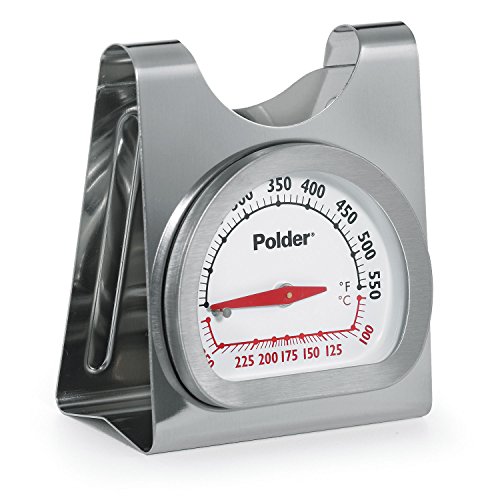
A plain stainless model is all most kitchens need. The Polder S/S Oven Thermometer is a long-running, simple stainless steel option that hangs from or stands on a rack, and it sits at a low price point in our database with a 4.7 rating.
Polder
Oven Temperature Accuracy for Baking and Roasting: Polder Stainless Steel Bi-Metal Oven Thermometer, 150F to 550F
This stainless steel bi-metal thermometer sits or clips onto an oven rack and shows real cavity temperature on a large speedometer-style dial readable through the oven door. Bakers and roasters whose ovens run hot or cold should buy it, since the 150F to 550F range covers everything from slow braises to high-heat pizza.
Pros and Cons
Pros
- Battery-free bi-metal design keeps working through repeated high-heat cycles.
- Oversized dial numbers stay legible from across the kitchen or through glass.
- Clip and stand mounting fits most standard oven rack layouts.
- Stainless steel body handles dishwasher cleaning without corroding.
Cons
- Analog dial thermometers lag behind fast temperature swings, so it needs a few minutes to settle after preheating.
- The scale stops at 550F, which is short of the temperatures some broiler and pizza-stone routines reach.
Polder Oven Temperature Accuracy for Baking and Roasting: Polder Stainless Steel Bi-Metal Oven Thermometer, 150F to 550F
Polder
Oven Temperature Accuracy for Baking and Roasting: Polder Stainless Steel Bi-Metal Oven Thermometer, 150F to 550F
This stainless steel bi-metal thermometer sits or clips onto an oven rack and shows real cavity temperature on a large speedometer-style dial readable through the oven door. Bakers and roasters whose ovens run hot or cold should buy it, since the 150F to 550F range covers everything from slow braises to high-heat pizza.
$9.45 at AmazonEditors' Favorite
Color: Stainless Steel Size: 1 EA Dimensions: 5.7 x 3.7 x 1.5 Inches Weight: 1 Pounds Product Group: Kitchen Binding: Kitchen
Shop NowCommon mistakes that make an oven thermometer unsafe or useless
Most issues with oven thermometers are easy to avoid. These are the habits that cause the most trouble.
Leaving it in during self-clean. Already covered, but it’s the number one reason these gauges fail early.
Washing it carelessly. Soaking a dial thermometer can let water seep behind the lens, which fogs the face and can corrode parts over time. Many manufacturers suggest wiping the housing with a damp cloth and mild soap instead of soaking it or putting it in the dishwasher. Follow whatever the packaging says for your model.
Ignoring a cracked lens. If the glass is chipped or cracked, stop using it. Small fragments near food aren’t worth the risk, and a damaged face usually means the reading is off too.
Confusing it with a meat thermometer. An oven thermometer measures air temperature. It can’t tell you whether the inside of a chicken breast has reached a safe internal temperature. For that, you need a probe. Our guide to the best meat thermometer covers instant-read and leave-in models, and outdoor cooks can look at the best thermometer for BBQ.
Trusting one reading forever. Mechanical gauges can drift after years of heat cycles or a hard drop. A quick boiling-water check gives you a reference point, though many oven dials don’t start low enough to show 212°F. If yours does, it should read close to that at sea level.
When to replace your oven thermometer
Replace it if the lens is cracked, the needle sticks or wobbles, the face has faded so you can’t read it, or the reading jumps around for no clear reason. Rust spots on the housing are another sign. So is a gauge that went through a self-clean cycle by accident and now reads wildly differently than before.
Because these thermometers are cheap, it doesn’t make sense to keep using one you don’t trust. A multi-pack is handy if you have more than one heat source, say a wall oven plus a toaster oven or a grill, or if you want to place two gauges on different racks to find hot spots. Hot spots matter when you’re baking on several sheets at once or using a heavy roasting pan. Speaking of which, our guide to the best pan for oven use covers which materials spread heat more evenly.
The TempPro 3-Pack Oven Thermometer is built from 431 stainless steel and is listed for gas ovens. Three gauges in one box makes it easy to keep a spare or map the temperature across your oven.

TempPro
Oven Temperature Accuracy for Gas Ovens and Pizza Ovens: TempPro 3-Pack 431 Stainless Steel Dial Thermometer
This 3-pack of battery-free dial thermometers sits inside your oven and shows real internal temperature from 100 to 600°F, exposing the gap between the dial setting and actual heat. Buy it if you bake in a gas oven, toaster oven, or grill and suspect uneven or inaccurate heat is ruining your results.
Pros and Cons
Pros
- Battery-free operation means it works during preheats, long roasts, and power outages with nothing to replace.
- Dual Fahrenheit and Celsius scales suit recipes written for either system.
- The 3x3x1.61 inch body is compact enough to sit beside a full sheet pan.
- Hook and base mounting fits gas, electric, convection, toaster ovens, grills, and smokers.
Cons
- Analog dials can be off by a few degrees out of the box, so verify against boiling or ice water before trusting a critical bake.
- The 600°F ceiling falls short of the temperatures many dedicated pizza ovens reach.
TempPro Oven Temperature Accuracy for Gas Ovens and Pizza Ovens: TempPro 3-Pack 431 Stainless Steel Dial Thermometer
TempPro
Oven Temperature Accuracy for Gas Ovens and Pizza Ovens: TempPro 3-Pack 431 Stainless Steel Dial Thermometer
This 3-pack of battery-free dial thermometers sits inside your oven and shows real internal temperature from 100 to 600°F, exposing the gap between the dial setting and actual heat. Buy it if you bake in a gas oven, toaster oven, or grill and suspect uneven or inaccurate heat is ruining your results.
$19.99 at AmazonEditors' Favorite
Color: Silver Size: 3x3x1.61 inches Product Group: BISS
Shop NowFAQ
Can you leave an oven thermometer in the oven all the time?
Yes, for normal baking and roasting. A stainless steel dial thermometer is built to stay on the rack while you cook. Just remove it before a self-cleaning cycle and before broiling at temperatures above its printed maximum.
Do oven thermometers contain mercury?
Most modern dial oven thermometers don’t. They use a bimetal coil that twists as it heats and moves the needle. Some old glass-bulb thermometers did contain mercury or other liquid, so if you have a very old one with a glass tube, handle it carefully and consider replacing it.
Is it safe to use an oven thermometer in a gas oven?
Yes. Gas ovens often have bigger temperature swings than electric ones, which makes a separate thermometer even more useful. Keep the gauge on the center rack, away from the burner opening at the bottom, so it reads the cooking zone instead of the flame.
Can an oven thermometer go in an air fryer or toaster oven?
Often, yes, if it fits. Check that there’s enough clearance between the thermometer and the heating element, and that it doesn’t block air circulation. Never put a metal thermometer in a microwave.
How do I clean an oven thermometer safely?
Let it cool completely first. Wipe the housing and lens with a damp cloth and a little mild dish soap, then dry it. Avoid soaking it, since water can get behind the lens and fog the face, and follow the care instructions that came with your model.


Write Your Review
No reviews yet. Be the first to share your experience!