

TL;DR — Yes, stainless steel mixing bowls are safe for food, including acidic ingredients and everyday mixing. Food-grade stainless (typically 18/8 or 18/10, meaning 18% chromium with 8 or 10% nickel) is non-porous, corrosion-resistant, and won’t leach meaningful amounts of metal under normal use. The chromium forms a passive oxide layer that protects the surface. Real cautions are minor: don’t store highly acidic foods for days, don’t scrub with steel wool, and people with severe nickel allergies may prefer 18/0 or glass. For picks, see our best mixing bowls guide.
The HomeWhisk editorial team researches kitchen equipment by analyzing manufacturer specifications, alloy grades, and aggregated owner reviews from major retailers and communities like Reddit r/Cooking and r/AskCulinary. Stainless steel is the default mixing bowl in professional kitchens for good reason, but home cooks still ask whether it’s truly safe — especially for beating acidic batters, whipping egg whites, or leaving dressings to sit. Here’s what the material science and real-world use actually show.

COOK WITH COLOR
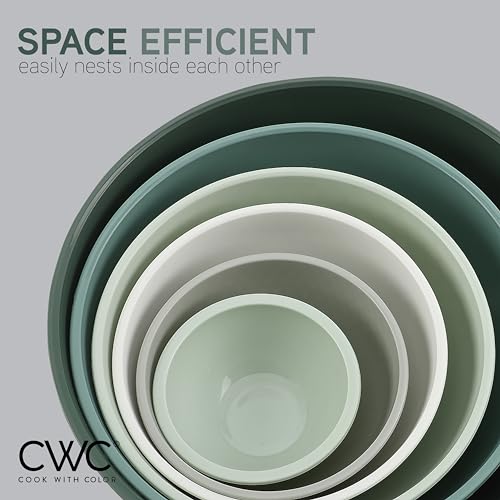
Food Prep and Storage Mixing Bowls with Lids, COOK WITH COLOR Sage Embossed Set
This COOK WITH COLOR set handles food prep, serving, and storage while nesting bowls and tight-fitting lids reduce cabinet clutter and simplify transport. It suits home cooks who want microwave-safe, freezer-safe plastic bowls for fruit, salads, snacks, and leftovers.
Pros and Cons
Pros
- The set combines six plastic bowls with six lids for prep, serving, storage, and transport.
- BPA-free polypropylene provides a food-safe material for regular kitchen use.
- Microwave, freezer, and top-rack dishwasher compatibility adds practical versatility.
- Nesting storage and a sage embossed finish keep the set organized and visually coordinated.
Cons
- The bowls are plastic rather than glass or metal, which may not suit buyers seeking heavier cookware.
- The product data lists five capacities even though the set includes six bowls, so size selection is not fully clear.

Nuogo
8-Quart Stainless Steel Mixing Bowls (Set of 4)
Four stainless steel bowls, each listed at 8 quarts, for preparing separate batches of dough, salad, or other ingredients. The listing specifies dishwasher-safe care. Allow room for these large bowls in your sink and cabinets, inspect the rims before first use, and hold the bowl securely during mixing.
Pros and Cons
Pros
- Four large bowls allow separate ingredients or batches to be prepared at the same time.
- Stainless steel is less vulnerable to breakage than glass when dropped.
- Dishwasher-safe care is listed for the bowls.
Cons
- Four equally large bowls require more storage and working space than a small set with mixed capacities.
- The seller warns of potentially sharp unpolished edges; inspect each bowl before use.

COOK WITH COLOR
Mixing and Baking Prep: COOK WITH COLOR 6-Piece Nesting Plastic Bowl Set with Pour Spouts
This six-piece plastic mixing bowl set supports cooking and baking with non-slip bases, handles, pour spouts, and interior measurement markings, while nesting saves storage space. It suits home cooks who want easy measuring, controlled pouring, and top-rack dishwasher cleanup in one organized set.
Pros and Cons
Pros
- Six bowls provide multiple sizes for mixing, measuring, and ingredient preparation.
- Handles, pour spouts, and non-slip construction improve control during everyday use.
- Interior measurement markings add convenient measuring directly inside each bowl.
- The plastic set is freezer safe and top-rack dishwasher safe for practical kitchen use.
Cons
- The bowls are specified for top-rack dishwasher cleaning, not unrestricted dishwasher use.
- Exact bowl dimensions and individual weights are not provided in the product data.

Cuisinart
3-Piece Stainless Steel Nesting Mixing Bowl Set for Baking, Cooking & Food Prep (1.5, 3, 5 Qt)
This three-bowl stainless steel set handles everyday mixing, prepping, and storage with dishwasher-safe cleanup and refrigerator-freezer compatibility. Home bakers and meal preppers who need durable, space-saving bowls that go from counter to fridge without transferring containers should consider this set.
Pros and Cons
Pros
- High-quality stainless steel withstands daily use without denting or rusting, maintaining a clean appearance over time.
- Three versatile sizes cover most home cooking and baking tasks, from whisking eggs to tossing large salads.
- Dishwasher-safe construction and smooth surface make cleanup faster than textured or coated bowls.
Cons
- Lacks non-slip bases or handles, so bowls may slide on smooth countertops during vigorous mixing.
- No lids included, requiring separate plastic wrap or covers for refrigerator storage.
COOK WITH COLOR Food Prep and Storage Mixing Bowls with Lids, COOK WITH COLOR Sage Embossed Set
COOK WITH COLOR
Food Prep and Storage Mixing Bowls with Lids, COOK WITH COLOR Sage Embossed Set
This COOK WITH COLOR set handles food prep, serving, and storage while nesting bowls and tight-fitting lids reduce cabinet clutter and simplify transport. It suits home cooks who want microwave-safe, freezer-safe plastic bowls for fruit, salads, snacks, and leftovers.
Check price on AmazonThis nesting set solves the need for separate bowls for prep, serving, leftovers, and transport while reducing cabinet clutter.
Tight-fitting TPR lids support food storage and on-the-go transport, while microwave and freezer safety let you prepare, heat, and store food in the same set.
BPA-free polypropylene keeps the bowls food safe and lightweight for daily handling. Listed capacities range from 0.32 QT to 5.8 QT, but product weight is not provided.
Best for home cooks who want versatile plastic prep and storage bowls with matching lids.
Nuogo 8-Quart Stainless Steel Mixing Bowls (Set of 4)
Nuogo
8-Quart Stainless Steel Mixing Bowls (Set of 4)
Four stainless steel bowls, each listed at 8 quarts, for preparing separate batches of dough, salad, or other ingredients. The listing specifies dishwasher-safe care. Allow room for these large bowls in your sink and cabinets, inspect the rims before first use, and hold the bowl securely during mixing.
Check price on AmazonThis set contains four stainless steel bowls, each listed at 8 quarts. It is intended for large-batch mixing, ingredient preparation, and serving.
The listing specifies dishwasher-safe care. Keep stainless steel bowls out of the microwave. Hold the bowl securely during mixing; bowl weight does not guarantee that it will stay stationary.
Published dimensions vary between the feature text and the specification table. Confirm the dimensions for the exact version before relying on refrigerator, sink, or cabinet clearance.
The seller notes potentially sharp unpolished edges. Inspect the rim and underside before using each bowl.
Use separate bowls for different dough batches, salads, or ingredients. Leave working space for mixing rather than filling to the rim.
These are four equal-size bowls. For small dressings, single eggs, or limited cabinet space, a smaller set with varied capacities may be easier to use.
COOK WITH COLOR Mixing and Baking Prep: COOK WITH COLOR 6-Piece Nesting Plastic Bowl Set with Pour Spouts
COOK WITH COLOR
Mixing and Baking Prep: COOK WITH COLOR 6-Piece Nesting Plastic Bowl Set with Pour Spouts
This six-piece plastic mixing bowl set supports cooking and baking with non-slip bases, handles, pour spouts, and interior measurement markings, while nesting saves storage space. It suits home cooks who want easy measuring, controlled pouring, and top-rack dishwasher cleanup in one organized set.
Check price on AmazonThis six-piece mixing bowl set combines prep, measuring, and pouring to reduce countertop clutter and the need for separate measuring tools.
Non-slip bases, handles, and pour spouts make mixing and transferring ingredients more controlled, while interior markings support recipe measurements.
Top-rack dishwasher use is specified, so buyers should avoid treating the set as fully dishwasher-safe on every rack.
Best for home cooks who need organized, space-saving bowls for everyday cooking and baking.
Cuisinart 3-Piece Stainless Steel Nesting Mixing Bowl Set for Baking, Cooking & Food Prep (1.5, 3, 5 Qt)
Cuisinart
3-Piece Stainless Steel Nesting Mixing Bowl Set for Baking, Cooking & Food Prep (1.5, 3, 5 Qt)
This three-bowl stainless steel set handles everyday mixing, prepping, and storage with dishwasher-safe cleanup and refrigerator-freezer compatibility. Home bakers and meal preppers who need durable, space-saving bowls that go from counter to fridge without transferring containers should consider this set.
Check price on AmazonThe Cuisinart CTG-00-SMB is a three-bowl stainless steel set that solves the common kitchen problem of juggling multiple prep tasks with mismatched containers. It replaces disposable mixing containers and flimsy plastic bowls.
The stainless steel construction resists flavor and odor transfer, critical when switching between savory and sweet recipes. The 1.5-quart bowl handles single-serving tasks like whisking dressings, the 3-quart works for cookie dough and marinades, and the 5-quart tackles bread dough and family-size salads.
Best for home cooks and bakers who want a durable, multi-size mixing solution that transitions from prep to storage without extra containers.
Use the 1.5-quart bowl for single-serving tasks: whisking vinaigrettes, beating one or two eggs, or mixing spice blends. Its compact size prevents waste when small volumes would get lost in a larger bowl.
The 3-quart bowl handles mid-range jobs like mixing cookie dough, marinating chicken breasts, or preparing batter for a single cake layer. It's also ideal for serving side salads or holding prepped vegetables during stir-fry prep.
Reserve the 5-quart bowl for high-volume tasks: kneading bread dough, tossing large dinner salads, or mixing multiple batches of muffin batter. Its refrigerator-safe design lets you prepare pizza dough in the morning, cover it, and let it rise chilled until dinner.
What “Stainless Steel” Means for a Mixing Bowl
Not all stainless is the same, and the grade printed on the bottom tells you most of what you need to know about safety. The numbers refer to the percentages of chromium and nickel in the alloy:
- 18/10 — 18% chromium, 10% nickel. The most corrosion-resistant and lustrous; common in higher-end bowls and cookware.
- 18/8 — 18% chromium, 8% nickel. Functionally very similar; the “8” and “10” are often used loosely and both fall under the 304 stainless designation, the standard food-grade alloy.
- 18/0 — 18% chromium, near-zero nickel (430 stainless). More affordable, slightly less corrosion-resistant, magnetic, and a good option for those avoiding nickel.
The chromium is what makes stainless “stainless.” It reacts with oxygen to form an ultra-thin, invisible passive layer of chromium oxide across the surface. This layer is self-healing: scratch it, and exposed chromium immediately re-oxidizes to reseal the surface. That passive film is why stainless resists rust and corrosion and why it doesn’t readily release metal into food. Food-grade 304 is the same alloy used in commercial food processing tanks and utensils.
Does Stainless Steel Leach Metal Into Food?
This is the core safety worry, and the answer is reassuring with a small asterisk. Under normal mixing, folding, and serving, food-grade stainless releases only trace, nutritionally insignificant amounts of iron, chromium, and nickel — far below any level of concern.
Leaching increases only under specific, avoidable conditions:
- Prolonged contact with acidic foods. Highly acidic ingredients (tomato sauce, citrus, vinegar dressings) left sitting in a stainless bowl for many hours or days can slowly draw out slightly more metal, particularly from a brand-new bowl. Mixing acidic batter and using it promptly is completely fine; long-term storage of acidic food is where you’d switch to glass.
- A damaged or heavily scratched surface, especially on lower-nickel grades, exposes more reactive metal. Deep gouges from steel wool or metal scrapers can compromise the passive layer over time.
- Brand-new bowls may release marginally more on first uses; a quick wash before first use helps.
For anyone worried specifically about nickel — a common contact allergen — the leaching that matters is dietary, and the amounts from normal stainless use are minimal. People with diagnosed nickel sensitivity who want to eliminate it entirely can choose 18/0 (nickel-free) bowls or a best mixing bowls set that includes glass options. For cookware where acid meets heat for long periods, the same logic favors quality construction, which our best stainless steel cookware and best stainless steel cookware set guides cover.
Why Professionals Choose Stainless Over Other Materials
Safety aside, stainless earns its place because of how it behaves day to day.
Non-porous and hygienic. The smooth, sealed surface gives bacteria nowhere to hide and doesn’t absorb odors, oils, or colors the way plastic does. This is a genuine food-safety advantage over scratched plastic, which can harbor microbes in its scored surface.
Durable and shatterproof. Stainless won’t crack or chip like glass or ceramic if dropped, and it won’t warp under normal use. A good bowl lasts decades.
Lightweight and responsive to temperature. Thin-walled stainless is easy to handle and conducts temperature quickly — useful for setting a bowl over simmering water to melt chocolate (a double boiler) or nesting it in ice to chill a custard fast. Glass and ceramic are heavier and slower to respond.
Great for whipping. A cold stainless bowl helps whip cream, and its rigidity gives you a stable surface for vigorous beating. One quirk: for whipping egg whites, some classic recipes favor copper or glass, because trace reactions and visibility differ — but stainless works well for the vast majority of tasks.
Stainless vs. Glass, Plastic, and Ceramic
Each material trades off differently, and safety is only one axis.
- Glass (like tempered borosilate or soda-lime sets) is non-reactive, microwave-safe, and lets you see contents, making it ideal for storing acidic foods and for microwaving. The downsides: heavy and breakable.
- Plastic is cheap and light but scratches easily, can stain and hold odors, and lower-quality plastics raise questions about chemical migration; it’s the weakest on hygiene over time.
- Ceramic/stoneware looks attractive and is non-reactive, but it’s heavy, breakable, and often not ideal for vigorous whipping.
- Stainless wins on durability, hygiene, and versatility, and is safe for mixing acidic foods — it just isn’t the first choice for long-term acidic storage or microwaving (metal doesn’t go in the microwave).
A practical kitchen often keeps both: stainless for mixing and whipping, glass for storing and microwaving. Our best mixing bowls guide covers sets that blend materials, and a best kitchen scale pairs naturally for accurate baking prep.
Caring for Stainless Bowls So They Stay Safe
Keeping the passive layer intact is simple:
- Wash with regular dish soap and a non-abrasive sponge. Most bowls are dishwasher-safe.
- Avoid steel wool and harsh abrasive scrubbers, which scratch the surface. For stuck-on batter, soak first.
- Remove rainbow-colored heat tint or white mineral spots (from hard water or dishwasher detergent) with a little vinegar or a stainless cleaner — these are cosmetic, not corrosion.
- Don’t store very acidic foods in the bowl for extended periods; transfer to glass for refrigeration.
- Dry after washing to prevent water spotting, though stainless won’t rust the way carbon steel does.
Do this and a stainless bowl stays safe and looks good for years, whether you’re using it under a stand mixer or as a bread-proofing bowl alongside a best dutch oven for bread baking, with sheet pans from a best baking sheets set for the bake itself.
Frequently Asked Questions
Are stainless steel mixing bowls safe for acidic foods like lemon or tomato?
Yes, for mixing and short-term use. Food-grade stainless (304 / 18/8 / 18/10) resists acid well thanks to its chromium oxide passive layer, so beating a lemon batter or tossing a vinaigrette causes no problem. The only caveat is prolonged storage — leaving highly acidic food sitting in the bowl for many hours or days can draw out slightly more metal, especially from a new bowl. For refrigerating acidic leftovers, transfer to glass. For active mixing, stainless is completely fine.
Do stainless steel bowls leach nickel into food?
Only in trace, nutritionally negligible amounts under normal use. The chromium passive layer keeps metal release very low. Leaching rises modestly with prolonged acidic contact, heavy scratching, or brand-new surfaces. For most people this is a non-issue. Those with a diagnosed nickel allergy who want to minimize exposure entirely can choose 18/0 (430) stainless, which contains essentially no nickel, or use glass bowls. A quick wash before first use also reduces initial release.
Is 18/10, 18/8, or 18/0 stainless best for mixing bowls?
For safety and corrosion resistance, 18/10 and 18/8 (both 304-grade, food-grade stainless) are the standard and perform nearly identically — the higher nickel content improves shine and corrosion resistance slightly. 18/0 (430-grade) is more affordable, magnetic, contains almost no nickel, and is slightly less corrosion-resistant but still perfectly safe for mixing. Choose 18/8 or 18/10 for the most durable, lustrous bowls, or 18/0 if you’re avoiding nickel or want a budget-friendly set.
Do stainless steel mixing bowls scratch, and does that matter?
They can develop surface scratches from metal whisks, scrapers, or abrasive scrubbers, but light scratches are cosmetic and don’t compromise safety — the passive chromium layer self-heals over minor scratches. Only deep, repeated gouging (from steel wool, for example) meaningfully exposes reactive metal over time. To keep bowls in good shape, use soft sponges, soak off stuck food rather than scouring, and avoid steel wool. Unlike plastic, scratched stainless still resists bacteria because the surface remains non-porous.
Can you put stainless steel mixing bowls in the dishwasher or microwave?
Dishwasher: yes, almost always. Stainless handles dishwasher heat and detergent without harm, though hard-water spots or a faint rainbow tint may appear; both wipe off with vinegar. Microwave: no. Metal must never go in a microwave — it reflects the energy, can spark, and can damage the appliance. If you need a bowl for microwaving (melting butter, warming ingredients), use glass or microwave-safe ceramic. Many cooks keep stainless for mixing and a glass set for microwave and storage tasks.
Are stainless steel bowls safe for whipping egg whites and cream?
Yes. Stainless is rigid and stays cold, which helps whip cream to stable peaks, and it’s a reliable everyday choice for beating egg whites. A classic note: some pastry cooks prefer copper or glass for egg whites, because a trace copper reaction stabilizes the foam and glass lets you watch the texture. But this is a refinement, not a safety issue — stainless whips egg whites perfectly well for home baking. Chill the bowl beforehand for the best results with cream.
The Bottom Line
Stainless steel mixing bowls are safe for food and are the professional standard because they’re non-porous, durable, corrosion-resistant, and non-reactive for everyday mixing, whipping, and serving — including acidic ingredients used promptly. The chromium oxide passive layer keeps metal leaching to trace, insignificant levels; it only rises with prolonged acidic storage, heavy gouging, or very cheap alloys. The few sensible cautions are to avoid long-term acidic storage (use glass), skip steel wool, keep metal out of the microwave, and choose 18/0 or glass if you have a nickel allergy. For most home cooks, a good stainless set is the safest, most versatile choice. See our best mixing bowls, best stainless steel cookware, and best kitchen scale guides to build out your baking kit.




Write Your Review
No reviews yet. Be the first to share your experience!