

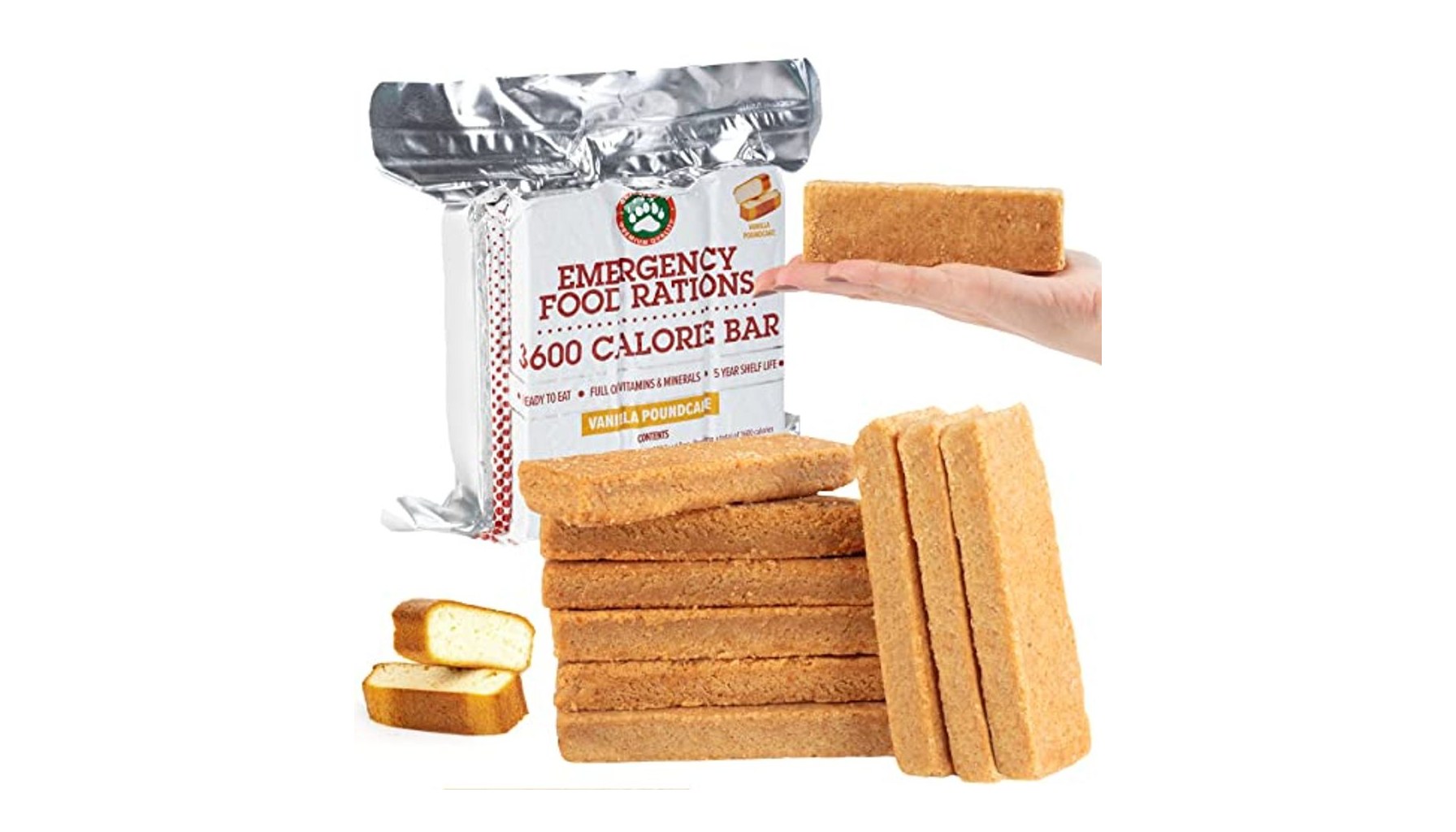
An emergency food bar is not a granola bar that got promoted. It is a solid brick of compressed calories engineered to sit forgotten in a hot car trunk for five years and still keep you alive during the worst week of your life. Most of them are baked into a dense rectangle, sealed inside a vacuum foil pouch, and rated to survive a temperature swing that would ruin nearly everything else in your pantry. Once you understand how these bricks are actually built, choosing the right one for a 72-hour kit stops being guesswork and starts being math.
The calorie brick, explained
The two numbers you will see stamped on almost every survival ration are 2,400 and 3,600 kcal per pack. That is not marketing rounding. The 2,400 figure exists because it maps cleanly to three days at roughly 800 calories per day, which is the classic maritime and search-and-rescue baseline for keeping a person functional but not fed to comfort. The 3,600 pack stretches that same three days to about 1,200 calories daily, or covers a shorter emergency for someone larger or working harder. A single pack usually splits into six or nine scored portions so you can ration by hand without a knife. The whole design assumes you are hungry, cold, and rationing, not enjoying lunch.
The way manufacturers cram that many calories into a pack the size of a paperback is fat and sugar. These bars run heavy on shortening, wheat flour, and sugar because fat carries nine calories per gram against four for carbohydrate or protein. That density is the entire point, but it also tells you what the eating experience will be: dry, sweet, faintly like shortbread, and monotonous by hour forty. Nobody engineers these for flavor. They engineer them for grams of energy per cubic inch and for the ability to be ignored for years.
Why they last five years
The five-year shelf life comes down to water, or the near-total absence of it. Bacteria and mold need moisture to grow, so these bars are baked to a very low water activity and then sealed against the air that would let anything rehydrate or oxidize. The vacuum foil pouch is the second half of the equation. That laminated foil is a barrier against oxygen, light, and humidity, and when it is intact the countdown to spoilage barely moves. This is also why a punctured pouch is a dead pouch. A pinhole from a set of keys rattling around a go-bag can quietly end that five years, so the packaging is not a wrapper you tear past and forget. It is part of the food.
Practically, that five-year date is a floor set for legal and certification reasons, not a hard expiration. A pouch stored somewhere cool and dark will often eat fine well past it. The fat can eventually go rancid, which you will smell instantly on opening, and that is your real signal, not the printed date. Heat is the enemy that shortens everything. A bar rated for five years in a closet is living a much shorter life on a dashboard in July.
Coast Guard approval and what it guarantees
The phrase you want to look for is U.S. Coast Guard approved, sometimes listed as SOLAS compliant. This is the single most useful shortcut on the whole product page. To earn it, a ration has to pass real testing rather than a manufacturer’s promise. It has to hold its rated calories, survive a defined temperature range, resist spoilage across the claimed shelf life, and, critically, be formulated so eating it does not make you thirstier. That last requirement is why the certification matters so much for anyone building a kit.
Water is almost always the tighter constraint than food in a real emergency. A ration that is heavily salted would drive up thirst and force you to spend water you may not have. Coast Guard testing screens for exactly that non-thirst-provoking formulation, which is why lifeboat rations became the template the whole prepping market copied. When a bar carries that approval, you are getting a product that has been proven not to work against your water supply. When it does not, you are trusting a label.
Temperature tolerance and where you stash it
The good rations are rated to hold up from around minus 20 to 150 degrees Fahrenheit. That range is not decoration. It is the difference between a bar that survives a winter in your trunk and one that becomes a sad puddle of shortening by August. This spec is the one most people ignore and then regret, because the whole appeal of an emergency bar is that you can put it somewhere and forget it. The place you forget it matters enormously.
A car kit lives the hardest life. A trunk in summer can push past 150 degrees, which sits at the very top of even a well-rated bar’s tolerance, so a car ration should be the toughest one you can find and it should be swapped on a schedule rather than trusted to the full five years. A go-bag by the door lives an easier life at room temperature, and there the shelf life claim actually holds. My own rule is simple: the car gets the highest temperature rating regardless of taste, and the go-bag gets whichever bar I can stomach eating, because in the bag I might actually be relying on it for three real days.
Taste, texture, and the tradeoffs nobody warns you about
Here is the honest part. These bars taste like dense, dry, lemony or vanilla shortbread, and after two days you will be sick of them. That is fine, because they are insurance, not groceries. But the taste tradeoff is real and it drives one decision: buy a flavor you can tolerate, then buy a small backup of something else, because eating the same brick for 72 hours kills your appetite right when you most need the calories. A little variety, even a single different bar type, keeps you actually eating.
Texture is the other quiet tradeoff. The densest, longest-lasting bars are the hardest and driest, which is exactly why the certification tests them against thirst. If you have young kids or older relatives in your plan, a slightly less dense bar that is easier to chew and needs less water can be worth the shorter shelf life. There is no perfect bar, only the right bar for who is eating it and where it is stored.
Allergens: the detail that can ruin a kit
Almost every mainstream emergency food bar is built on wheat flour, so gluten is baked into the default product. For most kits that is a non-issue, but if anyone in your household is celiac or seriously gluten-sensitive, a standard ration is worse than useless in an emergency because it is the one food you packed and cannot eat. Gluten-free versions exist, they cost more, and they often carry a shorter shelf life, so plan for that tradeoff on purpose rather than discovering it during a crisis.
Nuts are the second landmine. Many bars are made in facilities that also handle tree nuts or peanuts and will say so on the pouch. If you have a nut allergy in the family, read the allergen line before you buy, not after, and do not assume two flavors from the same brand share the same allergen profile. Building a kit around a food that could send someone to the hospital defeats the entire reason the kit exists.
How many emergency food bars do I actually need?
Start from the standard 72-hour kit target and do the math per person. One 2,400 kcal pack covers three days at the survival baseline of 800 calories daily, so one pack per person is the minimum for a classic go-bag. If you want people to stay genuinely functional rather than just alive, size up to the 3,600 kcal pack for around 1,200 calories a day, or pack a bar and a half per person. For a family of four planning a full three days at the higher rate, that is roughly four to six packs, which fits in a single bag without much fuss.
Can I eat these without water?
You can, and that is exactly why the Coast Guard tests for it, but you should still drink alongside them. The bars are dry and dense on purpose so that eating them does not spike your thirst, which means they will not force you to burn through water you need for hydration. That is very different from saying they replace water. You will chew more comfortably with a few sips, and your body still needs water to process the food, so treat the bar as the calorie half of survival and keep water as its own separate, larger priority in the kit.
Do I need to rotate them if the label says five years?
It depends entirely on where they live. A pack sitting in a cool closet inside its sealed foil will comfortably reach that five-year mark and often outlast it, so a go-bag stored indoors needs little more than an occasional check that the pouch is intact. A car ration is a different animal. The heat cycling in a trunk quietly shortens the real life of the food regardless of the printed date, so I rotate anything stored in a vehicle every year or two and eat the old one on a camping trip. Rotation is cheap insurance against opening a rancid pouch on the day you finally need it.
Deeper Dive: Our Top Picks
Our Top Picks

SOS Food Labs, Inc.
S.O.S. Rations 3600 Calorie Emergency Food Bar – Cinnamon & Coconut 2-Pack for 72-Hour Preparedness
Each packet delivers 3,682 calories across 9 fortified bars with a US Coast Guard-approved 5-year shelf life, making it one of the most reliable emergency calorie sources available. Households building a bug-out bag, campers, or anyone assembling a 72-hour kit should keep this on hand for guaranteed sustenance when normal food access fails.
Pros and Cons
Pros
- Coast Guard certification provides independent verification that calorie content and shelf life claims are accurate, not just marketing.
- At roughly 400 calories per bar, the portioning aligns with standard daily survival intake targets without any math required.
- Made in the United States with fortified nutrients, supporting both calorie and basic micronutrient needs during an emergency.
- The 5-year shelf life under all climatic conditions means heat, humidity, and cold storage do not degrade the product.
Cons
- With zero customer reviews on record, there is no user feedback to confirm taste, texture, or real-world palatability beyond the manufacturer's description.
- These bars are designed strictly for emergency survival intake, not daily nutrition, so they should not replace a balanced diet during extended situations.
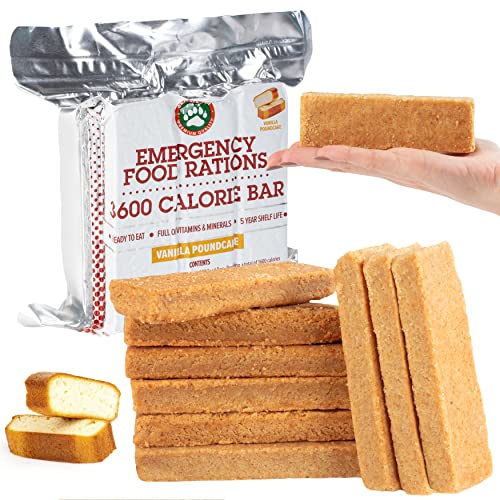
Grizzly Gear
72-Hour Emergency Food Supply for Disaster Kits | Grizzly Gear 3600 Calorie Vanilla Poundcake Bar
The Grizzly Gear 3600 Calorie Bar delivers a full 72-hour emergency food supply in a single compact bar with a 5-year shelf life, no cooking required, and a formula engineered to minimize thirst when water access is cut. Households stocking disaster kits, bug-out bags, or vehicle emergency packs will find it most useful precisely because it removes the need to manage multiple food items under crisis conditions.
Pros and Cons
Pros
- Supplies a complete 72-hour caloric allotment in one item, simplifying emergency food planning for individuals and families.
- No preparation required means the bar is usable immediately after a disaster with zero functional kitchen access.
- Non-thirst-provoking formula is specifically engineered for situations where water rationing is necessary, not just a marketing claim.
- Five-year shelf life means the bar can be stored and forgotten until needed without periodic stock checks.
Cons
- Only one vanilla poundcake flavor is available, which may cause appetite fatigue across a full three-day supply.
- At 3600 calories divided over three days, daily portions may fall short for larger individuals with higher caloric requirements.

Grizzly Gear
3600 Calorie Emergency Food Ration Bar – 72-Hour Blueberry Survival Bar with 5-Year Shelf Life
The Grizzly Gear Emergency Ration delivers 3,600 calories across 9 pre-measured 400-calorie blueberry bars, USCG-approved and sealed in Mylar packaging for a 5-year shelf life under any climate condition. Households, campers, and emergency preppers who need a compact, kosher, halal-compliant food supply that requires zero preparation will find this a reliable 72-hour solution.
Pros and Cons
Pros
- USCG approval and Mylar sealing provide verified, long-term storage confidence without annual rotation.
- Non-thirst-provoking formula addresses a real survival concern that many competing ration bars ignore.
- Dual Kosher and Halal certification broadens usability across diverse family and community preparedness kits.
- Pre-measured 400-calorie portions simplify rationing decisions under stress without needing to weigh or divide food.
Cons
- At 1,200 calories per day across 3 days, the supply falls below typical adult caloric needs for active or physically demanding emergency scenarios.
- Blueberry is the only available flavor, which limits variety for multi-day use and may not suit all taste preferences.

SOS Food Labs, Inc.
Best Emergency 3600 Calorie Food Bar for 72-Hour Survival Kits | SOS Food Labs 3-Day Ration
The SOS Food Labs 3600 Calorie Emergency Food Bar delivers a full 72-hour supply of compact, Coast Guard-approved nutrition in a single 1.6 lb package with a 5-year shelf life. Preppers, campers, and households building emergency kits will find this the most reliable grab-and-go ration for short-term disaster readiness.
Pros and Cons
Pros
- US Coast Guard approval provides third-party verification of caloric content and survivability standards, not just manufacturer claims.
- Pre-scored 400-calorie segments let one person ration precisely over 3 days or share portions across multiple people in a group.
- The 5-year shelf life reduces the maintenance burden of rotating emergency food supplies compared to standard pantry items.
- Compact brick form factor stores flat in tight spaces like vehicle kits, office drawers, or layered into a 72-hour bag.
Cons
- With no flavor variety described, palatability over a full 72-hour emergency period may be a concern for picky eaters or children.
- The single-unit package covers only one person for 3 days, so households or families need to purchase multiple units to be adequately prepared.

BDH
Emergency Food Ration Bars Chocolate Survival Tabs 12-Pack 20-Year Shelf Life Disaster Preparedness Kit
BDH Emergency Food Ration Bars deliver 6,840 total calories across 12 individually sealed chocolate-flavored packs, each providing 475kcal per 100g with a claimed 20-year shelf life under proper storage. Preppers, campers, and households building a disaster kit will find these a compact, no-cook option that fits in a pocket and requires zero preparation.
Pros and Cons
Pros
- Individual 120g foil pouches keep each serving isolated, so partial use does not compromise the remaining supply.
- A 20-year shelf life without preservatives is a standout claim for this price tier, reducing long-term restocking costs.
- The pocketable form factor works equally well stuffed into a bug-out bag, a car glove box, or a desk drawer.
- No preparation steps means the bars are usable even when water, power, and cooking equipment are unavailable.
Cons
- The bars have a dry, dense texture by design, which can feel unpleasant without water nearby, so always pair with adequate hydration.
- With zero verified reviews at time of writing, the 20-year shelf life and calorie claims cannot yet be confirmed by independent buyers.
Editors' Picks
SOS Food Labs, Inc. S.O.S. Rations 3600 Calorie Emergency Food Bar – Cinnamon & Coconut 2-Pack for 72-Hour Preparedness
SOS Food Labs, Inc.
S.O.S. Rations 3600 Calorie Emergency Food Bar – Cinnamon & Coconut 2-Pack for 72-Hour Preparedness
Each packet delivers 3,682 calories across 9 fortified bars with a US Coast Guard-approved 5-year shelf life, making it one of the most reliable emergency calorie sources available. Households building a bug-out bag, campers, or anyone assembling a 72-hour kit should keep this on hand for guaranteed sustenance when normal food access fails.
$18.08 at AmazonEditors' Favorite
Size: Pack of 2 Dimensions: 4 x 2 x 4 Inches Weight: 0.5625 Pounds Product Group: Tools Binding: Tools & Home Improvement
Shop NowGrizzly Gear 72-Hour Emergency Food Supply for Disaster Kits | Grizzly Gear 3600 Calorie Vanilla Poundcake Bar
Grizzly Gear
72-Hour Emergency Food Supply for Disaster Kits | Grizzly Gear 3600 Calorie Vanilla Poundcake Bar
The Grizzly Gear 3600 Calorie Bar delivers a full 72-hour emergency food supply in a single compact bar with a 5-year shelf life, no cooking required, and a formula engineered to minimize thirst when water access is cut. Households stocking disaster kits, bug-out bags, or vehicle emergency packs will find it most useful precisely because it removes the need to manage multiple food items under crisis conditions.
$21.99 at AmazonGreat Value
Size: 3600 Calories (1 Pack) Dimensions: 6.4 x 6.1 x 1.5 inches Weight: 1.5 Pounds Product Group: Outdoors Binding: Apparel
Shop NowGrizzly Gear 3600 Calorie Emergency Food Ration Bar – 72-Hour Blueberry Survival Bar with 5-Year Shelf Life
Grizzly Gear
3600 Calorie Emergency Food Ration Bar – 72-Hour Blueberry Survival Bar with 5-Year Shelf Life
The Grizzly Gear Emergency Ration delivers 3,600 calories across 9 pre-measured 400-calorie blueberry bars, USCG-approved and sealed in Mylar packaging for a 5-year shelf life under any climate condition. Households, campers, and emergency preppers who need a compact, kosher, halal-compliant food supply that requires zero preparation will find this a reliable 72-hour solution.
$16.19 at AmazonSize: 1 Pack Weight: 1.5 pounds Product Group: Grocery
Shop NowSOS Food Labs, Inc. Best Emergency 3600 Calorie Food Bar for 72-Hour Survival Kits | SOS Food Labs 3-Day Ration
SOS Food Labs, Inc.
Best Emergency 3600 Calorie Food Bar for 72-Hour Survival Kits | SOS Food Labs 3-Day Ration
The SOS Food Labs 3600 Calorie Emergency Food Bar delivers a full 72-hour supply of compact, Coast Guard-approved nutrition in a single 1.6 lb package with a 5-year shelf life. Preppers, campers, and households building emergency kits will find this the most reliable grab-and-go ration for short-term disaster readiness.
$14.94 at AmazonColor: white Size: 1 Count (Pack of 1) Dimensions: 5 x 5 x 2 inches Weight: 1.6 pounds Product Group: Tools Binding: Tools & Hardware
Shop NowBDH Emergency Food Ration Bars Chocolate Survival Tabs 12-Pack 20-Year Shelf Life Disaster Preparedness Kit
BDH
Emergency Food Ration Bars Chocolate Survival Tabs 12-Pack 20-Year Shelf Life Disaster Preparedness Kit
BDH Emergency Food Ration Bars deliver 6,840 total calories across 12 individually sealed chocolate-flavored packs, each providing 475kcal per 100g with a claimed 20-year shelf life under proper storage. Preppers, campers, and households building a disaster kit will find these a compact, no-cook option that fits in a pocket and requires zero preparation.
$37.99 at AmazonColor: Chocolate Flavor Size: Chocolate Flavor Dimensions: 10.236220462 x 3.93700787 x 2.755905509 inches Weight: 3.1746565728 pounds Product Group: Grocery
Shop Now

Write Your Review
No reviews yet. Be the first to share your experience!