

TL;DR — How to choose a flour sifter is not complicated, but it does reward a little patience and the right sequence. Use this as the practical background, then check best baking sheets, best kitchen scale, and best dutch oven for bread baking for specific product options.
We treated this as an editor’s note for home cooks: what matters, what is optional, and which related product guides are worth checking before you buy. For baking tools, sizing, material, accuracy, cleaning, and storage usually decide whether a tool stays useful or gets replaced.
Hamillar
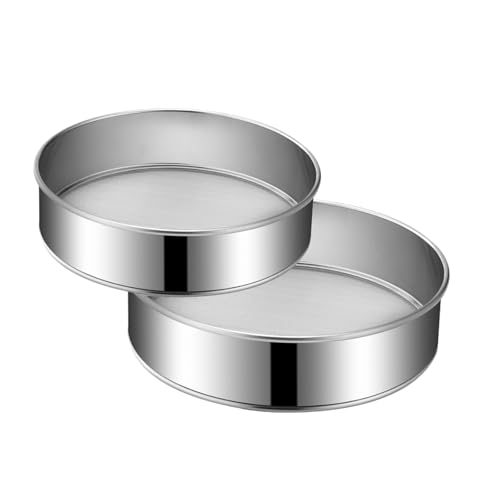
Two-Size Flour Sifter Set for Baking and Straining: Hamillar 8-Inch 60 Mesh and 10-Inch 40 Mesh Stainless Steel Sieves
This two-piece set pairs an 8-inch 60-mesh sieve with a 10-inch 40-mesh sieve in 304 stainless steel, so you can match fineness to the ingredient instead of forcing one screen to do everything. Buy it if you bake regularly and want both a coarse screen for bulk flour and an ultra-fine one for dusting cocoa or powdered sugar over finished cakes.
Pros and Cons
Pros
- Getting two distinct mesh counts removes the compromise of owning a single all-purpose sieve.
- Stainless steel rims and mesh stand up to hot water and dishwasher cycles without warping or corroding.
- The stackable round design stores flat and compact rather than eating shelf space.
- Handles spices, matcha, baking soda, and powdered sugar in addition to flour, so it earns its drawer space.
Cons
- These are hand-shaken sieves with no crank or squeeze mechanism, so sifting large flour quantities takes more arm work than a rotary sifter.
- Fine 60-mesh screens trap damp ingredients like cocoa and need immediate rinsing before residue dries and clogs the weave.
CXWUZH
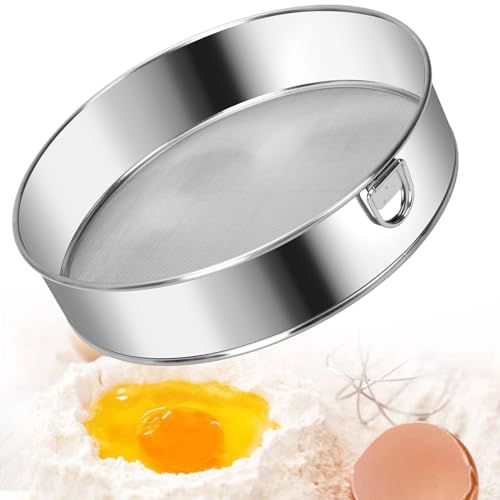
Lump-Free Flour Sifting for Cakes and Bread: CXWUZH 8-Inch Stainless Steel Flour Sifter, 60 Mesh Fine Sieve Strainer
This 8-inch stainless steel sieve runs flour, cocoa, and powdered sugar through a 60 mesh screen so clumps break apart and batters mix without dry pockets. Buy it if you bake cakes and bread regularly and want one rust-resistant hand sifter that rinses clean and stores flat or on a hook.
Pros and Cons
Pros
- Fine 60 mesh handles powdered sugar and cocoa for dusting finished cakes, not just raw flour.
- One-piece stainless build has no springs or crank parts that can jam partway through a bake.
- Works across dry ingredients including baking powder, baking soda, almond powder, and cornstarch.
- Hanging loops and a shallow 5cm profile keep it storable in a small kitchen.
Cons
- The tight 60 mesh slows coarse ingredients like almond flour and whole wheat, which need extra tapping to pass through.
- There is no crank or squeeze handle, so large batches mean shaking by hand and holding the rim throughout.
Hamillar Two-Size Flour Sifter Set for Baking and Straining: Hamillar 8-Inch 60 Mesh and 10-Inch 40 Mesh Stainless Steel Sieves
Hamillar
Two-Size Flour Sifter Set for Baking and Straining: Hamillar 8-Inch 60 Mesh and 10-Inch 40 Mesh Stainless Steel Sieves
This two-piece set pairs an 8-inch 60-mesh sieve with a 10-inch 40-mesh sieve in 304 stainless steel, so you can match fineness to the ingredient instead of forcing one screen to do everything. Buy it if you bake regularly and want both a coarse screen for bulk flour and an ultra-fine one for dusting cocoa or powdered sugar over finished cakes.
Check price on AmazonA two-piece stainless steel sieve set that solves the common problem of owning one sieve too coarse for cocoa and too fine for bulk flour.
The 10-inch 40-mesh handles flour, almond meal, and dry mixes quickly. The 8-inch 60-mesh catches finer particles for dusting powdered sugar over cakes.
Built from 304 stainless steel, both are light enough to hold one-handed while tapping, and the wider rim rests across standard mixing bowls.
Neither has a crank or spring mechanism, so sifting several cups of flour means sustained shaking or tapping by hand.
Best for home bakers who sift often and want the right mesh for each ingredient.
Use the 10-inch 40-mesh for volume work: aerating all-purpose flour, sifting cake mix, breaking up clumped baking soda, or straining lumps from dry batters.
Reach for the 8-inch 60-mesh for finishing. It gives an even dusting of cocoa, matcha, or powdered sugar across brownies, tiramisu, and layer cakes.
Both work beyond baking for rinsing small grains, sifting ground spices, and straining solids from stocks or infusions.
CXWUZH Lump-Free Flour Sifting for Cakes and Bread: CXWUZH 8-Inch Stainless Steel Flour Sifter, 60 Mesh Fine Sieve Strainer
CXWUZH
Lump-Free Flour Sifting for Cakes and Bread: CXWUZH 8-Inch Stainless Steel Flour Sifter, 60 Mesh Fine Sieve Strainer
This 8-inch stainless steel sieve runs flour, cocoa, and powdered sugar through a 60 mesh screen so clumps break apart and batters mix without dry pockets. Buy it if you bake cakes and bread regularly and want one rust-resistant hand sifter that rinses clean and stores flat or on a hook.
Check price on AmazonA one-piece 8-inch stainless steel sieve aimed at clumped flour, caked cocoa, and hardened icing sugar, the dry-ingredient problem behind streaky batters and a dense crumb.
The 60 mesh screen aerates flour in one pass and lays down an even dusting of cocoa or powdered sugar across a finished cake top.
Build is thickened stainless mesh on a 20cm rim, 5cm deep, rust resistant and light enough to hold one-handed while tapping over a bowl.
Limitation: coarse or slightly damp ingredients such as almond flour need repeated tapping, since the tight mesh restricts flow compared with a wider screen.
Best for home bakers making cakes and bread who want a simple hand sieve rather than a crank sifter.
Sift cake flour with baking powder and baking soda before folding into wet ingredients, which spreads leaveners evenly and prevents bitter pockets in the bake.
Dust powdered sugar or cocoa over cakes, brownies, and pastries. Hold the sieve high and tap the rim for a thin, even layer.
Also suits almond powder for macarons, cornstarch for sauces, and fine spice blends. Rinse and dry right after damp ingredients so the mesh does not clog.
How To Choose
Choosing a choose a flour sifter starts with your own use: how often you cook, the space you have, and which warping in a hot oven you most want to avoid. Match those to release performance, and measurement accuracy and the decision makes itself. Do not start from the spec sheet — start from your kitchen. If you are shopping, our best baking sheets and best kitchen scale guides are the fastest way in.
How To Know You Did It Right
The result should be practical and repeatable: the baking tool should work cleanly, feel controlled, and show no signs of uneven browning. If the same issue returns quickly, the cause is usually a missed care step — not the tool itself.
What You Will Need
Keep it simple: the baking tool itself, a clean workspace, and any basic supplies the material calls for. Set up before you start so you are not improvising mid-task.
Keeping It That Way
Maintenance beats repair. Fold lining with parchment, avoiding thermal shock, and hand-washing to protect the finish into your routine and the baking tool will stay reliable for years. Neglect any one of them and you invite rust on bare steel back.
Step By Step
1. Identify the material or type — baking tools vary, so avoid one-size-fits-all advice. 2. Use the gentlest effective method first, prioritizing avoiding thermal shock. 3. Work slowly and check progress; rushing causes batter that sticks. 4. Finish with storing flat to prevent bending so the result actually lasts. 5. Build the habit into normal cleanup instead of waiting for a problem.
Common Mistakes To Avoid
The usual failure is treating a durable baking tool as indestructible. Harsh shortcuts lead to rust on bare steel, and finishes that scratch off. Do not assume pricier gear removes the need for care, either — technique matters more than the badge. Start your shortlist with best baking sheets, best kitchen scale, and best dutch oven for bread baking before narrowing by budget.
Related Product Guides
If this topic is part of a buying decision, these are the HomeWhisk guides most closely tied to it:
- best baking sheets
- best kitchen scale
- best dutch oven for bread baking
- best mixing bowls
- best cutting board
- best food storage containers
Frequently Asked Questions
How do I choose a choose a flour sifter?
Weigh warp resistance, and sizing and volume against how you cook. Start your shortlist with best baking sheets and best kitchen scale.
How do I keep it in good shape?
Build lining with parchment, and drying fully before storage into normal cleanup. Light, consistent care prevents measurements that drift out of true far better than occasional deep effort.
What is the bottom line?
Match the baking tool to your real habits: buy for durability if it is daily, for value and storage if it is occasional.
What should I avoid?
Avoid buying by brand alone, ignoring skipping abrasive scrubbers, and oversizing for your space. Each invites batter that sticks down the line.
Who is this most useful for?
Mainly cooks short on cabinet space, and weekend bakers. If that is you, treat measurement accuracy as a requirement rather than a nice-to-have.
The Bottom Line
A good choose a flour sifter decision should feel obvious after you line up size, material, cleaning, and durability. If it is still a purchase question, the next step is best baking sheets, best kitchen scale, and best dutch oven for bread baking.



Write Your Review
No reviews yet. Be the first to share your experience!