

TL;DR — The right way to handle a cookie scoop with vinegar depends on material, edge or surface, and how the tool is used day to day. When this turns into a purchase decision, compare best baking sheets, best kitchen scale, and best dutch oven for bread baking before narrowing your shortlist.
The HomeWhisk approach is research-first: compare construction, usability, cleaning, and long-term complaints before recommending a direction. For baking tools, sizing, material, accuracy, cleaning, and storage usually decide whether a tool stays useful or gets replaced.

Save $3.00
Pros & Cons
Pros
- Universal #60 scoop sizing means the 1 tablespoon portion is predictable and repeatable across recipes.
- Solid 304 stainless steel is food grade, BPA free, and rust resistant for long-term use.
- Trigger release and built-in scraper handle sticky dough, melon, and meatball mixes without sticking.
- At 7.7 inches long, the handle gives enough leverage to work through firm, refrigerated dough.
Cons
- The 1 tablespoon capacity is small for muffin batter or large drop cookies, so you will need a bigger scoop size for those jobs.
- Spring-loaded mechanisms can trap dough near the trigger, so it needs a rinse before the dishwasher when batter is especially sticky.
Details
A trigger-release portioning scoop that solves uneven cookie sizes, the reason one tray finishes browned while the rest is underdone.
The #60 head holds 1 tablespoon and drops 2.25-inch cookies. The spring trigger and scraper eject sticky dough, meatball mix, or melon in one press.
Built from solid 304 stainless steel with a soft rubber grip, 7.7 inches long and 1.4 inches wide, dishwasher safe and BPA free.
One tablespoon is a small portion, so bakers who want bakery-size cookies will want a larger scoop number instead.
Best for home bakers who make cookies or meatballs in batches and want uniform results without hand-rolling.
Best Uses
Cookie dough is the core job. One level scoop per drop yields 2.25-inch cookies that bake evenly across the sheet, no rolling required.
Use it for appetizer-size meatballs, truffles, and cake pops where equal size means equal cook time and a tidy presentation on the plate.
It also works as a melon baller for fruit salad, and portions cookie dough onto a tray for freezing in single-bake amounts.
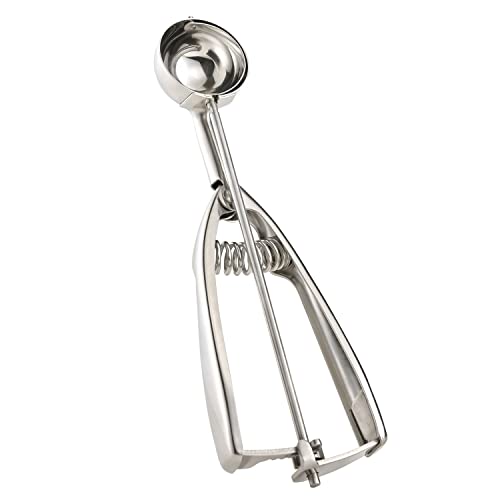
Save $8.24
Pros & Cons
Pros
- 18/8 stainless steel construction is backed by a five-year warranty from the brand.
- Squeeze-release mechanism drops dough cleanly without scraping it out with a finger or spoon.
- Exact stated capacity of 1.2 tablespoons makes bake times and recipe yields predictable.
- Ambidextrous grip keeps hand strain down during large batches.
Cons
- At 1.5 inches, this is the small size only, so bakers who want jumbo cookies or full ice cream scoops need a larger portioner.
- The sweeping release arm and its spring channel trap dough, so it needs a rinse right after use rather than sitting in the sink.
Details
A #50 spring-release portioner that solves uneven cookie sizing, where hand-spooned dough bakes into a mix of scorched thin cookies and underdone thick ones.
The 1.5-inch bowl holds 1.2 tablespoons and yields a 2 1/4-inch finished cookie, so one squeeze delivers a repeatable portion every time.
Built from 18/8 food-grade stainless steel that will not rust or corrode, with a light ambidextrous grip that stays comfortable through several dozen scoops.
It is a single size, so it will not cover jumbo cookies or hard, freezer-cold ice cream without some wrist effort.
Best for home bakers who make cookies in batches for holidays, bake sales, or gifting and want them to match.
Best Uses
Drop cookies are the core use: chocolate chip, oatmeal, snickerdoodle, and peanut butter dough all release cleanly and bake to a consistent 2 1/4 inches.
Beyond baking, use it for meatballs, falafel, cake pop bases, and portioning muffin or cupcake batter into liners at an even fill level.
Softened ice cream, sorbet, and melon balls also work, giving you neat 1.5-inch spheres for plating and layered desserts.
Cleaning a Cookie Scoop With Vinegar: The Essentials
Cleaning a cookie scoop with vinegar well is mostly about matching the method to the material and doing it before residue sets. The goal is to lift food and oils without stripping a finish or dulling a surface. Skip the dishwasher when the material calls for it, and never let rust on bare steel start from lazy rinsing.
Step By Step
1. Let the cookie scoop with vinegar cool to a safe temperature before washing. 2. Loosen residue with warm water and the gentlest tool that works. 3. Wash with a mild detergent unless the material forbids it, then rinse fully. 4. Dry immediately and completely — trapped moisture is what causes batter that sticks.
How To Know You Did It Right
The result should be practical and repeatable: the baking tool should work cleanly, feel controlled, and show no signs of batter that sticks. If the same issue returns quickly, the cause is usually a missed care step — not the tool itself.
Before You Start
Match the method to the baking tool in front of you. Clean a cookie scoop with vinegar is not hard, but the details matter — the wrong approach to drying fully before storage can shorten the life of otherwise good baking gear. For product picks, compare best baking sheets, best kitchen scale, and best dutch oven for bread baking.
Related Product Guides
If this topic is part of a buying decision, these are the HomeWhisk guides most closely tied to it:
- best baking sheets
- best kitchen scale
- best dutch oven for bread baking
- best mixing bowls
- best cutting board
- best food storage containers
Frequently Asked Questions
What is the right way to clean a cookie scoop with vinegar?
Cleaning a cookie scoop with vinegar well is mostly about matching the method to the material and doing it before residue sets. Do it consistently and you avoid warping in a hot oven.
Who is this most useful for?
Mainly cooks short on cabinet space, and beginners baking their first loaves. If that is you, treat material and gauge as a requirement rather than a nice-to-have.
What is the bottom line?
Match the baking tool to your real habits: buy for durability if it is daily, for value and storage if it is occasional.
How do I keep it in good shape?
Build storing flat to prevent bending, and avoiding thermal shock into normal cleanup. Light, consistent care prevents warping in a hot oven far better than occasional deep effort.
What should I avoid?
Avoid buying by brand alone, ignoring drying fully before storage, and oversizing for your space. Each invites uneven browning down the line.
The Bottom Line
For most home cooks, the best choice is the one that removes friction without adding maintenance you will ignore. Start with your use case, then cross-check best baking sheets, best kitchen scale, and best dutch oven for bread baking.









Write Your Review
No reviews yet. Be the first to share your experience!