

TL;DR — How to choose a bench scraper is not complicated, but it does reward a little patience and the right sequence. When this turns into a purchase decision, compare best baking sheets, best kitchen scale, and best dutch oven for bread baking before narrowing your shortlist.
The HomeWhisk approach is research-first: compare construction, usability, cleaning, and long-term complaints before recommending a direction. For baking tools, sizing, material, accuracy, cleaning, and storage usually decide whether a tool stays useful or gets replaced.

Pros & Cons
Pros
- Seam-free one-piece poly means nothing to disassemble or scrub out after dough work.
- The 8 1/2 by 5 inch face is wide enough to move a full board of chopped vegetables in a single scoop.
- Safe on nonstick sheet pans, coated bowls, and stone counters that a steel bench knife can scratch.
- Stiff enough to break down dough portions while still flexing against the curve of a mixing bowl.
Cons
- The blunt poly edge needs more downward pressure than a sharpened steel bench knife when cutting cold butter or stiff dough.
- There are no ruler markings along the edge, so portioning still requires a scale or separate ruler.
Details
A one-piece polypropylene bench scraper measuring 8 1/2 by 5 inches, sized to clear a full cutting board and lift sticky dough off a floured counter in one pull.
The plastic edge will not mark granite, quartz, laminate, or nonstick sheet pans, so it works on surfaces where a steel bench knife leaves scratches.
Molded white poly with no rivets or handle joint, light enough for long prep sessions and stiff enough to divide dough. Made in the United States.
The blunt edge does not slice through cold butter or firm bread dough as cleanly as sharpened steel, and it carries no portioning marks.
Best for home bakers and prep cooks who want a nonscratching scraper for stone and nonstick surfaces rather than a cutting-focused steel blade.
Best Uses
Dough work: divide pizza and bread portions, fold wet ciabatta, and move shaped loaves to parchment without tearing the surface.
Board clearing: scoop diced onion, herbs, or mirepoix straight into the pan, then sweep flour and trimmings into the bin.
Cleanup: pull dried batter and dough off counters, sheet pans, and bowl walls before washing, with no scratch marks left behind.

Pros & Cons
Pros
- Dual straight and curved edges cover both cutting and scraping tasks in one set.
- Flexible plastic conforms to bowl curves for cleaner batter transfer.
- Lightweight and easy to maneuver for beginners still learning dough handling.
- Non-slip textured grip maintains control during sticky work.
Cons
- PE plastic edges will not cut through stiff, heavily kneaded dough as cleanly as a stainless steel bench knife.
- Plastic construction is not suited to hot pans or dishwasher heat cycles that can warp thin sheets.
Details
A five-piece scraper set for bakers who lose batter to bowl walls and struggle to lift sticky dough off a work surface.
The straight edge portions bread dough, pastry, and fondant on the counter. The curved edge sweeps cake batter, frosting, and melted chocolate out of round bowls.
Made from flexible PE plastic that bends to follow curves, with a textured grip panel for wet or floured hands. Light enough for extended shaping sessions.
Plastic edges flex under pressure, so stiff bagel or rye dough is better handled with a metal bench knife.
Best for home bakers working with soft doughs, batters, and frostings who want less waste and faster cleanup.
Best Uses
Use the straight edge to divide bread dough into even rolls, cut pizza portions, and lift sticky dough off a floured counter in one motion.
Use the curved edge to clear cake batter and frosting from mixing bowls, fold ingredients along the bowl wall, and scrape tempered chocolate from a container.
Also handles fondant shaping, cleaning flour off the work surface between batches, and pressing pie dough scraps together for a second roll.
Pros & Cons
Pros
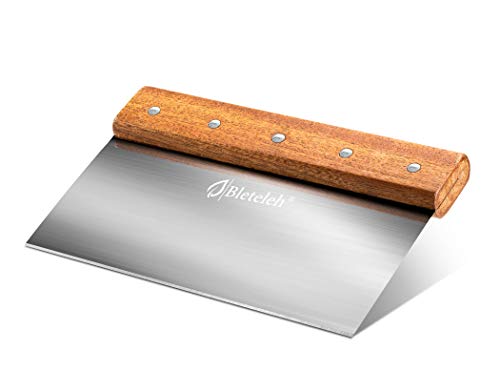
- Blade length exceeds the common 6-inch standard, which matters when dividing large dough batches or transferring bulk prep.
- Rigid high-carbon stainless steel resists flexing and rust after repeated contact with wet dough.
- Hardwood handle adds grip and keeps fingers clear of the sharpened edge during repeated chopping.
- Built to commercial specification, so it tolerates bakery-level daily use in a home kitchen.
Cons
- The wooden handle will dry out and loosen with repeated dishwasher cycles, so hand washing and immediate drying extends its life.
- The blade carries no measurement markings, so portioning dough evenly still requires a scale or a practiced eye.
Details
A bench scraper handles jobs a knife does badly: dividing sticky dough, lifting chopped onions off the board, and scraping dried flour paste off a work surface without gouging it.
The sharpened edge cuts through stiff bagel or pizza dough in one downward press, and the 8-inch span moves a full pile of diced vegetables to the pot in a single lift.
High-carbon stainless steel keeps the blade rigid so it will not bow against a countertop, and the hardwood handle stays grippy through long shaping sessions.
The wooden handle is the weak point over years of dishwasher cycles, and there are no ruler markings for measuring dough portions.
Best for home bakers doing weekly bread or pizza who want one tool for cutting, scraping, and cake finishing.
Best Uses
Dough work: divide boules, slice cinnamon roll logs, and lift wet ciabatta off the counter without tearing the gluten structure you just built.
Prep work: press down through herbs and garlic, then use the wide blade to scoop everything into the pan in one motion.
Finishing and cleanup: hold the flat edge against a frosted cake for smooth sides, then scrape hardened dough and flour off wood or steel surfaces.

Pros & Cons
Pros
- Stainless steel resists bending under hand pressure, keeping the edge flat against the cutting board for clean cuts.
- Measurement marks are engraved into the metal rather than printed, so they survive washing.
- Compact rectangular profile stores flat in a drawer without taking up utensil crock space.
- Gripped top edge gives enough control to use it for scooping and rough chopping, not just scraping.
Cons
- It is listed under grill scrapers, but a thin dough blade is not built for carbonized grill grates.
- Dishwasher safety is not stated, so hand washing and immediate drying is the safer routine to avoid water spots on the steel.
Details
A flat stainless steel blade with a gripped top edge, built for dividing dough and clearing a floured work surface. It replaces scraping sticky dough with a knife or spatula.
Engraved measurement marks run along the blade, so rolls, buns, and pizza portions can be cut to a consistent size directly on the board instead of by eye.
Stainless steel resists rust and holds shape under downward pressure. At 5.9 by 4.53 inches, the blade sweeps a useful width of counter while staying light in one hand.
The straight edge is designed for dough and flat boards, so it will not conform to curved cookware or bite into baked-on grill residue.
Best for home bakers making sourdough, pizza, or cookies who want even portions and faster counter cleanup.
Best Uses
Dividing dough: press straight down through sourdough, pizza, or cookie dough, using the engraved scale to keep every piece the same size.
Board cleanup: drag the edge across a floured counter to gather stuck dough and crumbs into a bin in one motion.
Prep and finishing: scoop chopped vegetables into a pan without losing pieces, or run the flat edge around a cake to smooth icing.

Pros & Cons
Pros
- Stainless steel blade holds a clean edge for dividing dough and stays free of stains and odors.
- Built-in measurement engraving supports even portioning for loaves, rolls, and pizza dough.
- Hardwood handle keeps the grip comfortable during repeated downward cuts.
- Handles surface scraping, chopping, and batter transfer, replacing several single-task tools.
Cons
- The wood handle should be hand washed and dried rather than run through a dishwasher, which can dry or loosen it over time.
- Blade dimensions and weight are not published, so buyers cannot confirm it clears a full-width dough batch in one sweep.
Details
A bench scraper built to divide dough, lift it off a floured counter, and clear stuck-on flour and batter without gouging the work surface.
Engraved measuring marks along the blade let you cut even portions for rolls or pizza, and the straight edge separates sticky dough cleanly in a single press.
The blade is stainless steel, which resists stains and odor absorption, paired with a smooth hardwood handle that stays comfortable during repeated pressing.
Blade size and weight are not listed, so buyers working with large batches cannot confirm coverage before ordering.
Best for home bakers who portion bread and pizza dough regularly and want a counter cleanup tool in the same hand.
Best Uses
Dividing bread dough into equal loaves or rolls, using the engraved marks to keep each piece the same weight and bake time.
Lifting and turning wet, high hydration dough during folding, then scraping the counter clean before the next batch.
Off the baking bench, it works as a griddle scraper, a cake side smoother, and a blade for chopping and transferring vegetables to the pan.
How To Choose
Choosing a choose a bench scraper starts with your own use: how often you cook, the space you have, and which measurements that drift out of true you most want to avoid. Match those to warp resistance, and measurement accuracy and the decision makes itself. Do not start from the spec sheet — start from your kitchen. If you are shopping, our best baking sheets and best kitchen scale guides are the fastest way in.
What You Will Need
Keep it simple: the baking tool itself, a clean workspace, and any basic supplies the material calls for. Set up before you start so you are not improvising mid-task.
Before You Start
Match the method to the baking tool in front of you. Choose a bench scraper is not hard, but the details matter — the wrong approach to avoiding thermal shock can shorten the life of otherwise good baking gear. For product picks, compare best baking sheets, best kitchen scale, and best dutch oven for bread baking.
How To Know You Did It Right
The result should be practical and repeatable: the baking tool should work cleanly, feel controlled, and show no signs of warping in a hot oven. If the same issue returns quickly, the cause is usually a missed care step — not the tool itself.
Common Mistakes To Avoid
The usual failure is treating a durable baking tool as indestructible. Harsh shortcuts lead to warping in a hot oven, and uneven browning. Do not assume pricier gear removes the need for care, either — technique matters more than the badge. Start your shortlist with best baking sheets, best kitchen scale, and best dutch oven for bread baking before narrowing by budget.
Related Product Guides
If this topic is part of a buying decision, these are the HomeWhisk guides most closely tied to it:
- best baking sheets
- best kitchen scale
- best dutch oven for bread baking
- best mixing bowls
- best cutting board
- best food storage containers
Frequently Asked Questions
How do I choose a choose a bench scraper?
Weigh rim and edge design, and nesting or storage shape against how you cook. Start your shortlist with best baking sheets and best kitchen scale.
Is a premium baking tool worth it?
Only if you use it enough to notice better control, durability, or cleanup regularly. Occasional users are well served by a mid-range pick like those in best dutch oven for bread baking.
How do I keep it in good shape?
Build avoiding thermal shock, and skipping abrasive scrubbers into normal cleanup. Light, consistent care prevents warping in a hot oven far better than occasional deep effort.
What is the bottom line?
Match the baking tool to your real habits: buy for durability if it is daily, for value and storage if it is occasional.
Who is this most useful for?
Mainly high-volume holiday bakers, and cooks short on cabinet space. If that is you, treat heat conductivity as a requirement rather than a nice-to-have.
The Bottom Line
For most home cooks, the best choice is the one that removes friction without adding maintenance you will ignore. Start with your use case, then cross-check best baking sheets, best kitchen scale, and best dutch oven for bread baking.



Write Your Review
No reviews yet. Be the first to share your experience!