

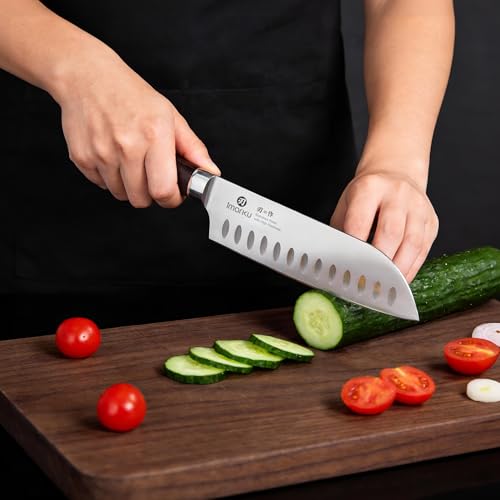
TL;DR — Food sticks to a santoku for a simple physical reason: its blade is tall, flat, and smooth, so wet slices cling to the wide side by surface tension and suction rather than falling away. Sticking gets worse with a very sharp, polished blade cutting moist foods like potatoes, cucumbers, and apples. The fixes are a hollow-edge (Granton) blade, wiping the blade between cuts, angling your slices, and — if it is carbon steel — keeping it dry and lightly oiled so a smooth patina forms. Sticking is normal geometry, not a defect. For picks, see our best santoku knife guide.
The HomeWhisk editorial team researches kitchen equipment by analyzing blade geometry, steel composition, and aggregated owner feedback from communities like Reddit r/chefknives and major retailers. “Why does everything stick to my santoku?” is one of the most common frustrations new owners report, and it is almost never a sign of a bad knife. It is a direct consequence of what makes a santoku good at push-cutting. Here is the mechanism and what actually reduces it.
Why Food Sticks: The Physics of a Flat Blade
A santoku has a tall, relatively flat blade with a broad, smooth face. When you cut a moist food, a thin film of water and starch sits between the freshly cut slice and the side of the blade. That film creates surface tension and a light vacuum, so the slice adheres to the steel instead of dropping onto the board.
Three factors make it worse:
- Blade height and flatness. The santoku’s wide, flat profile gives water a large, uninterrupted surface to grip. There is simply more contact area than on a narrower blade.
- A very smooth, polished finish. A mirror-polished face has fewer micro-gaps for air to break the seal, so slices cling harder. Counterintuitively, an extremely refined blade can stick more.
- A sharp edge cutting cleanly. A razor edge produces flat, wet-faced slices with no ragged edges to let them fall free — so sharpness and sticking often go together.
This is why sticking spikes with starchy or watery produce: potatoes, sweet potatoes, cucumbers, zucchini, apples, and beets. It is geometry and moisture, not a manufacturing flaw. If you are shopping and want to compare a santoku against a longer profile, our best chef knife guide covers the alternative shape.
The Hollow-Edge (Granton) Fix
The most common built-in solution is a hollow-edge blade, also called a Granton edge or kullenschliff. These are the row of oval dimples or scallops ground into both sides of the blade above the cutting edge.
The dimples create small pockets of air along the blade face. As you cut, those air pockets break the water seal between the slice and the steel, so the vacuum cannot form and the slice releases. It does not eliminate sticking entirely — very starchy potatoes will still cling somewhat — but it noticeably reduces it for most produce.
A hollow-edge santoku is worth seeking out if you slice a lot of vegetables. It is a genuine functional feature, not marketing. Our best santoku knife guide notes which picks use a hollow edge, and our best knife sets guide covers sets that pair one with other essentials.
Technique: How to Cut So Food Falls Away
Even without a hollow edge, technique dramatically reduces sticking.
1. Wipe the blade every few cuts. A dry blade sticks far less than a wet one. Keep a damp towel on the board and give the face a quick wipe when slices start piling up. 2. Cut with a slight forward push or draw, not a straight chop. Adding a small slicing motion shears the food rather than pressing it flat against the blade face. 3. Angle the blade slightly as you finish each cut so the slice sheds sideways off the face instead of staying flat against it. 4. Sweep slices off the board frequently. A crowded board lets slices restick to the blade as you continue. 5. For very starchy foods, rinse the blade in cool water occasionally. The starch itself is the glue; removing it resets the surface.
These habits matter more than any single feature, and they work on any knife with a tall face. If you also cut a lot of bread or bone-in cuts, note that those tasks call for different blades entirely — see our best bread knife and best boning knife guides.
When Sticking Signals a Care Problem (Carbon Steel)
If your santoku is carbon steel rather than stainless, sticking can be tied to how the blade is maintained, and the fix overlaps with rust prevention.
Carbon steel reacts with moisture, acids, and air. Left wet, it forms rough orange rust; cared for, it develops a smooth, dark patina — a stable oxide layer that is actually more food-release-friendly than bare, reactive steel. A blotchy, sticky, freshly-scrubbed carbon blade often grabs food more than a well-patinated one.
To keep a carbon santoku performing well:
- Wash and dry it immediately after use. Never leave it wet or soaking.
- Hand wash only — no dishwasher, which strips oil and corrodes the edge and handle.
- Wipe on a thin film of food-safe mineral oil (or camellia oil) before storing, especially in humid kitchens. This protects the steel and gives a slicker face.
- Let a natural patina develop rather than polishing the blade back to bright metal after every use.
Stainless santokus do not need oiling, but they still benefit from prompt drying and the technique tips above. Whichever steel you own, store it in a block, on a magnetic strip, or with an edge guard rather than loose in a drawer, where the edge dulls and chips. For a full lineup, our best knife sets guide covers storage-included options.
Sharpness Still Matters More Than Sticking
It is worth keeping perspective: a slightly sticky sharp knife is far safer and more pleasant than a smooth-releasing dull one. A dull blade requires more force, slips off food, and causes more accidents. If your santoku both sticks and feels like it is crushing rather than slicing, sharpen it first.
A whetstone (a 1000-grit stone for regular sharpening, stepping up to 3000 or higher to refine) restores a santoku’s edge better than a pull-through sharpener, which grinds away too much steel and can ruin thin Japanese blades. Keep the edge keen and treat the mild sticking as the manageable side effect it is. If you decide the santoku shape is not for you, compare it with the picks in our best chef knife guide.
Frequently Asked Questions
Why does everything stick to my santoku knife?
The blade is tall, flat, and smooth, so a thin film of water and starch on freshly cut food creates surface tension and light suction against the wide blade face. The slice clings instead of falling onto the board. It is worst with moist, starchy produce like potatoes, cucumbers, and apples, and it actually increases with a sharper, more polished blade. This is normal physics for the santoku shape, not a defect. A hollow-edge blade and wiping between cuts are the main remedies.
Do hollow-edge (Granton) santokus really stop food from sticking?
They reduce it noticeably but do not eliminate it. The oval dimples ground into the blade create pockets of air along the face that break the water seal between the slice and the steel, so the vacuum that holds food on cannot form. For most vegetables the difference is real and worthwhile. Very starchy foods like raw potato will still cling somewhat, so combine a hollow edge with wiping the blade and a slight slicing motion for the best release.
How do I stop vegetables and potatoes from sticking to my knife?
Wipe the blade with a damp towel every few cuts, since a dry face sticks far less. Cut with a slight forward push or draw rather than a straight chop so you shear the food instead of pressing it flat. Angle the blade a little at the end of each cut so slices shed sideways, and clear the board often. For very starchy produce, rinse the blade in cool water occasionally to wash off the starch that acts as glue.
Why does garlic stick to my santoku?
Garlic sticks because crushed cloves release sticky juices and fine particles that adhere to the smooth, wide blade face, the same adhesion that catches wet vegetable slices. Wiping the blade, adding a slight rocking or drawing motion, and occasionally rinsing the steel all help. A pinch of salt on the board when mincing garlic also absorbs moisture and reduces clinging, and it doubles as a way to smash the cloves into a paste.
Is a carbon steel santoku harder to keep from sticking?
It can be, because a bare or freshly scrubbed carbon blade is reactive and grabs food. The counterintuitive fix is to let a smooth, dark patina form, which is more food-release-friendly than bright steel. Wash and dry the knife immediately after use, hand wash only, and wipe on a thin film of food-safe mineral or camellia oil before storing. That routine prevents rust and gives a slicker surface. Stainless blades skip the oiling but still benefit from prompt drying.
Should I fix sticking by dulling or polishing my knife?
No. A dull knife is more dangerous and unpleasant than a slightly sticky sharp one, and over-polishing the blade face can actually make food cling harder by removing the micro-texture that lets air break the seal. Keep the edge sharp with a whetstone, choose a hollow-edge blade if sticking bothers you, and rely on technique. Never use a pull-through sharpener on a thin Japanese santoku, as it removes too much steel and can damage the edge.
The Bottom Line
A sticking santoku is the price of a tall, flat, sharp blade, and it is caused by water and starch clinging to the wide face, not by a bad knife. The most effective fixes are a hollow-edge (Granton) blade, wiping the steel between cuts, adding a slight slicing motion, and clearing the board often. If your knife is carbon steel, prompt drying, hand washing, a light oiling, and a well-developed patina both prevent rust and improve release. Above all, keep the edge sharp — a keen knife that sticks a little beats a dull one that does not. For picks across blade styles, see our best santoku knife, best chef knife, and best knife sets guides.
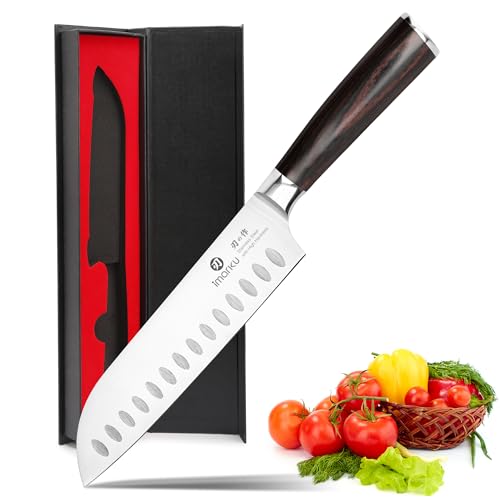
imarku
7-Inch Santoku Knife for Precision Slicing, Dicing & Mincing – High Carbon Japanese Steel with Pakkawood Handle
The imarku 7-inch Santoku knife combines a hollow scalloped edge and 15-18 degree hand-polished bevel to reduce drag and prevent food from sticking during high-volume prep work. Home cooks and apartment dwellers who want a restaurant-capable knife without the steep price will find it covers meat, vegetables, and bread with a single blade.
Pros and Cons
Pros
- The 2.5mm blade thickness paired with the hollow edge design handles both delicate julienne cuts and heavier chopping without flexing or wedging.
- Pakkawood handle construction offers a more sanitary and dimensionally stable grip than standard composite or natural wood handles.
- The 15-18 degree edge angle matches professional Japanese knife geometry, giving it a noticeably sharper out-of-box performance than German-style knives at this price.
- Versatile enough for meat, vegetables, fruit, and bread, making it a practical single-knife solution for small kitchens with limited storage.
Cons
- With zero verified reviews available, long-term edge retention and handle durability under daily use remain unconfirmed by real buyers.
- The 3-month refund window is shorter than the lifetime guarantees offered by competing brands at the same price point.

Zwilling
Henckels Santoku Knife 7-inch Hollow Edge German Stainless Steel
This 7-inch Santoku excels at mincing, slicing, and dicing with its hollow-edge blade that prevents food sticking during prep. Buy it if you want a durable, balanced Japanese-style knife that handles everyday vegetable work without the premium price tag.
Pros and Cons
Pros
- Hollow-edge grantons genuinely prevent cucumber and tomato slices from sticking to the blade mid-cut.
- German stainless steel holds its edge through repeated use on harder vegetables like carrots and beets.
- Fully forged construction creates noticeable weight and balance that makes repetitive dicing feel controlled and effortless.
Cons
- At 7 inches, it's smaller than Western chef's knives, requiring more frequent repositioning on larger vegetables.
- Dishwasher safe, but hand washing extends blade life and prevents potential handle loosening over time.

HOSHANHO
7-Inch Japanese Santoku Chef Knife | HOSHANHO High Carbon Stainless Steel
This 7-inch santoku slices vegetables, meat, and fish with a 15-degree blade angle that delivers thinner, more precise cuts than standard chef knives. Home cooks and professional chefs alike benefit from the triple-layer laminated steel construction that stays sharp longer and resists corrosion.
Pros and Cons
Pros
- The triple-layer laminated steel with 10Cr15CoMoV Japanese steel reaches 62HRC hardness, delivering edge retention that outlasts standard stainless blades.
- Ergonomic pakkawood handle provides secure grip and control without hand fatigue during extended prep sessions.
- 15-degree blade angle and hand-sharpened edge produce cleaner cuts through delicate vegetables and proteins compared to wider blade angles.
Cons
- Hand-washing required; dishwasher use will degrade the blade edge and handle finish over time.
- Requires regular honing to maintain the 15-degree angle; the initial sharpness will gradually diminish with normal kitchen use.

MercerCulinary
Mercer Genesis 7-Inch Santoku Knife: Professional Slicing & Mincing
This fully forged German steel santoku delivers razor-sharp precision for slicing vegetables and mincing herbs with its Granton edge that releases food cleanly. Buy it if you prep vegetables daily and want a professional-grade knife that won't require constant sharpening.
Pros and Cons
Pros
- Granton edge prevents food from sticking to the blade, making thin slicing of cucumbers, tomatoes, and fish noticeably faster than standard chef's knives.
- Ergonomic handle with substantial bolster reduces wrist strain during extended prep sessions and feels secure even when wet.
- Professional-grade construction at under $50 delivers the same German steel and forging process used in culinary schools.
Cons
- Requires hand-washing only; dishwasher use will damage the blade and handle, adding a maintenance step most busy cooks dislike.
- Santoku's shorter blade length and rectangular shape take practice if you're accustomed to Western chef's knives, requiring a learning curve.

Henckels Forged Accent 2-Piece Santoku Knife Set | German Stainless Steel
This 2-piece santoku set delivers razor-sharp German engineering for mincing, slicing, and dicing with effortless precision and lasting edge retention. Buy it if you prep vegetables daily and want knives that stay sharp without constant maintenance.
Pros and Cons
Pros
- Forged bolster transitions seamlessly from blade to handle, eliminating weak points that cause blade wobble during cutting.
- Satin-finished blade holds its edge noticeably longer than stamped knives, reducing the need for frequent sharpening.
- Two-knife set covers both precision work and larger prep tasks without requiring a full block of specialty knives.
Cons
- Santoku blade shape has a steeper learning curve than traditional chef's knives if you're accustomed to rocking motions.
- German stainless steel requires hand-washing to maintain edge longevity, despite being dishwasher-safe.
imarku 7-Inch Santoku Knife for Precision Slicing, Dicing & Mincing – High Carbon Japanese Steel with Pakkawood Handle
imarku
7-Inch Santoku Knife for Precision Slicing, Dicing & Mincing – High Carbon Japanese Steel with Pakkawood Handle
The imarku 7-inch Santoku knife combines a hollow scalloped edge and 15-18 degree hand-polished bevel to reduce drag and prevent food from sticking during high-volume prep work. Home cooks and apartment dwellers who want a restaurant-capable knife without the steep price will find it covers meat, vegetables, and bread with a single blade.
$39.99 at AmazonEditors' Favorite
Color: Brown and Silver Size: 7" Dimensions: 12 x 3 x 1 inches Weight: 0.43 pounds Product Group: Kitchen Binding: Kitchen
Shop NowZwilling Henckels Santoku Knife 7-inch Hollow Edge German Stainless Steel
Zwilling
Henckels Santoku Knife 7-inch Hollow Edge German Stainless Steel
This 7-inch Santoku excels at mincing, slicing, and dicing with its hollow-edge blade that prevents food sticking during prep. Buy it if you want a durable, balanced Japanese-style knife that handles everyday vegetable work without the premium price tag.
$79.95 at AmazonGreat Value
Brand Name: ZWILLING J.A. Henckels Manufacturer: ZWILLING UPC: 035886185930 Global Trade Identification Number: 00035886185930 Model Number: 31170-181 Manufacturer Part Number: 31170-181 -OPEN BOX Manufacturer Warranty Description: Lifetime Warranty Against Manufacturer'S Defects Item Type Name: Hollow Edge Santoku Knife Unit Count: 1.0 Count Included Components: Hollow Edge Santoku Knife Best Sellers Rank: #92,282 in Kitchen & Dining (See Top 100 in Kitchen & Dining) #244 in Bread Knives ASIN: B00068J2A0 Customer Reviews: 4.6 4.6 out of 5 stars (1,418) 4.6 out of 5 stars Blade Material Type: Stainless Steel Handle Material: Stainless Steel,Steel Is the item dishwasher safe?: No Material Type: ZWILLING Carbon No Stain Steel BladeLength: 7 Inches Item Weight: 6.4 ounces Item Length: 16 Inches Size: 7" Color: Stainless Steel Blade Color: Silver Blade Edge: Hollow Ground Construction Type: Forged Blade Material: Stainless Steel Brand: ZWILLING J.A. Henckels
Shop NowHOSHANHO 7-Inch Japanese Santoku Chef Knife | HOSHANHO High Carbon Stainless Steel
HOSHANHO
7-Inch Japanese Santoku Chef Knife | HOSHANHO High Carbon Stainless Steel
This 7-inch santoku slices vegetables, meat, and fish with a 15-degree blade angle that delivers thinner, more precise cuts than standard chef knives. Home cooks and professional chefs alike benefit from the triple-layer laminated steel construction that stays sharp longer and resists corrosion.
$52.99 at AmazonBrand Name: HOSHANHO Manufacturer: HOSHANHO UPC: 714757571477 Model Number: 7 inch Santoku Knife Manufacturer Part Number: HSHES-2022-002 Item Type Name: 7 inch Santoku Chef Knife Unit Count: 1.0 Count Included Components: 7 inch Santoku Knife Best Sellers Rank: #13,746 in Kitchen & Dining (See Top 100 in Kitchen & Dining) #29 in Chef's Knives ASIN: B0C1BQTQKL Customer Reviews: 4.7 4.7 out of 5 stars (1,742) 4.7 out of 5 stars Blade Edge: Plain Construction Type: Forged Blade Material Type: High Carbon Stainless Steel Handle Material: Pakkawood Is the item dishwasher safe?: No Material Type: High Carbon Stainless Steel BladeLength: 7 Inches Item Weight: 11.2 ounces Item Length: 7 Inches Size: 7" Color: Silver Blade Color: Silver Blade Material: High Carbon Stainless Steel Brand: HOSHANHO
Shop NowMercerCulinary Mercer Genesis 7-Inch Santoku Knife: Professional Slicing & Mincing
MercerCulinary
Mercer Genesis 7-Inch Santoku Knife: Professional Slicing & Mincing
This fully forged German steel santoku delivers razor-sharp precision for slicing vegetables and mincing herbs with its Granton edge that releases food cleanly. Buy it if you prep vegetables daily and want a professional-grade knife that won't require constant sharpening.
$39.95 at AmazonBrand Name: Mercer Culinary Manufacturer: Mercer Tool Corp. UPC: 749628445519 765301903244 Global Trade Identification Number: 00765301903244 Model Number: M20707 Manufacturer Part Number: M20707 Manufacturer Warranty Description: Lifetime limited manufacturer's warranty Item Type Name: Genesis Unit Count: 1.0 Count Included Components: Mercer Culinary Genesis 7-Inch Forged Santoku Knife Best Sellers Rank: #3,706 in Kitchen & Dining (See Top 100 in Kitchen & Dining) #15 in Santoku Knives ASIN: B000IBVD4I Customer Reviews: 4.8 4.8 out of 5 stars (1,577) 4.8 out of 5 stars Blade Material Type: High Carbon Steel Handle Material: Santoprene Is the item dishwasher safe?: No Material Type: Stainless steel and manmade BladeLength: 7 Inches Item Weight: 2.99 ounces Item Length: 14.05 Inches Size: 7" Color: Black Blade Color: Silver Blade Edge: Plain Construction Type: Forged Blade Material: High Carbon Steel Brand: Mercer Culinary
Shop NowHenckels Forged Accent 2-Piece Santoku Knife Set | German Stainless Steel
Henckels Forged Accent 2-Piece Santoku Knife Set | German Stainless Steel
This 2-piece santoku set delivers razor-sharp German engineering for mincing, slicing, and dicing with effortless precision and lasting edge retention. Buy it if you prep vegetables daily and want knives that stay sharp without constant maintenance.
$49.95 at AmazonBrand Name: HENCKELS Manufacturer: Henckels UPC: 035886649906 Model Number: 1021241 Manufacturer Part Number: 1021241 Item Type Name: Asian Knife Set Unit Count: 2.0 Count Included Components: 5" HE Santoku, 7" HE Santoku Best Sellers Rank: #41,522 in Kitchen & Dining (See Top 100 in Kitchen & Dining) #14 in Santoku Knives ASIN: B09RTDZ14W Customer Reviews: 4.6 4.6 out of 5 stars (284) 4.6 out of 5 stars Blade Edge: Plain Construction Type: Forged Blade Material Type: Stainless Steel Handle Material: Stainless Steel Is the item dishwasher safe?: Yes Material Type: Stainless Steel BladeLength: 5 Inches Item Weight: 9.07 g Item Length: 5 Inches Size: 2-pc Color: Black Blade Color: Silver Blade Material: Stainless Steel Brand: HENCKELS
Shop Now



Write Your Review
No reviews yet. Be the first to share your experience!