

TL;DR — A santoku that smells metallic, fishy, or oniony is almost never rotting food. The metallic tang is a real chemical reaction: reactive high-carbon steels like VG10, AUS-10, or a carbon core react with acids and sulfur compounds in food (onion, garlic, fish) to form a patina and trace iron salts you can smell and taste. Odor can also come from food trapped in the handle, a wet wooden handle harboring bacteria, or oxidized oil residue. Wash and dry the blade immediately, scrub the handle join, deodorize with lemon or baking soda, and the smell disappears. For a low-reactivity replacement, see our best santoku knife guide.
The HomeWhisk editorial team researches kitchen equipment by analyzing manufacturer specifications, steel behavior, and aggregated user reviews from major retailers and communities like Reddit r/chefknives and r/Cooking. A smelly knife is a common and fixable complaint, and the cause is usually chemistry or trapped moisture rather than anything spoiled.
If your santoku leaves a metallic smell on your hands or a strange odor on food, the good news is that the knife is not ruined and the food is safe. The odor points to a specific interaction between the blade steel, the handle materials, and what you have been cutting. Below is what is actually happening and how to clear it for good. If the reactivity bothers you enough to switch blades, our best santoku knife and best chef knife guides cover corrosion- and reaction-resistant steels.
The Metallic Smell: A Real Chemical Reaction
That “blood-like” or coppery metallic smell is not your imagination and it is not the food. When skin oils or acidic food contact iron, the iron reacts to form volatile organic compounds, chiefly 1-octen-3-one and related carbonyls, which the human nose detects at extremely low concentrations. In other words, you are not smelling the metal itself; you are smelling the odor molecules that iron catalyzes from oils and food acids.
This is far more pronounced on reactive Japanese steels. High-carbon blades such as VG10, AUS-10, and especially plain carbon cores (White/Shirogami and Blue/Aogami steel) have more exposed, reactive iron than a low-carbon German stainless. Cutting acidic or sulfurous food on them speeds the reaction, producing both a visible patina and a metallic scent transferred to food and hands. It is harmless, but it is a signature of reactive steel.
Onion, Garlic, and Fish: The Sulfur Problem
The most stubborn food smells on a santoku come from sulfur-containing foods. Onions and garlic release sulfur compounds (thiosulfinates and allyl sulfides) the moment their cells are cut. Fish leaves behind trimethylamine, the compound responsible for “fishy” odor. Both bond readily to a metal surface, and reactive steel accelerates the process.
Because sulfur compounds are chemically drawn to metal, simply rinsing with water does not remove them; the odor lingers on the blade and transfers to the next thing you cut. This is why the classic “stainless steel soap” bar works: rubbing metal under running water lets sulfur molecules bind to the sacrificial metal surface and rinse away. The same principle deodorizes your blade.
Trapped Food and the Handle Join
Not all knife odor is chemical. On many santokus, especially riveted Western-style handles or cheaper full-tang builds, tiny gaps exist where the handle scales meet the tang. Food particles, juices, and moisture work into these seams, and bacteria there produce genuine rotten or sour smells over time. A hidden gap at the bolster or the front of the handle is the number-one source of a truly foul (not metallic) odor.
Wooden and pakkawood handles compound the problem: if they are repeatedly soaked or run through a dishwasher, the wood absorbs moisture and food residue, cracks, and grows odor-causing bacteria and mildew. A knife that smells musty or sour rather than metallic almost always has an issue at the handle, not the blade.
Oxidized Oil and Board Cross-Contamination
Two more culprits are easy to miss. First, if you oil a carbon blade for storage (a good practice), old oil eventually oxidizes and turns rancid, giving a stale, paint-like smell. Refreshing the oil fixes it. Second, the cutting board can be the real source: a plastic board with deep knife scoring or a wooden board that stays damp harbors odors that transfer to the blade and back to your food. If the smell survives a thorough knife cleaning, suspect the board rather than the blade, and switch to a clean wood or plastic surface. If you are building out your kit, our best bread knife and best boning knife guides cover blades that keep you from overworking the santoku on the wrong foods.
How to Deodorize a Santoku Step by Step
Work through these in order; most knives are fixed by step three.
1. Wash immediately, by hand. Use warm water and mild dish soap right after cutting, before residue dries and bonds. Pay attention to the spine, the choil, and the front of the handle. Never use the dishwasher. 2. Neutralize sulfur with the metal-on-metal trick. Rub the blade (or your hands) against a stainless “soap” bar, or the inside of a stainless sink, under cold running water for 30 seconds. This binds and rinses away onion, garlic, and fish odors. 3. Deodorize with lemon or baking soda. Rub a cut lemon or a lime along the blade, or make a baking-soda paste and scrub gently, then rinse. Citric acid and baking soda both neutralize odor compounds. Keep acidic lemon contact brief on carbon steel. 4. Clean the handle seam. Use an old soft toothbrush with soapy water to scrub where the handle meets the tang and around any rivets. This clears trapped food that causes foul smells. 5. Dry completely, right away. Towel-dry the blade and handle; do not let the knife air-dry. Lingering moisture is what lets odor-causing bacteria grow. 6. Refresh storage oil on carbon blades. Wipe off old oil and apply a thin, fresh coat of food-safe mineral or camellia oil before storing.
If the smell persists after all this, the handle is likely cracked or delaminating internally and the knife may need replacing. See our best santoku knife and best knife sets guides for durable, sealed-handle options.
Frequently Asked Questions
Why does my knife make my food and hands smell metallic?
Iron in the blade catalyzes the formation of volatile odor molecules (mainly 1-octen-3-one) from skin oils and food acids. You are smelling those compounds, not the metal itself. Reactive high-carbon steels like VG10, AUS-10, and carbon cores have more exposed iron, so they produce a stronger metallic scent than low-carbon German stainless. It is completely harmless. Washing and drying the blade promptly, and rubbing it on stainless under water, removes the smell. A stainless or well-passivated blade minimizes it.
Is it safe to keep using a knife that smells bad?
A metallic smell is safe; it is a harmless chemical reaction and the food is fine to eat. A sour, musty, or rotten smell is different: it usually means bacteria are growing in food trapped at the handle join or in a damp wooden handle, which is a hygiene concern. In that case, deep-clean the handle seam and dry the knife thoroughly before using it again. If a foul smell keeps returning despite cleaning, the handle may be compromised and the knife should be replaced.
How do I get onion and garlic smell off my santoku?
Sulfur compounds from onion and garlic bond to metal and resist plain water. Rub the blade against a stainless steel “soap” bar, or the inside of your stainless sink, under cold running water for about 30 seconds; the sulfur transfers to the sacrificial metal and rinses away. You can also rub the blade with a cut lemon or a baking-soda paste, then rinse and dry. Doing this right after cutting, before the residue dries, works best.
Why does my wooden-handled knife smell musty or sour?
Wooden and pakkawood handles absorb water and food residue if they are soaked or run through a dishwasher. The trapped moisture breeds odor-causing bacteria and mildew, and the wood can crack, opening more space for gunk. Scrub the handle with a soft toothbrush and soapy water, dry it completely, and occasionally wipe it with a little food-safe mineral oil to reseal the surface. Never submerge or dishwasher a wooden handle. If it has cracked deeply, the odor may be permanent.
Does the metallic smell mean my knife is rusting?
Not necessarily, but it can be an early sign on reactive steel. The metallic odor comes from the iron reacting with oils and acids, the same reactivity that also leads to patina and, if the blade is left wet, rust. Smell and rust share a root cause but are not the same thing. If you also see reddish-brown spots, address the rust with a vinegar soak or baking-soda scrub. Either way, drying the blade immediately after washing prevents both odor and corrosion.
Will a stainless santoku smell less than a carbon one?
Generally yes. Higher-chromium, lower-carbon stainless has less reactive exposed iron, so it produces less of the metallic odor and resists the food-reaction patina that carbon steel develops. It will not be completely odorless, since any iron-bearing steel reacts somewhat, but the difference is noticeable. If reactivity and smell bother you, a fully stainless santoku is the practical choice. Our guides cover both reactive-steel and stainless options.
The Bottom Line
A bad-smelling santoku is a solvable problem with a clear cause. A metallic tang is a harmless reaction between reactive steel and the oils, acids, and sulfur in your food, worst on high-carbon blades like VG10, AUS-10, and carbon cores. A sour or rotten smell instead points to food and moisture trapped at the handle join or in a soaked wooden handle. The fix is the same routine either way: hand-wash immediately, deodorize with stainless-on-stainless or lemon and baking soda, scrub the handle seam, and dry completely. If the odor keeps coming back from a cracked handle, it is time to upgrade. See our best santoku knife, best chef knife, and best knife sets guides.
imarku
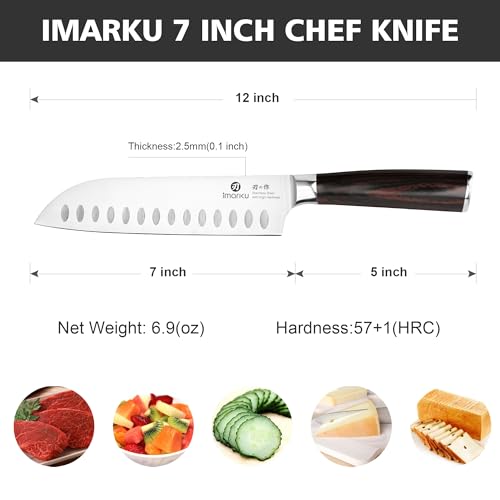
7-Inch Santoku Knife for Precision Slicing, Dicing & Mincing – High Carbon Japanese Steel with Pakkawood Handle
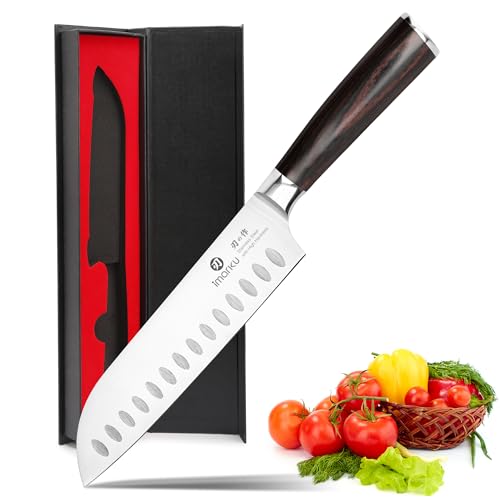
The imarku 7-inch Santoku knife combines a hollow scalloped edge and 15-18 degree hand-polished bevel to reduce drag and prevent food from sticking during high-volume prep work. Home cooks and apartment dwellers who want a restaurant-capable knife without the steep price will find it covers meat, vegetables, and bread with a single blade.
Pros and Cons
Pros
- The 2.5mm blade thickness paired with the hollow edge design handles both delicate julienne cuts and heavier chopping without flexing or wedging.
- Pakkawood handle construction offers a more sanitary and dimensionally stable grip than standard composite or natural wood handles.
- The 15-18 degree edge angle matches professional Japanese knife geometry, giving it a noticeably sharper out-of-box performance than German-style knives at this price.
- Versatile enough for meat, vegetables, fruit, and bread, making it a practical single-knife solution for small kitchens with limited storage.
Cons
- With zero verified reviews available, long-term edge retention and handle durability under daily use remain unconfirmed by real buyers.
- The 3-month refund window is shorter than the lifetime guarantees offered by competing brands at the same price point.

Zwilling
Henckels Santoku Knife 7-inch Hollow Edge German Stainless Steel
This 7-inch Santoku excels at mincing, slicing, and dicing with its hollow-edge blade that prevents food sticking during prep. Buy it if you want a durable, balanced Japanese-style knife that handles everyday vegetable work without the premium price tag.
Pros and Cons
Pros
- Hollow-edge grantons genuinely prevent cucumber and tomato slices from sticking to the blade mid-cut.
- German stainless steel holds its edge through repeated use on harder vegetables like carrots and beets.
- Fully forged construction creates noticeable weight and balance that makes repetitive dicing feel controlled and effortless.
Cons
- At 7 inches, it's smaller than Western chef's knives, requiring more frequent repositioning on larger vegetables.
- Dishwasher safe, but hand washing extends blade life and prevents potential handle loosening over time.

HOSHANHO
7-Inch Japanese Santoku Chef Knife | HOSHANHO High Carbon Stainless Steel
This 7-inch santoku slices vegetables, meat, and fish with a 15-degree blade angle that delivers thinner, more precise cuts than standard chef knives. Home cooks and professional chefs alike benefit from the triple-layer laminated steel construction that stays sharp longer and resists corrosion.
Pros and Cons
Pros
- The triple-layer laminated steel with 10Cr15CoMoV Japanese steel reaches 62HRC hardness, delivering edge retention that outlasts standard stainless blades.
- Ergonomic pakkawood handle provides secure grip and control without hand fatigue during extended prep sessions.
- 15-degree blade angle and hand-sharpened edge produce cleaner cuts through delicate vegetables and proteins compared to wider blade angles.
Cons
- Hand-washing required; dishwasher use will degrade the blade edge and handle finish over time.
- Requires regular honing to maintain the 15-degree angle; the initial sharpness will gradually diminish with normal kitchen use.

MercerCulinary
Mercer Genesis 7-Inch Santoku Knife: Professional Slicing & Mincing
This fully forged German steel santoku delivers razor-sharp precision for slicing vegetables and mincing herbs with its Granton edge that releases food cleanly. Buy it if you prep vegetables daily and want a professional-grade knife that won't require constant sharpening.
Pros and Cons
Pros
- Granton edge prevents food from sticking to the blade, making thin slicing of cucumbers, tomatoes, and fish noticeably faster than standard chef's knives.
- Ergonomic handle with substantial bolster reduces wrist strain during extended prep sessions and feels secure even when wet.
- Professional-grade construction at under $50 delivers the same German steel and forging process used in culinary schools.
Cons
- Requires hand-washing only; dishwasher use will damage the blade and handle, adding a maintenance step most busy cooks dislike.
- Santoku's shorter blade length and rectangular shape take practice if you're accustomed to Western chef's knives, requiring a learning curve.

Henckels Forged Accent 2-Piece Santoku Knife Set | German Stainless Steel
This 2-piece santoku set delivers razor-sharp German engineering for mincing, slicing, and dicing with effortless precision and lasting edge retention. Buy it if you prep vegetables daily and want knives that stay sharp without constant maintenance.
Pros and Cons
Pros
- Forged bolster transitions seamlessly from blade to handle, eliminating weak points that cause blade wobble during cutting.
- Satin-finished blade holds its edge noticeably longer than stamped knives, reducing the need for frequent sharpening.
- Two-knife set covers both precision work and larger prep tasks without requiring a full block of specialty knives.
Cons
- Santoku blade shape has a steeper learning curve than traditional chef's knives if you're accustomed to rocking motions.
- German stainless steel requires hand-washing to maintain edge longevity, despite being dishwasher-safe.
imarku 7-Inch Santoku Knife for Precision Slicing, Dicing & Mincing – High Carbon Japanese Steel with Pakkawood Handle
imarku
7-Inch Santoku Knife for Precision Slicing, Dicing & Mincing – High Carbon Japanese Steel with Pakkawood Handle
The imarku 7-inch Santoku knife combines a hollow scalloped edge and 15-18 degree hand-polished bevel to reduce drag and prevent food from sticking during high-volume prep work. Home cooks and apartment dwellers who want a restaurant-capable knife without the steep price will find it covers meat, vegetables, and bread with a single blade.
$39.99 at AmazonEditors' Favorite
Color: Brown and Silver Size: 7" Dimensions: 12 x 3 x 1 inches Weight: 0.43 pounds Product Group: Kitchen Binding: Kitchen
Shop NowZwilling Henckels Santoku Knife 7-inch Hollow Edge German Stainless Steel
Zwilling
Henckels Santoku Knife 7-inch Hollow Edge German Stainless Steel
This 7-inch Santoku excels at mincing, slicing, and dicing with its hollow-edge blade that prevents food sticking during prep. Buy it if you want a durable, balanced Japanese-style knife that handles everyday vegetable work without the premium price tag.
$79.95 at AmazonGreat Value
Brand Name: ZWILLING J.A. Henckels Manufacturer: ZWILLING UPC: 035886185930 Global Trade Identification Number: 00035886185930 Model Number: 31170-181 Manufacturer Part Number: 31170-181 -OPEN BOX Manufacturer Warranty Description: Lifetime Warranty Against Manufacturer'S Defects Item Type Name: Hollow Edge Santoku Knife Unit Count: 1.0 Count Included Components: Hollow Edge Santoku Knife Best Sellers Rank: #92,282 in Kitchen & Dining (See Top 100 in Kitchen & Dining) #244 in Bread Knives ASIN: B00068J2A0 Customer Reviews: 4.6 4.6 out of 5 stars (1,418) 4.6 out of 5 stars Blade Material Type: Stainless Steel Handle Material: Stainless Steel,Steel Is the item dishwasher safe?: No Material Type: ZWILLING Carbon No Stain Steel BladeLength: 7 Inches Item Weight: 6.4 ounces Item Length: 16 Inches Size: 7" Color: Stainless Steel Blade Color: Silver Blade Edge: Hollow Ground Construction Type: Forged Blade Material: Stainless Steel Brand: ZWILLING J.A. Henckels
Shop NowHOSHANHO 7-Inch Japanese Santoku Chef Knife | HOSHANHO High Carbon Stainless Steel
HOSHANHO
7-Inch Japanese Santoku Chef Knife | HOSHANHO High Carbon Stainless Steel
This 7-inch santoku slices vegetables, meat, and fish with a 15-degree blade angle that delivers thinner, more precise cuts than standard chef knives. Home cooks and professional chefs alike benefit from the triple-layer laminated steel construction that stays sharp longer and resists corrosion.
$52.99 at AmazonBrand Name: HOSHANHO Manufacturer: HOSHANHO UPC: 714757571477 Model Number: 7 inch Santoku Knife Manufacturer Part Number: HSHES-2022-002 Item Type Name: 7 inch Santoku Chef Knife Unit Count: 1.0 Count Included Components: 7 inch Santoku Knife Best Sellers Rank: #13,746 in Kitchen & Dining (See Top 100 in Kitchen & Dining) #29 in Chef's Knives ASIN: B0C1BQTQKL Customer Reviews: 4.7 4.7 out of 5 stars (1,742) 4.7 out of 5 stars Blade Edge: Plain Construction Type: Forged Blade Material Type: High Carbon Stainless Steel Handle Material: Pakkawood Is the item dishwasher safe?: No Material Type: High Carbon Stainless Steel BladeLength: 7 Inches Item Weight: 11.2 ounces Item Length: 7 Inches Size: 7" Color: Silver Blade Color: Silver Blade Material: High Carbon Stainless Steel Brand: HOSHANHO
Shop NowMercerCulinary Mercer Genesis 7-Inch Santoku Knife: Professional Slicing & Mincing
MercerCulinary
Mercer Genesis 7-Inch Santoku Knife: Professional Slicing & Mincing
This fully forged German steel santoku delivers razor-sharp precision for slicing vegetables and mincing herbs with its Granton edge that releases food cleanly. Buy it if you prep vegetables daily and want a professional-grade knife that won't require constant sharpening.
$39.95 at AmazonBrand Name: Mercer Culinary Manufacturer: Mercer Tool Corp. UPC: 749628445519 765301903244 Global Trade Identification Number: 00765301903244 Model Number: M20707 Manufacturer Part Number: M20707 Manufacturer Warranty Description: Lifetime limited manufacturer's warranty Item Type Name: Genesis Unit Count: 1.0 Count Included Components: Mercer Culinary Genesis 7-Inch Forged Santoku Knife Best Sellers Rank: #3,706 in Kitchen & Dining (See Top 100 in Kitchen & Dining) #15 in Santoku Knives ASIN: B000IBVD4I Customer Reviews: 4.8 4.8 out of 5 stars (1,577) 4.8 out of 5 stars Blade Material Type: High Carbon Steel Handle Material: Santoprene Is the item dishwasher safe?: No Material Type: Stainless steel and manmade BladeLength: 7 Inches Item Weight: 2.99 ounces Item Length: 14.05 Inches Size: 7" Color: Black Blade Color: Silver Blade Edge: Plain Construction Type: Forged Blade Material: High Carbon Steel Brand: Mercer Culinary
Shop NowHenckels Forged Accent 2-Piece Santoku Knife Set | German Stainless Steel
Henckels Forged Accent 2-Piece Santoku Knife Set | German Stainless Steel
This 2-piece santoku set delivers razor-sharp German engineering for mincing, slicing, and dicing with effortless precision and lasting edge retention. Buy it if you prep vegetables daily and want knives that stay sharp without constant maintenance.
$49.95 at AmazonBrand Name: HENCKELS Manufacturer: Henckels UPC: 035886649906 Model Number: 1021241 Manufacturer Part Number: 1021241 Item Type Name: Asian Knife Set Unit Count: 2.0 Count Included Components: 5" HE Santoku, 7" HE Santoku Best Sellers Rank: #41,522 in Kitchen & Dining (See Top 100 in Kitchen & Dining) #14 in Santoku Knives ASIN: B09RTDZ14W Customer Reviews: 4.6 4.6 out of 5 stars (284) 4.6 out of 5 stars Blade Edge: Plain Construction Type: Forged Blade Material Type: Stainless Steel Handle Material: Stainless Steel Is the item dishwasher safe?: Yes Material Type: Stainless Steel BladeLength: 5 Inches Item Weight: 9.07 g Item Length: 5 Inches Size: 2-pc Color: Black Blade Color: Silver Blade Material: Stainless Steel Brand: HENCKELS
Shop Now




Write Your Review
No reviews yet. Be the first to share your experience!