

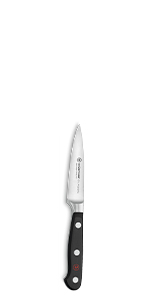
If you’re asking why is my chef knife smells bad, the short answer is trapped residue: food oils, proteins and moisture that settle into the handle seam, the bolster, a scratched blade surface or a dirty storage slot, where bacteria break them down into that sour, fishy or metallic odor. The steel itself doesn’t make the smell. What sits on it, or next to it, does.
This guide walks through where the smell actually comes from, how to clean each spot, which habits keep it from coming back, and when it’s time to stop scrubbing and replace the knife. You’ll know within a few minutes whether you’re dealing with a cleaning problem, a storage problem or a worn-out knife.
Where the smell comes from
Start with your nose and narrow it down. Smell the blade, then the spine, then the spot where the blade meets the handle, then the handle itself. Odor almost always concentrates in one place, and that place tells you what’s going on.
A fishy or garlicky smell on the blade usually means oil residue. Garlic, onion and fish all leave sulfur compounds and fats that cling to steel, especially if the knife sat on the cutting board for an hour before you washed it. Plain water won’t lift them. You need soap and a little friction.
A sour or musty smell near the handle is different. That points to moisture and food particles caught in the gap between the handle scales and the tang, or in hairline cracks in a wooden handle. Bacteria love that warm, damp pocket. This is the most common source of a stubborn knife smell, and it’s the one people miss because they only wipe the blade.
A metallic, almost coppery smell often comes from light surface rust or a reaction with acidic foods like tomatoes, citrus and vinegar. High-carbon steel is more reactive than standard stainless, so it picks up this smell faster if it’s left wet.
If your current knife has a cracked handle or deep gaps you can’t clean, a full-tang design with a sealed handle is easier to keep fresh. The Deeny Jarte set is one budget option built that way, with a full tang running through the handle.

Deeny Jarte
Faster Daily Meal Prep with Deeny Jarte 3-Piece Chef Knife Set, High-Carbon Stainless Steel
This three-knife set handles chopping, slicing, peeling, and trimming, with full-tang construction and 5Cr15MoV steel for balanced, chip-resistant performance. It suits home cooks, culinary students, and professional chefs who want three versatile knives for most daily prep.
Pros and Cons
Pros
- Full-tang construction supports balance during repeated chopping and slicing.
- The three blade sizes cover most everyday kitchen preparation tasks.
- 5Cr15MoV steel is hardened to 57±2 HRC for a balance of edge retention and chip resistance.
- Dishwasher-safe construction simplifies cleanup, although hand washing is recommended.
Cons
- The manufacturer recommends hand washing for the best long-term care despite dishwasher-safe construction.
- Product weight is not specified, so buyers cannot compare heft before purchase.
Deeny Jarte Faster Daily Meal Prep with Deeny Jarte 3-Piece Chef Knife Set, High-Carbon Stainless Steel
Deeny Jarte
Faster Daily Meal Prep with Deeny Jarte 3-Piece Chef Knife Set, High-Carbon Stainless Steel
This three-knife set handles chopping, slicing, peeling, and trimming, with full-tang construction and 5Cr15MoV steel for balanced, chip-resistant performance. It suits home cooks, culinary students, and professional chefs who want three versatile knives for most daily prep.
$16.79 at AmazonEditors' Favorite
Color: Silver Size: 8" Product Group: BISS
Shop NowHow to clean a smelly chef knife
Most odor problems clear up with one careful wash. The trick is cleaning the places a quick rinse skips. Here’s the order that works.
Wash the blade with hot soapy water
Use hot water, a drop of dish soap and the soft side of a sponge. Wipe from the spine toward the edge, never along the edge, so you don’t cut the sponge or yourself. Spend extra time on any textured or patterned areas of the blade, since residue hides in those grooves. Rinse well. Soap left behind can carry its own stale smell.
Scrub the bolster and handle seam
This is the step that fixes most cases. Take a soft toothbrush or a small bottle brush, add soapy water and work it into the joint where the blade enters the handle. Then run it along both sides of the handle where the scales meet the tang. You’ll often see gray or brown gunk come out. That’s your smell.
Neutralize lingering odor
If a smell remains after washing, mix one tablespoon of baking soda with enough water to make a paste. Rub it on the blade and handle, let it sit for 5 minutes, then rinse. For garlic and fish smells, a quick wipe with white vinegar or lemon juice also helps, but rinse it off within a minute or two and dry right away. Acid left on high-carbon steel can cause spotting.
Rub the blade on stainless steel
An old kitchen trick: rub the flat of the blade against a stainless steel sink or spoon under running water. It’s commonly used for garlic and onion smell on hands, and many cooks use the same idea on knives. It won’t hurt the edge as long as you keep the edge away from the metal.
Dry it completely
Towel-dry the blade, the bolster and the handle, then let the knife air out for 10 minutes before you put it away. Moisture trapped in a block or sheath is how a clean knife starts smelling again by morning.
Storage is often the real problem
Sometimes the knife is clean and the smell keeps coming back. Check where it lives. A wooden knife block can collect crumbs, water and mold deep inside its slots, and every time you slide the knife in, it picks up that odor again.
Clean or retire the knife block
Turn the block upside down and shake it out. Then use a pipe cleaner or thin bottle brush with soapy water in each slot, rinse, and let the block dry upside down for a full day. If the slots still smell musty after that, the wood has likely absorbed moisture for too long. A magnetic strip or a drawer insert is easier to keep clean.
Use sheaths that dry properly
Blade guards protect the edge in a drawer, but they also trap water if the knife goes in damp. Wash the sheath itself every week or two and make sure both the knife and the guard are dry before you put them together.
If you’d rather store knives in a drawer, the Joseph Joseph Slice & Sharpen set comes with sharpening protective sheaths for a 6″ chef’s knife and a 3.5″ paring knife. Sheaths you can pull off and rinse are simpler to keep fresh than a wooden block with deep slots.

Joseph Joseph
Self-Sharpening Chef and Paring Knife Duo for Everyday Prep: Joseph Joseph Slice & Sharpen 2-Piece Set
This two-knife set pairs a 6-inch chef's knife and 3.5-inch paring knife with sheaths that hold built-in ceramic sharpeners, so each blade gets a quick edge refresh as you pull it out. It suits small-kitchen cooks and first-apartment setups who want sharp knives without buying or learning a separate sharpening tool.
Pros and Cons
Pros
- Sharpening and storage are combined in one piece, so nothing extra takes up drawer or counter space.
- Stainless-steel blades with a non-stick coating cut cleanly through moist ingredients that normally stick.
- The sheath's non-slip base makes the sharpening motion steady and controlled.
- Two blade sizes cover the majority of daily kitchen prep without a full block set.
Cons
- The integrated sharpener works only on plain stainless-steel edges, so serrated and ceramic knives from your existing kitchen cannot use it.
- A 6-inch chef's knife is short for breaking down large squash, melons, or whole poultry.
Joseph Joseph Self-Sharpening Chef and Paring Knife Duo for Everyday Prep: Joseph Joseph Slice & Sharpen 2-Piece Set
Joseph Joseph
Self-Sharpening Chef and Paring Knife Duo for Everyday Prep: Joseph Joseph Slice & Sharpen 2-Piece Set
This two-knife set pairs a 6-inch chef's knife and 3.5-inch paring knife with sheaths that hold built-in ceramic sharpeners, so each blade gets a quick edge refresh as you pull it out. It suits small-kitchen cooks and first-apartment setups who want sharp knives without buying or learning a separate sharpening tool.
$17.99 at AmazonEditors' Favorite
Color: Black Size: 6" Dimensions: 1.77 x 12.2 x 0.51 Inches Weight: 0.41667367518 pounds Product Group: Kitchen Binding: Kitchen
Shop NowCommon mistakes that make knives smell
A few everyday habits cause most of the trouble. None of them are dramatic. They just add up.
Leaving the knife in the sink is the big one. A blade soaking in dirty dishwater for hours sits in diluted food waste, and water works its way into the handle joint. Wash and dry the knife right after you finish cutting. It takes about 60 seconds.
Running it through the dishwasher is the second. Even when a product listing says dishwasher safe, the long hot cycle, harsh detergent and steam can loosen handle scales over time and leave water inside the seam. Hand washing is gentler on any knife, and on any handle.
Skipping the handle is the third. People wipe the blade and forget that the handle touched raw chicken, onion juice and wet hands. Wash it every time.
Using a dirty cutting board is the fourth. A deeply scored wooden or plastic board holds juices in its grooves and transfers smell straight back to a freshly cleaned knife. Scrub the board with hot soapy water and replace plastic boards once the cuts get deep. For more on choosing a knife that holds up to daily prep, see our guide to the best chef knife.
And storing it wet. Already covered, but it’s worth repeating because it’s the habit that undoes every other fix.
Does the steel type matter?
Somewhat. Standard stainless steel resists rust and odor well because chromium forms a protective layer on the surface. High-carbon stainless steel, which most of the knives in this guide use, holds a sharper edge but can be a bit more reactive if it’s left wet or in contact with acid.
That doesn’t mean high-carbon blades smell worse in normal use. It means they reward good habits. Wash, dry and store them dry and they’ll stay neutral. Leave one wet overnight after cutting lemons and you may get a metallic smell or a faint spot.
Blade texture also plays a role. A textured or anti-stick surface helps food release while you chop, but any pattern gives residue more places to sit. A soft brush handles that in a few seconds. If you’re comparing materials before buying, our roundups of the best Japanese chef knife and the best German chef knife explain how different steels behave in a home kitchen.
When to replace your chef knife
Cleaning fixes most smells. Not all of them. Replace the knife when the odor keeps returning after a thorough brush-and-baking-soda clean, because that usually means water and residue have worked somewhere you can’t reach.
Signs it’s time: a wooden handle with cracks, a gap you can see between the handle and the tang, scales that wiggle, rust that comes back within a day of cleaning, or a black, musty smell from the handle itself. A handle that’s absorbed moisture for months won’t come back to neutral.
The good news is that a replacement doesn’t have to cost much. Budget picks in our best cheap chef knife and best chef knife under 50 guides cover options that are easy to care for. If you want a single 8-inch blade, the Hinye chef knife pairs high-carbon stainless steel with a blackwood handle and a textured anti-stick blade, and its listing describes it as rustproof. Hand wash it anyway to keep the handle sealed.

Hinye
8-Inch Chef Knife for Daily Chopping and Slicing: Hinye German 1.4116 Steel Blade with Blackwood Handle
This 8-inch chef knife handles everyday chopping, slicing, and dicing with a German 1.4116 high-carbon stainless blade honed to a 15-degree edge that cuts through dense produce with noticeably less downward force. It suits home cooks who prep in volume and want a contoured, anti-slip handle that stays comfortable through a full mise en place session.
Pros and Cons
Pros
- German 1.4116 steel is a proven cutlery-grade alloy that balances edge retention with easy resharpening.
- The textured blade face genuinely helps with sticky, starchy foods that normally cling to a flat blade.
- The 8-inch length is the standard all-purpose size, covering everything from herbs to roasts.
- Blackwood handle and full gift box presentation punch above what the blade typically offers at this tier.
Cons
- Despite the dishwasher-safe claim, the wood handle will dry out and the edge will dull faster in a dishwasher, so hand washing is effectively required.
- The listing's percentage claims about reduced force, comfort, and food adhesion are marketing figures with no published testing behind them.
Hinye 8-Inch Chef Knife for Daily Chopping and Slicing: Hinye German 1.4116 Steel Blade with Blackwood Handle
Hinye
8-Inch Chef Knife for Daily Chopping and Slicing: Hinye German 1.4116 Steel Blade with Blackwood Handle
This 8-inch chef knife handles everyday chopping, slicing, and dicing with a German 1.4116 high-carbon stainless blade honed to a 15-degree edge that cuts through dense produce with noticeably less downward force. It suits home cooks who prep in volume and want a contoured, anti-slip handle that stays comfortable through a full mise en place session.
$9.39 at AmazonEditors' Favorite
Color: Black Wood Size: 8.4 inches Dimensions: 13.3 x 0.1 x 1.8 Inches Weight: 0.83996121822 Pounds Product Group: Kitchen
Shop NowIf you’d rather replace several knives at once, a set can be better value than buying one at a time. Our best chef knife set guide compares sets by size, steel and storage.
FAQ
Why does my knife smell like fish even after washing?
Fish oils cling to steel and don’t rinse off with water alone. Wash with hot water and dish soap, then rub on a baking soda paste for 5 minutes and rinse. Check the handle seam too, since oils often collect there.
Can bacteria grow on a chef knife?
Yes, mostly in the handle joint, cracks in a wooden handle, or inside a dirty knife block or sheath. A clean, dry blade surface doesn’t hold much. Washing and drying right after use keeps bacteria from building up.
Is it safe to use a knife that smells bad?
A smell means residue or bacteria are present, so clean it before you cut food again. If the odor disappears after a thorough wash, the knife is fine to use. If it comes back fast, the handle may be damaged and replacement is the safer choice.
Why does my knife smell metallic?
A metallic smell usually comes from light surface rust or a reaction with acidic foods. Wash and dry the knife right after cutting tomatoes, citrus or anything pickled. High-carbon steel is a little more prone to this than standard stainless.
How often should I clean my knife block?
Shake it out weekly and give the slots a full brush-and-dry clean about once a month. If it smells musty after cleaning, switch to a magnetic strip or drawer storage. A smelly block will keep passing odor to clean knives.





Write Your Review
No reviews yet. Be the first to share your experience!