

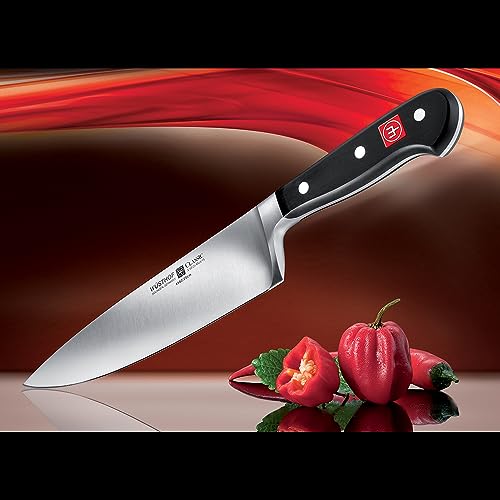
If you’re asking “why is my chef knife leaking,” the answer is almost always water or residue escaping from a gap in the handle, a loose rivet or bolster seam, or a pivot joint, and less often a dark film coming off the blade itself. A solid steel blade can’t leak. What you’re seeing is something that got in earlier and is working its way back out: dishwater, food juices, rust-tinted moisture, softened glue, or oil.
This guide walks through each source in the order you’re most likely to find it, shows you how to tell them apart with a paper towel and a few minutes of drying time, and explains which problems you can fix at home and which mean the knife has reached the end of its useful life.
Start with the handle: trapped water is the usual culprit
Most chef knives are built one of three ways. A full-tang knife has a strip of steel running the length of the handle, with two scales riveted or glued to either side. A partial or hidden-tang knife has a narrower spike of steel pushed into a one-piece handle and held with adhesive. A one-piece stamped or molded knife has a plastic or composite handle formed around the tang. Every one of those designs has joints, and every joint is a place where water can sit.
When a knife soaks in the sink or rides through a dishwasher cycle, hot water pushes into hairline gaps between the scales and the tang. The handle then looks dry on the outside. Hours later, sometimes the next day, you pick it up, squeeze, and a thin line of cloudy or brownish liquid appears along the seam or around a rivet. That’s the “leak.” It isn’t coming from the steel. It’s last night’s dishwater.
The quick check: wipe the handle completely dry, wrap it in a dry paper towel, and leave it handle-down in a cup for about 30 minutes. Unwrap it. Damp spots that line up with a rivet, the bolster, or the end cap tell you exactly where the gap is. Clear liquid means plain water. Orange or brown liquid means the hidden part of the tang has started to rust.
Folding knives deserve a special mention here, because their design puts a moving joint right where the blade meets the handle. The TACRAY Folding Kitchen Chef Knife is a good example: it’s a 4.4″ foldable camping knife with a 10cr15mov stainless steel blade and a G10 handle, built for both indoor and outdoor cooking. G10 is a fiberglass laminate that doesn’t absorb water the way wood does, which helps. The pivot is still a gap, though, and after a rinse at a campsite it can hold a few drops that drip out later. If you cook outdoors and want a blade that packs small, it’s a reasonable pick. Just open it fully, rinse, and dry the pivot area with the blade open before folding it back.

TACRAY
Indoor and Outdoor Food Prep: TACRAY Folding Kitchen Chef Knife with 4.4-Inch 10Cr15Mov Blade
The TACRAY folding chef knife handles fruits, vegetables, meats, and camping prep with a corrosion-resistant 10Cr15Mov blade, while its folding design makes storage and transport easier. It suits home cooks and campers who want one compact knife for indoor and outdoor cooking.
Pros and Cons
Pros
- The 10Cr15Mov stainless steel blade offers sharpness, hardness, toughness, and corrosion resistance.
- The G10 handle resists moisture, abrasion, and corrosion while providing a secure grip.
- The folding design supports both kitchen use and camping cooking without requiring a separate outdoor knife.
- The wide-blade opening hole and locking button support controlled handling.
Cons
- The 4.4-inch blade provides less cutting length than a full-size chef knife.
- Closing the blade requires pressing the middle locking button, so it is not as quick as a fixed-blade knife.
TACRAY Indoor and Outdoor Food Prep: TACRAY Folding Kitchen Chef Knife with 4.4-Inch 10Cr15Mov Blade
TACRAY
Indoor and Outdoor Food Prep: TACRAY Folding Kitchen Chef Knife with 4.4-Inch 10Cr15Mov Blade
The TACRAY folding chef knife handles fruits, vegetables, meats, and camping prep with a corrosion-resistant 10Cr15Mov blade, while its folding design makes storage and transport easier. It suits home cooks and campers who want one compact knife for indoor and outdoor cooking.
$39.51 at AmazonEditors' Favorite
Color: Orange Size: 10 inches Dimensions: 10.09842518655 x 0.01 x 0.01 Inches Weight: 0.33 Pounds Product Group: Kitchen Binding: Kitchen
Shop NowOther things that look like a leak
Not every drip is water. Once you’ve ruled out the handle, a few other causes are worth checking. Each one has a different color, texture, or smell, so the paper towel trick works here too.
Rust bleeding from the tang or rivets
Stainless steel resists rust, but it isn’t rust-proof. The section of tang hidden under the handle scales never sees air or a drying towel, so it’s the first place corrosion starts on a knife that’s washed often and dried quickly. The result is a brown or orange stain that seeps from the seam and can transfer to your hand or a cutting board. A light ring around a rivet is cosmetic. A steady brown weep after every wash means the corrosion is inside, where you can’t scrub it.
Dark gray film from the blade
Carbon steel and some high-carbon blends react with acidic foods like onions, tomatoes, and citrus. That reaction can leave a gray or black smear on the food and on a damp towel. It’s oxidation, not a leak, and it’s normal for reactive steels. A new knife can also shed a little polishing compound in the first few washes. Both wipe away. Neither should come from the handle seam.
Sticky or tacky residue
Rubberized and soft-touch handles can break down with heat, sunlight, and harsh detergent. When they do, the surface turns sticky and can feel like something is oozing out. Cheaper hidden-tang knives sometimes show softened adhesive at the point where the blade enters the handle, especially after repeated dishwasher cycles. If the residue is tacky rather than wet, you’re looking at material breakdown, not trapped water.
Oil from a wooden handle
Wood handles are often finished with mineral oil or a similar food-safe oil. If someone recently re-oiled the handle and didn’t wipe off the excess, it can bead up along the grain or seams for a day or two. It feels slick, smells faintly of oil, and fades on its own.
How to dry a knife so it stops leaking
Once water gets into a handle, the fix is to get it out and keep it from getting back in. Here’s the routine that works for most knives.
Hand wash only. Use warm water and a drop of dish soap, wash the blade and handle in under a minute, and never leave the knife soaking. Then dry it immediately with a towel, paying attention to the bolster, rivets, and the spine where the handle meets the blade. After that, stand it upright, handle down, in a dry spot or on a magnetic strip for an hour before putting it in a drawer or block. Gravity pulls any remaining water out of the seam and onto the counter instead of deeper into the handle.
If the knife has already been leaking for a while, give it a longer dry-out. Leave it in a warm, airy spot overnight, away from direct heat. Don’t put it in an oven or on a radiator. Heat can loosen adhesive and crack wooden scales, which makes the gap worse.
Another way to sidestep the problem: choose a blade that can’t rust in the first place. Ceramic knives aren’t made of steel, so there’s no tang to corrode and no rust to bleed out of a seam. The Kyocera FK-140-WH Ceramic Santoku is a 5.5″ white ceramic blade sold as a chef knife for everyday cooking. Ceramic stays sharp for a long time and won’t react with acidic foods, so there’s no gray film either. The trade-off is that ceramic is brittle. It can chip if it hits a bone, a frozen block, or a hard countertop, and you shouldn’t use it for prying or twisting. It’s best as a slicing and dicing knife for produce and boneless proteins, alongside a steel knife for heavier work.
KYOCERA FK-140-WH Ceramic Santoku, Chef Knife for Your Cooking Needs, 5.5”, White

Editors' Favorite
Color: White Size: 5-1/2-inch Dimensions: 13.1 x 2.9 x 1.1 Inches Weight: 0.18 pounds Product Group: BISS Binding: Apparel
Shop NowCommon mistakes that cause leaking
Nearly every leaking knife has the same backstory. Here are the habits that cause it.
The dishwasher is the big one. High heat, long exposure, and alkaline detergent attack handle joints from every side. Even knives labeled dishwasher-safe tend to last longer when washed by hand, and most knife makers recommend it.
Soaking is a close second. A knife left in a sink full of water for an hour gives that water plenty of time to creep into every seam. It’s also a safety problem, since a blade hidden under suds is easy to grab by the edge.
Air-drying flat in a dish rack is a quieter mistake. Water pools along the bolster and sits there. Wiping the knife dry takes 15 seconds and prevents most of the trouble.
Storing it wet is the last one. A damp knife dropped into a wooden block or a closed drawer stays damp for hours, and that’s when rust starts on the hidden part of the tang.
One more thing people overlook: cutting technique. Prying, twisting, or using the knife to pop open jars puts sideways stress on the handle joint. Over time, that loosens the scales and opens the very gaps that water slips into.
Can you fix a leaking knife?
Sometimes. It depends on where the gap is and how far the damage has gone.
If the leak is just trapped water and the handle is still tight, a full dry-out and better washing habits usually solve it for good. If a rivet or seam has a visible gap but the handle doesn’t wiggle, some owners seal it with a food-safe epoxy after drying the knife completely. That’s a reasonable home repair on an inexpensive knife. On a premium or heirloom knife, a professional knife sharpener or restorer can re-handle it properly, and that’s often worth the cost.
If the handle moves at all when you flex it, stop using the knife until it’s repaired. A loose handle can shift during a cut, and that’s how kitchen injuries happen.
When to replace your chef knife
Replace the knife when the handle is loose, when brown liquid keeps weeping out after a thorough dry-out, when a wooden handle has cracked along the grain, or when a rubberized grip has turned permanently sticky. Pitting on the blade that won’t polish out is another sign. At that point the hidden tang is likely corroded, and a new knife costs less than a proper re-handle on most mid-range models.
When you shop, look for a tight fit between blade and handle, with no visible gap at the bolster. Handles made of non-porous materials like G10 or molded synthetics hold up better to water than raw wood. Our guide to the best chef knife covers well-built options at several price points, and if you’d rather spend less, the best chef knife under $50 roundup is a good place to start. New cooks can also check the best beginner chef knife picks, and if you prefer harder, thinner steel, see the best Japanese chef knife list. Replacing several worn knives at once? A chef knife set may be the better value.
Left-handed cooks have one more reason to shop carefully. A knife with a right-handed bevel or handle shape pushes you into an awkward grip, and that extra twisting strain loosens handle joints faster. Lefty’s Left Handed Chef Knife is a stainless steel blade sold by Lefty’s The Left Hand Store and described as extra sharp and durable for general-purpose kitchen cutting. It’s an affordable option if you’re left-handed and want a knife built for your grip, or if you’re shopping for a left-handed cook. As with any stainless knife, hand washing and drying it right away will keep the handle seam dry.
Lefty's The Left Hand Store Lefty’s Left Handed Chef Knife - Stainless Steel Durable Blade - Extra Sharp - Great for Cutting, General Purpose, Kitchen items - Gifts for Left-Handed People, Lefty, Adults, Man, and Women

Lefty's The Left Hand Store
Lefty’s Left Handed Chef Knife - Stainless Steel Durable Blade - Extra Sharp - Great for Cutting, General Purpose, Kitchen items - Gifts for Left-Handed People, Lefty, Adults, Man, and Women
$21.99 at AmazonEditors' Favorite
Color: Silver Size: 7.5" Weight: 0.25 pounds Product Group: Kitchen
Shop NowFAQ
Why is water coming out of my knife handle?
Water got into a gap between the handle and the tang, usually during soaking or a dishwasher cycle, and it’s draining back out. It isn’t a defect in the steel. Dry the knife thoroughly, store it handle-down for an hour, and switch to quick hand washing to stop it from happening again.
Is brown liquid from my knife handle dangerous?
Brown liquid is usually rust-tinted water from corrosion on the hidden part of the tang. A small amount of rust isn’t considered a serious health risk, but it’s unpleasant on food and it means the knife is degrading inside. Wipe it away, dry the knife fully, and replace the knife if the brown weeping continues.
Can I put my chef knife in the dishwasher?
It’s best not to. Dishwasher heat and detergent loosen handle joints, push water into seams, and dull the edge as the blade knocks against other items. Hand washing takes less than a minute and adds years to the knife’s life.
Why does my knife leave black marks on food?
That’s oxidation from a reactive blade, most often carbon steel, reacting with acidic foods. It isn’t a leak. Wipe the blade often while cutting acidic foods, dry it right away, and the marks will lessen as the steel builds a stable patina.
Do ceramic knives leak or rust?
Ceramic blades don’t rust, so they won’t bleed brown liquid. Water can still collect where the blade meets the handle, so dry the joint after washing. The bigger concern with ceramic is chipping, so keep it away from bones, frozen food, and hard surfaces.





Write Your Review
No reviews yet. Be the first to share your experience!