

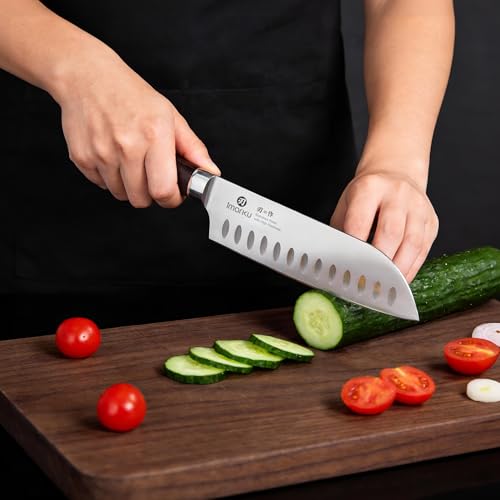
TL;DR — A Damascus steel santoku knife is a Japanese-style general-purpose knife (santoku means “three virtues”: slicing, dicing, and mincing) built with a layered, pattern-welded blade that shows a rippling, water-like surface. In almost every modern kitchen knife, that Damascus pattern is cosmetic cladding wrapped around a single hard cutting core — usually VG-10 or a similar high-carbon stainless steel — so the pattern looks striking but the cutting performance comes from the core, its heat treatment, and the edge geometry, not the number of layers. For picks, see our best santoku knife guide.
The HomeWhisk editorial team researches kitchen knives by analyzing manufacturer steel specs, blade geometry, and aggregated reviews from major retailers and communities like Reddit’s r/chefknives and r/cooking. The goal here is to cut through the marketing around “Damascus” and explain what you are actually buying, what makes it perform, and how to choose one that is worth the money.
“Damascus steel santoku” is one of the most misunderstood terms in the knife aisle, because two separate ideas are stacked together: a blade shape (santoku) and a steel construction/finish (Damascus). Understanding each one separately is the fastest way to shop smart and avoid paying a premium for looks alone.
What “Santoku” Actually Means
Santoku (三徳) translates roughly to “three virtues” or “three uses,” referring to slicing, dicing, and mincing — the idea being one knife that handles most everyday cutting. It is the Japanese counterpart to the Western chef’s knife, but the geometry is different in ways you feel immediately.
A santoku is typically 5 to 7 inches long, shorter than a standard 8-inch chef’s knife. The spine drops down to the tip in a gentle curve often called a sheepsfoot or reverse-tanto profile, and the cutting edge is comparatively flat rather than heavily curved. That flat profile is designed for a straight up-and-down push cut — you lift the blade and chop down, rather than rocking the tip back and forth. Many santoku blades also carry a row of oval dimples along the sides, called a Granton edge (kullenschliff), which create small air pockets so slices of potato, cucumber, or cheese release instead of sticking to the blade. A santoku pairs naturally with other Japanese-inspired shapes if you build out a set — see our best knife sets guide.
What “Damascus” Steel Really Is
Historical Damascus steel referred to wootz crucible steel with a naturally patterned surface, a process that was lost for centuries. What you buy today is pattern-welded steel: multiple layers of two or more steel alloys are forge-welded, folded, and hammered together, then acid-etched so the differing alloys reveal a wavy, flowing pattern.
The critical thing to understand is san mai construction, which most “Damascus santoku” knives use. A single hard steel core forms the actual cutting edge, and softer stainless Damascus layers are laminated onto each side purely as cladding. So when a listing brags about “67 layers,” those layers almost never touch the food or form the edge — they surround a mono-steel core. The layer count is largely a decorative and marketing figure.
This is the single most important takeaway: on a laminated Damascus knife, the pattern is beauty, and the core steel plus its heat treatment is performance. Two knives with identical gorgeous patterns can cut completely differently depending on what is hidden inside.
The Core Steel Is What Cuts — VG-10 and Friends
Because the edge is formed by the core, the core alloy matters most. The most common core in mid-range Damascus santoku knives is VG-10, a Japanese high-carbon stainless steel containing chromium (for corrosion resistance), plus cobalt, vanadium, and molybdenum. Hardened to roughly 60–61 HRC on the Rockwell scale, VG-10 takes a very keen edge and holds it well while staying stainless and low-maintenance.
You will also see cores like AUS-10, VG-MAX, and premium powdered steels such as SG2/R2, which reach even higher hardness (62–64 HRC) for longer edge retention at a higher price. The trade-off is consistent across steels: harder steel holds a sharper edge longer but is more brittle and more prone to chipping if you twist it, hit bone, or cut on glass or stone. If you want a dedicated blade for breaking down poultry or working around joints, that is a job for a best boning knife rather than a hard santoku edge, and delicate fish work belongs to a best fillet knife.
Japanese knives are also ground to a narrower edge angle — often around 15 degrees per side — versus the roughly 20 degrees typical of Western knives. That thinner geometry is a big part of why they feel so sharp, and it is another reason the edge is more delicate.
Santoku vs. Chef’s Knife
Buyers almost always cross-shop these two, so here is the honest comparison. A chef’s knife has a longer (usually 8-inch), curved belly built for a rocking motion, keeping the tip on the board while the handle rises and falls — great for mincing herbs and garlic and for anyone who learned Western technique. A santoku is shorter, flatter, and lighter, favoring a push/chop motion and precise straight-down slicing; the tall, flat blade also makes it excellent for scooping chopped food off the board.
Neither is objectively better. Cooks with smaller hands or those who chop rather than rock often prefer the santoku’s control and lighter feel, while those who rock-chop or want extra length and a pointed tip lean chef’s knife. Many kitchens keep both. If you want maximum versatility in one blade, read our best chef knife guide alongside the santoku picks; the two shapes complement rather than replace each other.
How to Choose a Damascus Santoku Knife
Once you know the pattern is cosmetic and the core is king, choosing gets much simpler. Prioritize in this order.
Core steel and hardness. Look for a stated core — VG-10 at 60–61 HRC is a reliable, low-fuss sweet spot for home cooks. Be skeptical of listings that hype “Damascus layers” but never name the core steel; vague listings are usually cheap stainless with a printed or lightly etched pattern.
Handle material. Western-style handles are often Pakkawood (resin-impregnated wood, water-resistant and durable), G10 or Micarta (composite, extremely tough and hygienic), or stabilized wood. Traditional Japanese wa handles are lightweight wood in an octagonal or D-shape. Pakkawood is the practical default; avoid untreated raw wood, which cracks and harbors bacteria.
Blade length. A 7-inch santoku is the versatile all-rounder; a 5-inch is nimble for smaller hands and detail work. Match it to your board size and your grip.
Construction and tang. A full tang (steel running the length of the handle) adds balance and durability on Western-handled knives. Check that the pattern is genuinely etched into forged steel, not laser-printed onto a stamped blade.
Price. Expect a real VG-10 Damascus santoku to cost more than a plain stainless one, but the premium buys the core steel and finish, not miraculously better cutting from the layers alone. A single excellent santoku often delivers more value than a cheap block set — though if you want coverage, compare it against a curated best knife sets option and round out with a best bread knife for crusty loaves.
Care: Getting Your Money’s Worth
Hard, thin Japanese edges reward good habits and punish bad ones. Hand wash and dry immediately — dishwashers dull edges, loosen handles, and bang blades against other items. Use a wood or soft poly cutting board, never glass, stone, or ceramic, which chip hard edges. Hone gently and sparingly; a very hard core does not respond to a honing steel the way soft Western steel does, and many owners maintain these on whetstones (around 1000 grit to sharpen, 3000–6000 to refine) rather than pull-through sharpeners, which grind away too much metal and can crack the edge. Avoid twisting, prying, or cutting through bone. Treated well, a good Damascus santoku stays razor sharp for years.
Frequently Asked Questions
Is a Damascus steel santoku knife worth it?
It is worth it if you value the look and the knife has a quality core such as VG-10 with a proper heat treatment — then you are paying for genuine performance plus aesthetics. It is not worth it if the listing only advertises “Damascus layers” without naming the core steel, because the pattern alone does nothing for cutting. Judge value by the core, the hardness, the handle, and the fit and finish, not the layer count. A plain high-carbon santoku can cut just as well as a fancy patterned one.
Do the Damascus layers make the knife sharper or stronger?
No, not in the laminated knives most people buy. Those use san mai construction, where the cutting edge is formed by a single hard core and the visible Damascus layers are decorative cladding on the sides. The pattern does not touch the food or improve sharpness or edge retention. Cutting performance comes from the core alloy, its Rockwell hardness, and the edge geometry. Genuine multi-layer differential performance exists only in specialized forged blades, not typical retail Damascus santokus.
Santoku or chef’s knife — which should I buy first?
Buy the one that matches your cutting style. Choose a chef’s knife if you rock-chop, want more length and a pointed tip, or learned Western technique; see our best chef knife guide. Choose a santoku if you push/chop straight down, have smaller hands, or want a lighter, more controllable blade with easy release from the flat profile. Both cover most everyday tasks, so many cooks eventually own each. If budget allows only one, pick the motion you naturally use.
How do I sharpen a Damascus santoku?
Sharpen the core steel on whetstones: a 1000-grit stone to reset the edge, then 3000–6000 grit to refine and polish. Because the edge angle is narrow (around 15 degrees per side) and the steel is hard, avoid electric or pull-through sharpeners, which remove too much metal and can chip a hard core. Maintain the existing angle, work both sides evenly, and finish by stropping. Between sharpenings, minimal light honing and a soft cutting board keep the edge keen far longer.
Will a Damascus santoku rust or stain?
Most use stainless cores like VG-10 and stainless Damascus cladding, so they resist rust well but are not immune. Acidic foods, prolonged moisture, and dried-on food can cause spotting or dull the etched pattern over time. Hand wash, dry immediately, and never leave the blade wet in the sink or the dishwasher. A few knives use reactive carbon-steel cores that will patina and can rust if neglected, so check the specs if low maintenance is a priority.
Is a santoku good for cutting bread or meat off the bone?
Not really — a santoku is a general slicing, dicing, and mincing knife, and its hard, thin edge is the wrong tool for hard crusts or bones. Use a serrated best bread knife for loaves and a best boning knife for separating meat from bone. Forcing a santoku through bone or crust risks chipping its delicate edge. Keep the santoku for vegetables, boneless proteins, and everyday prep where its sharpness shines.
The Bottom Line
A Damascus steel santoku knife combines a genuinely useful Japanese blade shape — flat-profiled, light, and built for precise push-cutting — with an eye-catching pattern-welded finish. The pattern is almost always decorative cladding, so shop by the core steel (VG-10 at 60–61 HRC is a dependable target), the hardness, the handle, and the finish, not the advertised layer count. Treated with a soft cutting board, hand washing, and whetstone sharpening, a quality Damascus santoku is a joy to use and lasts for years. It is ideal for home cooks who chop straight down and want one beautiful, versatile everyday knife. For our current recommendations, see the best santoku knife guide, and round out your kit with a best chef knife, best knife sets, best bread knife, and best boning knife.
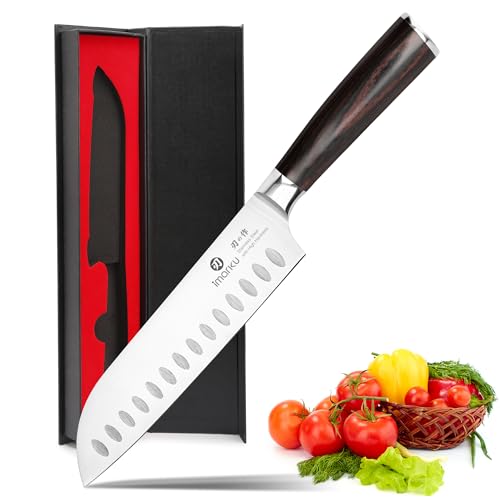
imarku
7-Inch Santoku Knife for Precision Slicing, Dicing & Mincing – High Carbon Japanese Steel with Pakkawood Handle
The imarku 7-inch Santoku knife combines a hollow scalloped edge and 15-18 degree hand-polished bevel to reduce drag and prevent food from sticking during high-volume prep work. Home cooks and apartment dwellers who want a restaurant-capable knife without the steep price will find it covers meat, vegetables, and bread with a single blade.
Pros and Cons
Pros
- The 2.5mm blade thickness paired with the hollow edge design handles both delicate julienne cuts and heavier chopping without flexing or wedging.
- Pakkawood handle construction offers a more sanitary and dimensionally stable grip than standard composite or natural wood handles.
- The 15-18 degree edge angle matches professional Japanese knife geometry, giving it a noticeably sharper out-of-box performance than German-style knives at this price.
- Versatile enough for meat, vegetables, fruit, and bread, making it a practical single-knife solution for small kitchens with limited storage.
Cons
- With zero verified reviews available, long-term edge retention and handle durability under daily use remain unconfirmed by real buyers.
- The 3-month refund window is shorter than the lifetime guarantees offered by competing brands at the same price point.

Zwilling
Henckels Santoku Knife 7-inch Hollow Edge German Stainless Steel
This 7-inch Santoku excels at mincing, slicing, and dicing with its hollow-edge blade that prevents food sticking during prep. Buy it if you want a durable, balanced Japanese-style knife that handles everyday vegetable work without the premium price tag.
Pros and Cons
Pros
- Hollow-edge grantons genuinely prevent cucumber and tomato slices from sticking to the blade mid-cut.
- German stainless steel holds its edge through repeated use on harder vegetables like carrots and beets.
- Fully forged construction creates noticeable weight and balance that makes repetitive dicing feel controlled and effortless.
Cons
- At 7 inches, it's smaller than Western chef's knives, requiring more frequent repositioning on larger vegetables.
- Dishwasher safe, but hand washing extends blade life and prevents potential handle loosening over time.

HOSHANHO
7-Inch Japanese Santoku Chef Knife | HOSHANHO High Carbon Stainless Steel
This 7-inch santoku slices vegetables, meat, and fish with a 15-degree blade angle that delivers thinner, more precise cuts than standard chef knives. Home cooks and professional chefs alike benefit from the triple-layer laminated steel construction that stays sharp longer and resists corrosion.
Pros and Cons
Pros
- The triple-layer laminated steel with 10Cr15CoMoV Japanese steel reaches 62HRC hardness, delivering edge retention that outlasts standard stainless blades.
- Ergonomic pakkawood handle provides secure grip and control without hand fatigue during extended prep sessions.
- 15-degree blade angle and hand-sharpened edge produce cleaner cuts through delicate vegetables and proteins compared to wider blade angles.
Cons
- Hand-washing required; dishwasher use will degrade the blade edge and handle finish over time.
- Requires regular honing to maintain the 15-degree angle; the initial sharpness will gradually diminish with normal kitchen use.

MercerCulinary
Mercer Genesis 7-Inch Santoku Knife: Professional Slicing & Mincing
This fully forged German steel santoku delivers razor-sharp precision for slicing vegetables and mincing herbs with its Granton edge that releases food cleanly. Buy it if you prep vegetables daily and want a professional-grade knife that won't require constant sharpening.
Pros and Cons
Pros
- Granton edge prevents food from sticking to the blade, making thin slicing of cucumbers, tomatoes, and fish noticeably faster than standard chef's knives.
- Ergonomic handle with substantial bolster reduces wrist strain during extended prep sessions and feels secure even when wet.
- Professional-grade construction at under $50 delivers the same German steel and forging process used in culinary schools.
Cons
- Requires hand-washing only; dishwasher use will damage the blade and handle, adding a maintenance step most busy cooks dislike.
- Santoku's shorter blade length and rectangular shape take practice if you're accustomed to Western chef's knives, requiring a learning curve.

Henckels Forged Accent 2-Piece Santoku Knife Set | German Stainless Steel
This 2-piece santoku set delivers razor-sharp German engineering for mincing, slicing, and dicing with effortless precision and lasting edge retention. Buy it if you prep vegetables daily and want knives that stay sharp without constant maintenance.
Pros and Cons
Pros
- Forged bolster transitions seamlessly from blade to handle, eliminating weak points that cause blade wobble during cutting.
- Satin-finished blade holds its edge noticeably longer than stamped knives, reducing the need for frequent sharpening.
- Two-knife set covers both precision work and larger prep tasks without requiring a full block of specialty knives.
Cons
- Santoku blade shape has a steeper learning curve than traditional chef's knives if you're accustomed to rocking motions.
- German stainless steel requires hand-washing to maintain edge longevity, despite being dishwasher-safe.
imarku 7-Inch Santoku Knife for Precision Slicing, Dicing & Mincing – High Carbon Japanese Steel with Pakkawood Handle
imarku
7-Inch Santoku Knife for Precision Slicing, Dicing & Mincing – High Carbon Japanese Steel with Pakkawood Handle
The imarku 7-inch Santoku knife combines a hollow scalloped edge and 15-18 degree hand-polished bevel to reduce drag and prevent food from sticking during high-volume prep work. Home cooks and apartment dwellers who want a restaurant-capable knife without the steep price will find it covers meat, vegetables, and bread with a single blade.
$39.99 at AmazonEditors' Favorite
Color: Brown and Silver Size: 7" Dimensions: 12 x 3 x 1 inches Weight: 0.43 pounds Product Group: Kitchen Binding: Kitchen
Shop NowZwilling Henckels Santoku Knife 7-inch Hollow Edge German Stainless Steel
Zwilling
Henckels Santoku Knife 7-inch Hollow Edge German Stainless Steel
This 7-inch Santoku excels at mincing, slicing, and dicing with its hollow-edge blade that prevents food sticking during prep. Buy it if you want a durable, balanced Japanese-style knife that handles everyday vegetable work without the premium price tag.
$79.95 at AmazonGreat Value
Brand Name: ZWILLING J.A. Henckels Manufacturer: ZWILLING UPC: 035886185930 Global Trade Identification Number: 00035886185930 Model Number: 31170-181 Manufacturer Part Number: 31170-181 -OPEN BOX Manufacturer Warranty Description: Lifetime Warranty Against Manufacturer'S Defects Item Type Name: Hollow Edge Santoku Knife Unit Count: 1.0 Count Included Components: Hollow Edge Santoku Knife Best Sellers Rank: #92,282 in Kitchen & Dining (See Top 100 in Kitchen & Dining) #244 in Bread Knives ASIN: B00068J2A0 Customer Reviews: 4.6 4.6 out of 5 stars (1,418) 4.6 out of 5 stars Blade Material Type: Stainless Steel Handle Material: Stainless Steel,Steel Is the item dishwasher safe?: No Material Type: ZWILLING Carbon No Stain Steel BladeLength: 7 Inches Item Weight: 6.4 ounces Item Length: 16 Inches Size: 7" Color: Stainless Steel Blade Color: Silver Blade Edge: Hollow Ground Construction Type: Forged Blade Material: Stainless Steel Brand: ZWILLING J.A. Henckels
Shop NowHOSHANHO 7-Inch Japanese Santoku Chef Knife | HOSHANHO High Carbon Stainless Steel
HOSHANHO
7-Inch Japanese Santoku Chef Knife | HOSHANHO High Carbon Stainless Steel
This 7-inch santoku slices vegetables, meat, and fish with a 15-degree blade angle that delivers thinner, more precise cuts than standard chef knives. Home cooks and professional chefs alike benefit from the triple-layer laminated steel construction that stays sharp longer and resists corrosion.
$52.99 at AmazonBrand Name: HOSHANHO Manufacturer: HOSHANHO UPC: 714757571477 Model Number: 7 inch Santoku Knife Manufacturer Part Number: HSHES-2022-002 Item Type Name: 7 inch Santoku Chef Knife Unit Count: 1.0 Count Included Components: 7 inch Santoku Knife Best Sellers Rank: #13,746 in Kitchen & Dining (See Top 100 in Kitchen & Dining) #29 in Chef's Knives ASIN: B0C1BQTQKL Customer Reviews: 4.7 4.7 out of 5 stars (1,742) 4.7 out of 5 stars Blade Edge: Plain Construction Type: Forged Blade Material Type: High Carbon Stainless Steel Handle Material: Pakkawood Is the item dishwasher safe?: No Material Type: High Carbon Stainless Steel BladeLength: 7 Inches Item Weight: 11.2 ounces Item Length: 7 Inches Size: 7" Color: Silver Blade Color: Silver Blade Material: High Carbon Stainless Steel Brand: HOSHANHO
Shop NowMercerCulinary Mercer Genesis 7-Inch Santoku Knife: Professional Slicing & Mincing
MercerCulinary
Mercer Genesis 7-Inch Santoku Knife: Professional Slicing & Mincing
This fully forged German steel santoku delivers razor-sharp precision for slicing vegetables and mincing herbs with its Granton edge that releases food cleanly. Buy it if you prep vegetables daily and want a professional-grade knife that won't require constant sharpening.
$39.95 at AmazonBrand Name: Mercer Culinary Manufacturer: Mercer Tool Corp. UPC: 749628445519 765301903244 Global Trade Identification Number: 00765301903244 Model Number: M20707 Manufacturer Part Number: M20707 Manufacturer Warranty Description: Lifetime limited manufacturer's warranty Item Type Name: Genesis Unit Count: 1.0 Count Included Components: Mercer Culinary Genesis 7-Inch Forged Santoku Knife Best Sellers Rank: #3,706 in Kitchen & Dining (See Top 100 in Kitchen & Dining) #15 in Santoku Knives ASIN: B000IBVD4I Customer Reviews: 4.8 4.8 out of 5 stars (1,577) 4.8 out of 5 stars Blade Material Type: High Carbon Steel Handle Material: Santoprene Is the item dishwasher safe?: No Material Type: Stainless steel and manmade BladeLength: 7 Inches Item Weight: 2.99 ounces Item Length: 14.05 Inches Size: 7" Color: Black Blade Color: Silver Blade Edge: Plain Construction Type: Forged Blade Material: High Carbon Steel Brand: Mercer Culinary
Shop NowHenckels Forged Accent 2-Piece Santoku Knife Set | German Stainless Steel
Henckels Forged Accent 2-Piece Santoku Knife Set | German Stainless Steel
This 2-piece santoku set delivers razor-sharp German engineering for mincing, slicing, and dicing with effortless precision and lasting edge retention. Buy it if you prep vegetables daily and want knives that stay sharp without constant maintenance.
$49.95 at AmazonBrand Name: HENCKELS Manufacturer: Henckels UPC: 035886649906 Model Number: 1021241 Manufacturer Part Number: 1021241 Item Type Name: Asian Knife Set Unit Count: 2.0 Count Included Components: 5" HE Santoku, 7" HE Santoku Best Sellers Rank: #41,522 in Kitchen & Dining (See Top 100 in Kitchen & Dining) #14 in Santoku Knives ASIN: B09RTDZ14W Customer Reviews: 4.6 4.6 out of 5 stars (284) 4.6 out of 5 stars Blade Edge: Plain Construction Type: Forged Blade Material Type: Stainless Steel Handle Material: Stainless Steel Is the item dishwasher safe?: Yes Material Type: Stainless Steel BladeLength: 5 Inches Item Weight: 9.07 g Item Length: 5 Inches Size: 2-pc Color: Black Blade Color: Silver Blade Material: Stainless Steel Brand: HENCKELS
Shop Now




Write Your Review
No reviews yet. Be the first to share your experience!