

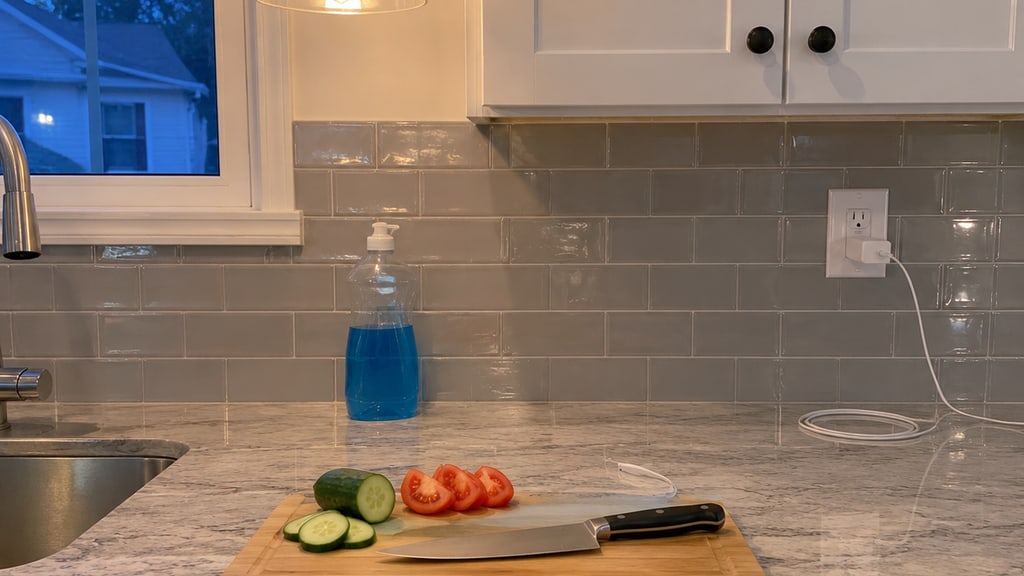
What is a chef knife used for? Almost every cutting job in a home kitchen: chopping onions, slicing meat, dicing peppers, mincing garlic and herbs, and breaking down large vegetables like squash and cabbage. Its long, curved blade, usually 7 to 10 inches, is built to rock across a cutting board, which is why most cooks reach for it first and put it down last.
This guide explains each of those cuts, shows how the rocking motion works, lists the jobs a chef’s knife shouldn’t do, and compares it with the santoku and the paring knife so you can tell which blade belongs in your hand for a given task.
The main jobs a chef’s knife handles
A chef’s knife is a generalist. The front third of the blade does fine work, the middle does most of the slicing, and the heel near the handle supplies force for dense food. Learning which part of the edge to use for each cut is most of the skill.
Chopping
Chopping means cutting food into rough, roughly even pieces where looks don’t matter much. Think onions for a soup base, carrots for stock, or celery for a braise. You lift the blade a little and bring it down through the food, letting the weight of the knife do the work. A rough chop for stock can be pieces of an inch or more. Speed counts here more than precision.
Slicing
Slicing produces thin, even pieces with a long drawing stroke. You push the knife forward and down, or pull it back toward you, so the full length of the edge passes through the food. This is the stroke for slicing a cooked chicken breast, a flank steak against the grain, tomatoes, cucumbers and mushrooms. A sharp chef’s knife cuts a ripe tomato without crushing it. A dull one squashes it flat.
Dicing
Dicing turns food into uniform cubes. Cooks usually describe three sizes: a large dice around 3/4 inch, a medium dice around 1/2 inch and a small dice around 1/4 inch. You first cut the food into planks, then into sticks, then across the sticks into cubes. Even cubes cook at the same rate, which matters for roasted potatoes and for soups where you want every piece done at once.
Mincing
Mincing is the finest cut, used for garlic, shallots, ginger and fresh herbs like parsley and cilantro. You gather the food in a small pile, rest your free hand flat on the spine near the tip, and rock the blade back and forth over the pile, scraping it back together every few passes. The curved belly of a chef’s knife makes this fast. A straight-edged knife has to be lifted for every cut.
The wide blade also crushes garlic cloves under the flat side and works as a scoop to carry chopped food to the pan.
Blade material changes how a chef’s knife feels in those jobs. Steel is the default, but ceramic blades are an option for cooks who mostly prep vegetables, fruit and boneless meat and want an edge that stays sharp for a long time between sharpenings. The Kyocera INNOVATIONwhite is a 7″ ceramic chef’s knife with a white Z212 blade and a non-slip black handle. Ceramic is very hard and very light, which makes long sessions of slicing onions or herbs less tiring. It’s also brittle, so it isn’t the knife for squash rinds, bones or anything frozen, and it needs a gentle board.

KYOCERA
Lightweight Ceramic Chef's Knife for Effortless Daily Prep - Kyocera INNOVATIONwhite 7" Z212 Blade
The Kyocera INNOVATIONwhite 7" ceramic chef's knife handles rocking-style chopping through heavy prep sessions at a fraction of the weight of a steel blade, so your hand and wrist stay fresh. It suits cooks with arthritis or hand injuries, and anyone who wants produce to taste clean with no metallic transfer or browning at the cut edge.
Pros and Cons
Pros
- Light enough to use comfortably with arthritic or injured hands.
- Holds a sharp edge through months of use without honing.
- Non-corrosive blade will not rust, stain, or pit from acidic foods.
- White blade and black handle make it easy to spot in a crowded sink or drawer.
Cons
- Ceramic is brittle and can chip or snap on bones, frozen food, or hard squash rinds.
- Resharpening requires a diamond wheel or the manufacturer's sharpening service, not a home steel.
KYOCERA Lightweight Ceramic Chef's Knife for Effortless Daily Prep - Kyocera INNOVATIONwhite 7" Z212 Blade
KYOCERA
Lightweight Ceramic Chef's Knife for Effortless Daily Prep - Kyocera INNOVATIONwhite 7" Z212 Blade
The Kyocera INNOVATIONwhite 7" ceramic chef's knife handles rocking-style chopping through heavy prep sessions at a fraction of the weight of a steel blade, so your hand and wrist stay fresh. It suits cooks with arthritis or hand injuries, and anyone who wants produce to taste clean with no metallic transfer or browning at the cut edge.
$90.00 at AmazonEditors' Favorite
Color: Black Handle Size: 7" Product Group: Kitchen Binding: Kitchen
Shop NowHow the rocking motion works
The rocking motion is the technique most closely tied to the chef’s knife, and it’s the reason the blade has a curved belly.
Start with a pinch grip
Hold the handle with your last three fingers, and pinch the blade itself just in front of the bolster between your thumb and the side of your index finger. This grip gives you far more control than wrapping your whole hand around the handle with your index finger on the spine. It feels odd for about a week. Then second nature.
Use the claw with your other hand
Your guiding hand holds the food with fingertips curled under and knuckles forward, so the flat of the blade rests against your knuckles. The knuckles guide the blade and the fingertips stay out of the way. Move the claw back a little after each cut to set the thickness of the next slice.
Rock, don’t chop
Keep the tip of the knife on the board, or very close to it, and rock the heel up and down while pushing slightly forward. The blade slides through the food on each downward stroke. You aren’t lifting the whole knife into the air. For mincing, your free hand can rest on the spine near the tip, and you pivot the knife across the pile like a paper cutter.
What a chef’s knife shouldn’t be used for
A chef’s knife can do a lot, but some jobs damage the edge or put your hands at risk. These are the common ones to avoid:
Cutting through bones is the biggest one. Chicken joints are fine because you cut through cartilage, but thick beef or pork bones can chip or roll the edge. Use a cleaver or a boning knife instead. Same with frozen food. Hacking at a frozen block of chicken thighs can crack thin, hard steel and will almost certainly chip a ceramic blade.
Crusty bread is another poor match. A smooth edge tends to crush the loaf, while a serrated bread knife saws through the crust cleanly. Peeling small fruit, hulling strawberries and coring tomatoes are easier with a paring knife, because a long blade is awkward for work held in the air.
Never use the edge to scrape chopped food across the board. Flip the knife and use the spine. Scraping with the edge dulls it fast. And don’t use the tip to pry open cans, jar lids or packaging, since tips snap off more easily than people expect.
Chef’s knife vs paring knife
A chef’s knife and a paring knife split kitchen work between them. The chef’s knife does work on the board: chopping, slicing, dicing and mincing. A paring knife, usually 3 to 4 inches long, does work in the hand: peeling apples, trimming green beans, deveining shrimp, cutting the eyes out of potatoes and scoring the skin of a pork roast.
Between them, plus a serrated knife for bread, they cover most home prep. That’s why a small set built around a chef’s knife is often a better buy than a 15-piece block full of blades that never leave the wood.
If you’d rather buy matched pieces at once, the BRODARK 3PCS Damascus Chef Knife Set is a compact option. The blades use VG10 steel with full-tang construction, meaning the steel runs the full length of the handle, and the handles are Pakkawood, a resin-treated wood that resists moisture better than plain wood. Three pieces cover the core cuts without crowding a drawer. For more options, see our guide to the best chef knife set.

BRODARK
Damascus Chef Knife Set for Everyday Prep: BRODARK 3-Piece VG10 Full Tang with Pakkawood Handles
This three-piece Damascus set covers chopping, slicing, and detail work with a VG10 core honed to 14 degrees, so it moves through tomatoes and meat without crushing or tearing. It suits home cooks upgrading from a starter block who want full-tang balance and gift-box presentation without stepping up to single-knife custom pricing.
Pros and Cons
Pros
- VG10 cutting core with a hardness above 60 HRC delivers sharpness that lasts well past the first few uses.
- Full-tang build with sloped bolster and end pommel gives the balance point a comfortable pinch grip position.
- Pakkawood handles offer natural anti-slip texture that synthetic handles often lack.
- Arrives in a gift box, so it works as a housewarming or holiday present without extra packaging.
Cons
- Three knives leave gaps in coverage: there is no bread knife or paring knife, so you will still need those separately.
- High-hardness Damascus steel chips if used on bone, frozen food, or glass boards, and it needs hand washing rather than a dishwasher cycle.
BRODARK Damascus Chef Knife Set for Everyday Prep: BRODARK 3-Piece VG10 Full Tang with Pakkawood Handles
BRODARK
Damascus Chef Knife Set for Everyday Prep: BRODARK 3-Piece VG10 Full Tang with Pakkawood Handles
This three-piece Damascus set covers chopping, slicing, and detail work with a VG10 core honed to 14 degrees, so it moves through tomatoes and meat without crushing or tearing. It suits home cooks upgrading from a starter block who want full-tang balance and gift-box presentation without stepping up to single-knife custom pricing.
$99.00 at AmazonEditors' Favorite
Color: Black Size: 3 Pcs Dimensions: 7.36 x 13.39 x 14.61 inches Product Group: BISS
Shop NowChef’s knife vs santoku
The santoku is the Japanese counterpart to the Western chef’s knife, and the two overlap a lot. Both chop, slice, dice and mince. The difference is in the shape.
A Western chef’s knife has a pronounced curve from the heel to a pointed tip, which suits the rocking motion. A santoku is usually 5 to 7 inches long with a flatter edge and a rounded “sheep’s foot” tip that curves down to meet the edge. Because the edge is flatter, a santoku works best with an up-and-down chop or a forward push cut rather than a rock.
Which one to pick depends on how you cut. If you like rocking through herbs and garlic, or you often cut large items like melons and whole chickens, a chef’s knife is the better fit. If you mostly prep vegetables with straight chopping strokes and prefer a shorter, lighter blade, a santoku can feel quicker and more nimble. Plenty of cooks own one of each.
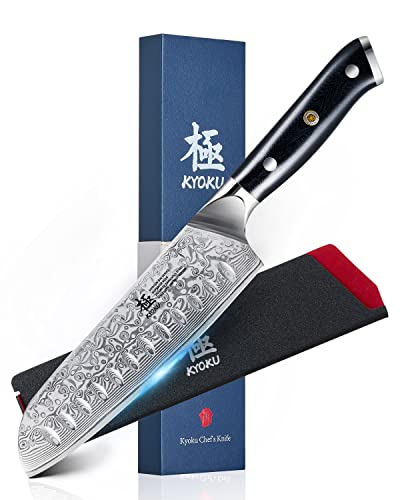
A good example of the style is the KYOKU Gin Series 7″ Santoku Knife. It uses VG10 Damascus stainless steel with a silver ion blade and a G10 handle finished with a mosaic pin. G10 is a fiberglass composite that shrugs off water and grease, a practical choice for a knife that gets wiped down all day. If you’re leaning toward Japanese blades in general, our best Japanese chef knife roundup covers the wider category.
KYOKU
7-Inch Santoku for Fast Vegetable and Protein Prep: KYOKU Gin Series VG10 Damascus Chef Knife
This 7-inch Santoku handles meat, fruit, vegetables, and herbs with an 8 to 12 degree Honbazuke edge that cuts with almost no resistance. It suits home cooks and working kitchen professionals who want a full-tang VG10 Damascus blade with a sheath and case included.
Pros and Cons
Pros
- VG10 core with 66 Damascus layers delivers hard edge retention and visible layered patterning on the blade.
- The ergonomic G10 handle with mosaic pin is weighted for grip comfort that reduces hand fatigue and cramping over long prep sessions.
- Silver ion coating and the supplied sheath and case address hygiene and storage in one package.
- The 7-inch Santoku profile is versatile enough to replace separate vegetable and general-purpose knives on most boards.
Cons
- A hard VG10 edge ground this thin chips if used on bone, frozen food, or hard surfaces such as glass and stone boards.
- Damascus steel and the G10 handle require hand washing and immediate drying, so this is not a dishwasher knife.
KYOKU 7-Inch Santoku for Fast Vegetable and Protein Prep: KYOKU Gin Series VG10 Damascus Chef Knife
KYOKU
7-Inch Santoku for Fast Vegetable and Protein Prep: KYOKU Gin Series VG10 Damascus Chef Knife
This 7-inch Santoku handles meat, fruit, vegetables, and herbs with an 8 to 12 degree Honbazuke edge that cuts with almost no resistance. It suits home cooks and working kitchen professionals who want a full-tang VG10 Damascus blade with a sheath and case included.
$52.99 at AmazonEditors' Favorite
Color: Black Size: 7" Dimensions: 7 x 0.01 x 0.01 inches Weight: 0.57 Pounds Product Group: Kitchen Binding: Kitchen
Shop NowCommon mistakes with a chef’s knife
The most common mistake is letting the knife go dull. A dull blade needs more force, slips off the skin of tomatoes and onions, and causes more cuts than a sharp one. Hone the knife before each use and sharpen it a few times a year.
The dishwasher is the second mistake. Heat, harsh detergent and other dishes knocking against the blade dull the edge and can loosen or crack wooden handles. Wash the knife by hand, dry it right away and store it in a block, on a magnetic strip or in a blade guard rather than loose in a drawer.
Third, many beginners buy a knife that’s too long or too heavy for their hands. An 8-inch blade is the common starting point, but a 7-inch knife can feel more manageable in a small kitchen or for smaller hands. If you’re shopping for a first one, our guide to the best beginner chef knife focuses on forgiving, easy-to-maintain picks.
Choosing the right chef’s knife for your kitchen
Western knives, often called German style, use slightly softer steel with a thicker spine and a heavier feel. They tolerate rough handling and are easy to sharpen. If that sounds like your cooking, the best German chef knife picks are a good place to start. Japanese-style knives use harder steel ground thinner, so they cut with less effort and hold an edge longer but chip more easily if twisted or dropped.
Budget doesn’t have to be high. A well-made knife in the $30 to $50 range will handle daily cooking for years if you keep it sharp, and our list of the best chef knife under $50 shows what that money buys. For a broader look across every price point, see our main guide to the best chef knife.
FAQ
What is the main purpose of a chef’s knife?
A chef’s knife is the all-purpose blade for cutting food on a board. It chops, slices, dices and minces vegetables, fruit, herbs and boneless meat. Its curved edge supports the rocking motion, which makes repetitive cuts fast.
Can you cut meat with a chef’s knife?
Yes. A chef’s knife slices raw and cooked boneless meat well and can separate chicken at the joints. It shouldn’t be used to cut through thick bones, which can chip or roll the edge. A cleaver or boning knife is the right tool for that job.
What size chef’s knife should I get?
An 8-inch blade is the most common choice for home cooks because it handles both small and large items. A 7-inch knife is lighter and easier to control in tight spaces or for smaller hands. Blades of 10 inches suit people who regularly break down large produce.
Is a santoku better than a chef’s knife?
Neither is better across the board. A santoku has a flatter edge and works best with straight chopping strokes, while a chef’s knife has a curved edge made for rocking. Pick the santoku for quick vegetable prep and the chef’s knife for herbs, garlic and larger items.
How often should a chef’s knife be sharpened?
Most home cooks should hone the edge with a steel before each use and sharpen it two to four times a year. You’ll know it needs sharpening when it slides off a tomato skin instead of biting into it. Harder Japanese steels usually go longer between sharpenings.





Write Your Review
No reviews yet. Be the first to share your experience!