

A two burner griddle pan tends to fail in the same handful of ways, and none of them are subtle. Picture pancake morning for six: the four pancakes sitting over the burners turn deep gold while the two stranded in the middle stay pale and gummy, so the batch comes off the plate at three different levels of done. Run a big bacon batch next and rendered grease slides off the flat edge straight onto the flames, setting off the smoke alarm before the first strip crisps. Three months later the plate no longer sits flat on the grate at all — it rocks when you press a corner, and it has flipped one grilled cheese too many onto the counter. And the handles, forgotten through forty minutes of frying, brand anybody who grabs one barehanded.
None of this is bad luck. Each failure traces back to a specific piece of engineering: the thickness of the metal, how far apart your burners sit relative to the plate’s width, how the alloy expands under heat, whether grease has anywhere to go, and what the handles are made of. Walk through the failure modes below and the shopping decision gets a lot simpler, because every problem points straight at a specification worth checking.
Why the Middle of a Two Burner Griddle Pan Stays Cold
Start with geometry. On a standard 76-centimeter range, the left and right burner centers sit roughly 25 to 30 centimeters apart, and a gas flame flattens into a circle only 15 to 18 centimeters wide once it strikes the plate. A griddle 48 centimeters across therefore carries a band down its centerline that neither flame ever touches. Heat reaches that dead zone only by conducting sideways from the heated ends, and sideways conduction costs thickness. A plate thinner than 3 millimeters loses that race: by the time warmth creeps toward the middle, the ends have climbed past 230 degrees Celsius, so one pancake browns, one barely sets, and the one you flip last is still glossy with raw batter.
This is why material matters more than branding. Cast aluminum moves heat laterally roughly four times faster than steel, which is why serious stovetop griddles are poured from it despite the softer surface, typically 5 to 6 millimeters thick. Carbon steel spreads heat more slowly but shrugs off higher temperatures and weighs less; anything under 3 millimeters will fight you. Electric cooktops deserve a special warning here, because their heat arrives in two harsh rings rather than soft flames, which magnifies every weakness in a thin plate.
Warping: How a Flat Plate Becomes a Rocker
Metal expands when heated, and aluminum does it about twice as enthusiastically as steel — roughly 24 microns per meter for every degree Celsius. Stretch a 50-centimeter plate across two lit burners and the ends get hot first, growing longer while the center strip stays cool and holds its length. Something has to give, so the ends lift and the plate bows into a shallow taco. A thin sheet has almost no stiffness to resist this, and after enough heat cycles the bow simply stops springing back. That is the rocker living on your stove: a pan that spins on the grates and pools batter against one edge while the opposite edge hovers in the air.
The defense is mass and symmetry. Stiffness scales with the cube of thickness, so doubling the plate makes it eight times harder to bend, which is why a 5-millimeter casting stays planted where a 2-millimeter stamped sheet folds within weeks. A bottom machined flat after casting helps as well, because a plate that was never trued starts life slightly crowned. One habit protects whichever pan you buy: never chase a screaming-hot griddle with cold water. Thermal shock alone can warp even a thick plate in a single high-heat session, and it remains the most common way people ruin otherwise well-built cookware.
Coating Bubbles and Stripped Seasoning
Nonstick surfaces fail on thin griddles in a predictable sequence. PTFE coatings start to break down near 260 degrees Celsius, and an empty thin-base plate parked over a burner on high blows past that mark in three or four minutes — hottest exactly where the flame licks. The coating blisters, bubbles up in patches, and eventually sheds flecks into your eggs. A thick plate slows the climb because its mass keeps temperature rising gradually and evenly, but no nonstick coating survives being preheated dry on maximum power, regardless of what the packaging claims.
Cast iron and carbon steel skip coatings altogether and lean on seasoning: layers of polymerized oil baked onto the metal until they read as a dark, slick skin. That skin strips when the plate endures violent temperature swings, sits under salty or acidic foods overnight, or meets a scouring pad and a dishwasher cycle. Budget pans complicate things further, since their factory seasoning is often a thin sprayed coat that burns off within a month — judge those on the quality of the raw metal instead. Cast aluminum offers the escape route: no rust and no seasoning schedule, though it browns food less aggressively than black steel and rarely suits induction.
Grease Rivers: Lips, Channels, and the Bacon Test
Cook half a kilogram of bacon on a flat plate with no grease management and the lesson arrives quickly: fat goes wherever gravity sends it, and the shortest path runs off the edge and down the burner wells. Good designs interrupt that journey one of two ways. A raised lip of 1 to 2 centimeters around the perimeter corrals the grease outright, ideally with a notched corner that lets you pour it off after cooking. Alternatively, the whole surface tilts a fraction of a degree toward a channel feeding a corner drain. Ridged plates solve it differently — fat drains into the grooves between ridges and travels along them to a trough, clear of the food.
This is where reversible griddles justify themselves. One face lies flat for pancake mornings and a grilled cheese assembly line, the other carries ridges for burgers and sausage batches whose fat needs an exit. Before buying a reversible model, check two unglamorous details: that the drain notch actually sits at the lowest point when the plate rests level on the grates, and that the channels run deep enough to swallow a full bacon batch without sending it back across your toast.
Handles and Weight: The Part Nobody Specs
Handle design determines whether a griddle is pleasant or punishing to live with. Bare metal arms bolted close to the plate conduct heat relentlessly; twenty minutes into frying they pass 150 degrees and a folded towel stops being optional gear. Silicone or phenolic sleeves buy genuine margin, though you should confirm their temperature rating if you finish melts under the broiler. Riveting matters too: full-length strap handles fixed along the plate’s long edge spread the load, while short stubby tabs hang all that weight from two small points of contact.
Weight cuts both ways. A 48-centimeter cast iron griddle can exceed 7 kilograms — steady as a bench anvil and perfectly flat under batter, yet genuinely awkward to carry wet to the sink. Cast aluminum versions of the same footprint generally fall between 2.5 and 3.5 kilograms, with carbon steel landing in between depending on gauge. Make an honest assessment of your own habits, because a pan too heavy to move conveniently ends up parked on the stove gathering dust, which cancels everything else it does well.
Two Burner Griddle Pan Questions, Answered
Will a two burner griddle pan work on my type of stove?
Gas ranges suit them best, since flames wrap the underside and forgive minor imperfections in flatness. Electric coil burners also work, but they depend on firm contact, so any rocking or crowning in the plate shows up immediately as pale rings on your pancakes. Induction is the trap: most cast aluminum and plenty of older carbon steel griddles are invisible to an induction hob unless the base carries magnetic iron, so treat compatibility as something to verify in the listing rather than assume. Glass-top cooktops add one more caution, because heavy cast iron can scratch the surface and a warped plate concentrates its entire weight on a few square centimeters of glass.
What size two burner griddle pan fits a standard stove?
Measure first, because “two burner” describes intent rather than a fixed dimension. Plates between 46 and 51 centimeters wide cover paired burners on most 76-centimeter freestanding ranges, while compact 61-centimeter apartment stoves usually top out near 41 centimeters. Lay a ruler across your grates from the outer edge of the left burner to the outer edge of the right one, then shop inside that measurement. Leaving a centimeter or two of slack ensures the plate rests on the grates themselves rather than bridging across the cooktop frame, where it can slide or crack the surrounding porcelain.
Cast iron, carbon steel, or cast aluminum — which lasts longest?
All three outlast their owners when maintained for what they are, so the real question is which maintenance routine you will genuinely follow. Cast iron absorbs abuse that would destroy anything else but demands seasoning upkeep and two-handed lifting at 7-plus kilograms. Carbon steel seasons faster than iron, weighs less, and performs beautifully provided you buy at least 3 millimeters thick so it stays flat through years of thermal cycling. Cast aluminum asks the least of you — no rust, no seasoning, remarkably even heating — in exchange for losing induction and capping out at moderate searing temperatures. Frequent weekend cooks usually settle happiest on thick cast aluminum or heavy carbon steel, leaving cast iron to those who enjoy the ritual as much as the results.

GreenPan
Family-Size Stovetop Griddle: GreenPan 18-Inch Double Burner Ceramic Nonstick Pan
The GreenPan 18-inch double burner griddle provides a roomy surface for family-size meals, with diamond-infused ceramic nonstick coating for easier cooking and cleanup. It suits households that cook pancakes, eggs, burgers, or other large batches and need a durable oven-safe pan for compatible stovetops.
Pros and Cons
Pros
- The large two-burner surface accommodates family-size breakfasts and other batch cooking.
- The ceramic nonstick coating supports easy food release and wipe-clean maintenance.
- It is oven and broiler safe up to 350°F for finishing dishes beyond the stovetop.
- The heavy-duty body and stainless steel handles are built for regular kitchen use.
Cons
- It is not compatible with induction stovetops.
- The oven and broiler temperature limit is 350°F.
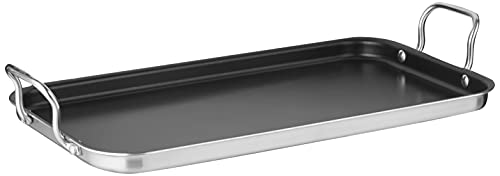
Cuisinart
Double-Burner Griddle for Even Family-Size Cooking: Cuisinart MCP45-25NSP1
This 10x18-inch nonstick griddle skillet spans two burners and uses Triple Ply Construction with Heat Surround Technology for evenly distributed cooking heat. Buy it if you need a large induction-compatible surface for cooking multiple portions and value dishwasher-safe cleanup.
Pros and Cons
Pros
- Triple Ply Construction combines a pure aluminum core with a brushed stainless exterior.
- The tightfitting cover helps retain moisture and nutrients while cooking.
- Solid stainless steel riveted handles provide a secure grip and stay cool on the stovetop.
- A lifetime warranty and BPA-free construction add long-term ownership value.
Cons
- The 10x18-inch footprint requires two burners and substantial storage space.
- The product data does not specify its weight, so handling may be difficult for some users.

Lodge
Two-Burner Reversible Grill Griddle for Pancakes and Burgers, Lodge Double Play Cast Iron Pan
The Lodge Double Play provides a large reversible griddle and grill surface across two burners, helping you cook family-sized breakfasts or sear burgers and vegetables in one pan. It suits home cooks, grill users, and campers who want PFAS-free cast iron that works on induction, ovens, grills, and campfires.
Pros and Cons
Pros
- The reversible grill and griddle surfaces handle both breakfast cooking and high-heat searing.
- Its PFAS-free, pre-seasoned cast iron construction provides a naturally nonstick cooking surface.
- The pan works across indoor stovetops and outdoor grills or campfires.
- The 16.75 x 9.5-inch surface covers two burners for larger cooking batches.
Cons
- Its 16.75 x 9.5-inch footprint occupies two burners, making it less suitable for compact stovetops.
- The two-sided cast iron design requires careful handling when flipping between cooking surfaces.

Vayepro
17-Inch Double-Burner Ceramic Griddle for Pancakes, Eggs, Bacon and Indoor or Outdoor Cooking
The Vayepro 17-inch griddle spans two burners to cook larger batches, while its reinforced aluminum base helps resist warping under high heat. It suits families, campers and home cooks who want lightweight cookware with ceramic nonstick release on gas or electric stoves.
Pros and Cons
Pros
- The double-burner size provides useful space for family breakfasts and multi-item meals.
- The PTFE- and PFOA-free ceramic coating supports easier food release with less oil.
- The reinforced aluminum construction combines low weight with added resistance to heat-related warping.
- Dishwasher compatibility makes post-meal cleanup more convenient.
Cons
- It is not compatible with induction cooktops.
- A two-burner griddle may be too large for compact stovetops or limited storage space.
The Best Deals This Week*
-
Family-Size Stovetop Griddle
$49.99
($59.99)Save $10.00 -
Nordic Ware Two Burner Griddle
$24.99
($26.99)Save $2.00 -
Double-Burner Griddle for Even Family-Size
$59.95
($79.95)Save $20.00 -
Vayepro 17-Inch Double-Burner Ceramic Griddle
$31.96
($45.99)Save $14.03
*Deals are selected by our commerce team
GreenPan Family-Size Stovetop Griddle: GreenPan 18-Inch Double Burner Ceramic Nonstick Pan
GreenPan
Family-Size Stovetop Griddle: GreenPan 18-Inch Double Burner Ceramic Nonstick Pan
The GreenPan 18-inch double burner griddle provides a roomy surface for family-size meals, with diamond-infused ceramic nonstick coating for easier cooking and cleanup. It suits households that cook pancakes, eggs, burgers, or other large batches and need a durable oven-safe pan for compatible stovetops.
$49.99 at AmazonEditors' Favorite
Color: Black Size: 18" x 11" x 2" Dimensions: 18 x 11 x 2 inches Weight: 4.315989703174 Pounds Product Group: Kitchen Binding: Kitchen
Shop NowNordic Ware Two Burner Griddle, 10.3 x 17.4 inches, Non-Stick, Black

Great Value
Color: Black Size: 17.5" x 10.1" x 1" Dimensions: 16.5 x 9.875 x 0.375 Inches Weight: 0.000625 Pounds Product Group: Kitchen Binding: Kitchen
Shop NowCuisinart Double-Burner Griddle for Even Family-Size Cooking: Cuisinart MCP45-25NSP1
Cuisinart
Double-Burner Griddle for Even Family-Size Cooking: Cuisinart MCP45-25NSP1
This 10x18-inch nonstick griddle skillet spans two burners and uses Triple Ply Construction with Heat Surround Technology for evenly distributed cooking heat. Buy it if you need a large induction-compatible surface for cooking multiple portions and value dishwasher-safe cleanup.
$59.95 at AmazonColor: Non-Stick Double Burner Griddle Size: 10-Inch x 18-Inch Dimensions: 10 x 18 x 3.25 inches Weight: 4 pounds Product Group: Kitchen Binding: Kitchen
Shop NowLodge Two-Burner Reversible Grill Griddle for Pancakes and Burgers, Lodge Double Play Cast Iron Pan
Lodge
Two-Burner Reversible Grill Griddle for Pancakes and Burgers, Lodge Double Play Cast Iron Pan
The Lodge Double Play provides a large reversible griddle and grill surface across two burners, helping you cook family-sized breakfasts or sear burgers and vegetables in one pan. It suits home cooks, grill users, and campers who want PFAS-free cast iron that works on induction, ovens, grills, and campfires.
$39.98 at AmazonColor: Black Size: 16.8" x 9.5" x 0.8" Dimensions: 9.5 x 0.5 x 16.75 inches Weight: 9.38 Pounds Product Group: Kitchen Binding: Kitchen
Shop NowVayepro 17-Inch Double-Burner Ceramic Griddle for Pancakes, Eggs, Bacon and Indoor or Outdoor Cooking
Vayepro
17-Inch Double-Burner Ceramic Griddle for Pancakes, Eggs, Bacon and Indoor or Outdoor Cooking
The Vayepro 17-inch griddle spans two burners to cook larger batches, while its reinforced aluminum base helps resist warping under high heat. It suits families, campers and home cooks who want lightweight cookware with ceramic nonstick release on gas or electric stoves.
$31.96 at AmazonColor: Black Size: 17 Inch Dimensions: 16.9 x 10.24 x 1 inches Weight: 2.93 pounds Product Group: Kitchen Binding: Kitchen
Shop Now




Write Your Review
No reviews yet. Be the first to share your experience!