

A roasting pan looks like the simplest object in the kitchen: a rectangle with walls. Yet more Thanksgiving dinners are compromised by the wrong pan than by the wrong bird, and the failures follow predictable patterns. The pan does not fit the oven. The pan is far too big for the turkey. The drippings burn black before the thermometer reads 165°F. Someone tries to carry twenty-odd pounds of hot metal and fat by a folded lip of stamped steel. Each of those is a sizing or design problem, decided weeks earlier at the point of purchase, and each becomes visible only when the oven is hot and eight people are waiting.
The clearest way to think about roasting pans is not by feature list but by situation. What follows are the situations that actually recur, with the numbers that decide them.
The First Big Bird in an Ordinary Oven
A 14 to 16 pound turkey wants a pan around 16 by 13 inches. That number sounds modest until you measure the cavity it has to live in. A standard 30-inch range gives roughly 22 inches of interior width, which is generous, but only about 19 to 20 inches of usable front-to-back depth once the door seal and the rear wall are accounted for. Floor area is rarely the binding constraint. Height is.
Stack the components and the problem becomes obvious. Oven racks sit 5 to 6 inches apart. A pan with 3-inch walls, a V-rack lifting the bird another 2 to 3 inches, and a 16 pound turkey whose breast rises 8 or 9 inches above the rack easily totals 13 or 14 inches of vertical space. You need at least 2 inches of clearance between the highest point of the breast and the upper heating element, or the skin over the breast scorches while the thigh is still 20 degrees short of done. The fix is unglamorous and free: remove the upper rack entirely before the bird goes in, and set the lower rack at its lowest usable position.
Measure the cavity before buying anything. Interior width, interior depth from the closed door to the back wall, and the vertical gap from the lowest rack position to the element. Write the three numbers down and take them shopping. A pan that arrives too tall for the cavity is a pan that cannot be used at all, and that discovery on the fourth Thursday of November is not recoverable.
Cooking for Six With a Pan Built for Twenty
Oversizing is the most common mistake, and it is the least intuitive, because a bigger pan feels like insurance. It is not. A pan much wider than the bird spreads the rendered fat and juices into a thin film across a large expanse of hot metal. Thin films do not reduce; they scorch. What you wanted was concentrated fond, the tacky brown layer that dissolves into gravy. What you get is a dry black crust that tastes bitter and cannot be rescued by any amount of stock.
The working target is roughly 2 inches of clearance on each side of the bird, enough for air to move and for a baster to reach the bottom, not so much that the liquid abandons the center. For a 10 to 12 pound turkey, that puts you near 14 by 11 inches. It does not put you at 18 inches, which is the pan people buy against the possibility of a 22 pound bird they will host once in a decade. Size the pan to the turkey you actually roast most years. If the exceptional year arrives, a foil tent and a shallower rack position will accommodate a larger bird in a slightly snug pan far more gracefully than a cavernous pan handles a small one.
When the Whole Point Is the Gravy
For cooks who judge the meal by the gravy, material choice stops being an abstraction. Anodised aluminium conducts evenly and browns fond reliably. Clad stainless with an aluminium or copper core does the same and takes a hard deglaze on a burner without warping, which matters because deglazing directly in the pan is the shortest route from fond to sauce. Enamelled steel is inexpensive and light, and it works, but the thin substrate develops hot spots that darken drippings unevenly, and the enamel chips at the rim once it has been knocked around a few seasons.
Disposable foil pans deserve a plainer verdict. They buckle under a loaded bird, especially in the awkward moment between the oven rack and the counter, and they cannot go on a burner at all. That forfeits the deglaze entirely and leaves you making gravy from a saucepan of stock and a spatula-scraped mess. They are a legitimate choice for a potluck contribution you do not want back. They are a poor choice if the gravy is the reason you cooked.
Wall height belongs to the same discussion. Three inches is close to ideal: tall enough to contain the fat rendered from a 16 pound bird without sloshing, low enough that dry oven air reaches the skin on all sides. Walls near 5 inches trap steam around the lower half of the bird, and steamed turkey thigh skin turns the color of wet paper and stays there no matter how long you leave it at 425°F.
The Rack, Which Is Half the Pan
A V-rack cradles a bird along its spine and lifts it 2 to 3 inches off the pan floor, so hot air circulates underneath and the back and thighs actually brown rather than poaching in accumulated fat. That is a real advantage on poultry, and it is the reason V-racks come bundled with most dedicated turkey pans. The tradeoff is specificity. A flat rack does less for a bird but far more for everything else: a standing rib roast, a pork shoulder, a tray of root vegetables underneath catching drippings.
Fit is where non-adjustable V-racks disappoint. A rack geometry designed to hold a 20 pound turkey holds a 10 pound one loosely, letting it slump sideways and settle against one arm, which produces one pale flank and one overbrowned one. Adjustable or hinged V-racks solve this for a modest premium and are worth it if your bird size varies year to year.
Check the handles on the rack itself, not just on the pan. Lifting 16 pounds of hot, slippery bird by two thin wires, over a pan holding a quart of 350°F fat, is where the burns happen. Racks with proper upright loops give you something to hook a folded towel through, and the difference in confidence at the counter is substantial.
The Cook Who Roasts Once a Year
For a household that roasts a turkey each November and nothing larger the rest of the year, the honest calculation is storage rather than performance. A 16 by 13 inch pan with 3-inch walls does not fit inside most base cabinets and will not nest with anything. It lives on top of the refrigerator, in a basement, or in the back of a closet, and used once annually it occupies a great deal of shelf space per meal.
The substitutes are better than their reputation. A heavy-gauge rimmed sheet pan with a wire rack set inside it handles birds up to roughly 12 to 14 pounds acceptably; the shallow sides encourage browning, and the pan stores flat. A broiler pan that came with the range often does the same job. A large enamelled cast iron braiser will take a small bird and is something you will use in January. The dedicated roasting pan earns its footprint for the cook who roasts several times a season or regularly handles large cuts of meat. For everyone else, it is a specialised tool bought for one afternoon.
Carrying It Out of the Oven
Handling is a genuine specification, not an afterthought. A 16 pound bird plus the pan plus accumulated drippings runs 22 to 26 pounds, and that load is carried at arm’s length, bent forward, out of a 350°F cavity, wearing mitts that reduce your grip. The handle design decides whether that goes smoothly.
Riveted upright handles standing clear of the pan wall let you close a mitted hand fully around them. Folded lips stamped into the pan rim, marketed as handles, give you a quarter inch of hot metal to pinch. Gauge matters as much as shape: a thin-walled pan flexes under 25 pounds, and flex at the moment you clear the oven door is how fat ends up on the floor. Pick up an empty pan in the store and press the center of a long wall with your thumb. If it gives easily, it will give under a turkey.
What Actually Goes Wrong on the Day
The failures cluster. An oven crowded with casseroles and a bird competing for the same air, so nothing browns and everything runs late. A pan too tall for the cavity, discovered at noon. Drippings cooked to carbon in a pan twice the width it needed to be. None of these are cooking mistakes exactly; they are sizing mistakes, and the correction is the same in every case. Choose the pan for the bird you will roast and the oven you own, not for the largest gathering you can imagine. Then confirm the whole assembly fits, empty and cold, a week before you need it.
What size roasting pan do I need for a 20 pound turkey?
A 20 pound bird generally calls for a pan close to 18 by 14 inches with 3-inch walls, allowing about 2 inches of clearance on each side. Before buying at that size, measure your oven’s usable depth, which is often only 19 to 20 inches once the door seal and back wall are subtracted, and confirm the pan’s outer dimensions including handles will clear. Height is the tighter constraint: a 20 pound turkey on a V-rack in a 3-inch pan can stand 15 inches tall, so plan to remove the upper rack and set the lower one at its lowest position. If the assembly leaves less than 2 inches below the upper element, the breast will darken long before the thigh reaches 165°F. Many cooks with compact ovens are better served by two smaller birds or a spatchcocked turkey on a sheet pan.
Can I roast a turkey without a rack in the pan?
You can, and people did for generations, but the underside pays for it. A bird resting directly on the pan floor sits in its own rendering fat, so the back and lower thighs poach rather than roast and the skin there stays soft and pale. A serviceable improvisation is a bed of thick-cut onion rounds, carrots, and celery ribs about an inch tall, which lifts the bird enough for air to pass and flavors the drippings at the same time. Tightly coiled ropes of aluminium foil work as well, though they compress under 16 pounds and need to be sturdy. A proper rack still browns more evenly and, more importantly, gives you something to lift by.
Why did my drippings burn instead of making good gravy?
Almost always the pan was too large for the bird. Fat and juices spread across an oversized floor form a thin film that evaporates and then scorches, leaving a dry black layer instead of the sticky brown fond gravy is built from. Thin, uneven materials such as light enamelled steel make it worse by developing hot spots that carbonise patches while the rest is still liquid. Two habits prevent it: match pan size to bird size within about 2 inches per side, and pour half a cup of stock or water into the pan whenever the bottom looks close to dry, repeating as needed through the roast. If a section has already blackened, scrape it out and discard it before deglazing, because bitterness spreads through the whole batch.

Glad
Large Glad Nonstick Roasting Pan with Rack for Turkey, Chicken, Beef, and Vegetables
This Glad 11x15 roasting pan cooks large meats and vegetables while its V-shaped rack improves airflow and its nonstick coating simplifies cleanup. It suits holiday hosts and families who need a durable, dishwasher-safe roaster for large meals.
Pros and Cons
Pros
- The included V-shaped rack supports more consistent airflow while roasting.
- The nonstick surface is dishwasher safe and easier to clean than uncoated metal.
- Steel construction withstands oven temperatures up to 464°F.
- The large 15-inch capacity handles holiday roasts and family-sized meals.
Cons
- It is not broiler safe and cannot be used on a stovetop or open flame.
- The nonstick surface requires avoiding metal utensils, abrasive cleaners, soaking, and steel wool.
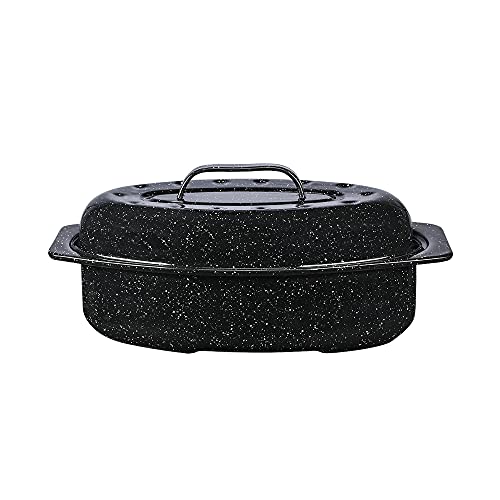
Granite Ware
Sourdough Bread Baking and Roasting: Granite Ware 13-Inch Oval Roaster with Lid
This enameled steel roaster handles up to 7-pound meats while trapping steam for crisp sourdough crusts, making its biggest advantage dual-purpose use. Buy it if you want one dishwasher-safe vessel for high-heat bread baking, roasting, and casseroles.
Pros and Cons
Pros
- The dual-purpose design supports both sourdough baking and roasting in one vessel.
- The self-basting lid retains moisture for tender roasts and improved bread crust development.
- PFOA- and PTFE-free enameled steel provides a durable, non-absorptive cooking surface.
- The high 932°F oven rating accommodates demanding sourdough and roasting temperatures.
Cons
- The enclosed lid is less suitable for recipes that require uncovered roasting and direct surface browning.
- Its 13-inch oval shape may not fit every oven rack or storage space as easily as a standard rectangular pan.
The Best Deals This Week*
-
Armorbear Nonstick Turkey Roasting Pan with 2
$26.98
($29.99)Save $3.01 -
Cuisinart 16-Inch Roasting Pan
$59.95
($79.95)Save $20.00 -
Sourdough Bread Baking and Roasting
$27.99
($29.99)Save $2.00 -
Turkey Roasting Pan With Lid 18in Enamel Carbon
$38.85
($42.39)Save $3.54
*Deals are selected by our commerce team
Glad Large Glad Nonstick Roasting Pan with Rack for Turkey, Chicken, Beef, and Vegetables
Glad
Large Glad Nonstick Roasting Pan with Rack for Turkey, Chicken, Beef, and Vegetables
This Glad 11x15 roasting pan cooks large meats and vegetables while its V-shaped rack improves airflow and its nonstick coating simplifies cleanup. It suits holiday hosts and families who need a durable, dishwasher-safe roaster for large meals.
$18.49 at AmazonEditors' Favorite
Color: Gray Size: Large Dimensions: 17.6 x 11 x 3.1 inches Weight: 3.2 pounds Product Group: Kitchen Binding: Kitchen
Shop NowArmorbear Nonstick Turkey Roasting Pan with 2 Racks, Up to 12 lb Turkey
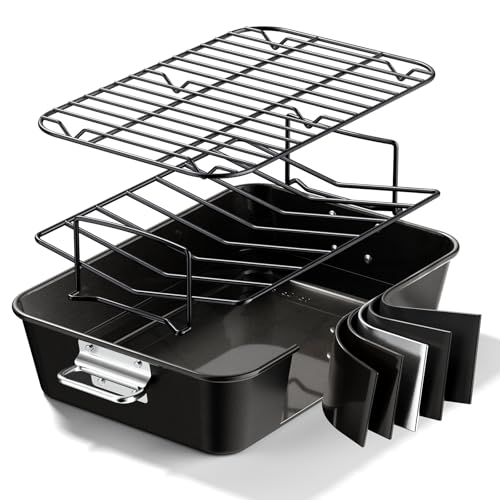
Great Value
Color: Nonstick Black Size: 15" * 11" Dimensions: 15.75 x 11.02 x 3.15 Inches Weight: 2.65 pounds Product Group: Kitchen
Shop NowCuisinart 16-Inch Roasting Pan, Induction Compatible Premium Rectangular Roaster Pan With Rack, Stainless Steel Roasting Pan with Rack, Large Capacity, Dishwasher Safe

Cuisinart
16-Inch Roasting Pan, Induction Compatible Premium Rectangular Roaster Pan With Rack, Stainless Steel Roasting Pan with Rack, Large Capacity, Dishwasher Safe
$59.95 at AmazonColor: Stainless Steel Size: 16-Inch Dimensions: 6.25 x 20.75 x 13.25 inches Weight: 0.000625 Pounds Product Group: Kitchen Binding: Kitchen
Shop NowGranite Ware Sourdough Bread Baking and Roasting: Granite Ware 13-Inch Oval Roaster with Lid
Granite Ware
Sourdough Bread Baking and Roasting: Granite Ware 13-Inch Oval Roaster with Lid
This enameled steel roaster handles up to 7-pound meats while trapping steam for crisp sourdough crusts, making its biggest advantage dual-purpose use. Buy it if you want one dishwasher-safe vessel for high-heat bread baking, roasting, and casseroles.
$27.99 at AmazonColor: Speckled Black Size: 13 inches Dimensions: 13 x 8 x 5 inches Weight: 1.48 Pounds Product Group: Home Binding: Kitchen
Shop NowGranite bowl Turkey Roasting Pan With Lid 18in Enamel Carbon Steel Roaster Pot, Broiler Pan Great-for Roasted Turkey Chicken Baking Bread18 Pound Large Capacity High Temperature Resistance Oval Cookware

Granite bowl
Turkey Roasting Pan With Lid 18in Enamel Carbon Steel Roaster Pot, Broiler Pan Great-for Roasted Turkey Chicken Baking Bread18 Pound Large Capacity High Temperature Resistance Oval Cookware
$38.85 at AmazonColor: Black Size: 18inch Dimensions: 17.7 x 13.5 x 3.9 inches Weight: 3.78974628378 pounds Product Group: Kitchen
Shop Now




Write Your Review
No reviews yet. Be the first to share your experience!