

Ask about kitchen knives in any shop and somebody will tell you, with real conviction, that forged beats stamped. It is one of the most repeated pieces of advice in cookware, and it has grown a whole family of smaller beliefs around it about bolsters, tangs, weight, and edge life. Nearly all of them mistake a description of a factory step for a verdict on how a blade cuts. A stamped knife is defined by one operation near the beginning of its life, and almost everything that happens after that operation is where the performance is actually decided. The claims are worth taking one at a time.
The Sheet, the Billet, and What Each One Does
Stamping starts with steel that arrives at the factory as a rolled sheet or coil, commonly 1.5 to 3 mm thick. A press drives a hardened die through it and punches out a blade blank, profile and tang together, the way a cutter takes a shape out of dough. Forging starts with a bar or billet of the same family of steel, heated until it glows at roughly 1,000 degrees Celsius, then hammered or pressed into a die that squeezes the metal into a rough knife shape. That squeezing is what produces the thick collar behind the edge and the taper along the spine. From there the two paths converge: both blanks are hardened and tempered, both are ground to a bevel, both are sharpened, and both get a handle fitted. The difference between the words stamped and forged lives almost entirely in that first operation.
Forged Is a Category, Not a Grade
The claim that forging makes a better knife sounds like engineering and behaves like marketing. Hammering a hot billet does not hand the edge anything it can use, because the grain structure people cite gets reset by the hardening that follows. Heat treatment is the decisive part: the temperature the steel is soaked at, how quickly it is quenched, and how it is tempered afterward together set the hardness and the way an edge stands up to real cutting. A stamped blade taken to 58 HRC by a careful process will out-cut a forged blade that was over-tempered down to 54 and left soft. What is fair to say is that forging travels with more expensive lines, thicker steel, hand-applied finishing, and a polished spine and heel. That is a matter of labor and market position, not a sharper edge.
The Collar That Went Missing
A bolster is the thick band of steel between blade and handle, and on a forged knife it is a byproduct of the die rather than a feature somebody chose to add. It does stiffen that joint and it does keep fingers from sliding forward onto the edge. Whether either benefit matters depends on what you ask a knife to do. Cutting loads run along the blade and into the food, and a kitchen knife is not a pry bar, so most of the stress a bolster resists is stress a cook should not be creating. The genuine loss on a stamped knife is the finger guard. The genuine gain is access, because a full bolster physically blocks a stone or a rod from reaching the last 10 to 15 mm of edge at the heel. That is why so many forged lines now use a half bolster, and why plenty of cooks count the missing collar as a win.
Thin, and Why That Usually Helps
Stamped blades are generally thinner. Two millimeters at the spine is typical, sometimes 1.5, against 2.5 to 3 mm on a German-style forged knife of the same 8-inch length. Thin is not the same as flimsy. A hardened blade is very stiff in the direction it is loaded, and a thinner one pushes less material aside as it travels, so it wedges less in a dense sweet potato and releases slices instead of gluing them back together. The honest limits are lateral. Splitting a winter squash, working around a joint, or twisting a stuck blade free asks for stiffness across the flat of the steel, and 1.8 mm gives you less of that than 3 mm does. The other limit is mass: a knife that weighs eight ounces falls through an onion partly on its own, while one that weighs five wants you to drive it.
What the Eye Cannot Confirm
People believe they can spot a forged knife from across a counter, and the cues they use, a bolster and a heavy spine and a solid feel in the hand, are cues for a style of construction and a price bracket. Makers can supply every one of them without a forge. Bolsters get welded or clamped onto stamped blanks, spines get left deliberately thick, and a taper toward the tip can be ground in rather than hammered in. Some of the best-cutting knives sold anywhere are Japanese blades cut from sheet and hardened to 60 or 61 HRC, and nobody who has used one would call it a lesser tool. The related belief, that a full tang proves forging, is just as loose. A stamped blank can run the whole length of the handle and sit sandwiched between two scales on three rivets, while a forged knife can taper down to a narrow partial tang. The pairing is a convention rather than a rule.
Edge Life, Weight, and the Upkeep Rhythm
Edge retention has two inputs, and the press is neither of them. What the alloy contains, meaning the carbon, chromium and vanadium and the carbides they form, and what the heat treatment did with it, together decide how long a sharpened edge survives. A stamped blade in a sound stainless at 56 to 58 HRC behaves like any other knife at that hardness. The pattern people notice is real but indirect: budget lines are stamped, and budget lines also tend to use softer, cheaper steel, so stamping marks the price point instead of causing the edge to fold.
Weight is another preference that gets read as a hierarchy. A heavy forged knife rewards a rocking chop, where mass does part of the work and the curve of the belly carries the motion. A light stamped knife rewards a push cut and quick tip work, and it is noticeably less tiring three hours into a prep list. Professional kitchens are full of both, often on the same board. Sharpening follows the same logic: a stamped knife earns exactly the attention any knife earns, and it is easier to sharpen well because nothing obstructs the heel. Softer steel takes an edge fast and loses it sooner, so what changes is the rhythm, not the worth of the exercise, a few passes more often instead of one long session twice a year.
Paying Less Without Expecting Less
Stamped construction is a reason to pay less, not a reason to expect less. The specifications that predict how a knife will behave are the steel it is made from, the hardness it was taken to, the geometry of the grind and how thin the blade is behind the edge, and the way the handle sits in your particular hand. Not one of those is settled by whether a press or a hammer shaped the blank. For most home cooks, a thin, properly hardened stamped knife around 8 inches is both the better value and the more pleasant tool to work with, and the money saved is better spent on a stone and the habit of using it.
Is a stamped knife good enough for daily cooking?
For most cooks it is the better daily choice, not a fallback. A stamped blade in a sound stainless at 56 to 58 HRC will slice, dice and portion anything a home kitchen produces, and the lighter weight is easier on the wrist over a long session. The jobs where it is genuinely outmatched are narrow ones: splitting hard squash, cutting through poultry joints, anything that asks a blade to work sideways. Keep a heavier knife or a cleaver for those and let the thin one handle the rest. Sharpen it a little more often and it stays a good knife for years.
Does a missing bolster make a knife unsafe?
Not unsafe, though it does change how you hold the knife. With no collar behind the heel, nothing stops a wet hand from sliding forward, so a pinch grip with thumb and forefinger on the blade flat matters more than it would on a bolstered knife. Most stamped handles answer this with a raised or contoured front where the scales meet the steel. What you get in exchange is an edge you can sharpen end to end, including the heel that does the heavy pushing. If your hands are often slick, pick a handle with real texture instead of a polished one.
How can I tell whether a knife is stamped or forged?
Read the specification rather than the silhouette. Listings and maker pages usually state the method outright, and where they stay quiet, spine thickness is a hint: roughly 1.5 to 2 mm points to a stamped blank, 2.5 to 3 mm to a forged one. A bolster is weak evidence, since applied bolsters and thickened spines both turn up on stamped lines. The more useful question is what the steel is and how hard it was taken, because that is what your hand feels on the board. Treat the process as trivia and the hardness figure as information.

Matsato
Everyday Kitchen Prep Knife: Matsato Osuren 6.3-Inch Japanese Stainless Steel Chef Knife
The Matsato Osuren handles slicing, chopping, and cutting vegetables, meat, and herbs, with balanced control as its biggest advantage. It suits home cooks and professional food preparation users who want one versatile stainless steel knife for daily kitchen tasks.
Pros and Cons
Pros
- Sharp stainless steel construction supports dependable cutting performance.
- Balanced design helps with control while slicing and chopping.
- Versatile use covers vegetables, meat, herbs, and general kitchen preparation.
- The 6.3-inch size is suited to everyday food preparation.
Cons
- It is not dishwasher safe and requires hand washing and immediate drying.
- The product data does not specify the knife's weight.

Matsato
6.3 Inch Chef Knife Japanese Steel Blade for Home Cooking
This 6.3-inch Japanese stainless steel chef knife delivers razor-sharp precision for slicing, dicing, and chopping vegetables and meats with minimal effort and superior edge retention. Home cooks and meal preppers will appreciate the balanced ergonomic handle that reduces hand fatigue during extended kitchen tasks.
Pros and Cons
Pros
- High-carbon stainless steel blade resists dulling and chipping, maintaining sharpness through hundreds of cutting sessions.
- Ergonomic handle crafted from premium materials reduces fatigue during meal prep and makes controlled cuts feel effortless.
- Compact 6.3-inch size offers better maneuverability than larger chef knives while handling everyday kitchen tasks effectively.
Cons
- Requires hand washing and immediate drying to maintain blade quality and prevent water spots on the steel.
- At 6.3 inches, slightly smaller than traditional 8-inch chef knives, which may limit effectiveness for breaking down large cuts of meat.
Matsato
Sharpen Kitchen, Chef, and Pocket Knives with the Matsato Knife Sharpener
The Matsato Knife Sharpener restores kitchen, chef, and pocket knife edges with ceramic rods, while its non-slip base keeps sharpening controlled. It suits home cooks who want one compact manual sharpener for several knife types.
Pros and Cons
Pros
- Works with kitchen knives, chef knives, and pocket knives.
- Ceramic sharpening rods support smooth, controlled blade maintenance.
- The non-slip base and comfortable grip improve sharpening stability.
- The compact design is easy to store or transport.
Cons
- As a manual sharpener, it requires hands-on effort instead of electric operation.
- Its listed compact dimensions may provide less handling area than larger countertop sharpeners.

Matsato
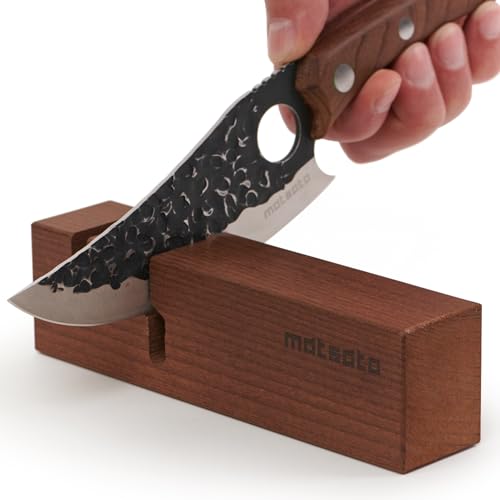
Compact Meat and Vegetable Prep Knife: Matsato Japanese Steel Chef Knife, 4.53-Inch Blade
The Matsato Japanese Steel Chef Knife handles meat, vegetables, and everyday chopping with a compact hammered blade that helps reduce food sticking. It suits home cooks and grilling enthusiasts who want one versatile knife with a secure finger-hole grip.
Pros and Cons
Pros
- The compact blade and finger-hole grip support precise, controlled cutting.
- The hammered surface is designed to reduce food sticking during slicing.
- The knife handles both meat and vegetables, reducing the need to switch tools.
- The carbonized beech wood handle gives the knife a distinctive, gift-ready appearance.
Cons
- The 4.53-inch blade provides less cutting reach than a standard full-size chef knife when processing large vegetables or substantial cuts of meat.
- The listing does not provide the knife's weight, sheath details, or dishwasher-safety guidance.

Matsato
Meat and Vegetable Chopping: Matsato 5.8-Inch Japanese Steel Cleaver Knife
The Matsato 5.8-inch cleaver chops meat, poultry, and vegetables with a lightweight 176g design that provides controlled, precise handling. It suits home cooks, barbecue enthusiasts, and gift buyers seeking a compact 3CR13 stainless steel knife with a secure finger-hole grip.
Pros and Cons
Pros
- Its compact 5.8-inch blade is easier to maneuver than a large traditional meat cleaver.
- The lightweight 176g construction reduces bulk while maintaining a balanced chopping motion.
- A hammered blade surface helps prevent sliced ingredients from clinging to the steel.
- The finger hole, beech wood handle, and hanging hole combine control, comfort, and convenient storage.
Cons
- The compact 5.8-inch blade provides less cutting reach for large cuts of meat or oversized vegetables.
- The listing does not specify dishwasher compatibility, so the beech wood handle should be washed and dried carefully.
Matsato Everyday Kitchen Prep Knife: Matsato Osuren 6.3-Inch Japanese Stainless Steel Chef Knife
Matsato
Everyday Kitchen Prep Knife: Matsato Osuren 6.3-Inch Japanese Stainless Steel Chef Knife
The Matsato Osuren handles slicing, chopping, and cutting vegetables, meat, and herbs, with balanced control as its biggest advantage. It suits home cooks and professional food preparation users who want one versatile stainless steel knife for daily kitchen tasks.
$35.95 at AmazonEditors' Favorite
Color: Black, Brown Size: 6.3" Dimensions: 11 x 2.1 x 0.9 inches Weight: 0.3968320716 Pounds Product Group: Kitchen
Shop NowMatsato 6.3 Inch Chef Knife Japanese Steel Blade for Home Cooking
Matsato
6.3 Inch Chef Knife Japanese Steel Blade for Home Cooking
This 6.3-inch Japanese stainless steel chef knife delivers razor-sharp precision for slicing, dicing, and chopping vegetables and meats with minimal effort and superior edge retention. Home cooks and meal preppers will appreciate the balanced ergonomic handle that reduces hand fatigue during extended kitchen tasks.
$39.99 at AmazonGreat Value
Brand Name: Matsato Manufacturer: Matsato Model Number: Matsato Manufacturer Part Number: Matsato Item Type Name: Knife Unit Count: 1.0 Count Included Components: Knife Best Sellers Rank: #3,455 in Kitchen & Dining (See Top 100 in Kitchen & Dining) #4 in Chef's Knives ASIN: B0CLVMXH3Y Customer Reviews: 4.5 4.5 out of 5 stars (9,153) 4.5 out of 5 stars Blade Edge: Plain Construction Type: Forged Blade Material Type: Stainless Steel Handle Material: Wood Is the item dishwasher safe?: No Material Type: 1.4116 Japanese Stainles, Wood BladeLength: 6.3 Inches Item Weight: 176 Grams Item Length: 10.8 Inches Size: 6.3" Color: Brown, Silver Blade Color: Silver Blade Material: Stainless Steel Brand: Matsato
Shop NowMatsato Sharpen Kitchen, Chef, and Pocket Knives with the Matsato Knife Sharpener
Matsato
Sharpen Kitchen, Chef, and Pocket Knives with the Matsato Knife Sharpener
The Matsato Knife Sharpener restores kitchen, chef, and pocket knife edges with ceramic rods, while its non-slip base keeps sharpening controlled. It suits home cooks who want one compact manual sharpener for several knife types.
$25.99 at AmazonColor: Brown Size: 7.09" x 1.97” x 1.57" Dimensions: 7.086614166 x 1.968503935 x 1.574803148 Inches Weight: 0.440924524 Pounds Product Group: Kitchen
Shop NowMatsato Compact Meat and Vegetable Prep Knife: Matsato Japanese Steel Chef Knife, 4.53-Inch Blade
Matsato
Compact Meat and Vegetable Prep Knife: Matsato Japanese Steel Chef Knife, 4.53-Inch Blade
The Matsato Japanese Steel Chef Knife handles meat, vegetables, and everyday chopping with a compact hammered blade that helps reduce food sticking. It suits home cooks and grilling enthusiasts who want one versatile knife with a secure finger-hole grip.
$36.99 at AmazonColor: Brown Size: 4.5" Dimensions: 10.8267716425 x 1.968503935 x 0.15748 inches Weight: 0.62 pounds Product Group: Kitchen
Shop NowMatsato Meat and Vegetable Chopping: Matsato 5.8-Inch Japanese Steel Cleaver Knife
Matsato
Meat and Vegetable Chopping: Matsato 5.8-Inch Japanese Steel Cleaver Knife
The Matsato 5.8-inch cleaver chops meat, poultry, and vegetables with a lightweight 176g design that provides controlled, precise handling. It suits home cooks, barbecue enthusiasts, and gift buyers seeking a compact 3CR13 stainless steel knife with a secure finger-hole grip.
$43.99 at AmazonColor: Brown Size: 5.8" Dimensions: 11.1417322721 x 3.543307083 x 0.787401574 inches Weight: 0.38801358112 Pounds Product Group: Kitchen
Shop Now





Write Your Review
No reviews yet. Be the first to share your experience!