

On a store shelf, two insulated tumblers can look identical: same brushed finish, same tapered profile, same promise printed on the cardboard sleeve. Yet one holds ice through a full summer day while the other surrenders it before lunch. The gap between them is not branding. It is physics, and nearly all of it hides where you cannot see — in a sliver of nothing between two steel walls, in a bead of weld metal, in a rubber flap inside a lid.
How a vacuum gap actually stops heat
Heat moves in three ways, and a double-wall cup is engineered to cut off each one. Conduction needs solid contact, so the inner and outer walls never touch; they meet only at the rim and the base, far from your drink. Convection needs air to circulate, which is why factories pump the air out of the gap during assembly — remove the medium and nothing can swirl. That leaves radiation, which passes straight through a vacuum no matter how perfect it is.
This is where copper or silver linings earn their keep. A thin plated layer on the outside of the inner wall reflects radiant energy back toward the contents, typically adding 10 to 20 percent heat retention compared with bare steel. Cheaper cups skip the plating entirely. You will never spot the difference in a showroom; you notice it on the second afternoon, when the unplated tumbler’s ice is gone and the plated one still rattles.
18/8 versus 201: the steel grade nobody prints clearly
Almost every reputable maker builds from 18/8 stainless — eighteen percent chromium, eight percent nickel, known in materials charts as grade 304. Chromium forms the passive oxide layer that resists rust, while nickel steadies the alloy’s structure and helps it tolerate acids. Budget plants sometimes substitute grade 201, which swaps costly nickel for manganese and nitrogen. The spec sheet looks similar. The cup does not behave similarly.
Fill 201 steel with lemonade, orange juice, or anything acidic and leave it overnight; small dark freckles may greet you in the morning. Those are pits — corrosion blooms that start at scratches and slowly deepen. They will not rinse out, because they are not residue. They are holes. Since both grades are essentially non-magnetic, a fridge magnet proves nothing. Look for “18/8” or “304” stated outright in the specifications, and treat silence on the subject from a very cheap cup as an answer in itself.
Welds and vacuum ports kill insulation quietly
Building the cavity is a sequence with several ways to fail. Factories roll the inner and outer shells from sheet steel, weld them together at the rim, seal a base plate underneath, then evacuate the gap through a small port — usually a pinhole near the bottom — before soldering it shut. Every joint in that chain is a potential slow leak, and the rim weld plus the base seal see the most abuse.
Drop a tumbler onto concrete and the weld can crack invisibly; air creeps back into the gap over the following weeks. Nothing announces the failure. There is no rattle, no visible dent, no change in appearance. The only symptom is thermal: the entire outer wall adopts the temperature of the drink, so hot coffee makes the whole cup feel warm instead of leaving it neutral in your hand. That sensation doubles as a diagnostic. Fill a suspect cup with ice water, give it five minutes, then rest a palm against the side. Room temperature means the vacuum holds. A cool, clammy wall means the vacuum is gone, and no amount of careful handling brings it back.
Your lid loses more heat than the walls do
Wall engineering attracts all the advertising, yet the lid is where performance drains away first. Hold a tumbler open while you work and evaporation strips heat from the coffee’s surface far faster than the walls conduct it out; ten minutes of exposed ninety-millimeter aperture does more damage than two hours behind a decent wall. How often the lid closes therefore matters as much as how well it was made.
Slide-close covers let you sip anywhere and snap shut between drinks. Magnetic latches offer the same convenience with fewer parts to gum up. Threaded lids with silicone gaskets seal hardest, which is why travel mugs meant for backpack pockets rely on them instead of sliders. Read box language skeptically: splash-resistant describes a lid that survives a tip-over in a car holder, while genuinely leakproof demands a compressed gasket seal that holds through inversion. Few slide lids qualify. Hot liquid complicates things further — hermetically sealing a steaming drink traps pressure, which is exactly why the better designs pair a gasket with a small vent.
Ice hours, gram weights, and dents hiding under paint
Grounded expectations for a competent twenty-ounce tumbler: ice lasts twelve to twenty-four hours, and coffee stays above sixty degrees Celsius for roughly four to six. Marketing numbers read higher because of how they are measured — “twenty-four hours cold” often means a single ice cube survived to the finish line, not that your drink stayed pleasantly chilled. Ask instead how long the beverage remains worth drinking.
Weight tells its own story. Expect an empty twenty-ounce tumbler to run somewhere between 300 and 400 grams, rising with capacity and wall thickness. A “twenty-ounce” cup noticeably lighter than its neighbors likely carries thinner walls or a thinner base plate, and thin bases dent first. Powder-coated exteriors deserve particular suspicion: the texture looks premium and grips well, but it conceals impacts. A knock that crimps the outer shell can pinch the vacuum gap or crack a weld beneath paint that shows nothing. When a coated cup abruptly stops performing after a drop, believe the lukewarm coffee over the flawless finish.
Dishwasher water, coffee oils, and the mold crevice
Plenty of insulated cups carry hand-wash-only markings, and the reason is structural rather than fussy. Machine cycles hammer gaskets with hot, pressurized water until the silicone stiffens and seals imperfectly. Should water then find its way past a failing lid seal or a fatigued weld, it enters the space between the walls — territory no brush will ever visit. A cup that grows heavier over months of dishwashing, or begins sweating outside despite an intact vacuum, has probably taken on internal water that cannot be dried.
Hand washing sets its own traps. Slide-lid channels gather coffee oils and fine grounds along their tracks; a casual rinse leaves the film in place, and aged oil turns bitter, seasoning every fresh pour with yesterday’s cup. Separate the lid’s moving parts where the design allows and scrub the channel with hot, soapy water. Geometry compounds the problem: straight bottle brushes glide past the tapered shoulder inside narrow tumblers, leaving a ring of biofilm above the waterline, while the recessed vacuum port at the base collects grime in a crevice standard brushes never approach. A small detail brush for lids and a bent-tip brush for shoulders cover most of it. Neglected, a damp closed lid grows pink or black slime within days in a dark cabinet.
What you actually pay for at $12 versus $35
The awkward truth about pricing is that raw steel is a rounding error. Grade 304 blanks cost roughly the same whether they become a famous-brand tumbler or a gas-station special. What separates the $25–40 tier from the $10–15 tier is process control: batch checks for vacuum integrity, weld inspection, gasket tolerance, and a warranty department that picks up the phone. Generics are a lottery, though the wins are genuine — certain twelve-dollar cups hold ice as long as anything on the market. Others fade within a season. The pragmatic play is buying cheap only where returns are painless, then running the ice-water palm test on day one, since a dead vacuum exposes itself immediately. Established brands sell consistency and spares; replacement lids and gaskets matter enormously across a five-year life. Judge the object in your hand, not the story wrapped around it.
How can I tell if my insulated cup has lost its vacuum?
Fill the cup with ice water, wait about five minutes, then touch the outside wall. A healthy vacuum leaves the exterior at room temperature with no condensation at all. If the wall feels cool or beads moisture, air has leaked into the gap and the insulation is finished. Melt speed confirms it: ice that once lasted a full day will now disappear within a few hours. Nothing restores a lost vacuum, so the honest remedy is replacement.
Is it safe to put a stainless steel tumbler in the dishwasher?
Your safety is rarely the concern; the steel itself will not leach anything meaningful in a machine. The danger flows toward the cup instead. Repeated hot cycles stiffen lid gaskets, and pressurized jets can push water through seams or the vacuum port into the unreachable gap between walls, ruining the cup from the inside. Honor the manufacturer’s marking where one exists, because hand-wash labels protect the product rather than pad the manual. If your model is rated dishwasher-safe, keep it on the top rack and dry the lid gasket separately afterward.
Why does my tumbler still smell like coffee after washing?
The odor almost always lives in the lid rather than the cup. Coffee oils migrate into the silicone gasket and settle along the slide channel, spots a routine rinse cannot flush, and the aging film oxidizes into bitterness that flavors each new drink. Take the lid apart as far as its design allows and soak the pieces for a few hours in hot water with baking soda. A soft toothbrush reaches the channel better than any sponge. Should the smell survive a deep clean, replacement gaskets are cheap for major sizes — or swap the whole lid, since it wears out long before the walls do.
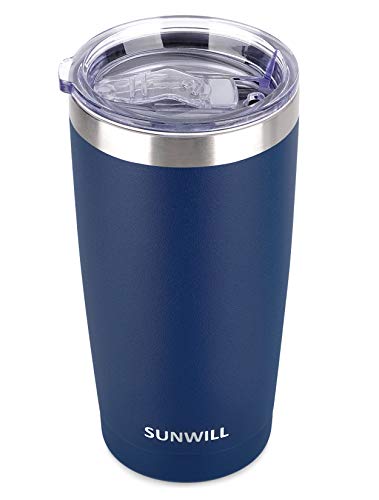
SUNWILL
20 oz Insulated Travel Coffee Tumbler – Stainless Steel, Navy Powder Coated, BPA Free Sliding Lid
The SUNWILL 20 oz tumbler uses double-wall vacuum insulation to keep coffee hot for 6 hours and cold drinks cold for up to 24, with a spill-resistant sliding lid designed for commuters and outdoor use. It suits anyone who wants a durable, car-holder-compatible mug that won't sweat, rust, or break under daily use.
Pros and Cons
Pros
- Vacuum insulation delivers genuine 6-hour heat retention, useful for long commutes or slow-sipping work mornings.
- Food-grade 18/8 stainless steel is lead-free and won't impart metallic taste even with acidic drinks like black coffee.
- The sliding lid is straw-compatible and seals with a silicone gasket, reducing spill risk during movement.
- Powder-coated Navy finish provides a non-slip grip and holds up to regular handling without chipping.
Cons
- No reviews are currently available, so real-world lid durability and long-term insulation performance are unverified.
- At 20 oz the capacity suits a single large coffee but won't cover users who want to carry a full day's water.

STANLEY
Cold Drinks for Commuting: STANLEY Quencher H2.0 30 oz Tumbler with Handle and Straw
The STANLEY Quencher H2.0 keeps water, iced drinks, and hot beverages at temperature for hours, while its narrow base fits most car cup holders. Buy it if you want a durable 30 oz tumbler with a carry handle, reusable straw, and dishwasher-safe cleanup.
Pros and Cons
Pros
- Vacuum insulation handles cold, iced, and hot beverages for hours.
- The reusable straw, rotating lid, and handle make everyday drinking convenient.
- The stainless steel body is BPA-free, dishwasher safe, and built for durability.
- The narrow base provides practical compatibility with most vehicle cup holders.
Cons
- The lid offers added leak resistance but is not described as completely leakproof.
- The 30 oz capacity may feel bulky for buyers who prefer a smaller everyday cup.
The Best Deals This Week*
-
SUNWILL 20 oz Insulated Travel Coffee Tumbler
$9.99
($15.99)Save $6.00 -
Cold Drinks for Commuting
$32.98
($35)Save $2.02
*Deals are selected by our commerce team
SUNWILL 20 oz Insulated Travel Coffee Tumbler – Stainless Steel, Navy Powder Coated, BPA Free Sliding Lid
SUNWILL
20 oz Insulated Travel Coffee Tumbler – Stainless Steel, Navy Powder Coated, BPA Free Sliding Lid
The SUNWILL 20 oz tumbler uses double-wall vacuum insulation to keep coffee hot for 6 hours and cold drinks cold for up to 24, with a spill-resistant sliding lid designed for commuters and outdoor use. It suits anyone who wants a durable, car-holder-compatible mug that won't sweat, rust, or break under daily use.
$9.99 at AmazonEditors' Favorite
Color: Powder Coated Navy Blue Size: 20 Ounces Dimensions: 3.37 x 3.37 x 6.75 inches Weight: 0.72 Pounds Product Group: Kitchen Binding: Kitchen
Shop NowYETI Rambler 20 oz Tumbler, Stainless Steel, Vacuum Insulated with MagSlider Lid, Stainless

YETI
Rambler 20 oz Tumbler, Stainless Steel, Vacuum Insulated with MagSlider Lid, Stainless
$35.00 at AmazonGreat Value
Color: All Stainless Steel Size: 20 Ounces Dimensions: 3.5 x 3.5 x 7 inches Weight: 0.39903669422 Pounds Product Group: Kitchen Binding: Sports
Shop NowMimorou 8 Pack Stainless Steel Insulated Cup 10 oz Metal Tumbler Double Wall Vacuum Water Glasses Camping Reusable Mugs Bbq Home Office Party Coffee

Mimorou
8 Pack Stainless Steel Insulated Cup 10 oz Metal Tumbler Double Wall Vacuum Water Glasses Camping Reusable Mugs Bbq Home Office Party Coffee
$29.99 at AmazonColor: Silver Size: 10 oz Dimensions: 3.15 x 3.15 x 2.17 inches Product Group: Kitchen Binding: Unknown Binding
Shop NowFristChoice 30 oz Tumbler with Lids and Straws Double Wall Insulated Tumbler Cup,Stainless Steel Leak-proof Thermal Coffee Tumbler Powder Coated Travel Mug for Cold and Hot Beverages,Silver

FristChoice
30 oz Tumbler with Lids and Straws Double Wall Insulated Tumbler Cup,Stainless Steel Leak-proof Thermal Coffee Tumbler Powder Coated Travel Mug for Cold and Hot Beverages,Silver
$11.99 at AmazonColor: Silver Size: 30 Ounces Dimensions: 3.9 x 3.9 x 7.6 inches Weight: 1.15081300764 pounds Product Group: Kitchen Binding: Kitchen
Shop NowSTANLEY Cold Drinks for Commuting: STANLEY Quencher H2.0 30 oz Tumbler with Handle and Straw
STANLEY
Cold Drinks for Commuting: STANLEY Quencher H2.0 30 oz Tumbler with Handle and Straw
The STANLEY Quencher H2.0 keeps water, iced drinks, and hot beverages at temperature for hours, while its narrow base fits most car cup holders. Buy it if you want a durable 30 oz tumbler with a carry handle, reusable straw, and dishwasher-safe cleanup.
$32.98 at AmazonColor: Rose Quartz 2.0 Size: 30 Ounces Dimensions: 5.43 x 5.43 x 12.52 Inches Weight: 1.18829018 pounds Product Group: Outdoors Binding: Sports
Shop Now




Write Your Review
No reviews yet. Be the first to share your experience!