

Three Myths That Keep Good Cooks Away From Stainless
Walk into any kitchen store and you will hear the same warnings repeated like folklore. Stainless steel always sticks. The more layers of metal a pan has, the better it must be. Nonstick is simply easier, so a beginner should skip stainless altogether. Each of these sounds reasonable. Each is also mostly wrong, and believing them will steer you toward the wrong pan or away from a tool you would actually love.
A stainless steel deep saute pan is one of the most versatile pieces you can own. It has tall, straight sides, a wide flat bottom, and enough depth to hold a braise or shallow-fry a batch of chicken thighs without splattering your stovetop. Before you spend money, it helps to clear away the misconceptions, because they are the reason so many of these pans end up shoved to the back of a cabinet, blamed for problems they never caused.
Myth One: Stainless Steel Always Sticks
Food sticks to cold metal. That is the whole secret, and it explains nearly every frustrated review you have ever read. When protein hits a pan that has not reached temperature, the surface proteins bond to the microscopic pores in the steel. As the pan heats, that bond only tightens, and by the time you try to flip, half the fish is welded down.
Preheat the empty pan over medium heat for two or three minutes, then run the water test. Flick a few drops onto the surface. If they sizzle and vanish, the pan is too cool. If they gather into a quivering bead that skates across the metal like mercury, you have hit the Leidenfrost point and the pan is ready. Add your fat now, let it shimmer, then add the food and leave it alone. A chicken breast will release itself when a proper crust forms, usually after three or four minutes. Chase it too early and it tears; wait, and it lifts clean.
None of this requires talent, only patience. Once you internalize the rhythm of preheat, test, fat, wait, stainless stops being the villain and starts behaving like the workhorse it is.
Myth Two: More Ply Is Always Better
Marketing loves a number, and ply count is an easy one to inflate. You will see three-ply, five-ply, and even seven-ply pans, each promising superior performance. The truth is quieter. Ply refers to the layers of metal bonded together: stainless on the surfaces for durability, aluminum or copper in the middle for heat conduction. What matters is not how many layers exist but how thick the conductive core is and how far up the sides the cladding reaches.
A well-made three-ply pan with a thick aluminum core will out-cook a thin five-ply pan every day of the week. Extra layers can even work against you by adding weight and cost without improving how evenly the surface heats. What you want is fully clad construction, meaning the layered metal wraps the entire pan rather than sitting as a disc glued only to the bottom. Disc-bottom pans heat the base well but leave the walls cool, which matters in a deep pan where you are simmering liquid against those tall sides.
So ignore the ply arms race. Ask about core thickness, ask whether the cladding is full, and pick up the pan. A quality piece feels substantial without being punishing, somewhere around three to four pounds for a four-quart size.
Myth Three: Beginners Should Just Buy Nonstick
Nonstick has a real place. Eggs, delicate fish, and pancakes come off it beautifully, and there is no shame in owning one. But the idea that it should be a beginner’s only pan does them a disservice. Nonstick coatings degrade. Their surfaces cannot tolerate high heat, they scratch under metal utensils, and most need replacing every couple of years. You also cannot build a proper fond, the browned residue that forms the base of pan sauces and gravies, because the coating prevents food from bonding at all.
Stainless does the opposite. It thrives on high heat, tolerates metal tools, lasts for decades, and turns those browned bits into the foundation of a sauce with a splash of wine or stock. Learning to cook on it makes you a better cook, because it gives honest feedback about heat and timing that a forgiving coating hides. Keep the nonstick for your morning omelet. Reach for the deep stainless saute pan for almost everything else.
What Actually Matters When You Buy
Now that the myths are out of the way, here is where your attention belongs. Capacity comes first. A four-quart pan suits most households, giving you room for a family braise or a full pound of pasta finished in sauce. Larger cooks and batch makers should consider five or six quarts, though a heavier pan grows harder to lift when full.
Look at the base next. A flat, thick bottom sits squarely on an induction burner or a gas grate and resists warping over years of heat cycling. Confirm induction compatibility if your cooktop demands it; most quality stainless pans work, but a magnet on the base is a quick sanity check. Then consider the interior. A brushed or matte finish hides scratches and cleans easily, while a mirror polish looks gorgeous in the box and shows every mark within a month.
Finally, weight and balance. Hold the pan by its handle as if lifting it off the stove. It should feel planted, not tippy, and the heft should sit toward the pan rather than the handle. These are the details that separate a pan you use daily from one you resent.
Why the Deep Saute Shape Earns Its Keep
The shape is the whole point. A traditional skillet flares outward with sloped sides, which is great for tossing vegetables but poor at containing liquid. A saucepan holds liquid well but offers little surface area for browning. The deep saute pan splits the difference with tall, straight walls and a broad flat floor, and that geometry unlocks a surprising range of cooking.
You can sear then braise in the same vessel, building fond on the wide bottom and then adding liquid that the high sides keep from boiling over. You can shallow-fry cutlets with less oil splatter reaching your backsplash. You can reduce a sauce quickly thanks to the exposed surface, poach chicken, simmer a curry, or cook down a big pile of greens that would tumble out of a shallow skillet. A matching lid extends the range further, trapping steam for anything that needs gentle, moist heat. One pan, a dozen jobs.
The Small Stuff: Handles, Lids, and Care
Handles deserve more thought than they usually get. A riveted stainless handle stays cool longer than a hollow one and survives the oven, which matters if you plan to move from stovetop to a 400-degree finish. Rivets should sit flush on the interior so food does not pack around them. A helper handle on the opposite side is a genuine gift once the pan is full and heavy; four quarts of braise is more than a wrist wants to manage one-handed.
Lids come in glass or stainless. Glass lets you watch without lifting; stainless is more durable and oven-safe to higher temperatures. Either works, so buy for preference. As for care, stubborn stuck-on residue lifts with a paste of baking soda and water, and a cloudy interior brightens with a specialized stainless cleaner like Bar Keepers Friend. Skip the dishwasher when you can, since long-term detergent exposure dulls the finish. Treated with a little respect, a good stainless saute pan will still be on your stove long after three nonstick pans have gone to the landfill.
Is a stainless steel deep saute pan safe to put in the oven?
In most cases, yes, and this is one of the pan’s great advantages over nonstick. Fully clad stainless pans with riveted metal handles are typically oven-safe to at least 500 degrees Fahrenheit, which lets you sear on the stovetop and finish in the oven without switching vessels. The limiting factor is usually the handle material or a glass lid, not the pan body. Check the manufacturer’s stated temperature, and if your pan has a glass lid, leave it out of the oven or confirm its own rating separately.
How do I stop food from sticking without ruining the pan?
Preheat before anything else. Warm the empty pan over medium heat for a couple of minutes, then test with a few drops of water; when they bead up and glide instead of sizzling and evaporating, the surface is ready. Add fat, let it shimmer, then add your food and resist the urge to move it. Protein releases naturally once a crust forms, usually after a few minutes. If it grips the pan, it simply is not done searing yet. This technique protects the pan too, since you never need harsh scraping to free stuck food.
Do I really need fully clad, or is a disc-bottom pan fine?
It depends on how you cook. A disc-bottom pan heats its base well and often costs less, which suits straightforward searing and boiling. But in a deep saute pan you frequently simmer liquid that rises well up the walls, and a disc bottom leaves those walls comparatively cool, creating uneven heat around the sides. Fully clad construction carries the conductive core all the way up, so the entire pan heats consistently. For a pan you intend to braise and reduce sauces in, fully clad is worth the extra cost.

Cuisinart
One-Pan Sautéing and Braising: Cuisinart 5.5-Quart Stainless Steel Sauté Pan with Lid
This 5.5-quart Cuisinart sauté pan handles large sautés, sauces, and braises, with an aluminum-encapsulated base that promotes fast, even heating. It suits cooks who need generous capacity, broad cooktop compatibility, and dishwasher-safe cleanup.
Pros and Cons
Pros
- The 5.5-quart capacity accommodates larger meals without requiring an unusually tall pot.
- It works with induction, electric, and gas cooktops and can also be used in the oven.
- The included Flavor Lock lid helps retain moisture while simmering or braising.
- Cuisinart backs the BPA-free pan with a lifetime warranty.
Cons
- The large 5.5-quart body may be cumbersome to store in kitchens with limited cabinet space.
- Its straight high sides provide capacity but are less convenient for tossing food than the sloped sides of a traditional skillet.

VocVoi
Everyday Sautéing and Braising: VocVoi 6-Quart Tri-Ply Stainless Steel Sauté Pan with Lid
The VocVoi 6-quart sauté pan handles frying, sautéing, braising, and broiling while its tri-ply construction promotes quick, even heat transfer. It suits cooks who want a non-coated stainless steel pan that works on every cooktop and in the oven.
Pros and Cons
Pros
- Tri-ply stainless steel is designed to improve heat distribution compared with pure steel.
- The 6-quart, 12-inch format provides useful capacity for family-size cooking.
- The ergonomic handle is designed to make the pan easier to handle.
- It combines a durable stainless steel build with dishwasher and oven compatibility.
Cons
- The product data does not specify the pan's weight or maximum oven temperature.
- Because the surface is uncoated stainless steel, cooks may need proper preheating and oil use to reduce sticking.
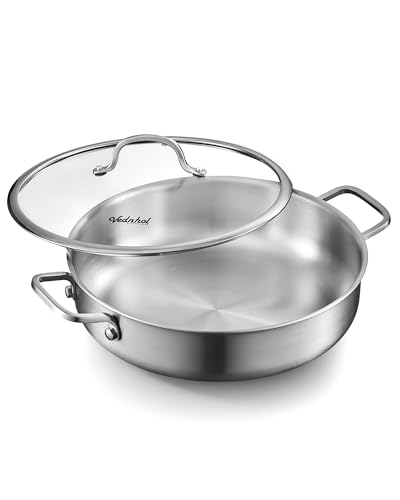
VEDNHOL
12-Inch 7QT Tri-Ply Stainless Steel Sauté Pan with Lid by VEDNHOL – Induction & Oven Safe Deep Skillet
The VEDNHOL 12-inch sauté pan combines a 7-quart deep capacity with tri-ply stainless steel construction to handle everything from searing steaks to simmering soups with even, efficient heat. Home cooks who want one versatile pan that works on every stovetop, goes into the oven, and cleans up in the dishwasher will get the most out of this buy.
Pros and Cons
Pros
- The tri-ply stainless steel body distributes heat quickly and evenly across the full 12-inch surface, reducing the need to adjust the burner repeatedly.
- At 7 quarts with deep sidewalls, this pan handles generous family-sized portions while containing splatter from frying or sautéing.
- Full induction compatibility combined with oven-safe construction makes it genuinely multi-method cookware, not just a stovetop pan.
- The included matching lid adds utility for braising and steaming without requiring a separate purchase.
Cons
- With no verified reviews yet, long-term durability of the tri-ply bonding and handle rivets under heavy daily use remains untested.
- Stainless steel requires proper preheating and fat management to prevent sticking, which adds a learning curve for cooks used to nonstick surfaces.
The Best Deals This Week*
-
Everyday Sautéing and Braising
$25.99
($33.99)Save $8.00 -
CAROTE 10" Tri-Ply Stainless Steel Deep Frying Pan
$24.99
($37.99)Save $13.00 -
12-Inch 7QT Tri-Ply Stainless Steel Sauté Pan
$28.49
($59.99)Save $31.50
*Deals are selected by our commerce team
Cuisinart One-Pan Sautéing and Braising: Cuisinart 5.5-Quart Stainless Steel Sauté Pan with Lid
Cuisinart
One-Pan Sautéing and Braising: Cuisinart 5.5-Quart Stainless Steel Sauté Pan with Lid
This 5.5-quart Cuisinart sauté pan handles large sautés, sauces, and braises, with an aluminum-encapsulated base that promotes fast, even heating. It suits cooks who need generous capacity, broad cooktop compatibility, and dishwasher-safe cleanup.
$69.95 at AmazonEditors' Favorite
Color: 5.5-Quart Size: 5.5-Quart Dimensions: 23.2 x 11.8 x 4.5 inches Weight: 6.15 pounds Product Group: Kitchen Binding: Kitchen
Shop NowVocVoi Everyday Sautéing and Braising: VocVoi 6-Quart Tri-Ply Stainless Steel Sauté Pan with Lid
VocVoi
Everyday Sautéing and Braising: VocVoi 6-Quart Tri-Ply Stainless Steel Sauté Pan with Lid
The VocVoi 6-quart sauté pan handles frying, sautéing, braising, and broiling while its tri-ply construction promotes quick, even heat transfer. It suits cooks who want a non-coated stainless steel pan that works on every cooktop and in the oven.
$25.99 at AmazonGreat Value
Color: Stainless Steel Size: 6QT Dimensions: 10 x 12 x 2 inches Product Group: Kitchen Binding: Kitchen
Shop NowCAROTE 10" Tri-Ply Stainless Steel Deep Frying Pan with Lid, Non-Toxic Saute Pan, Oven Safe, Induction, Ceramic and Gas Cooktops Compatible, Silver
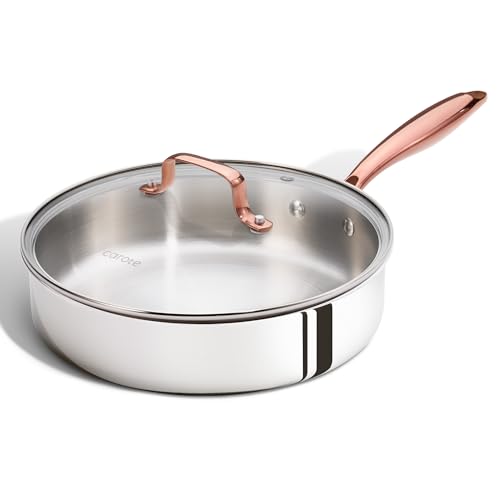
CAROTE
10" Tri-Ply Stainless Steel Deep Frying Pan with Lid, Non-Toxic Saute Pan, Oven Safe, Induction, Ceramic and Gas Cooktops Compatible, Silver
$24.99 at AmazonColor: Silver Size: 10" Dimensions: 19.6 x 10 x 2.8 inches Weight: 5.34180060826 pounds Product Group: Kitchen
Shop NowDELARLO Tri-Ply Stainless Steel Frying Pan,12 inch Skillet with Lid,6 Quart Saute Pan,Compatible with All Cooktops,Oven Up to 660℉,Chicken Fryer,Dishwasher-Friendly

DELARLO
Tri-Ply Stainless Steel Frying Pan,12 inch Skillet with Lid,6 Quart Saute Pan,Compatible with All Cooktops,Oven Up to 660℉,Chicken Fryer,Dishwasher-Friendly
$39.99 at AmazonColor: Sliver Size: 6QT Long Handle Dimensions: 13.3 x 13.3 x 3.93 inches Weight: 6.48 pounds Product Group: Kitchen Binding: Kitchen
Shop NowVEDNHOL 12-Inch 7QT Tri-Ply Stainless Steel Sauté Pan with Lid by VEDNHOL – Induction & Oven Safe Deep Skillet
VEDNHOL
12-Inch 7QT Tri-Ply Stainless Steel Sauté Pan with Lid by VEDNHOL – Induction & Oven Safe Deep Skillet
The VEDNHOL 12-inch sauté pan combines a 7-quart deep capacity with tri-ply stainless steel construction to handle everything from searing steaks to simmering soups with even, efficient heat. Home cooks who want one versatile pan that works on every stovetop, goes into the oven, and cleans up in the dishwasher will get the most out of this buy.
$28.49 at AmazonColor: Stainless Steel Size: 7QT Dimensions: 3 x 13 x 13 Inches Weight: 3.5 Pounds Product Group: Kitchen
Shop Now




Write Your Review
No reviews yet. Be the first to share your experience!