

A small saucepan with a pour spout transforms one of the kitchen’s most routine tasks—transferring hot liquids—into something effortless and precise. Whether you’re drizzling pan sauce over a roast, portioning hot soup into jars, or measuring melted butter for baking, that integrated spout means no more awkward tilting, no drips down the side, and no need to fish out a separate ladle. But the difference between a $25 pan and a $150 pan shows up in details you won’t notice until you’ve used both.
This guide walks through the price-value tiers for small saucepans with pour spouts, breaking down what you gain as you move up—and what you can safely skip if your cooking style doesn’t demand it.
Budget Tier: Functional Pour Spouts Without the Frills
Budget saucepans in the $20-$40 range typically feature stamped aluminum or thin stainless steel construction with a welded or riveted handle and a molded pour spout on one or both sides. The spout itself is usually a simple V-shaped notch or a shallow channel pressed into the rim during manufacturing. These designs work, but they’re not refined. Liquids flow cleanly enough for everyday tasks like heating milk or making oatmeal, but thicker sauces or oils can cling to the rim and create drips.
Heat distribution in this price range tends to be uneven. Aluminum pans conduct heat quickly but can develop hot spots, especially on gas burners. Stainless steel models at this tier often lack a fully encapsulated base, meaning the pan’s sides heat more slowly than the bottom. You’ll need to stir more frequently and watch heat levels closely.
Budget pour-spout saucepans fill a real need. If you’re outfitting a first apartment, cooking infrequently, or simply want a dedicated pan for reheating liquids without dirtying your nicer cookware, these get the job done. Look for models with at least a 2.5mm base thickness and a capacity between 1 and 2 quarts—anything smaller limits versatility, and larger pans in this price range tend to warp on high heat.
Mid-Tier: Improved Pour Control and Heat Response
Step up to the $50-$90 range and you’ll see meaningful improvements in both spout design and pan construction. Mid-tier saucepans often feature tri-ply or five-ply construction—stainless steel exterior and interior layers bonded to an aluminum or copper core. This design extends even heating all the way up the sides of the pan, reducing scorching and improving control for delicate tasks like making beurre blanc or heating cream without breaking it.
Pour spouts at this level are more thoughtfully shaped. Instead of a basic notch, you’ll find gently tapered channels with polished edges that guide liquids cleanly and cut off flow without trailing. Some manufacturers add a slight flare to the spout or incorporate dual spouts for ambidextrous pouring. The difference is most noticeable with viscous liquids—caramel, melted chocolate, or reduced stock—where a well-designed spout prevents the frustrating dribble that budget models allow.
Handles in this tier are almost always riveted, often with stainless steel or silicone-wrapped grips that stay cooler during stovetop use. The rivet placement and handle angle matter more than you’d expect; a poorly balanced pan forces you to use two hands even when pouring small volumes. Mid-tier pans also tend to include helper handles on the opposite side, making it easier to lift a full pan without straining your wrist or risking a spill.
For home cooks who use a small saucepan multiple times per week—making morning coffee with steamed milk, reducing pan sauces, or batch-cooking grains—this tier offers the best balance of performance and cost. You’re paying for durability and precision without stepping into specialty materials or hand-finished details.
Premium Tier: Restaurant-Grade Materials and Lifetime Construction
Premium small saucepans with pour spouts—typically $100-$200—are built for professional kitchens or serious home cooks who demand absolute consistency. The core differences lie in material quality, manufacturing precision, and long-term durability. Many premium models use copper cores or fully clad copper construction, which conducts heat roughly twice as efficiently as aluminum. This means faster response to temperature changes and virtually no hot spots, even at the pan’s edges.
Pour spouts at this level are often hand-polished or laser-cut to exacting tolerances. The interior edge is beveled so liquids separate cleanly from the pan, while the exterior curve prevents drips from running down the side. Some premium brands incorporate flared rims around the entire circumference, meaning you can pour from any angle without sacrificing control.
Handle construction in premium pans reflects decades of ergonomic refinement. Rivets are often countersunk and polished flush with the interior surface, eliminating the gunk-collecting crevices common in cheaper pans. Handles themselves are cast or forged from a single piece of stainless steel, shaped to balance the pan’s weight even when full.
You’re also paying for warranty coverage and repairability. Many premium brands offer lifetime warranties and will replace warped pans, re-rivet loose handles, or refinish scratched interiors. If you cook daily and view cookware as a multi-decade investment rather than a consumable, the math works out.
What You Gain (and Lose) at Each Price Point
The budget tier sacrifices even heating and spout precision but delivers basic functionality. You’ll work around hot spots and occasional drips, but the pan will heat liquids and the spout will pour. Expect a usable lifespan of two to four years with regular use, longer if you treat it gently and avoid high heat or metal utensils.
Mid-tier pans eliminate most frustrations. Heat spreads evenly, spouts pour cleanly, and riveted handles feel solid. You’re still compromising on material thickness compared to premium models—most mid-tier pans use 2.5-3mm total thickness versus 3.5-4mm in high-end pans—but the practical difference only shows up in high-heat searing or hours-long simmering. For typical small-saucepan tasks, mid-tier performance is indistinguishable from premium in blind tests.
Premium pans offer incremental gains that matter most to professionals or enthusiasts. Copper’s heat response is measurably faster, hand-finished spouts pour with surgical precision, and build quality ensures the pan will outlast your stove. But you’re paying exponentially more for logarithmic improvements.
Matching the Pan to Your Cooking Style
Choose based on frequency and task complexity. If you’re heating canned soup or boiling eggs twice a week, budget pans handle that without complaint. If you’re making béchamel, caramel, or pastry cream—tasks where temperature control and clean pouring directly affect results—mid-tier pans remove enough variables to make the process less stressful. If you’re a daily cook who relies on precise heat control and plans to use the same pan for the next 15 years, premium construction justifies the upfront cost.
Consider your stovetop, too. Gas burners emphasize the importance of even heat distribution, making multi-ply construction more valuable. Induction cooktops do some of the heavy lifting themselves, so a well-made mid-tier induction-compatible pan performs closer to premium models. Electric coil burners are unforgiving—hot spots are unavoidable—so even premium pans won’t fully compensate.
The Pour Spout Detail That Actually Matters
Across all price tiers, one design feature predicts pouring performance better than any other: the interior bevel angle. A sharp 90-degree edge at the rim encourages liquids to cling and drip. A gentle 15-20 degree bevel guides liquids away from the pan and cuts flow cleanly. Budget pans rarely include this detail. Mid-tier pans sometimes do. Premium pans always do, often with hand-polishing to eliminate microscopic burrs that would otherwise disrupt flow.
You can test this in a store or from product photos. Look at the spout in profile. If the interior rim is squared off or only slightly rounded, expect drips. If you see a visible bevel or taper leading into the spout, pouring will be noticeably cleaner. This single detail often separates a $50 pan that pours like a $100 pan from a $50 pan that feels like a $25 pan.
Dual spouts on both sides of the pan add convenience for left-handed cooks and ambidextrous pouring, but they don’t improve pouring performance per se. A single well-designed spout is preferable to poorly executed spouts on both sides, so don’t pay extra for the feature unless you specifically need it.
Common Questions About Small Saucepans With Pour Spouts
Do pour spouts make lids fit poorly?
Well-designed pour spouts shouldn’t interfere with lid fit, but cheaper pans sometimes compromise. The issue arises when the spout is stamped too deeply into the rim, creating a gap between the lid and pan edge. This allows steam to escape during simmering and can slow cooking times. Better manufacturers account for this by designing lids with corresponding notches or by keeping the spout shallow enough that a flat lid still seals properly. Before buying, check whether the pan includes a matched lid and whether reviews mention steam leakage. If you’re buying a lidless pan, make sure you can source a universal lid that fits snugly despite the spout.
Can you add a pour spout to an existing saucepan?
Aftermarket pour spouts exist—clip-on silicone or metal attachments that hook over a pan’s rim—but they’re clumsy compromises. Clip-on spouts sit proud of the rim, making lids impossible to use and creating a pivot point that can tip a lightweight pan. They also trap liquids and food particles in the crevice between the attachment and pan, turning into cleaning headaches and potential bacterial harbors. If you find yourself wanting a pour spout badly enough to consider an add-on, you’re better off buying a dedicated pan with an integrated spout. The cost difference is minimal, and the usability difference is night and day.
Are pour spouts worth it for pans larger than two quarts?
Pour spouts become less useful as pan capacity increases, because larger pans are too heavy to pour single-handed once filled. A three-quart saucepan full of soup weighs six to eight pounds, requiring two-handed control that negates the spout’s convenience. For pans larger than two quarts, a ladle or measuring cup is often more practical. That said, pour spouts on larger pans still help when you’re working with partial volumes—reducing stock by half or portioning out a few cups of cooked grains. If you’re buying new and the spout-equipped version costs the same, the spout adds occasional value without meaningful downside.
Farberware Classic Series Stainless Steel Butter Warmer, Melting Pot, Milk Warmer Pot
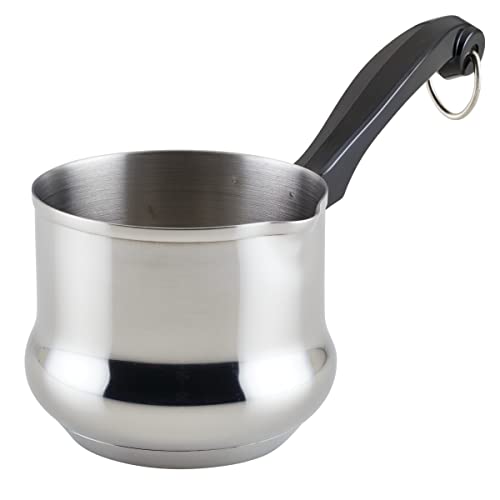
Farberware
Classic Series Stainless Steel Butter Warmer, Melting Pot, Milk Warmer Pot
$14.99 at AmazonEditors' Favorite
Color: Stainless Steel Size: 0.6 Quarts Dimensions: 4.9 x 9.3 x 4.2 Inches Weight: 0.7 pounds Product Group: Kitchen Binding: Kitchen
Shop NowCuisinart 735-16OP Chef's Classic Stainless 1-Quart Pour Saucier,Silver

Great Value
Color: 1-Quart Size: 1 Quarts Dimensions: 12.8 x 6.3 x 4.3 inches Weight: 1.15 Pounds Product Group: Kitchen Binding: Kitchen
Shop NowCAROTE Nonstick 1.5Qt & 3.0Qt Sauce Pan Sets with Lid, White

Color: White Size: 1.5QT+3QT Dimensions: 16 x 12 x 6 inches Weight: 5.78052050964 pounds Product Group: Kitchen Binding: Kitchen
Shop NowBOHUIZ 18/10 Stainless Steel Butter Warmer Measuring Pan, 0.5 Quart Small Sauce Pan with Dual Pour Spout, 17OZ/500ml Coffee Milk Chocolate Butter Melting Pot

BOHUIZ
18/10 Stainless Steel Butter Warmer Measuring Pan, 0.5 Quart Small Sauce Pan with Dual Pour Spout, 17OZ/500ml Coffee Milk Chocolate Butter Melting Pot
$19.49 at AmazonColor: Silver Size: one size Product Group: Kitchen
Shop NowFarberware Classic Series Stainless Steel Straining Sauce Pan with Lid, 1-Quart Small Pot, Silver

Farberware
Classic Series Stainless Steel Straining Sauce Pan with Lid, 1-Quart Small Pot, Silver
$24.99 at AmazonColor: Stainless Steel Size: 1 Quarts Dimensions: 5.75 x 11.25 x 6 inches Weight: 1.2 pounds Product Group: Kitchen Binding: Kitchen
Shop Now




Write Your Review
No reviews yet. Be the first to share your experience!