

The first time I grilled on my third-floor balcony, I set off the hallway smoke detector, got a passive-aggressive note taped to my door, and ended up scrubbing grease off the underside of my metal railing for an hour. Small-space grilling is a different sport than backyard grilling, and most of the advice online assumes you have a lawn. You don’t. You have maybe 40 square feet, a shared wall, neighbors who can smell everything you cook, and a lease that probably has opinions. So before I talk about what a good small balcony gas grill does well, let me walk through everything that goes wrong, because understanding the failure modes is the only way to buy the right grill instead of the biggest one that fits.
Flare-ups and the smoke alarm problem
The number one balcony disaster is the grease flare-up that sends a plume straight into your sliding door and trips the detector inside. This happens because fat drips onto an exposed burner, ignites, and throws up thick smoke for ten or fifteen seconds. On a big grill in open air, nobody notices. On a balcony, that smoke has nowhere to go, it hugs the ceiling, and it drifts indoors through the door you left open to carry plates back and forth. The root cause is almost always a grill with a burner sitting directly under the food and no barrier between the flame and the drippings. A well-designed small gas grill puts a sloped grease management system, usually angled flame tamers or a porcelain plate, between the burner and the food, so fat runs off to a catch cup instead of hitting open flame. You still get sear, you just don’t get the fireball. I keep a spray bottle of water within reach anyway, but I haven’t tripped the alarm since I switched to a grill with real flame diffusers.
Your lease and HOA probably say more than you think
Here is the boring failure mode that costs people their deposit. Many fire codes and building rules prohibit open-flame grills within a set distance of combustible construction, often ten feet, on any balcony of a multi-unit building. Some allow electric only. Some carve out an exception for propane canisters under a certain size but ban the full-size 20lb tank. The reason is real: a 20lb tank is a serious fuel bomb to store on a wooden deck stacked above other apartments. Read your actual lease and your municipal fire code before you buy anything, not the marketing copy. The practical takeaway is that a grill running on a 1lb disposable propane cylinder, or a small refillable one, is far more likely to be allowed than a tank-fed unit, and it stores in a cabinet instead of sitting out. When I moved, my new building banned tanks outright but permitted the 1lb canisters, and that single detail decided which grill I could keep.
Tiny grates cook unevenly, and cheap ones cook worst
When you shrink a grill down, the heat distribution gets harder, not easier. A single small burner in the center leaves a screaming hot spot in the middle and cool dead zones at the edges, so four burgers cook at four different speeds and you spend the whole time shuffling food like a sliding puzzle. The fix is partly burner design and partly BTU-to-area ratio. For a balcony grill I want somewhere around 200 to 300 square inches of cooking area, which is genuinely enough for four burgers or two steaks plus a few skewers, paired with roughly 8,000 to 12,000 BTU. That ratio matters more than the raw BTU number. A cheap grill bragging about 20,000 BTU on a tiny grate just runs hot and uneven and burns propane fast. A cast-iron or thick porcelain-coated grate also buys you even heat and better sear marks because the metal holds temperature when you drop cold food on it. Thin stamped-steel grates lose heat the second raw chicken touches them.
Grease under the railing and the mess you don’t see
Balcony grease is sneaky because gravity carries it somewhere you don’t look until it’s a stain. Splatter arcs past the edge of the grill, runs down the railing, and drips onto the balcony below yours, which is the fastest way to turn a neighbor into an enemy. Two things cause it: a shallow drip tray that overflows, and grilling with the grill pushed against the railing so splatter clears the edge. A grill with a deep, removable grease cup that actually pulls out for cleaning solves half of it. The other half is placement and a cheap silicone or metal splatter mat under the whole setup. I run my grill at least a foot off the railing, keep a roll of paper towels and a degreaser spray in the same cabinet as the propane, and wipe the grate and the surrounding tile every single time while it’s still warm. Cold balcony grease is a nightmare. Warm grease comes off in one pass.
Wind blows out burners and wrecks your temperature
Balconies are windier than yards because you’re up high and the building funnels gusts around corners. A stiff breeze does two nasty things to a small grill: it strips heat off the grate so your surface temp craters, and on some open-burner designs it can blow the flame out entirely, which means gas keeps flowing until you notice. This is where a proper lid earns its keep. A grill with a real closing lid, ideally with a few inches of clearance so you can shut it over a thick pork chop, holds temperature against the wind and lets you actually roast, not just sear. Lid height clearance is a spec people ignore until they try to close the lid on a beer-can chicken and can’t. I also position the grill so the balcony wall blocks the prevailing wind, and on genuinely gusty days I just don’t grill, because fighting the wind wastes fuel and patience.
What a good small balcony gas grill actually solves
Put all those failure modes together and the shopping list writes itself. You want flame tamers between burner and food so drippings don’t flare. You want a fuel setup your building allows, which for most apartments means a 1lb propane cylinder or a small refillable one instead of a 20lb tank. You want 200 to 300 square inches of cast-iron or heavy porcelain grate matched to 8,000 to 12,000 BTU for even heat without wasting gas. You want a deep pull-out grease cup so nothing drips off the edge. You want a lid that closes with enough clearance to roast and to shield the flame from wind. And because balcony storage is precious, fold-down side tables are not a luxury, they’re the difference between having somewhere to set the tongs and the plate versus balancing everything on the railing. A grill that folds flat and tucks into a cabinet or corner when you’re done is what keeps this from taking over your only outdoor square footage. Get those things right and balcony grilling stops being a fire drill and becomes the reason you actually use the balcony.
Is a 1lb propane cylinder enough for a real cookout?
For a small grill running 8,000 to 12,000 BTU, a single 1lb disposable cylinder gives you roughly one to two hours of grilling, which covers dinner for two to four people with margin to spare. The catch is cost per cook, since disposables are pricier per pound than a refilled tank, so if you grill several times a week the math pushes you toward a small refillable cylinder or an adapter hose to a 5lb tank where your building permits it. Keep a spare 1lb canister on hand regardless, because running dry mid-sear with raw chicken on the grate is its own special failure mode.
How do I keep from annoying my neighbors?
Smoke and grease are what generate complaints, so control both at the source. Use a grill with flame tamers to kill flare-up smoke, cook fatty foods like burgers over slightly lower heat to reduce dripping, and clean the grate and the balcony floor while everything is still warm so grease never migrates downstairs. Position the grill away from the railing and away from your neighbor’s open window, and avoid grilling at hours when someone’s laundry is drying or their windows are open for the night. A quick heads-up to the unit below you the first time goes a surprisingly long way toward buying goodwill.
Gas or electric for a balcony that bans open flame?
If your lease or fire code prohibits open-flame cooking, gas is off the table regardless of how small the cylinder is, and an electric grill is your legal path to grill marks. Electric won’t match the sear or the flavor of gas, and it’s tethered to an outdoor-rated outlet, but it sidesteps the flare-up, tank-storage, and burner-blowout problems entirely. If open flame is allowed, a small gas grill on a 1lb cylinder gives you noticeably better heat and taste for the space. Read the rules first, then decide, because buying the wrong fuel type is the most expensive balcony grilling mistake there is.
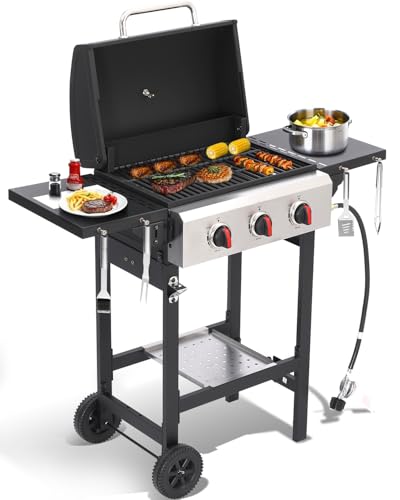
GRILL DEPOTS
Small-Space Grilling for 2-4 People: GRILL DEPOTS 3-Burner Propane Gas Grill
The GRILL DEPOTS propane grill combines 252 square inches of cast iron grate space with a perforated griddle pan, while its 30,000 BTU output delivers the biggest advantage: flexible cooking for varied meals. It suits couples, small families, balcony or patio users, and campers who need folding prep tables and wheeled mobility.
Pros and Cons
Pros
- The 30,000 BTU output and 252 square inches of cooking space are sized for meals serving 2-4 people.
- Cast iron grates and the included perforated griddle pan support both searing and delicate foods.
- Folding tables and wheels make the grill easier to position in compact outdoor areas.
- The lid, adjustable controls, grease tray, and tool hooks add practical cooking convenience.
Cons
- The folding side tables are for prep only and do not include a side burner.
- The standard 20-pound propane tank should sit on the ground beside the grill; the side hook is intended for lighter 1-pound tanks.

Charbroil
Portable Grilling for Small Kitchens and Outdoor Meals: Charbroil 465133010 1-Burner Propane Grill
The Charbroil 465133010 provides portable propane grilling with 190 square inches of cooking space, while its porcelain-coated grates simplify cleanup. It suits apartment cooks, campers, and small households who need a compact grill with minimal assembly.
Pros and Cons
Pros
- The porcelain-coated grates offer rust resistance and easier cleaning.
- The 190-square-inch cooking area provides useful capacity in a portable format.
- Minimal assembly and included step-by-step instructions simplify setup.
- The steel body and high-temperature finish support durability.
Cons
- The single-burner design limits temperature-zone control for foods requiring different heat levels.
- The 90-day warranty is short compared with many longer-term appliance warranties.

Charbroil
Bistro Pro 2-in-1 Gas and Charcoal Grill for Small Patios – 240 Sq In, 700°F Sear
The Charbroil Bistro Pro switches between gas and charcoal grilling on a single compact unit, reaching 700°F for deep sear marks without lighter fluid. Apartment dwellers, condo owners, and anyone with a small deck who wants genuine charcoal flavor without sacrificing convenience will get the most from this grill.
Pros and Cons
Pros
- The 2-in-1 gas and charcoal system with an optional wood chunk slot gives three distinct flavor profiles from one grill.
- Piezo ignition lights consistently with a single press-and-turn, removing the need for external igniters or matches.
- Compact footprint fits patios and decks where full-size grills are impractical, without cutting the cooking area below practical use.
Cons
- At 240 square inches of primary cooking space, the grill is sized for two to four people and will require batching for larger gatherings.
- No reviews are currently available to validate long-term durability of the grates and burner under repeated high-heat charcoal use.

MASTER COOK
Portable Tabletop Grilling for Camping and Patios: MASTER COOK Single Burner Propane Gas Grill
The MASTER COOK propane grill provides 266 square inches of cooking space and 11,500 BTU heat, with a detachable cart for flexible outdoor cooking. It suits campers, tailgaters, and patio cooks who need one grill that works on a cart or tabletop.
Pros and Cons
Pros
- The cart provides a raised cooking setup while also storing a 20-pound propane tank.
- The cast iron grates support cooking meats, seafood, and vegetables.
- The temperature gauge and adjustable control knob help manage roasting heat.
- The side shelves fold under the lid when not in use and support up to 4.4 pounds each.
Cons
- The propane tank is not included, so buyers must supply a compatible 1-pound or 20-pound tank.
- The cooking area is smaller than full-size grills, making it less suitable for large gatherings.
The Best Deals This Week*
-
Small-Space Grilling for 2-4 People
$149.99
($169.99)Save $20.00 -
Charbroil Bistro Pro 2-in-1 Gas and Charcoal Grill
$225
($299.99)Save $74.99
*Deals are selected by our commerce team
GRILL DEPOTS Small-Space Grilling for 2-4 People: GRILL DEPOTS 3-Burner Propane Gas Grill
GRILL DEPOTS
Small-Space Grilling for 2-4 People: GRILL DEPOTS 3-Burner Propane Gas Grill
The GRILL DEPOTS propane grill combines 252 square inches of cast iron grate space with a perforated griddle pan, while its 30,000 BTU output delivers the biggest advantage: flexible cooking for varied meals. It suits couples, small families, balcony or patio users, and campers who need folding prep tables and wheeled mobility.
$149.99 at AmazonEditors' Favorite
Color: Black Size: Standard 3 Burner Dimensions: 13.8 x 40.9 x 39 inches Product Group: Lawn & Patio
Shop NowCharbroil Portable Grilling for Small Kitchens and Outdoor Meals: Charbroil 465133010 1-Burner Propane Grill
Charbroil
Portable Grilling for Small Kitchens and Outdoor Meals: Charbroil 465133010 1-Burner Propane Grill
The Charbroil 465133010 provides portable propane grilling with 190 square inches of cooking space, while its porcelain-coated grates simplify cleanup. It suits apartment cooks, campers, and small households who need a compact grill with minimal assembly.
$54.99 at AmazonGreat Value
Color: Black Size: Standard Dimensions: 24 x 12 x 15 inches Weight: 11 Pounds Product Group: Lawn & Patio Binding: Apparel
Shop NowCharbroil Bistro Pro 2-in-1 Gas and Charcoal Grill for Small Patios – 240 Sq In, 700°F Sear
Charbroil
Bistro Pro 2-in-1 Gas and Charcoal Grill for Small Patios – 240 Sq In, 700°F Sear
The Charbroil Bistro Pro switches between gas and charcoal grilling on a single compact unit, reaching 700°F for deep sear marks without lighter fluid. Apartment dwellers, condo owners, and anyone with a small deck who wants genuine charcoal flavor without sacrificing convenience will get the most from this grill.
$225.00 at AmazonColor: Black Size: 32.8 x 23 x 39.6 cubic inches Dimensions: 23 x 32.8 x 39.6 inches Weight: 51 pounds Product Group: Lawn & Patio Binding: Tools & Home Improvement
Shop NowMegamaster Tabletop 1 Burner Gas Grill, Foldable Legs with Warming Rack

Color: Red + Black Size: 1-Burner Dimensions: 28.43 x 19.69 x 12.91 inches Weight: 14.42 pounds Product Group: Lawn & Patio Binding: Tools & Home Improvement
Shop NowMASTER COOK Portable Tabletop Grilling for Camping and Patios: MASTER COOK Single Burner Propane Gas Grill
MASTER COOK
Portable Tabletop Grilling for Camping and Patios: MASTER COOK Single Burner Propane Gas Grill
The MASTER COOK propane grill provides 266 square inches of cooking space and 11,500 BTU heat, with a detachable cart for flexible outdoor cooking. It suits campers, tailgaters, and patio cooks who need one grill that works on a cart or tabletop.
$169.99 at AmazonColor: Matte Black Size: Single Burner Dimensions: 20.07 x 40.16 x 39.37 inches Product Group: Lawn & Patio Binding: Automotive
Shop Now








Write Your Review
No reviews yet. Be the first to share your experience!