

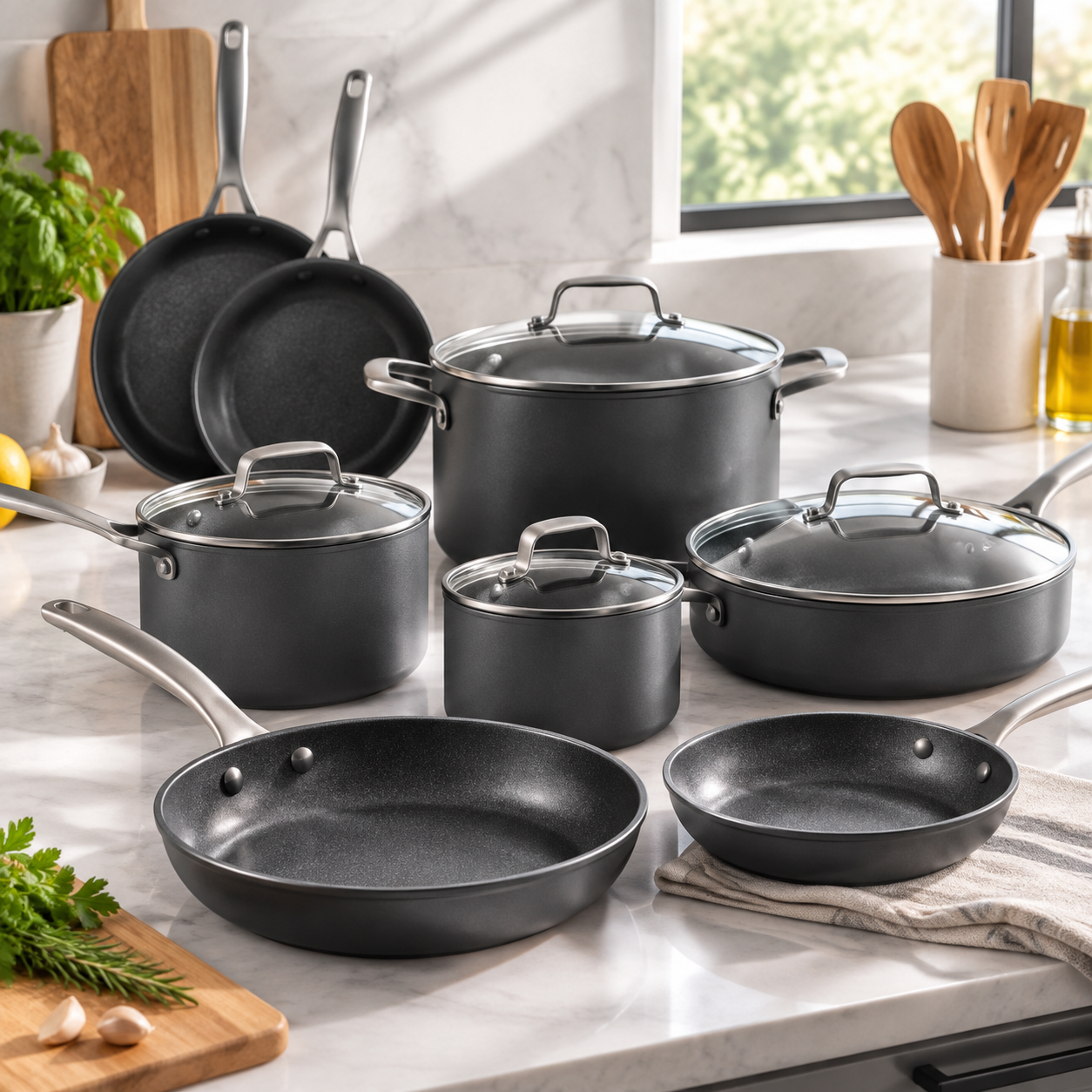
The Ninja Foodi NeverStick Premium Hard Anodized 10 Pc Cookware Set is a 10-piece hard anodized aluminum set from Ninja, and the short answer for most buyers is simple: it suits anyone who wants a full set of pots and pans in one box and is willing to hand wash to protect the nonstick surface. HomeWhisk is a research team, so this guide sticks to what the product name, the material and the wider cookware category tell you.
Below you’ll find what “hard anodized” means on a burner, how to care for a nonstick coating so it lasts, and how it compares with a ceramic interior. The product cards we pulled for this guide are Ninja’s ceramic sets. They’re shown as alternatives to the NeverStick set, not as the NeverStick set itself.
What a 10-piece hard anodized set usually covers
A 10-piece count on a cookware set usually means five vessels plus five lids, though the split varies from one set to the next. A typical lineup includes a pair of frying pans, a saucepan, a saute pan and a stockpot. That roster handles searing, boiling, braising and sauce work, which is why so many people buy a set instead of collecting pieces one at a time.
Hard anodized means the aluminum body has been treated in an electrochemical bath so the surface turns into a harder, denser layer. The result is a pan that resists scratching and warping better than plain aluminum, spreads heat evenly, and weighs more than a cheap stamped pan of the same size.
Two practical consequences follow. The pans feel heavier than they look, so a full skillet is a two-hand lift for most people. And the nonstick coating, not the metal, is the part with a shelf life. The aluminum body will outlast several coatings if you treat it well.
How hard anodized aluminum behaves on a real burner
Aluminum is one of the better heat conductors in cookware, and the anodized layer doesn’t change that. What it changes is durability. A hard anodized pan holds a flat bottom across years of heating and cooling, and the exterior shrugs off the bumps and scrapes of a busy kitchen.
Heat response and preheating
Medium heat is the working setting for this kind of pan. Aluminum moves heat fast, so a pan preheated on high will overshoot before the food goes in. Nonstick coatings also degrade faster at sustained high temperatures. Give the pan two or three minutes on medium, then add oil. That single habit does more for coating life than any cleaning product.
Weight and handling
Hard anodized bodies run heavy, so handle design matters more than it does on a light pan. Look for a grip that stays comfortable under a full load and enough length that your knuckles clear the rim when you tilt. Glass lids let you watch a simmer without lifting and losing heat, but check the listing, because lid materials vary by set.
If weight is your deciding factor, a ceramic-coated set often runs lighter. The Ninja Extended Life 9-piece ceramic set is one alternative from the same brand. It’s a 9-piece grey set rather than a 10-piece hard anodized one, so treat it as a different build.
Ninja Ninja® Extended Life 9-Pc Ceramic Cookware Set, Grey, CW99009

Editors' Favorite
Color: Gray Size: 9-piece Dimensions: 12.5 x 9 x 7.5 inches Product Group: Kitchen Binding: Kitchen
Shop NowCaring for a nonstick coating so it doesn’t quit early
Nonstick failure is rarely a surprise. It’s almost always heat, abrasion or washing. The coating is a thin film over the metal, and it wears from the inside out at the spot where the pan runs hottest.
Washing and storage
Hand wash with a soft sponge and warm soapy water, then dry right away. Dishwasher detergent is aggressive and the heated dry cycle is harder still. Stack pans with a paper towel or a felt liner between them. The most common death of a nonstick pan is a nested pan scratching the interior of the one below it.
Utensils and heat limits
Wood, silicone and nylon utensils keep the cooking surface intact. Metal tools are a gamble on any coated pan. Never preheat an empty nonstick pan on high, and don’t plunge a hot pan into cold water, because thermal shock can warp the base and lift the coating at the edge.
If you’d rather skip the coating question, a ceramic interior is the alternative most shoppers look at next. The Ninja Ceramic Pro 11-piece set is the fuller option in that line. Its listing describes glass lids, oven-safe construction, PTFE-free ceramic coating and compatibility with all stovetops including induction.

Ninja
PTFE-Free Nonstick for Everyday Searing and Simmering: Ninja Ceramic Pro 11-Piece Cookware Set CW39011MM, Induction Ready
This four-vessel Ninja set covers frying, sauteing, saucepan work, and stockpot batches with a titanium-infused ceramic surface Ninja rates 5x more scratch resistant and 3x more scrub resistant than Caraway ceramic cookware. It suits cooks replacing worn PTFE pans who want nonstick that tolerates metal utensils, dishwasher cycles, and broiling to 550F under a 10-year nonstick guarantee.
Pros and Cons
Pros
- Ninja backs the cooking surface with a 10-year nonstick guarantee, which is unusually long for ceramic coatings.
- Flat, fitted tempered glass lids stack cleanly in a cabinet and let you monitor a simmer without lifting.
- Dishwasher safe and stain resistant, so tomato sauce and turmeric cleanup does not require hand scrubbing.
- Warp resistant body keeps the pan flat on induction and glass tops, maintaining full contact for even searing.
Cons
- The piece count includes lids and guides, so you get only four cooking vessels: a 10.25 inch fry pan, 3qt saute pan, 2qt saucepan, and 6qt stock pot, with no second skillet for parallel cooking.
- Ceramic coatings lose slickness faster than PTFE when run at high heat, so daily ripping-hot searing will shorten the nonstick life despite the durability claims.
Ninja PTFE-Free Nonstick for Everyday Searing and Simmering: Ninja Ceramic Pro 11-Piece Cookware Set CW39011MM, Induction Ready
Ninja
PTFE-Free Nonstick for Everyday Searing and Simmering: Ninja Ceramic Pro 11-Piece Cookware Set CW39011MM, Induction Ready
This four-vessel Ninja set covers frying, sauteing, saucepan work, and stockpot batches with a titanium-infused ceramic surface Ninja rates 5x more scratch resistant and 3x more scrub resistant than Caraway ceramic cookware. It suits cooks replacing worn PTFE pans who want nonstick that tolerates metal utensils, dishwasher cycles, and broiling to 550F under a 10-year nonstick guarantee.
$359.99 at AmazonEditors' Favorite
Color: Midnight Blue Size: 11-piece Weight: 18.3 Pounds Product Group: Kitchen Binding: Kitchen
Shop NowHard anodized versus ceramic: which interior fits your kitchen
Both are nonstick. They age differently, and that difference should drive the choice.
A hard anodized set with a conventional nonstick coating tends to be forgiving of imperfect technique and releases food well for a long stretch. It’s a sensible pick for someone who cooks most nights and wants one set to last. The tradeoff is that conventional nonstick coatings are synthetic polymers, which some households want to avoid.
Ceramic coatings are mineral-based, which is why the Ceramic Pro listings advertise nontoxic, PTFE-free construction. Ceramic releases beautifully when new, then often loses that slickness sooner than a polymer coating, especially with high heat or abrasive sponges. Fair tradeoff. Just know it going in.
The Ceramic Pro 11-piece build also comes in a second colorway, Steam White instead of Midnight Blue. That matters if you’re matching a kitchen rather than replacing a mismatched drawer.

Ninja
Nonstick Cookware for Everyday Stovetop Cooking: Ninja Ceramic Pro 11-Piece Set CW39011WH
This 11-piece ceramic-coated set covers frying, simmering, sautéing, and stockpot cooking with a titanium-infused nonstick surface backed by a 10-year guarantee. It suits home cooks replacing worn PTFE pans who want metal-utensil-safe, dishwasher-safe pieces that work on induction and every other stovetop.
Pros and Cons
Pros
- Ninja backs the cooking surface with a 10-year nonstick guarantee when used as directed.
- Works on gas, electric, glass ceramic, and induction, so the set moves with you to a new kitchen.
- Eleven pieces cover 8-inch and 10.25-inch fry pans, 1.5qt and 2.5qt saucepans, a 3qt saute pan, and a 6qt stock pot.
- Warp and stain resistant construction holds its shape under high-heat searing.
Cons
- The 10.25-inch fry pan ships without a lid, so covered cooking in the larger skillet is not an option out of the box.
- Ceramic coatings generally lose slickness faster than PTFE at sustained high heat, so medium heat cooking extends its life.
Ninja Nonstick Cookware for Everyday Stovetop Cooking: Ninja Ceramic Pro 11-Piece Set CW39011WH
Ninja
Nonstick Cookware for Everyday Stovetop Cooking: Ninja Ceramic Pro 11-Piece Set CW39011WH
This 11-piece ceramic-coated set covers frying, simmering, sautéing, and stockpot cooking with a titanium-infused nonstick surface backed by a 10-year guarantee. It suits home cooks replacing worn PTFE pans who want metal-utensil-safe, dishwasher-safe pieces that work on induction and every other stovetop.
$359.99 at AmazonEditors' Favorite
Color: White Size: 11-piece Weight: 18.3 Pounds Product Group: Kitchen Binding: Kitchen
Shop NowCommon mistakes buyers make with a 10-piece set
The first is buying for the piece count instead of the pieces. Ten sounds generous until you realize several of them are lids. Count what you actually cook. If you never braise, a stockpot is dead weight, and a set with a bigger skillet would serve you better.
The second is assuming “oven safe” means the whole pan goes under the broiler. Oven-safe usually refers to a temperature ceiling well below broiler heat, and glass lids often have a lower limit than the pan itself. Check the manual for the exact number before you slide anything in at 450.
The third is cooking on high heat out of habit. It’s the fastest way to shorten the life of any coated pan, hard anodized or ceramic. And it’s the one variable you fully control.
When to replace a coated pan instead of living with it
Replace a pan when food starts sticking in a ring at the center, when the coating feels rough or shows silver patches, or when the base has warped so it rocks on a flat burner. A pan that spins on the stovetop transfers heat unevenly, and no amount of seasoning fixes that.
Staining and a slight brown tint are cosmetic. Flaking, peeling and exposed metal aren’t, and a flaking coating has no business near food. At that point the practical move is to replace the worn pieces, or the whole set if the sizes no longer match how you cook.
For a broader comparison across brands and price points, our guide to the best cookware set covers the field, and the roundup of the best nonstick cookware set narrows it to coated options. If induction is on your counter, start with the best induction cookware set. Budget shoppers should look at the best cookware set under 200, and anyone avoiding synthetic coatings will want the best non-toxic cookware set.
FAQ
Is hard anodized cookware safe to cook with?
Yes, in general. The anodizing process seals the aluminum, so the metal isn’t exposed to food through the finish. The main safety issue with any coated pan is overheating it, which can degrade the coating. Keep it at medium and below and it behaves fine.
Can a Ninja hard anodized set go in the dishwasher?
Check the care instructions that come with your set. Even when a dishwasher is allowed, detergent and the heated dry cycle shorten coating life, so hand washing with warm water and a soft sponge is the safer routine.
Does hard anodized work on induction cooktops?
Not automatically. Induction needs a magnetic base, and aluminum isn’t magnetic, so a hard anodized pan only works on induction if the base has a magnetic layer. Look for an induction claim on the listing instead of assuming it from the material name.
How long should a nonstick set last?
With hand washing, medium heat and soft utensils, a decent coating can hold for several years of regular cooking. Daily high-heat use can cut that sharply. The coating, not the anodized body, sets the replacement clock.
Is ceramic nonstick better than conventional nonstick?
Neither wins across the board. Ceramic is mineral-based and releases well when new. Conventional coatings generally stay slick longer under repeated use. The right pick depends on whether you value longevity or a coating without synthetic polymers.





Write Your Review
No reviews yet. Be the first to share your experience!