

A Ninja drink blender is any Ninja blender you use to turn fruit, ice, greens and liquid into smoothies, shakes and other drinks, and the right one depends mostly on how much you pour at a time. If you blend one tall glass before work, a personal cup system makes sense. If you fill a pitcher for the family or want a machine that also chops and mixes dough, a full-size system fits better.
This guide explains how the main Ninja formats differ, what the model names on the box actually tell you, and how to get a smoother drink out of whichever one you pick. We researched the product listings and the details Ninja publishes in each title, so every spec below comes from the listing itself and not from guesswork.
What a Ninja drink blender really means
Ninja sells a wide range of blenders, and shoppers who type “Ninja drink blender” usually mean one of two things. The first is a personal blender: a small base with a blade assembly that screws onto a single-serve cup, so you blend and drink from the same vessel. The second is a full-size blender with a large pitcher, often paired with extra attachments so it works as a food processor too.
Both can make drinks. The difference is volume, counter space and how many other jobs you want the machine to handle. Personal blenders win on speed and cleanup. Pitcher systems win when you serve more than one person or want to do more than liquids.
If you only want a quick breakfast smoothie, start with a personal model like the Ninja Nutri-Plus. Its listing names it a personal blender with a 900PW rating and three 20oz cups, which covers grab-and-go drinks for a few people without running the same cup through the dishwasher between uses.

Ninja
Single-Serve Smoothies and Frozen Drinks with Ninja Nutri-Plus BN301 900-Watt Personal Blender
The Ninja Nutri-Plus BN301 blends smoothies, frozen drinks, and nutrient extractions directly in 20-ounce cups, with a 900-peak-watt motor that crushes ice and frozen ingredients. It suits busy individuals or small households seeking quick portions, portable lids, and dishwasher-safe cleanup.
Pros and Cons
Pros
- The Pro Extractor Blades Assembly crushes ice and breaks down whole fruits and vegetables.
- Three 20-ounce cups support multiple servings or back-to-back drink preparation.
- Included spout and storage lids provide options for drinking immediately or storing a blend.
- Dishwasher-safe removable parts simplify cleanup.
Cons
- Push-to-blend operation requires manual pressure rather than offering automatic blending programs.
- The 20-ounce cups are designed for personal portions, not large family-size batches.
Ninja Single-Serve Smoothies and Frozen Drinks with Ninja Nutri-Plus BN301 900-Watt Personal Blender
Ninja
Single-Serve Smoothies and Frozen Drinks with Ninja Nutri-Plus BN301 900-Watt Personal Blender
The Ninja Nutri-Plus BN301 blends smoothies, frozen drinks, and nutrient extractions directly in 20-ounce cups, with a 900-peak-watt motor that crushes ice and frozen ingredients. It suits busy individuals or small households seeking quick portions, portable lids, and dishwasher-safe cleanup.
Check price on AmazonEditors' Favorite
The Ninja Nutri-Plus BN301 is a personal blender for making smoothies, frozen drinks, and produce-based extractions without using a full-size pitcher.
Its 900-peak-watt motor and Pro Extractor Blades Assembly handle ice, seeds, frozen ingredients, and whole fruits or vegetables for smoother individual drinks.
The package includes three 20-ounce cups, spout lids, and storage lids. Material and weight details are not provided, but the removable components are top-rack dishwasher safe.
Blending is controlled manually by pressing the cup, so buyers wanting timed cycles or preset programs should consider another model.
Best for individuals and small households that prioritize portable single servings, strong ice-crushing power, and simple cleanup.
Personal cups versus full-size pitchers
Before you compare model numbers, decide which format fits your routine. Most buyers get this wrong by shopping on power alone, then discover the machine is awkward for the way they actually drink.
Single-serve cups
A cup-style blender suits one person or two. You fill the cup, twist on the blade, blend, then swap the blade for a lid and take the drink with you. Fewer parts touch the food, so rinsing is quick. The trade-off is capacity. A 20oz cup is a good size for a smoothie, but it won’t make a batch for four, and you can’t fill it to the brim with frozen fruit and expect a smooth result.
Full-size pitcher systems
A pitcher gives you room to blend several servings at once and to handle bulkier ingredients. These models cost more and take more counter space, and the pitcher is heavier to wash. In return you get flexibility. The Foodi systems in this guide add processor functions, so one base can chop vegetables and mix dough as well as make drinks. That’s useful if you’d otherwise buy a separate processor.
A quick way to decide
Count how many drinks you make in a typical week and how many people you make them for. One or two servings a day points to cups. Three or more servings at once, or a wish to cut down on appliances, points to a pitcher system. Simple.
Comparing the Ninja Foodi blender systems
Two Foodi models come up often in drink searches, and their names are close enough to cause confusion. Both are listed as a power blender with a food processor, both come in silver, and both are made by Ninja. The difference sits in the model code and the function count.
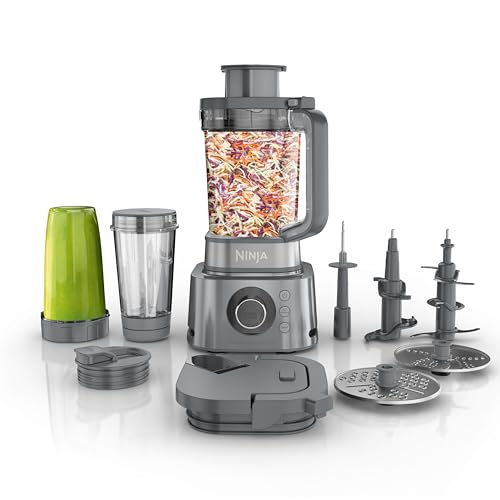
The Ninja Foodi Power Blender and Processor System, model SS401, advertises 7 functions in its listing. That’s the one to look at if you want the longer list of programs on a single base and plan to use the processor side regularly. Think of it as the more feature-rich option of the pair.
Ninja
Smoothies, Food Prep and Nut Butter with Ninja Foodi SS401 Power Blender and Processor
The Ninja Foodi SS401 blends drinks, makes thick smoothie bowls, and slices, shreds, or grates food, with a 1600-peak-watt smartTORQUE motor as its biggest advantage. It suits cooks who want one countertop system for both high-power blending and precise food processing.
Pros and Cons
Pros
- Its seven functions cover both blending and food-processing tasks in one countertop system.
- The smartTORQUE motor is designed to maintain power when handling thick or frozen mixtures.
- Select-cut processing discs provide more precise results when slicing, shredding, or grating ingredients.
- The built-in tamper helps create thick smoothie bowls and nut butters without requiring excess liquid.
Cons
- The product data does not provide dimensions or weight, so buyers should verify available counter and storage space.
- Using its full range of functions requires switching among the processing lid, discs, smoothie bowl maker, and extraction cup.
Ninja Smoothies, Food Prep and Nut Butter with Ninja Foodi SS401 Power Blender and Processor
Ninja
Smoothies, Food Prep and Nut Butter with Ninja Foodi SS401 Power Blender and Processor
The Ninja Foodi SS401 blends drinks, makes thick smoothie bowls, and slices, shreds, or grates food, with a 1600-peak-watt smartTORQUE motor as its biggest advantage. It suits cooks who want one countertop system for both high-power blending and precise food processing.
Check price on AmazonEditors' Favorite
The Ninja Foodi SS401 combines a crushing blender, smoothie bowl maker, nutrient extraction cup, and food processor to reduce the need for separate countertop appliances.
Its 1600-peak-watt smartTORQUE motor tackles dense frozen mixtures, while variable speed control helps match texture to smoothies, protein shakes, nut butters, and other recipes.
The enhanced processing lid has a feed chute and select-cut discs for controlled slicing, shredding, and grating during everyday meal preparation.
Materials, dimensions, and weight are not listed, so confirm counter clearance and cabinet storage before buying this multi-component system.
Best for households that regularly make blended drinks, thick smoothie bowls, nut butters, and sliced or shredded ingredients.
The Ninja Foodi Power Blender and Food Processor, model SS351, is listed with 6 functions. One fewer function won’t matter to someone who mainly blends drinks, and it’s worth reading both listings side by side to see which accessories and programs each includes before you buy. Check the current price too. The two sit close together, so a small gap in cost can settle the choice.
Ninja Foodi Power Blender & Food Processor, 6 Functions, Silver, SS351

If neither system appeals, our roundup of the best Ninja blender models lays out more options across the brand, and the best blender guide compares brands beyond Ninja.
How to get a smoother Ninja drink
Good technique matters as much as the machine. These habits apply to nearly any personal or pitcher blender, though you should always follow the manual that comes with your own model.
Layer ingredients in a sensible order
Put liquid in first, then soft ingredients such as yogurt, banana or leafy greens, and add frozen fruit and ice last. Heavy frozen pieces on top push everything toward the blades, which helps them catch. Dry powders like protein go near the liquid so they don’t cake on the sides.
Respect the fill line
Every cup and pitcher has a maximum fill mark. Going past it can cause leaks and a lumpy result, because the contents can’t circulate. If your recipe is big, blend in two rounds. It takes a minute longer and the texture is better.
Use pulses, then blend
A few short pulses break up large chunks so the blades can pull in the rest. After that, a continuous run finishes the job. If the drink still looks gritty, add a splash of liquid and run it again instead of holding the button for several minutes.
Let ice and frozen fruit soften slightly
Fruit straight from a deep freezer is rock hard. Letting it sit on the counter for a couple of minutes, or using slightly smaller pieces, puts less strain on the motor and gives a smoother pour.
Common mistakes with drink blenders
Most complaints about blenders trace back to a handful of habits. Overfilling is the first. Blending hot liquid in a sealed cup is the second, and it’s a safety concern as well as a mess, since steam builds pressure under the lid. Let hot ingredients cool before blending and keep the vent or lid arrangement the manual describes.
The third is skimping on liquid. A thick smoothie bowl needs a different approach than a drinkable smoothie, and a blender that stalls on a dense mix isn’t necessarily weak. It’s often just short on liquid. Add a little at a time until the contents start to move.
Finally, don’t ignore the blade assembly. Look at the gasket and blade base now and then. A worn or misseated gasket is a common reason for a drip at the bottom of a cup. If you ever see cracks in a cup or pitcher, stop using it and replace the part.
For cup-style machines, our guide to the best mini blender and the best Nutri blender show how this format compares across price points.
Cleaning and care
Clean a blender soon after use. Smoothie residue dries into a film that is tedious to scrub. The easiest method is to fill the cup or pitcher about halfway with warm water, add a drop of dish soap, and run the blender for 20 to 30 seconds. Rinse, then let the parts air dry.
Check your manual before using the dishwasher. Many removable cups, lids and pitchers are listed as dishwasher-safe, but the motor base never is. Wipe the base with a damp cloth and keep water away from the electrical parts. Store blades and lids separately, or loosely assembled, so trapped moisture can escape.
Sharp blades deserve respect. Handle the blade assembly by the base, never by the edges, and unplug the base before you reach in with a spatula or spoon.
When to replace or upgrade
A blender has reached the end of its useful life when it struggles with ingredients it used to handle, smells hot after a short run, or leaks around the blade base even with a fresh gasket. Cups also wear out. Scratched, cloudy plastic is harder to clean and can hold odors.
Upgrading makes sense when your routine outgrows the machine. If you started with a single-serve cup and now find yourself blending twice to serve the household, a pitcher system saves time. If you bought a large system and mostly make one drink a day, a smaller model may suit you better and take up less room. Browse the best small blender picks if space is tight, or the best juice blender guide if drinks are your main focus.
When you do upgrade, a model like the Nutri-Plus is a sensible way back into personal blending.
FAQ
What is the best Ninja blender for drinks?
It depends on how much you make. A personal model such as the Ninja Nutri-Plus, with three 20oz cups, fits single servings. A Foodi power blender and processor system fits larger batches and extra kitchen tasks. Pick the format first, then compare model details.
Can a Ninja blender crush ice?
Ninja markets its power blenders for blending ice and frozen ingredients, but results depend on the model and how you load it. Add liquid first, keep ice below the fill line and pulse before a full run. Check your manual for limits on your particular unit.
What’s the difference between the Foodi SS401 and SS351?
Per their listings, the SS401 offers 7 functions and the SS351 offers 6. Both are silver power blender and processor systems. Compare the included parts and the current price, since those details usually decide which one is the better buy.
Can I blend hot liquids in a Ninja blender?
Be careful. Hot liquid creates steam, and in a sealed cup that pressure can force the lid off. Let soups and drinks cool first, blend small amounts, and follow the instructions for your model. When in doubt, don’t do it.
How do I keep a smoothie from tasting watery or gritty?
Use frozen fruit instead of too much ice, add liquid gradually, and pulse before you blend continuously. For grit, run the blender a little longer with a bit more liquid. You’ll get a thicker, smoother drink without diluting the flavor.
Write Your Review
No reviews yet. Be the first to share your experience!