

Ninja blender power comes down to three things: the motor’s wattage, the blade assembly, and the shape of the jar or cup. Wattage is the headline number, but it’s only part of the story, and a higher figure doesn’t always mean a smoother smoothie.
This guide explains what the power numbers on Ninja listings really tell you, how motor strength affects ice, greens and nuts, and how three Ninja models from the HomeWhisk product database compare on the details their titles actually list. If you’re deciding between a personal blender and a full-size system, you’ll have a clear way to choose by the end.
What Ninja blender power actually means
Blender power is usually quoted in watts. A watt is a measure of the electrical energy the motor can draw, so a bigger number generally points to a motor built to push harder against resistance. Think thick frozen blends, a cup packed with ice, or a spoonful of nut butter that wants to cling to the blades.
There’s a catch. Some brands list continuous watts, others list peak watts, and the two aren’t directly comparable. Peak is a short burst at startup or under load. Continuous is what the motor can hold. When a listing gives a single number without saying which one it is, treat it as a rough guide, not a promise. Read the product page for the definition before you compare two models on wattage alone.
Power also gets spent differently depending on the blade design. A stacked blade assembly that reaches higher into the jar pulls more food into the cutting zone. A short blade at the bottom of a wide cup leaves food at the top sitting there. That’s why a well-designed 900-watt class machine can outperform a clumsier one with a bigger number.
The Ninja Nutri-Plus is a good place to start, because it’s the simplest example of a power-focused personal blender. Its product title lists it as a 900PW model with three 20oz cups in a silver finish, model BN301. Ninja doesn’t spell out in the title what the “PW” stands for, so check the full listing for how the 900 figure is defined. What the title does confirm is the cup count: three 20-ounce cups, which suits single-serve smoothies and grab-and-go portions.
For a small household or one person making breakfast, a personal blender like this keeps the batch size matched to the motor. Smaller batches blend faster because every piece of fruit gets close to the blades. It’s a sensible pick if your main goal is smoothies, protein shakes, or quick sauces rather than family-size pitchers.

Ninja
Single-Serve Smoothies and Frozen Drinks with Ninja Nutri-Plus BN301 900-Watt Personal Blender
The Ninja Nutri-Plus BN301 blends smoothies, frozen drinks, and nutrient extractions directly in 20-ounce cups, with a 900-peak-watt motor that crushes ice and frozen ingredients. It suits busy individuals or small households seeking quick portions, portable lids, and dishwasher-safe cleanup.
Pros and Cons
Pros
- The Pro Extractor Blades Assembly crushes ice and breaks down whole fruits and vegetables.
- Three 20-ounce cups support multiple servings or back-to-back drink preparation.
- Included spout and storage lids provide options for drinking immediately or storing a blend.
- Dishwasher-safe removable parts simplify cleanup.
Cons
- Push-to-blend operation requires manual pressure rather than offering automatic blending programs.
- The 20-ounce cups are designed for personal portions, not large family-size batches.
Ninja Single-Serve Smoothies and Frozen Drinks with Ninja Nutri-Plus BN301 900-Watt Personal Blender
Ninja
Single-Serve Smoothies and Frozen Drinks with Ninja Nutri-Plus BN301 900-Watt Personal Blender
The Ninja Nutri-Plus BN301 blends smoothies, frozen drinks, and nutrient extractions directly in 20-ounce cups, with a 900-peak-watt motor that crushes ice and frozen ingredients. It suits busy individuals or small households seeking quick portions, portable lids, and dishwasher-safe cleanup.
$69.98 at AmazonEditors' Favorite
Color: Silver Size: 900-Peak-Watts Dimensions: 4.7 x 4.7 x 13.8 inches Weight: 5.34 Pounds Product Group: Kitchen Binding: Kitchen
Shop NowHow motor strength changes your results
Once you know what the number means, the practical question is what it does in the kitchen. The effects show up in three areas: how well the blender handles hard ingredients, how smooth the finished texture is, and how long the motor needs to run.
Ice and frozen fruit
Ice is the classic stress case. Hard cubes need the blades to chip and pulverize them quickly, and a weak motor will stall or leave chunks. Frozen fruit is similar but a little more forgiving, since it softens at the edges as it warms.
Two habits help any Ninja. Add liquid first, then soft ingredients, then frozen items on top. That puts weight over the blades and keeps the mixture moving. And use short pulses at the start to break up large pieces before you commit to a long run. Nothing fancy, but it makes a visible difference.
Fibrous greens, seeds and nuts
Kale stems, flax and chia seeds, and whole almonds all ask more from a blender than soft berries do. Greens tend to wrap around the blades and form a clump if the liquid is low. Seeds and nuts need sustained blade speed to break down fully instead of leaving a gritty texture.
More watts help here, but so does patience. Blend the greens with the liquid first and add the rest afterward. If the mixture still looks gritty after a minute, stop, scrape the sides, and run it again. Running a motor non-stop for a long stretch isn’t kind to it, whatever the brand.
Ninja Foodi power blenders: more functions, more system
If a personal cup feels too small, the Foodi line moves to a larger setup. The Ninja Foodi Power Blender & Processor System, model SS401, is listed with seven functions in a silver finish. The title calls it a blender and processor system, which signals that it’s built for more than smoothies. A processor attachment means chopping, mixing and dough-style jobs sit within reach.
The number of functions matters because it tells you how many preset programs or modes the unit offers. It doesn’t tell you the wattage, and the title doesn’t list one. So don’t assume the Foodi has more raw power than the Nutri-Plus just because it’s bigger and costs more. Look at the motor rating on the listing, and weigh that alongside what you want to make.
Who is it for? Anyone who wants one machine to handle smoothies, frozen drinks and some food prep, and who has the counter space for a larger base. Who should skip it? Someone who only ever makes a single shake in the morning. A system like this takes more room, has more parts to wash, and the extra versatility goes unused if you never reach for the processor.
If you’re comparing several Ninja options side by side, our roundup of the best Ninja blender models walks through the lineup in more detail.
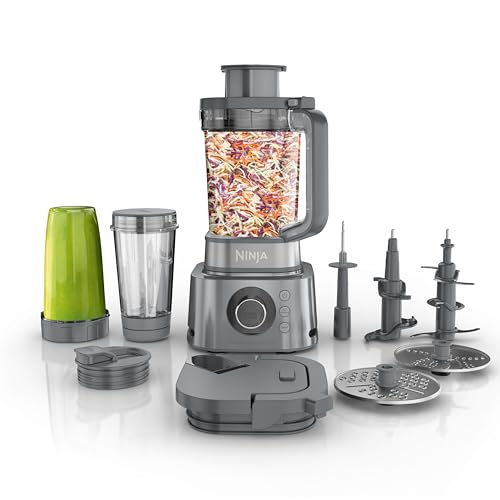
Ninja
Smoothies, Food Prep and Nut Butter with Ninja Foodi SS401 Power Blender and Processor
The Ninja Foodi SS401 blends drinks, makes thick smoothie bowls, and slices, shreds, or grates food, with a 1600-peak-watt smartTORQUE motor as its biggest advantage. It suits cooks who want one countertop system for both high-power blending and precise food processing.
Pros and Cons
Pros
- Its seven functions cover both blending and food-processing tasks in one countertop system.
- The smartTORQUE motor is designed to maintain power when handling thick or frozen mixtures.
- Select-cut processing discs provide more precise results when slicing, shredding, or grating ingredients.
- The built-in tamper helps create thick smoothie bowls and nut butters without requiring excess liquid.
Cons
- The product data does not provide dimensions or weight, so buyers should verify available counter and storage space.
- Using its full range of functions requires switching among the processing lid, discs, smoothie bowl maker, and extraction cup.
Ninja Smoothies, Food Prep and Nut Butter with Ninja Foodi SS401 Power Blender and Processor
Ninja
Smoothies, Food Prep and Nut Butter with Ninja Foodi SS401 Power Blender and Processor
The Ninja Foodi SS401 blends drinks, makes thick smoothie bowls, and slices, shreds, or grates food, with a 1600-peak-watt smartTORQUE motor as its biggest advantage. It suits cooks who want one countertop system for both high-power blending and precise food processing.
$183.83 at AmazonEditors' Favorite
Color: ['Platinum'] Size: 1600 Peak Watts Dimensions: 8.7 x 8.3 x 16.14 inches Weight: 12.1 pounds Product Group: Kitchen Binding: Kitchen
Shop NowCommon mistakes when judging blender power
Most disappointment with a blender comes from expecting the wattage number to do all the work. A few mistakes come up again and again.
First, comparing peak watts on one model with continuous watts on another. Different measurements, different meaning. Second, overfilling. Cramming a cup past the max line starves the blades of airflow and makes even a strong motor labor. Third, skipping the liquid. Blenders move food by building a vortex, and with too little liquid the vortex never forms. You get a hollow pocket around the blades and unblended food above.
Another one is ignoring cup size. A personal cup works best with smaller batches, so putting a full pitcher’s worth of ingredients into a 20oz cup will never go well. If you regularly blend for several people, a larger jar is the better fit, and our guide to the best blender for different jobs can help you match size to use.
Finally, don’t forget the cleanup and storage trade-off. A powerful blender that’s a hassle to wash ends up unused. Smaller models are easier to rinse right after use, which keeps the habit going. If counter space is tight, browse our picks for the best small blender and the best mini blender.
Matching the blender to your routine
Start with what you make most often. If it’s single-serve smoothies and shakes, a compact personal blender covers it, and the extra capacity of a larger system just sits there. If you want to chop vegetables, mix batters, or blend larger batches for a family, look at a Foodi-style system instead.
Budget matters too. The Nutri-Plus is the more affordable of the models covered here, according to the prices in the HomeWhisk product database, while the two Foodi models cost noticeably more. Prices move, so confirm the current figure on Amazon. If cost is your first filter, our list of the best cheap blender options is a good next stop, and the best nutri blender page covers personal-cup models in the same style as the Nutri-Plus.
When to step up or switch models
Signs that your current blender is underpowered for what you ask of it are easy to spot. Ice stays in chunks. Smoothies come out gritty. The motor smells warm after a short run, or it stalls and you have to stop and stir. If that sounds familiar and you’re running a personal-size unit with a heavy workload, a step up makes sense.
The Ninja Foodi Power Blender & Food Processor, model SS351, is the other Foodi in this set. Its title lists six functions and a silver finish, one fewer function than the SS401. That’s the main difference you can confirm from the titles alone. Both are blender-and-processor combinations, so the choice between them comes down to how many modes you’ll use and what the current price looks like. If the extra function on the SS401 doesn’t matter to you, the SS351 deserves a look.
Before you buy any of them, check the listing for the motor rating, the jar capacity, and the list of included accessories. Titles only tell part of the story, and these details decide whether a given unit fits your kitchen.
Ninja Foodi Power Blender & Food Processor, 6 Functions, Silver, SS351

Editors' Favorite
Color: Silver Size: 1600 Peak Watts Dimensions: 8.19 x 8.43 x 14.17 Inches Weight: 8.2 Pounds Product Group: Kitchen Binding: Kitchen
Shop NowFAQ
How many watts does a Ninja blender have?
It depends on the model. The Ninja Nutri-Plus is listed as 900PW in its product title, while the Foodi titles in this guide don’t state a wattage. Check each product page for the motor rating, and note whether the figure is peak or continuous.
Is a higher-wattage blender always better?
No. Wattage helps with hard ingredients like ice and nuts, but blade design, jar shape and batch size play just as big a role. A well-designed lower-wattage blender can beat a poorly designed one with a bigger number.
Can a Ninja personal blender crush ice?
Personal blenders are built for smoothies and frozen drinks, and ice is a normal part of those recipes. For best results, add liquid first, put the ice on top, and pulse a few times before a longer blend. Keep the batch below the max line.
What’s the difference between the Foodi SS401 and SS351?
From their titles, the SS401 is a Power Blender & Processor System with seven functions, and the SS351 is a Power Blender & Food Processor with six functions. Both come in silver. Check the full listings for jar sizes, accessories and motor ratings before deciding.
Should I buy a personal blender or a Foodi system?
Choose a personal blender like the Nutri-Plus if you mostly make single-serve smoothies and want something easy to store and clean. Choose a Foodi system if you want to blend larger batches and handle food prep with the same machine. Your routine should decide it, not the biggest number on the box.
Write Your Review
No reviews yet. Be the first to share your experience!