

The Ninja blender newest model is the one with the most recent model number on Ninja’s own product pages, and the fastest way to confirm that is to match the code printed on the box or listing (something like BN301, SS401 or SS351) against what Ninja currently sells. Names alone won’t tell you. A listing called “Foodi Power Blender” can point to more than one version over the years.
This guide shows you how to work out which Ninja blender is actually the current one, what to compare when two models look alike, and where three real Ninja options fit: a personal blender and two full-size Foodi blender and processor setups. We’re a research team, so everything here comes from product listings and published specs, not kitchen time with each unit.
What “newest model” means for a Ninja blender
Shoppers searching for the newest Ninja usually want one of three things. Some want the most recent release because they assume it has the best motor or the best blades. Others have an older Ninja at home and wonder if an upgrade is worth the money. A third group just doesn’t want to buy a discontinued unit that’s about to lose replacement parts.
Those are different goals, and “newest” only answers the first one. A blender can be a few years old and still be the better pick for your kitchen if it fits your cup sizes, your counter space and your budget. A brand new release can also be a minor tweak, such as a color change or a different cup bundle, on a design that was already on the shelf.
Ninja sells several families under one brand. There are personal blenders built around single-serve cups, countertop pitcher blenders, and the Foodi line that pairs a blender with food processor attachments. When someone says “the newest Ninja,” it helps to ask which family they mean. The newest personal blender and the newest full-size blender are separate questions with separate answers.
How to check that you’re looking at the current version
You don’t need insider knowledge. Three quick checks will keep you from paying full price for an outdated listing.
Read the model number, not just the name
The model code is the most reliable identifier on any appliance. In the listings we reviewed, the personal blender carries BN301, one Foodi system carries SS401 and the other carries SS351. Product names get reused or shortened by sellers, but the code stays tied to one specific configuration. If two listings share a name and show different codes, you’re looking at different products.
Write the code down before you compare prices. It also makes searching for manuals, replacement cups and lids far easier later.
Check what’s in the box
Two listings for the same family can differ in what’s included. The Nutri-Plus title, for example, spells out three 20oz cups. The Foodi titles list their function counts instead: 7 functions for the SS401 system and 6 for the SS351. If a seller’s title leaves those details out, open the full description before you buy. A cheaper price sometimes just means fewer accessories.
Compare against the manufacturer’s page
Retail listings can lag behind. Ninja’s own site shows what the company currently sells and what it has moved to its older-models or clearance area. If the code you’ve found isn’t on the main product page anymore, that’s a sign it’s been replaced or is on its way out. That isn’t a reason to skip it. Discontinued doesn’t mean broken. It does mean you should check that cups, lids and blade assemblies are still sold separately.
One honest caveat: we can’t confirm from product listings alone which of the three blenders below came out most recently. Release order isn’t something the titles reveal, so treat Ninja’s site as the final word.
The personal blender pick: Ninja Nutri-Plus
If your version of “newest” means a compact single-serve blender for smoothies, protein shakes and small batches, the Ninja Nutri-Plus Personal Blender is the one to look at. Its listing calls out a 900PW rating, three 20oz cups, a silver finish and the model number BN301. That cup count is the practical headline. You can blend, snap on a lid and take it out the door, then rinse a spare cup while the first one is in your bag.
The trade-off is size. A 20oz cup suits one person, maybe two if you’re making small servings. It won’t handle a family-size batch of soup or a pitcher of frozen drinks for a crowd. If you regularly blend for four or more, you’ll likely want a full-size pitcher instead. For everyday single servings, though, it’s a straightforward fit.
In our product database it’s listed at around $70 with a 4.9 rating, which makes it the lowest-priced of the three. Prices move, so check the current number before you commit. If you’d like to see how it stacks up against similar compact options, our best nutri blender roundup covers the category in more detail.

Ninja
Single-Serve Smoothies and Frozen Drinks with Ninja Nutri-Plus BN301 900-Watt Personal Blender
The Ninja Nutri-Plus BN301 blends smoothies, frozen drinks, and nutrient extractions directly in 20-ounce cups, with a 900-peak-watt motor that crushes ice and frozen ingredients. It suits busy individuals or small households seeking quick portions, portable lids, and dishwasher-safe cleanup.
Pros and Cons
Pros
- The Pro Extractor Blades Assembly crushes ice and breaks down whole fruits and vegetables.
- Three 20-ounce cups support multiple servings or back-to-back drink preparation.
- Included spout and storage lids provide options for drinking immediately or storing a blend.
- Dishwasher-safe removable parts simplify cleanup.
Cons
- Push-to-blend operation requires manual pressure rather than offering automatic blending programs.
- The 20-ounce cups are designed for personal portions, not large family-size batches.
Ninja Single-Serve Smoothies and Frozen Drinks with Ninja Nutri-Plus BN301 900-Watt Personal Blender
Ninja
Single-Serve Smoothies and Frozen Drinks with Ninja Nutri-Plus BN301 900-Watt Personal Blender
The Ninja Nutri-Plus BN301 blends smoothies, frozen drinks, and nutrient extractions directly in 20-ounce cups, with a 900-peak-watt motor that crushes ice and frozen ingredients. It suits busy individuals or small households seeking quick portions, portable lids, and dishwasher-safe cleanup.
$69.98 at AmazonEditors' Favorite
Color: Silver Size: 900-Peak-Watts Dimensions: 4.7 x 4.7 x 13.8 inches Weight: 5.34 Pounds Product Group: Kitchen Binding: Kitchen
Shop NowFull-size Foodi options
Ninja’s Foodi blenders are aimed at people who want one machine to do more than smoothies. The listings pair a power blender with food processor functions, so they can take over some jobs from a separate processor. That’s a real space-saver in a small kitchen, as long as you’ll use the extra functions.
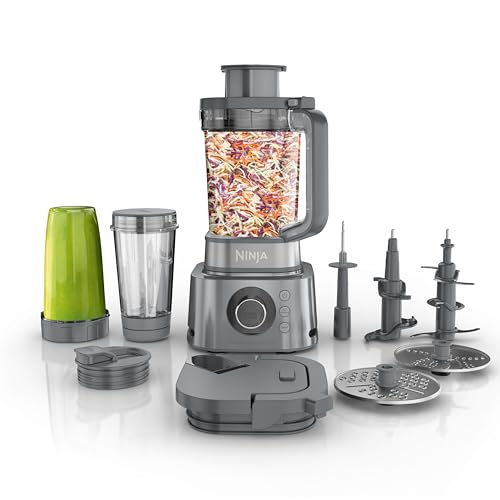
Ninja Foodi Power Blender & Processor System, SS401
This one is listed as a blender and processor system with 7 functions in a silver finish. The extra function over the SS351 is the main difference you can see in the titles. What that extra function is, and how much it matters, depends on the settings Ninja assigns to each model, so look at the control panel description on the product page rather than assuming.
It’s priced around $184 in our data with a 4.9 rating. If you want the fuller feature set among these three, the SS401 is the place to start. Our best Ninja blender page lists more of the brand’s range if you want to see how the Foodi sits next to other lines.
Ninja
Smoothies, Food Prep and Nut Butter with Ninja Foodi SS401 Power Blender and Processor
The Ninja Foodi SS401 blends drinks, makes thick smoothie bowls, and slices, shreds, or grates food, with a 1600-peak-watt smartTORQUE motor as its biggest advantage. It suits cooks who want one countertop system for both high-power blending and precise food processing.
Pros and Cons
Pros
- Its seven functions cover both blending and food-processing tasks in one countertop system.
- The smartTORQUE motor is designed to maintain power when handling thick or frozen mixtures.
- Select-cut processing discs provide more precise results when slicing, shredding, or grating ingredients.
- The built-in tamper helps create thick smoothie bowls and nut butters without requiring excess liquid.
Cons
- The product data does not provide dimensions or weight, so buyers should verify available counter and storage space.
- Using its full range of functions requires switching among the processing lid, discs, smoothie bowl maker, and extraction cup.
Ninja Smoothies, Food Prep and Nut Butter with Ninja Foodi SS401 Power Blender and Processor
Ninja
Smoothies, Food Prep and Nut Butter with Ninja Foodi SS401 Power Blender and Processor
The Ninja Foodi SS401 blends drinks, makes thick smoothie bowls, and slices, shreds, or grates food, with a 1600-peak-watt smartTORQUE motor as its biggest advantage. It suits cooks who want one countertop system for both high-power blending and precise food processing.
$183.83 at AmazonEditors' Favorite
Color: ['Platinum'] Size: 1600 Peak Watts Dimensions: 8.7 x 8.3 x 16.14 inches Weight: 12.1 pounds Product Group: Kitchen Binding: Kitchen
Shop NowComparing the two Foodi models side by side
The SS401 and SS351 look like close cousins from their titles. Both are silver, both carry the Foodi name, and both are described as a power blender plus a processor. The SS351 is listed as a Power Blender & Food Processor with 6 functions, while the SS401 is a Power Blender & Processor System with 7. Higher model numbers often signal a later configuration, but that isn’t a rule you can lean on, and the listings don’t confirm it here.
Where they overlap
Both are full-size, so both suit batches that a personal cup can’t handle: soups, sauces, frozen drinks and nut-based mixes. Both pull double duty as a processor. If chopping and blending are the jobs you do most, either one covers the basics.
Where they differ
The function count is the clearest gap, 7 against 6. Price is the other. In our data the SS351 sits at about $190 with a 4.8 rating, a little above the SS401 even though it’s listed with fewer functions. That’s an odd pairing, and it’s a good reminder that price doesn’t track age or features in a straight line. Third-party sellers and bundles can shift the number. Compare the current price of both before you decide.
If you’re weighing several machines at once, our best blender for guide walks through how to match a blender to the job.
The SS351 is the more affordable-sounding name on paper and the older-looking code, but the listing’s price doesn’t reflect that. If it’s on sale or bundled with accessories you’d actually use, it’s worth a second look.
Ninja Foodi Power Blender & Food Processor, 6 Functions, Silver, SS351

Editors' Favorite
Color: Silver Size: 1600 Peak Watts Dimensions: 8.19 x 8.43 x 14.17 Inches Weight: 8.2 Pounds Product Group: Kitchen Binding: Kitchen
Shop NowCommon mistakes when shopping for the newest model
Most bad purchases here come from a few predictable slips.
First, trusting the product name. Several versions can share a name, and a seller may use the family name for an older unit. Always match the model code.
Second, assuming newer means stronger. A watt or “PW” figure in a title is a marketing rating, and it doesn’t tell you how a blender handles ice or tough greens in real use. Look at how the jar, blade design and function list fit what you make.
Third, ignoring the cups and accessories. A personal blender with three cups is a different purchase from one with a single cup. A processor system with extra bowls is a different purchase from a blender-only unit. Read the contents before you compare prices.
Fourth, buying the wrong size. A 20oz cup is great for one smoothie and awkward for a family. A full-size pitcher is great for a batch and annoying to wash for a single serving. If you’d rather keep it small and cheap, our best mini blender guide is a good place to start.
Fifth, overpaying for a name. Newer doesn’t always mean better value. If a slightly older model does everything you need and costs less, that’s usually the smarter buy. For tighter budgets, see our best cheap blender picks.
When it’s worth upgrading to a newer Ninja
You don’t have to replace a working blender just because a new code appeared. Upgrade when something concrete is holding you back. A cracked pitcher or worn blade assembly you can’t replace is one reason. Another is outgrowing your current size, such as moving from single servings to cooking for a household. A third is wanting processor functions so you can retire a separate appliance.
If none of those apply, keep what you have. Used and older blenders hold up well when the motor base is sound and the parts are still available. Before you buy a replacement, check that your current cups and blades can still be bought separately, since a small part is often cheaper than a whole machine.
If counter space is the real issue, a compact unit might do more for you than a bigger, newer one. Our best small blender roundup covers options that save room.
FAQ
What is the newest Ninja blender?
It depends on the family. Ninja sells personal blenders, countertop blenders and Foodi blender-processor systems, and each line has its own most recent release. Check Ninja’s website for the current lineup and match the model code, such as BN301, SS401 or SS351, to the one on the listing. We couldn’t confirm release order from retail titles alone.
How do I find the model number on a Ninja blender?
It’s usually on the product page title and on a label on the base or in the manual. Retail listings typically include it in the title too. Use that code when you search for replacement parts or compare listings, because it identifies one exact configuration.
Is a higher model number always newer?
Not always. Model numbers can follow a company’s own system rather than a simple timeline. In the Foodi examples above, the SS401 carries the higher number and lists 7 functions against 6 for the SS351, but the listings don’t state which one launched first. Check the manufacturer for dates before you assume.
Should I buy the newest Ninja or an older one?
Pick the one that matches your use. If an older model has the cup size, function count and price you want, it’s a fine buy, provided replacement parts are still sold. A newer release makes more sense when it adds a feature you’ll use or when the price difference is small.
Are Ninja Foodi blenders worth it over a personal blender?
If you want to chop, process and blend in one machine, the Foodi setups cover more ground. If you mostly make single servings, a personal blender like the Nutri-Plus is simpler, takes less space and costs less. Think about how many people you cook for and how often you’d use the processor functions.
Write Your Review
No reviews yet. Be the first to share your experience!