

Ninja blender cost depends mostly on the tier you pick. A personal cup blender like the Ninja Nutri-Plus BN301 was listed near $70 in our research, while the Ninja Foodi Power Blender systems, the SS401 and SS351, were listed between roughly $184 and $190. Listings move, so treat those numbers as a snapshot and check the current price before you buy.
This guide explains what you pay for at each level, what pushes the price up, and how to match a model to your kitchen so you don’t overspend. Short version: pay for the jobs you actually do. Nothing more.
Ninja blender price ranges at a glance
The three models we vetted for this guide fall into two clear bands. The entry band is a personal blender built around single-serve cups. The upper band is a countertop system that blends and also handles food processing. Based on the listed prices we found, the gap between the bands is about $115 to $120. That gap is the real answer to what a Ninja blender costs for most shoppers.
If you make smoothies and protein shakes for one or two people, the lower band covers you. If you also want to chop or process food, the upper band adds a role the cheaper tier doesn’t have. Think of it as a choice between a drink maker and a small kitchen workhorse. Pick based on how your week actually looks, not how you hope it will look.
The Ninja Nutri-Plus Personal Blender (BN301) is the lowest-cost way into the brand among these three. Its title lists a 900PW rating and three 20oz cups. That means one base can serve several cups, so you can prep more than one serving without washing between batches. It’s a tidy fit for a small household, a dorm room, or a second blender for a busy morning.

Ninja
Single-Serve Smoothies and Frozen Drinks with Ninja Nutri-Plus BN301 900-Watt Personal Blender
The Ninja Nutri-Plus BN301 blends smoothies, frozen drinks, and nutrient extractions directly in 20-ounce cups, with a 900-peak-watt motor that crushes ice and frozen ingredients. It suits busy individuals or small households seeking quick portions, portable lids, and dishwasher-safe cleanup.
Pros and Cons
Pros
- The Pro Extractor Blades Assembly crushes ice and breaks down whole fruits and vegetables.
- Three 20-ounce cups support multiple servings or back-to-back drink preparation.
- Included spout and storage lids provide options for drinking immediately or storing a blend.
- Dishwasher-safe removable parts simplify cleanup.
Cons
- Push-to-blend operation requires manual pressure rather than offering automatic blending programs.
- The 20-ounce cups are designed for personal portions, not large family-size batches.
Ninja Single-Serve Smoothies and Frozen Drinks with Ninja Nutri-Plus BN301 900-Watt Personal Blender
Ninja
Single-Serve Smoothies and Frozen Drinks with Ninja Nutri-Plus BN301 900-Watt Personal Blender
The Ninja Nutri-Plus BN301 blends smoothies, frozen drinks, and nutrient extractions directly in 20-ounce cups, with a 900-peak-watt motor that crushes ice and frozen ingredients. It suits busy individuals or small households seeking quick portions, portable lids, and dishwasher-safe cleanup.
$69.98 at AmazonEditors' Favorite
Color: Silver Size: 900-Peak-Watts Dimensions: 4.7 x 4.7 x 13.8 inches Weight: 5.34 Pounds Product Group: Kitchen Binding: Kitchen
Shop NowWhat drives Ninja blender prices up or down
Four things do most of the work: the motor rating, the container style, the number of functions, and the parts included in the box. Price tracks those, not the logo on the front.
Motor rating and container style
The Nutri-Plus lists 900PW in its title, which is the headline power figure for the personal line. Personal blenders use a compact cup that attaches to the base, and that simple design keeps cost low. Countertop systems tend to carry more parts and are built for bigger jobs, which adds to the bill. Don’t compare power figures across product lines as if they mean the same thing. Ninja labels vary, so compare features and included parts instead of one number.
Functions and included parts
The two Foodi models are named by function count: seven for the SS401 and six for the SS351. A function is a mode the appliance is built to perform, and extra modes usually mean more engineering and more parts. Here’s the odd part. In our research the six-function SS351 was listed slightly above the seven-function SS401. Prices shift often, so that order can flip. Don’t assume a bigger function count always costs more.
Bundled accessories
Cups, lids and blades vary by listing. The Nutri-Plus title promises three 20oz cups, and that alone adds value over a single-cup model. Read the item list on each page. A model that looks $20 cheaper may leave out parts you’d end up buying later.
Why the Foodi systems cost more than a personal blender
The Ninja Foodi Power Blender & Processor System is a different kind of appliance. Its title describes a blender paired with food-processing capability and lists 7 functions. You’re buying one footprint that covers two jobs. If you already own a food processor, that second role may be money you don’t need to spend. If you don’t own one, a combined unit can make sense, though you should price your own alternatives before assuming it saves anything.
Counter space matters here too. A system with extra parts needs somewhere to live, and a drawer full of attachments is a real cost if you never reach for them. Worth knowing before you click buy.
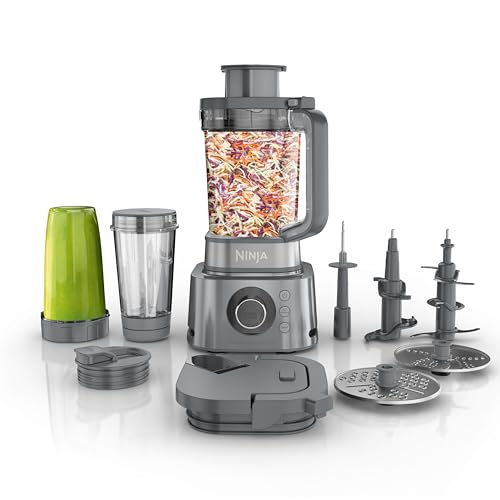
The Ninja Foodi Power Blender & Processor System SS401 is the one to look at if you want that two-in-one setup. At about $184 in our research, it sat just under the SS351.
Ninja
Smoothies, Food Prep and Nut Butter with Ninja Foodi SS401 Power Blender and Processor
The Ninja Foodi SS401 blends drinks, makes thick smoothie bowls, and slices, shreds, or grates food, with a 1600-peak-watt smartTORQUE motor as its biggest advantage. It suits cooks who want one countertop system for both high-power blending and precise food processing.
Pros and Cons
Pros
- Its seven functions cover both blending and food-processing tasks in one countertop system.
- The smartTORQUE motor is designed to maintain power when handling thick or frozen mixtures.
- Select-cut processing discs provide more precise results when slicing, shredding, or grating ingredients.
- The built-in tamper helps create thick smoothie bowls and nut butters without requiring excess liquid.
Cons
- The product data does not provide dimensions or weight, so buyers should verify available counter and storage space.
- Using its full range of functions requires switching among the processing lid, discs, smoothie bowl maker, and extraction cup.
Ninja Smoothies, Food Prep and Nut Butter with Ninja Foodi SS401 Power Blender and Processor
Ninja
Smoothies, Food Prep and Nut Butter with Ninja Foodi SS401 Power Blender and Processor
The Ninja Foodi SS401 blends drinks, makes thick smoothie bowls, and slices, shreds, or grates food, with a 1600-peak-watt smartTORQUE motor as its biggest advantage. It suits cooks who want one countertop system for both high-power blending and precise food processing.
$183.83 at AmazonEditors' Favorite
Color: ['Platinum'] Size: 1600 Peak Watts Dimensions: 8.7 x 8.3 x 16.14 inches Weight: 12.1 pounds Product Group: Kitchen Binding: Kitchen
Shop NowComparing the two Foodi models
The Ninja Foodi Power Blender & Food Processor SS351 sits right next to the SS401 in the Foodi family. Its title lists 6 functions rather than 7, and the two were listed within about $6 of each other. At that distance, price shouldn’t be your deciding factor. Function count and the parts in the box should.
If the seventh function on the SS401 matches something you’ll use, it’s the better value on paper. If you’d never use it, the SS351 covers the same core idea. Check both listings on the day you buy, because the cheaper one can change. Same goes for any deal.
Ninja Foodi Power Blender & Food Processor, 6 Functions, Silver, SS351

Editors' Favorite
Color: Silver Size: 1600 Peak Watts Dimensions: 8.19 x 8.43 x 14.17 Inches Weight: 8.2 Pounds Product Group: Kitchen Binding: Kitchen
Shop NowHow to read a Ninja listing before you compare prices
Two listings can look identical and still be different products. Ninja reuses names across years and bundles, so the model number is your anchor. The three models here carry BN301, SS401 and SS351 in their titles. Match that code, then compare.
Match the model number first
A price quoted for one model code tells you nothing about another. If a deal page says “Ninja Foodi blender” without a code, you can’t tell which of the Foodi models it covers. Open the listing and confirm the code in the title before you trust the number.
Compare cost per capability
Instead of asking which is cheapest, ask what each dollar buys. The Nutri-Plus gives you three 20oz cups and a 900PW rating for the lowest price. The Foodi models give you 6 or 7 functions and a processing role for roughly $115 to $120 more. Neither is a better deal in the abstract. It depends on whether you’ll use what you’re paying for.
Common mistakes when budgeting for a Ninja blender
Buying more than the kitchen needs is the usual one. A shopper who blends one smoothie a day rarely needs seven functions. If that’s you, our best mini blender and best nutri blender guides show smaller options worth a look.
Another trap is judging by sticker price alone. A $70 blender that sits in a cabinet costs more per use than a pricier one used every day. Divide the price by how many times you’ll realistically use it over a year and the picture changes.
Last, don’t forget replacement parts. Cups, lids and blades can be separate purchases if something cracks or wears out. Check that spares are available for the model you pick before you plan to keep it for years. And read the warranty terms on the listing instead of assuming them.
When to spend more and when to step down
Spend more when the job is bigger
Move up to a Foodi system if you want one machine for both drinks and food prep, or if you cook for a family and batch size matters. In that case the extra $115 or so buys a role the personal blender can’t fill. Our best Ninja blender guide compares more of the line if you want to see what else is out there.
Step down when the job is simple
Stay with the Nutri-Plus tier if smoothies and shakes are the whole job. Budget shoppers can browse our best cheap blender picks to see how other brands price against Ninja, and the best blender value roundup does the same on a cost-per-feature basis. Smaller households may also like our best small blender list. Compare first. Then decide.
FAQ
How much does a Ninja blender cost?
In our research, the Ninja Nutri-Plus BN301 personal blender was listed near $70, and the Foodi SS401 and SS351 were listed around $184 and $190. Other Ninja models exist, and prices change often, so confirm the current figure on the product page before you order.
Is the Ninja Nutri-Plus worth about $70?
For single-serve drinks, it can be. The title lists a 900PW rating and three 20oz cups, which is a lot of cup capacity for the money. If you need to process food or blend big batches, it isn’t the right tool, and paying less for the wrong tool is still a waste.
Why does the Ninja Foodi cost more than a personal Ninja?
The Foodi systems pair blending with food processing and list 6 to 7 functions. More modes and more included parts raise the price. You’re paying mainly for versatility.
Do Ninja blender prices change?
Yes. Retail listings move with promotions, stock and seasonal demand. That’s why the SS351 and SS401 can swap places on price. Check the live listing right before you buy.
How can I pay less for a Ninja blender?
Start by choosing the smallest tier that does your jobs. Compare listings for the same model code, and read what’s in the box so you don’t pay for parts you won’t use. If you’re flexible on brand, a quick look at budget alternatives sets a useful price floor.
Write Your Review
No reviews yet. Be the first to share your experience!