

A minimalist tea kettle is one with a plain silhouette, a single finish and nothing on it that doesn’t earn its place. Think smooth stainless steel or clear glass, one spout, one handle, and no printed pattern, novelty whistle or decorative trim.
This guide explains what makes a kettle read as minimalist, how stovetop and electric designs differ, and what to check before you buy. We pulled two products from our research that fit the look, and we’ll say plainly where each one falls short.
What makes a tea kettle minimalist
Three things do most of the work. The first is shape: a rounded body or a straight-sided cylinder with a clean spout line and a handle that follows the curve of the body instead of fighting it. The second is finish: one material, one color, no decals. The third is restraint. No extra knobs, no painted flowers, no lid that looks like a hat.
Plain steel, clear glass and matte white are the safe bets. They sit quietly next to a toaster, a cutting board or a row of canisters without pulling the eye. That’s the whole idea. A minimalist kettle should look calm on the counter or the stove, and it should still pour cleanly and boil water without drama.
Minimal doesn’t mean bare-bones in function, either. A good plain kettle has a handle that stays comfortable, a lid that fits snugly and a base that sits flat. Those details are easy to overlook because they aren’t flashy, yet they decide whether you enjoy using the thing every morning.
The Viking 3-Ply Stainless Steel Tea Kettle is a good example of the stovetop route. Its listing describes a 2.6 quart body in 3-ply stainless steel with a mirror finish, a tempered glass lid and an ergonomic handle. It’s also listed as induction ready, which matters if your cooktop is induction. The look is polished rather than matte, so it leans sleek more than soft.

Viking
Stovetop Whistling Tea Kettle for Tea and Pour-Over Coffee: Viking 3-Ply Stainless Steel 2.6 Quart with Glass Lid
This 2.6 quart stovetop kettle boils water fast and evenly thanks to a 3-ply base with a thick aluminum core, and the tempered glass lid lets you watch the boil instead of guessing. Buy it if you make tea or pour-over coffee daily and want an induction-ready kettle that stays quiet in taste and loud in whistle.
Pros and Cons
Pros
- Works on gas, electric, and induction, so it moves with you if your next kitchen changes stovetops.
- 2.6 quart capacity fills a full teapot or several mugs in one boil instead of two rounds.
- Mirror-finish stainless exterior wipes clean and looks at home left out on the range.
- Whistle plus glass lid gives you both an audible and a visual read on the boil.
Cons
- The glass lid and mirror finish show water spots and fingerprints, so hard-water households will be drying it by hand.
- Viking notes a heat warning for this kettle, so keep the flame within the base and avoid running it dry or on high uncovered burners.
Viking Stovetop Whistling Tea Kettle for Tea and Pour-Over Coffee: Viking 3-Ply Stainless Steel 2.6 Quart with Glass Lid
Viking
Stovetop Whistling Tea Kettle for Tea and Pour-Over Coffee: Viking 3-Ply Stainless Steel 2.6 Quart with Glass Lid
This 2.6 quart stovetop kettle boils water fast and evenly thanks to a 3-ply base with a thick aluminum core, and the tempered glass lid lets you watch the boil instead of guessing. Buy it if you make tea or pour-over coffee daily and want an induction-ready kettle that stays quiet in taste and loud in whistle.
$149.95 at AmazonEditors' Favorite
Color: Mirror Finish Size: 2.7 Quarts Dimensions: 9.84 x 8.19 x 9.5 inches Weight: 2.55 Pounds Product Group: Kitchen Binding: Kitchen
Shop NowStovetop or electric: which suits a minimal kitchen
This is the first real decision, and it shapes everything else. Both styles can look clean. They just ask for different things from your kitchen, so it helps to think about where the kettle will actually live.
If you’re still comparing styles at a broader level, our roundup of the best tea kettle options covers both stovetop and electric designs side by side.
Stovetop kettles
A stovetop kettle lives on the range, so there’s no cord, no base and no outlet to plan around. That alone makes for a tidier counter. The kettle also doubles as a design object, since it stays in view whenever the stove isn’t in use. Stainless steel is the usual material here, and it’s tough, simple and easy to wipe down.
The trade-off is attention. You have to listen for the boil or watch for steam, and you need a burner free. If your cooktop is induction, check that the kettle is listed as induction compatible before you buy. Not every pot is.
Electric kettles
An electric kettle sits on a power base, boils on its own and usually shuts off when it’s done. For tea drinkers who want a specific water temperature, many models add temperature settings, which is handy for delicate green or white teas. The cost to the look is a cord and a base that need counter space and an outlet nearby.
Glass and white-bodied electric models can still read as minimal. Keep the color range tight and the controls few. If you want to see how the electric side stacks up, the best rated electric tea kettle guide is a good next stop.
Materials and finishes that keep the look clean
Material is where a kettle goes from plain to cheap-looking, or from plain to quietly well made. Here’s how the common options behave in a minimal kitchen.
Stainless steel is the default for good reason. It doesn’t chip, it doesn’t hold flavors, and it fits almost any style. Brushed steel hides smudges. Mirror-polished steel looks sharp when it’s clean, but it tends to show fingerprints and water spots, so expect to wipe it down more often.
Glass lets you see the water, which some people love and others find fussy. A clear body shows limescale sooner, so it asks for regular descaling. It also pairs well with white or black bases for a very clean two-tone look.
Enamel and painted finishes are another story. A floral or vintage enamel kettle can be lovely, but it’s the opposite of minimal. If you want the quiet look, skip the pattern and stay with a single solid color.
For a lighter, glass-bodied take, the Aesthetern Electric Tea Kettle with Infuser comes in white. The listing describes a 1.5L glass water boiler with temperature control, a 24H keep warm function, auto shut-off and a built-in infuser. Any kettle with temperature settings needs some kind of control, so it’s less pared back than a simple pot on the stove. In return you get precise heat and a kettle that shuts itself off. Whether that trade suits you depends on how much you value a spare look versus convenience.
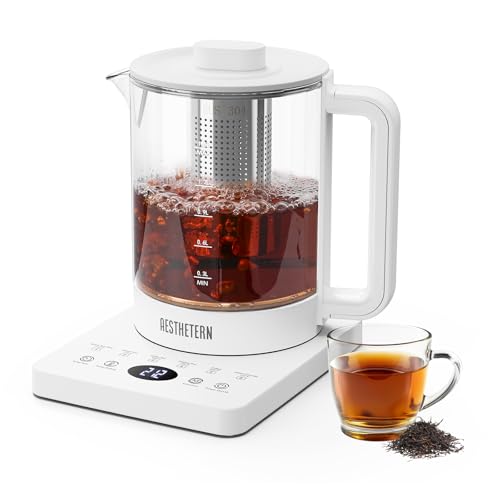
Aesthetern
Precision Tea Brewing at Home: Aesthetern 1.5L Glass Electric Kettle with Infuser, Temperature Control and 24H Keep Warm
This 1.5L borosilicate glass kettle heats water anywhere from 104°F to 212°F with six presets and ±1°F fine-tuning, so green tea never gets scorched and pour-over coffee hits the right window. Buy it if you brew multiple tea types or mix baby formula and want held-temperature water on demand rather than reboiling all day.
Pros and Cons
Pros
- ±1°F adjustment across the full 104°F to 212°F range covers delicate greens through rolling boil.
- Auto shut-off, boil-dry protection, and an anti-scald lid cover the main kettle safety risks.
- Glass body shows water level and infusion color at a glance during brewing.
- 1.5L capacity fills a teapot and a couple of mugs in one heat cycle.
Cons
- Glass exteriors show mineral scale and water spots quickly, so hard-water households will descale and wipe it often.
- Running keep warm for a full 24 hours draws power continuously and concentrates minerals in the leftover water.
Aesthetern Precision Tea Brewing at Home: Aesthetern 1.5L Glass Electric Kettle with Infuser, Temperature Control and 24H Keep Warm
Aesthetern
Precision Tea Brewing at Home: Aesthetern 1.5L Glass Electric Kettle with Infuser, Temperature Control and 24H Keep Warm
This 1.5L borosilicate glass kettle heats water anywhere from 104°F to 212°F with six presets and ±1°F fine-tuning, so green tea never gets scorched and pour-over coffee hits the right window. Buy it if you brew multiple tea types or mix baby formula and want held-temperature water on demand rather than reboiling all day.
$49.39 at AmazonEditors' Favorite
Color: White Size: 1.6 Quarts Dimensions: 8.23 x 6.42 x 11.02 inches Product Group: Kitchen
Shop NowChoosing size, handle and spout
Looks matter, but a kettle that pours badly will annoy you faster than a busy pattern ever could. Run through these checks first.
Capacity
Size depends on how many cups you pour at once. A larger body, like the 2.6 quart size on the Viking listing, suits a household that makes several mugs or a pot of tea at a time. A smaller electric body, like the 1.5L glass model above, is plenty for one or two people. A bigger kettle takes more space and more time to heat, so don’t buy more than you’ll use.
Handle and spout
The handle should be easy to grip with a full kettle and shouldn’t sit too close to the body, or your knuckles will feel the heat. The spout should be narrow enough to give a controlled stream. One tip: read what owners say about dripping and balance, because photos won’t show it. Those details show up in reviews more reliably than in product copy.
Lid and base
A lid that sits flush adds to the clean look and keeps steam in. On an electric model, a base that is flush with the kettle body looks neater than one with a wide flared skirt. Small things, big difference on the counter.
If you also brew in a pot, the best teapot for loose tea picks are worth a look so the two pieces match, and our best loose leaf tea list is handy for stocking the shelf.
Common mistakes when buying a minimalist kettle
Most regrets come from a handful of avoidable slips.
The first is buying on looks alone. A gorgeous kettle that’s too heavy to lift when full, or that doesn’t work on your cooktop, ends up in a cupboard. Check capacity, weight and compatibility before you fall for the finish.
The second is ignoring your stove. Induction needs a magnetic base and a kettle that’s marked for it. Gas and electric coil are more forgiving, but a base that doesn’t sit flat will heat unevenly and rattle.
The third is picking a mirror finish and then hating the upkeep. If fingerprints bother you, go brushed or matte. It’s a personal call, and neither is wrong.
The fourth is mixing too many looks. A minimal kitchen works because things repeat. If your toaster is matte black and your canisters are white, a glossy steel kettle may look out of place. Pick the finish that echoes what’s already there.
The fifth is treating an electric kettle like a stovetop pot. Electric models shouldn’t be set on a burner, and stovetop models don’t plug in. Obvious, yes, but gift buyers mix them up more than you’d think.
Keeping a plain kettle looking its best
A minimal kettle shows wear because there’s nothing to distract from it. A few habits help.
Wipe the outside with a soft cloth after it cools. Dry the spout area so water spots don’t build up. Descale every month or two if you have hard water, using a vinegar and water solution or a descaler that the maker approves. Rinse well afterward, and boil and discard one fresh batch before drinking from it. Always follow the care instructions that come with your kettle, since glass lids, infusers and electric bases each have their own rules.
Don’t use steel wool or harsh scrubbers on a polished finish. They leave scratches that catch the light. A soft sponge and mild dish soap handle almost everything.
When to replace or upgrade your kettle
Replace a kettle when the handle loosens, the base wobbles, the glass cracks or limescale won’t come off after a proper descale. On an electric model, a frayed cord or a switch that sticks is a clear sign to stop using it.
Upgrading makes sense if you’ve changed your cooktop, say from gas to induction, or if you’ve moved to drinking tea that needs a certain water temperature. If you’re mostly after reliable boiling at a fair cost, the best electric kettle value picks are a sensible place to compare, and the best kettle for boiling water guide covers the plain boil-and-pour crowd.
Don’t upgrade just for style. If your current kettle works and fits your kitchen, a good clean and a descale will often bring it back to looking sharp.
FAQ
What is a minimalist tea kettle?
It’s a kettle with a simple shape, one material or finish, and no decoration. Plain stainless steel, clear glass and solid white are typical. The goal is a calm look that blends into the kitchen while still pouring and heating well.
Is stainless steel or glass better for a minimalist look?
Both work. Stainless steel is tougher and hides wear better, especially in a brushed finish. Glass shows the water and looks light and modern, but it reveals limescale sooner and needs more careful handling. Pick the one that matches the other materials in your kitchen.
Will a minimalist stovetop kettle work on induction?
Only if it’s made for it. Check that the listing says induction ready or induction compatible. The Viking 3-Ply Stainless Steel Tea Kettle is listed that way, but always confirm the details for any kettle before you buy.
How do I keep a mirror-finish kettle from looking smudged?
Wipe it with a soft, dry or slightly damp cloth once it has cooled, and dry the area around the spout. Avoid abrasive pads. If you can’t stand fingerprints, a brushed or matte finish is the easier choice.
What size minimalist tea kettle should I get?
For one or two people, a kettle around 1.5 liters is usually enough. For a family or for making several mugs at a time, a larger body around 2.5 quarts gives you more room. Choose the size you’ll actually fill, not the biggest one on the shelf.


Write Your Review
No reviews yet. Be the first to share your experience!