

The first time you watch a cook with small hands work through three shallots using an 8-inch chef knife, the problem writes itself. The blade towers over each onion, knuckles scrape the cutting board, and by shallot number two the wrist files small complaints it will repeat louder tomorrow. Hand the same person a 5-inch santoku and the rhythm changes: short forward strokes, a lighter tool, a wrist that stays straight instead of arcing through cuts sized for a bigger blade.
That swap explains most of what a mini santoku is for. In a camper galley it is the one blade that fits the counter. At the lunchbox station it dices cheese into tidy cubes without flattening them. In a studio apartment it lives in a cutlery tray instead of demanding a knife block. What follows maps the jobs it earns, the specs that matter for each, and the places where you should reach for something longer.
What the Sheep’s-Foot Tip Changes About Cutting
A full-size santoku carries 6.5 to 7 inches of blade; mini versions compress that into 4.5 to 5.5 inches while keeping the signature silhouette. The spine slopes downward toward the tip instead of rising to a point, so the thinnest steel sits close to the board. Along its working length the edge is nearly flat, with only a hint of curve near the tip. That flatness drives the technique: set the blade on a shallot, press down and forward, and the whole edge finishes the slice at once. This push-cut produces even pieces with almost no wrist rotation, which is precisely the relief small-handed cooks notice first.
The flip side appears the moment you try to rock-chop. Pin the tip and swing the heel the way you would with a German chef knife, and the flat belly refuses to cooperate: the heel lifts off the board mid-arc, parsley bunches and smears instead of mincing. The remedy is technique rather than force. Commit to push-cuts, or rest your fingertips on the spine and cross-chop straight up and down for herbs. One pleasant surprise survives the shrink: heels stay proportionally deep, often 1.5 inches or more, so knuckle clearance remains adequate on a small board.
Cramped Counters: The Galley-Kitchen Case
Plenty of apartments offer a prep surface best described as a 10-by-14-inch board wedged beside the sink. Lay an 8-inch chef knife across that board and the arithmetic collapses: the blade overhangs the edge, and every slice risks knocking it to the floor. A 5-inch santoku works inside the middle third of the same board, leaving margins on both sides for gathering diced onions or pepper strips. Storage follows the same logic. The knife lies flat in a cutlery tray, hangs unnoticed on a short magnetic strip, and weighs 4 to 6 ounces against the 8 or more of a full chef knife. Mess stays contained too, since peels and trim collect on the board rather than scattering past it.
Campers, Vans, and the Trunk Kit
Away from a proper kitchen, the priorities shift toward weight, footprint, and corrosion. Most mini santokus run 4 to 6 ounces, and a simple plastic sheath lets one ride in a camp box without rattling or shredding fabric. Humidity is the quiet enemy aboard boats and in vans, so choose stainless and wipe the blade dry before sheathing; AUS-8 and German-style X50CrMoV15 both tolerate a damp weekend far better than carbon steel ever will. At the picnic table the short blade proves its worth: sausage coins, cheese slabs, bell pepper rings, and onions slice cleanly on a paper plate or a small poly board, with nothing long enough to swing past the edges. Honestly, a cheap unbranded-stainless model is defensible here, because camp kits absorb abuse a nicer knife should not have to endure.
Lunchbox Duty: Small Targets, Quick Hands
Packing lunches five mornings a week is repetitive knife work on small things, and the mini format quietly wins it. A cheese block cubes into half-inch squares with a few push-cuts, and if the blade carries Granton scallops, the hollow ovals ground into its sides break the vacuum that otherwise glues soft cheese to the steel. Grapes halve lengthwise in single presses, strawberry caps come off in one stroke, and a sandwich quarters cleanly because a light short blade pushes through rather than squashing. Control improves as well: with 5 inches of blade instead of 8, the tip stays in view and the guiding hand sits farther from the food, which also makes this a sensible first real knife for teaching a careful ten-year-old.
Buying as a Second Knife: Steel and Handle Notes
Most shoppers eyeing a mini santoku already own an 8-inch chef knife, so the buying logic differs from stocking a first blade. You are choosing a specialist, and the spec sheet deserves scrutiny. Between $25 and $45 expect AUS-8, a Japanese stainless that hardens to roughly 58 on the Rockwell scale: it takes a keen edge quickly, surrenders it sooner than premium steels, and re-sharpens in minutes on a basic stone. Above roughly $70 you meet VG-10, usually dressed in a damascus-clad jacket and running 60 to 61 HRC; its edge lasts for weeks of home cooking but chips if you twist through hard rinds or strike a seed. Bargain knives stamped from soft unbranded stainless or German-style X50CrMoV15 occupy the forgiving end, going dull sooner yet nearly impossible to ruin.
Handles deserve equal attention, because some makers mount full-size Western handles on these short blades, leaving the knife nose-heavy for exactly the small-handed cooks it should serve. Look for a grip scaled to the blade, about 3.75 to 4.25 inches long, or a lightweight oval wa handle that pulls the balance back toward your fingers. Test it in a pinch grip, thumb and forefinger clamped on the blade shoulders; if your hand tires holding that position for half a minute, keep shopping.
Know Where It Stops
Honesty about limits saves money. Winter squash, melons, and dense pumpkins exceed both the blade length and the thin sheep’s-foot tip, which favors precision over splitting force. Crusty bread saws poorly on an edge with almost no belly, bone-in poultry calls for a heavier knife, and carving a roast wants another 3 inches of steel. None of this disqualifies the mini; it simply draws the boundary. Cook mostly produce, boneless proteins, cheese, and fruit, and the boundary rarely shows up in a normal week. Spend Sundays breaking down chickens and baking sourdough, and the big knives should stay in service with the santoku as the weekday specialist.
Mini Santoku Questions, Answered
Can a mini santoku replace an 8-inch chef knife?
Partly, and the honest answer depends on your grocery list more than your skill. A solo cook whose meals center on vegetables, boneless meat, and fruit will find the short blade covering nearly every nightly task, and some never miss the longer knife. Add winter squash, whole roasts, crusty loaves, or bone-in cuts, and a 4.5-to-5.5-inch edge runs out of reach while the chef knife returns to duty. Treat the mini as a full-time tool only in a genuinely tiny kitchen; everywhere else, run it as a companion piece and leave the heavy days to the 8-incher.
Are Granton scallops worth paying for on a blade this small?
Often yes, because the foods that benefit most are the foods a mini santoku meets daily. Those hollow ovals admit air between steel and food, so cucumber rounds, potato slices, and above all cheese release cleanly instead of stacking into a wet column on the blade. Dry items such as carrots gain little, so do not pay a steep premium for the feature alone. Execution matters too: a crisply ground scallop on decent AUS-8 helps, while a shallow decorative grind on a bargain knife adds nothing but a brochure line. Slice lots of cheese or cooked protein and it moves near the top of your list; stick to sturdy vegetables and it stays a nice-to-have.
How should I sharpen and store a mini santoku?
Wash by hand and towel dry, always; a dishwasher bangs the thin tip against racks and strips the edge. For sharpening, a 1000-grit whetstone brings an AUS-8 edge back in minutes, and a follow-up pass on a 3000-to-6000-grit stone returns a VG-10 blade to frightening sharpness. Coarse steel honing rods suit neither steel, so touch up between sharpenings with a ceramic rod instead. Store the knife sheathed, on a magnetic strip, or in a guarded drawer slot so the delicate tip never takes a rattle hit. Kept that way, a mid-priced mini holds a working edge for weeks of daily lunch prep.

Matsato
Everyday Kitchen Prep Knife: Matsato Osuren 6.3-Inch Japanese Stainless Steel Chef Knife
The Matsato Osuren handles slicing, chopping, and cutting vegetables, meat, and herbs, with balanced control as its biggest advantage. It suits home cooks and professional food preparation users who want one versatile stainless steel knife for daily kitchen tasks.
Pros and Cons
Pros
- Sharp stainless steel construction supports dependable cutting performance.
- Balanced design helps with control while slicing and chopping.
- Versatile use covers vegetables, meat, herbs, and general kitchen preparation.
- The 6.3-inch size is suited to everyday food preparation.
Cons
- It is not dishwasher safe and requires hand washing and immediate drying.
- The product data does not specify the knife's weight.

Matsato
6.3 Inch Chef Knife Japanese Steel Blade for Home Cooking
This 6.3-inch Japanese stainless steel chef knife delivers razor-sharp precision for slicing, dicing, and chopping vegetables and meats with minimal effort and superior edge retention. Home cooks and meal preppers will appreciate the balanced ergonomic handle that reduces hand fatigue during extended kitchen tasks.
Pros and Cons
Pros
- High-carbon stainless steel blade resists dulling and chipping, maintaining sharpness through hundreds of cutting sessions.
- Ergonomic handle crafted from premium materials reduces fatigue during meal prep and makes controlled cuts feel effortless.
- Compact 6.3-inch size offers better maneuverability than larger chef knives while handling everyday kitchen tasks effectively.
Cons
- Requires hand washing and immediate drying to maintain blade quality and prevent water spots on the steel.
- At 6.3 inches, slightly smaller than traditional 8-inch chef knives, which may limit effectiveness for breaking down large cuts of meat.
Matsato
Sharpen Kitchen, Chef, and Pocket Knives with the Matsato Knife Sharpener
The Matsato Knife Sharpener restores kitchen, chef, and pocket knife edges with ceramic rods, while its non-slip base keeps sharpening controlled. It suits home cooks who want one compact manual sharpener for several knife types.
Pros and Cons
Pros
- Works with kitchen knives, chef knives, and pocket knives.
- Ceramic sharpening rods support smooth, controlled blade maintenance.
- The non-slip base and comfortable grip improve sharpening stability.
- The compact design is easy to store or transport.
Cons
- As a manual sharpener, it requires hands-on effort instead of electric operation.
- Its listed compact dimensions may provide less handling area than larger countertop sharpeners.

Matsato
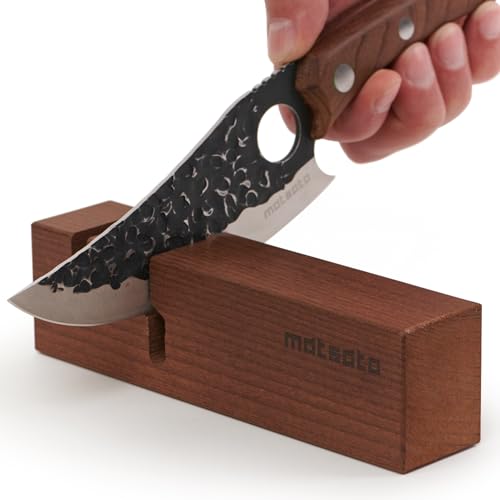
Compact Meat and Vegetable Prep Knife: Matsato Japanese Steel Chef Knife, 4.53-Inch Blade
The Matsato Japanese Steel Chef Knife handles meat, vegetables, and everyday chopping with a compact hammered blade that helps reduce food sticking. It suits home cooks and grilling enthusiasts who want one versatile knife with a secure finger-hole grip.
Pros and Cons
Pros
- The compact blade and finger-hole grip support precise, controlled cutting.
- The hammered surface is designed to reduce food sticking during slicing.
- The knife handles both meat and vegetables, reducing the need to switch tools.
- The carbonized beech wood handle gives the knife a distinctive, gift-ready appearance.
Cons
- The 4.53-inch blade provides less cutting reach than a standard full-size chef knife when processing large vegetables or substantial cuts of meat.
- The listing does not provide the knife's weight, sheath details, or dishwasher-safety guidance.

Matsato
Meat and Vegetable Chopping: Matsato 5.8-Inch Japanese Steel Cleaver Knife
The Matsato 5.8-inch cleaver chops meat, poultry, and vegetables with a lightweight 176g design that provides controlled, precise handling. It suits home cooks, barbecue enthusiasts, and gift buyers seeking a compact 3CR13 stainless steel knife with a secure finger-hole grip.
Pros and Cons
Pros
- Its compact 5.8-inch blade is easier to maneuver than a large traditional meat cleaver.
- The lightweight 176g construction reduces bulk while maintaining a balanced chopping motion.
- A hammered blade surface helps prevent sliced ingredients from clinging to the steel.
- The finger hole, beech wood handle, and hanging hole combine control, comfort, and convenient storage.
Cons
- The compact 5.8-inch blade provides less cutting reach for large cuts of meat or oversized vegetables.
- The listing does not specify dishwasher compatibility, so the beech wood handle should be washed and dried carefully.
Matsato Everyday Kitchen Prep Knife: Matsato Osuren 6.3-Inch Japanese Stainless Steel Chef Knife
Matsato
Everyday Kitchen Prep Knife: Matsato Osuren 6.3-Inch Japanese Stainless Steel Chef Knife
The Matsato Osuren handles slicing, chopping, and cutting vegetables, meat, and herbs, with balanced control as its biggest advantage. It suits home cooks and professional food preparation users who want one versatile stainless steel knife for daily kitchen tasks.
$35.95 at AmazonEditors' Favorite
Color: Black, Brown Size: 6.3" Dimensions: 11 x 2.1 x 0.9 inches Weight: 0.3968320716 Pounds Product Group: Kitchen
Shop NowMatsato 6.3 Inch Chef Knife Japanese Steel Blade for Home Cooking
Matsato
6.3 Inch Chef Knife Japanese Steel Blade for Home Cooking
This 6.3-inch Japanese stainless steel chef knife delivers razor-sharp precision for slicing, dicing, and chopping vegetables and meats with minimal effort and superior edge retention. Home cooks and meal preppers will appreciate the balanced ergonomic handle that reduces hand fatigue during extended kitchen tasks.
$39.99 at AmazonGreat Value
Brand Name: Matsato Manufacturer: Matsato Model Number: Matsato Manufacturer Part Number: Matsato Item Type Name: Knife Unit Count: 1.0 Count Included Components: Knife Best Sellers Rank: #3,455 in Kitchen & Dining (See Top 100 in Kitchen & Dining) #4 in Chef's Knives ASIN: B0CLVMXH3Y Customer Reviews: 4.5 4.5 out of 5 stars (9,153) 4.5 out of 5 stars Blade Edge: Plain Construction Type: Forged Blade Material Type: Stainless Steel Handle Material: Wood Is the item dishwasher safe?: No Material Type: 1.4116 Japanese Stainles, Wood BladeLength: 6.3 Inches Item Weight: 176 Grams Item Length: 10.8 Inches Size: 6.3" Color: Brown, Silver Blade Color: Silver Blade Material: Stainless Steel Brand: Matsato
Shop NowMatsato Sharpen Kitchen, Chef, and Pocket Knives with the Matsato Knife Sharpener
Matsato
Sharpen Kitchen, Chef, and Pocket Knives with the Matsato Knife Sharpener
The Matsato Knife Sharpener restores kitchen, chef, and pocket knife edges with ceramic rods, while its non-slip base keeps sharpening controlled. It suits home cooks who want one compact manual sharpener for several knife types.
$25.99 at AmazonColor: Brown Size: 7.09" x 1.97” x 1.57" Dimensions: 7.086614166 x 1.968503935 x 1.574803148 Inches Weight: 0.440924524 Pounds Product Group: Kitchen
Shop NowMatsato Compact Meat and Vegetable Prep Knife: Matsato Japanese Steel Chef Knife, 4.53-Inch Blade
Matsato
Compact Meat and Vegetable Prep Knife: Matsato Japanese Steel Chef Knife, 4.53-Inch Blade
The Matsato Japanese Steel Chef Knife handles meat, vegetables, and everyday chopping with a compact hammered blade that helps reduce food sticking. It suits home cooks and grilling enthusiasts who want one versatile knife with a secure finger-hole grip.
$36.99 at AmazonColor: Brown Size: 4.5" Dimensions: 10.8267716425 x 1.968503935 x 0.15748 inches Weight: 0.62 pounds Product Group: Kitchen
Shop NowMatsato Meat and Vegetable Chopping: Matsato 5.8-Inch Japanese Steel Cleaver Knife
Matsato
Meat and Vegetable Chopping: Matsato 5.8-Inch Japanese Steel Cleaver Knife
The Matsato 5.8-inch cleaver chops meat, poultry, and vegetables with a lightweight 176g design that provides controlled, precise handling. It suits home cooks, barbecue enthusiasts, and gift buyers seeking a compact 3CR13 stainless steel knife with a secure finger-hole grip.
$43.99 at AmazonColor: Brown Size: 5.8" Dimensions: 11.1417322721 x 3.543307083 x 0.787401574 inches Weight: 0.38801358112 Pounds Product Group: Kitchen
Shop Now





Write Your Review
No reviews yet. Be the first to share your experience!