

Most compact propane grills fail in predictable ways, and knowing those failure points before you buy saves you from a summer of scorched sausages and cold burger centers. The trouble usually starts with heat output that reads impressive on the box but stalls in real conditions. A single-burner unit rated at 8,000 BTU sounds fine until a light breeze pulls warmth off the cooking surface faster than the flame can replace it. Add a thin lid, a cramped grate, and a regulator that hisses more than it flows, and the little grill that promised backyard freedom becomes the reason dinner runs an hour late.
The good news is that every one of these weak spots has a workaround, and the right small footprint model handles them well enough to cook for two or three people without drama. This guide walks through each disappointment in turn, so you can spot the design flaws that matter and skip the ones marketing invented.
Weak BTU Output Is the First Thing to Check
Raw BTU numbers get quoted constantly, but they mislead more than they inform. A burner pushing 10,000 BTU across a 145-square-inch grate delivers far more usable heat than a 12,000 BTU burner spread thin over 250 square inches. The figure you actually want is BTU per square inch, and a solid target for a portable unit sits between 75 and 100. Below that range, searing a steak becomes wishful thinking, and the grill leans on residual grate heat rather than active flame.
Cold weather punishes low-output models the most. Propane vaporizes poorly when the tank and ambient air drop toward freezing, so a grill that struggles at 70 degrees will barely warm up at 40. If you plan to cook in shoulder seasons or at altitude, buy more BTU than the manufacturer suggests you need. The extra headroom compensates for the pressure loss you cannot see. A quality mini grill gas setup should hit 400 degrees on the grate within eight to ten minutes of ignition; time yours with a thermometer probe rather than trusting the built-in lid gauge, which often reads the dome temperature and not the cooking surface.
Single-Burner Heat Comes Out Uneven
The defining limitation of a compact grill is its lone burner. One tube of flame cannot create the hot zone and cool zone that full-size grills use to sear then finish. Instead you get a bright center that runs 100 degrees hotter than the edges, which is why the middle of a batch of drumsticks chars while the outer pieces stay raw. Cheaper models make this worse by using a straight burner tube with no flame tamer or heat diffuser above it, so the hot spots sit directly over the burner ports.
Look for a model with a flavorizer bar, a ceramic plate, or at minimum a folded-steel tent over the burner. These parts spread the flame sideways and even out the surface temperature. You can also cook around the problem: preheat with the lid closed, then arrange food in a ring toward the edges and rotate it every few minutes. A cast-iron grate helps too, since it stores heat and smooths over the flame’s peaks and valleys better than the thin chrome-plated wire grates that ship on budget units.
Flimsy Regulators and Hoses Choke the Flame
A grill can have a strong burner and still underperform because the fuel never reaches it at full pressure. Portable models frequently ship with lightweight regulators tuned for the small 1-pound canisters, and those regulators become the bottleneck. Symptoms include a flame that looks yellow and lazy instead of blue and sharp, a burner that surges then dies, or a persistent hiss at the connection point. Any of these means gas is being throttled or leaking.
Test every new connection with soapy water: brush it on, open the valve, and watch for bubbles. If bubbles form, tighten by hand and retest before you ever strike a spark. Many regulators also trip a safety bypass if you open the tank valve before the burner knob, so build the habit of opening the burner slightly, lighting it, then opening the tank slowly. Should the flame stay stubbornly weak, disconnect everything, close both valves, wait thirty seconds, and reconnect in the correct order to reset the flow limiter. Replacement regulators and hoses cost under twenty dollars and are worth swapping out on any grill more than a couple of seasons old.
Tip-Over Risk Deserves Real Attention
Small grills are light, and light grills tip. A tabletop model weighing twelve pounds can be knocked over by a leaning propane hose, a gust against the open lid, or a dog brushing the leg. When it goes, hot grease and an open flame go with it. This is not a rare edge case; it is the most common way compact grills cause burns and small fires.
Stability comes down to the footprint and where the weight sits. A wide, low base with rubber feet resists tipping far better than a tall narrow one, and models that mount the fuel canister underneath rather than off to one side keep the center of gravity centered. If you use a 1-pound canister that threads directly into the side of the grill, be aware that the canister acts as a lever arm and pulls the balance sideways; support it or route it so nothing snags. Set the grill on a level, heat-safe surface every time, and never place it on a plastic table that can soften and buckle under the heat.
Choosing Fuel: 1-Pound Canisters Versus a 20-Pound Tank
Fuel format shapes both cost and cooking time. A 1-pound canister holds enough gas for roughly one to two hours of grilling, which suits a picnic or a tailgate but empties fast during a longer cookout. Those canisters also cost far more per ounce of propane than bulk fuel, so relying on them regularly gets expensive. A standard 20-pound tank, the kind that fits a full-size grill, holds about twenty times the fuel and drops the per-cook cost dramatically.
Many portable grills accept both if you buy a simple adapter hose, and this flexibility is worth prioritizing. Use the 1-pound canister for genuine portability at the campsite, then connect the big tank when the grill lives on a patio. One caution: do not refill disposable 1-pound canisters unless they are the refillable type rated for it, since ordinary ones are not built for repeated pressure cycles. Keep any tank upright and outdoors, and store it away from the grill’s heat.
Match the Grill to How You Actually Cook
Before you commit, count the people you feed and the foods you cook most. A grate around 145 to 190 square inches handles two to four burgers or a pair of steaks comfortably; anything smaller forces you to cook in shifts, and the second batch waits while the first goes cold. If you mostly grill vegetables and thin cuts, a lower-output unit is fine, but if thick chops and reverse-seared steaks are the goal, prioritize the BTU density and a lid tall enough to close over a roast.
Portability has a cost in every other category, so be honest about whether you truly move the grill or just like the idea. If it lives on a balcony ninety percent of the time, a slightly larger unit with a heavier grate and dual fuel capability will outperform a featherweight model at the same price. Reserve the smallest, lightest grills for people who genuinely carry them to the beach or trailhead.
Frequently Asked Questions
How many BTUs does a small propane grill really need?
Aim for 8,000 to 12,000 BTU on a compact single-burner grill, but judge it by BTU per square inch rather than the headline number. A ratio of 75 to 100 BTU per square inch gives you enough heat to sear and to hold temperature on a breezy day. If you cook in cool weather or at elevation, choose the higher end of that range, because propane loses pressure and vaporizes slower as temperatures drop, quietly stealing output you paid for.
Can I use a portable grill with a full-size 20-pound tank?
Yes, if the grill supports it or accepts an adapter hose, and doing so cuts your fuel cost sharply compared with disposable 1-pound canisters. The larger tank runs for many hours and suits patio use, while the small canister stays handy for camping. Always keep the 20-pound tank upright, connect it outdoors, and check the connection with soapy water for bubbles before lighting. Confirm your specific model is rated for the higher-volume tank, since a few very small grills are designed only for the little canisters.
Why does my compact grill cook unevenly?
A single burner concentrates heat down the center of the grate, leaving the edges markedly cooler, and grills without a heat diffuser or flame tamer show the effect most. Combat it by preheating with the lid closed, arranging food toward the outer edges, and rotating pieces every few minutes so each spends time over the hot zone. Upgrading to a cast-iron grate also helps, because it absorbs and redistributes heat far more evenly than the thin wire grates that ship with budget models.
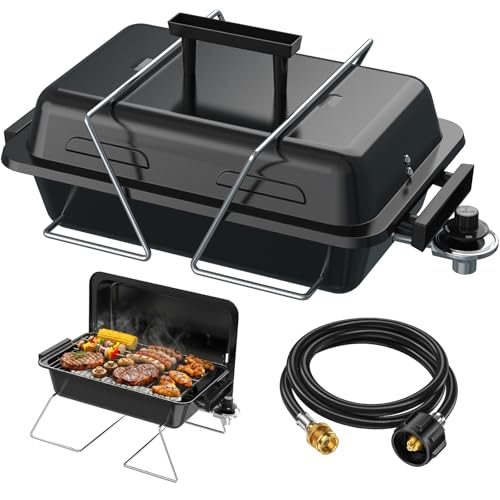
BESTFIRE
Camping and Tailgate Grilling: BESTFIRE Portable Propane Gas Grill with 2-in-1 Valve, Foldable Legs and 165 sq in Grate
This single-burner propane grill folds flat for transport and runs on either a 1-lb cylinder or a 20-lb tank through its 2-in-1 valve, so fuel is never the thing that ends the cookout. Buy it if you grill away from home at campsites, tailgates, or RV stops and want 165 square inches of porcelain-coated grate you can carry in one hand.
Pros and Cons
Pros
- Tank flexibility is built in, so you are not locked into buying disposable cylinders on the road.
- Assembly is minimal and the adjustable regulator gets the burner running within a few minutes of arrival.
- Rust-resistant grates and finish hold up to being stored outdoors or in a damp camper.
- Compact footprint fits picnic tables and tailgates where a full-size grill has nowhere to sit.
Cons
- A single burner means no true two-zone fire, so searing and slow-finishing have to happen in sequence.
- The valve requires pressing down before rotating to open, close, or disconnect the hose, which takes a few uses to feel natural.

Charbroil
Portable Outdoor Grilling with the Charbroil 1-Burner Stainless Steel Gas Grill
The Charbroil 1-Burner Portable Gas Grill provides propane-powered grilling in a compact 200-square-inch cooking area, with push-button ignition as its biggest convenience. It suits campers, tailgaters, and small households that need portable grilling without matches or batteries.
Pros and Cons
Pros
- Push-button piezo ignition removes the need to carry matches or batteries.
- Porcelain-coated grates provide rust resistance and easier cleanup.
- The compact 200-square-inch surface supports portable grilling for smaller meals.
- Stainless steel and durable steel construction are suited to outdoor cooking.
Cons
- The disposable 16.4-ounce LP cylinder is sold separately.
- The single burner and 200-square-inch surface limit cooking volume for larger groups.
The Best Deals This Week*
-
Veralune 2-Burner Tabletop Gas Grill
$104.49
($109.99)Save $5.50 -
Portable Outdoor Grilling with the Charbroil
$89.99
($109.99)Save $20.00 -
MASTER COOK 10,000 BTU Portable Gas Grill
$61.74
($64.99)Save $3.25 -
3-in-1 Portable Camping Grill
$59.84
($62.99)Save $3.15
*Deals are selected by our commerce team
BESTFIRE Camping and Tailgate Grilling: BESTFIRE Portable Propane Gas Grill with 2-in-1 Valve, Foldable Legs and 165 sq in Grate
BESTFIRE
Camping and Tailgate Grilling: BESTFIRE Portable Propane Gas Grill with 2-in-1 Valve, Foldable Legs and 165 sq in Grate
This single-burner propane grill folds flat for transport and runs on either a 1-lb cylinder or a 20-lb tank through its 2-in-1 valve, so fuel is never the thing that ends the cookout. Buy it if you grill away from home at campsites, tailgates, or RV stops and want 165 square inches of porcelain-coated grate you can carry in one hand.
$49.99 at AmazonEditors' Favorite
Color: BLACK- with Dual Connections Size: Black Dimensions: 11.8 x 18.9 x 12.4 inches Weight: 8 pounds Product Group: Lawn & Patio
Shop Nowveralune 2-Burner Tabletop Gas Grill, 22000 BTU Stainless Steel Grill

Great Value
Color: 2 Burner Dimensions: 17.7 x 17.9 x 13.8 inches Weight: 26.4 pounds Product Group: Lawn & Patio
Shop NowCharbroil Portable Outdoor Grilling with the Charbroil 1-Burner Stainless Steel Gas Grill
Charbroil
Portable Outdoor Grilling with the Charbroil 1-Burner Stainless Steel Gas Grill
The Charbroil 1-Burner Portable Gas Grill provides propane-powered grilling in a compact 200-square-inch cooking area, with push-button ignition as its biggest convenience. It suits campers, tailgaters, and small households that need portable grilling without matches or batteries.
$89.99 at AmazonColor: Black Size: 24.75" W x 14.7" D x 14" H Dimensions: 14.7 x 24.75 x 14 inches Weight: 19.5 Pounds Product Group: Lawn & Patio Binding: Lawn & Patio
Shop NowMASTER COOK 10,000 BTU Portable Gas Grill, Outdoor Compact Tabletop BBQ Small Propane Grill with Foldable Legs for RV, Hiking, Camping, Patio, Tailgating

MASTER COOK
10,000 BTU Portable Gas Grill, Outdoor Compact Tabletop BBQ Small Propane Grill with Foldable Legs for RV, Hiking, Camping, Patio, Tailgating
$61.74 at AmazonColor: Black Dimensions: 14.17 x 27.16 x 14.17 inches Weight: 8.2 Pounds Product Group: Lawn & Patio
Shop NowQuliMetal 3-in-1 Portable Camping Grill, Foldable Charcoal Wood Gas BBQ

Size: 17“ Dimensions: 17.71 x 11.45 x 8.51 inches Weight: 12.566348934 Pounds Product Group: Lawn & Patio
Shop Now








Write Your Review
No reviews yet. Be the first to share your experience!