

A mini barbecue grill earns its money in the twenty minutes before you cook and the fifteen after: the part where you carry it, feed it, and clean it somewhere that is not your own kitchen. Grate size matters far less than whether the legs fold, whether the lid stays shut in a moving car, and whether you packed enough fuel.
So the trip you actually plan to take is the only sensible starting point. Six situations cover nearly all of it, and each pushes a different specification to the front.
What Actually Fits in a Car Boot
Two shapes dominate the small-grill shelf and they pack differently. A tabletop kettle collapses to roughly 15 by 15 by 12 inches with the legs stowed, weighing 12 to 20 pounds depending on how much steel went into the bowl. A portable gas grill with a folding lid lies flatter, around 18 by 12 by 6 inches, but add a 1 pound propane canister to whatever space you budgeted, and a canister is rigid and refuses to nest against anything.
The packed footprint is not what decides it, though. What decides it is whether the legs fold flat or detach, and whether the lid latches to the body. An unlatched lid in a moving car is exactly how a grey film of old ash ends up across the boot carpet and in the seams of everything packed beside it. One clip or a wire bail is worth more than two inches of grate.
Either way, the grill travels in its own bag or crate. Grease works out of drip trays and ash escapes the tightest cup, and neither comes out of upholstery. A cheap plastic tub with a lid does the job.
Two Nights at a Campsite With No Hookups
Away from shops, fuel becomes the whole planning problem. Charcoal for one meal runs 2 to 3 pounds of briquettes, plus a lighting method packed alongside: a chimney starter, paraffin cubes, or a bottle of lighter fluid you would rather not have leaking near the food. Lump charcoal burns hotter and faster than briquettes with less predictable timing, which suits steaks and frustrates anything needing a steady half hour.
Gas quantifies more cleanly. A 16.4 ounce canister runs a small burner roughly 1.5 to 2 hours at a medium setting, so a weekend of dinners means two, with the second treated as supply rather than spare. Canisters never tell you how much is left, which is the real annoyance: you learn by weight, or you carry extra.
The trade between them shows up as time. Charcoal costs less per meal and takes 15 to 20 minutes from lighting to usable cooking heat, and that part cannot be hurried. Gas is ready in 3 to 5 minutes and turns down when you ask it to, which matters more than it sounds when the light is going and four people are waiting on a second batch of sausages.
Beaches and Parks Where the Rules Choose Your Fuel
Public land is where a purchase goes wrong quietly. Plenty of parks and beaches ban charcoal outright, seasonally or year round; others confine grilling to designated pads, and a common rule requires the grill to stand above the ground rather than sit on grass or sand. Read the bylaw for the places you actually go before buying, because the fuel decision may already have been made for you.
Notice what those rules are usually about. The cooking is rarely the concern; hot ash is. A grill with a fully enclosed ash catcher, rather than vents that drop embers straight down, is the difference between complying with a posted rule and improvising with a water bottle while a warden watches. It also lets you carry the ash out, which is what most of these sites are asking for.
The Balcony That Only Looks Like an Option
Balconies are a common reason people shop for a mini barbecue grill and a common place the plan collapses. A great many leases prohibit charcoal and open flame outright, and municipal fire codes in many cities set minimum clearances from combustible walls that a standard balcony cannot provide. A small footprint creates no exemption, because the rule addresses flame and embers rather than square inches.
Treat it as a rules question, then, not a size question, and get the answer from the lease or the local fire code before spending anything. This is also the one situation here where an electric unit is often the only permitted answer, worth knowing before a charcoal kettle ends up living in a cupboard.
A Tailgate on Gravel With Six People Waiting
Cooking area governs here, and the arithmetic is unforgiving. Roughly 100 to 150 square inches of grate handles 4 to 6 burgers at once with room to turn them, which means a group of six eats in two rounds rather than one. Somebody waits. Knowing that in advance changes the menu: sausages and skewers tolerate staggered service far better than burgers do.
Stability outranks capacity in this setting. Gravel, grass, and the lip of a tailgate are all uneven, and a grill with a wide stance and legs that lock in place is the better buy over a taller one offering another 30 square inches. A hot grill going over in a car park is a different class of problem from a slow one.
Wind does the rest of the damage in an open spot. A lid that closes properly becomes a windbreak and holds temperature through a gust, while a bare grate in a 15 mile per hour crosswind will not brown anything evenly however much fuel you feed it. Out there, a lid earns its space ahead of extra grate.
Cleaning It in a Car Park Before You Drive Home
Nobody weighs this at the shop, and it drives long-term satisfaction more than any other feature. Cast iron grates hold heat, leave good marks, and are the reason a small grill can sear at all. They also rust within days if packed away damp, and washing up at a campsite tap or a beach shower makes damp the default. Re-seasoning wants a warm grill and an oiled rag at the end of a long day.
Porcelain-coated steel gives up some searing and wipes clean cold with a paper towel. It tolerates being put away imperfectly, which is exactly the behaviour travel produces, and that tolerance is worth more on the road than a better crust. The coating chips eventually, especially under a wire brush, but a chipped grate that still works beats a rusted one that does not.
Ash must be completely cold before it goes anywhere, and cold takes longer than it feels like it should. A removable ash pan that slides out and empties in one motion turns a twenty minute job of scraping and tipping into a five minute one, and it is the feature most worth paying for on a charcoal model you intend to move around.
The honest trade reads like this. A mini barbecue grill buys the ability to cook a real meal almost anywhere and charges for it in batch size and in the fifteen or twenty minutes per trip spent on fuel and cleanup. For camping, tailgates, and picnics that is a good bargain. For anyone cooking mostly at home it is a poor one, and a full-size grill plus a cheap second unit for travel beats one small grill asked to do both jobs.
Common Questions
How long should a small grill cool before I pack it in the car?
Longer than most people wait. The firebox of a charcoal grill stays hot enough to scorch a car mat for 45 to 60 minutes after the coals stop glowing, and the ash inside holds usable heat for hours after that. Gas is easier: shut the valve, give the grate 15 to 20 minutes, and the body is safe to handle. If you are pressed, douse the coals, stir them, douse again, and accept that you are carrying wet sludge rather than a dry pan. Never bag warm ash in plastic.
How many propane canisters do I need for a weekend trip?
Two covers a weekend of dinners, and three if breakfast or coffee also comes off the burner. A 16.4 ounce canister gives roughly 1.5 to 2 hours of cooking at medium, and that figure falls in cold weather because pressure drops with temperature. Canisters give no reading of what is left, so weigh them at home or write the first-use date on the label. Store them upright, out of direct sun, and never in a car sitting in the heat all afternoon. Airlines will not carry them at all, so a trip by air means buying fuel after you land.
What do I do with the ash when the site has no bin?
Carry it out, which means deciding how before you leave home. A metal tin with a lid, an old biscuit tin or a small empty paint can, holds one meal’s worth of cold ash and lives in the same crate as the grill. Wait until the ash is genuinely cold, stir it to check for hidden embers, then seal the tin and stow it. Do not tip ash into vegetation, sand, or a plastic litter bin; buried ash has restarted fires hours after the cooking finished. Empty the tin at home when you are certain.
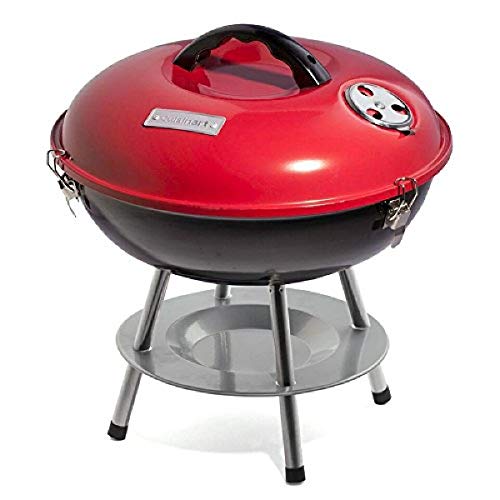
Cuisinart
Portable Tabletop Charcoal Grill for Camping and Tailgating: Cuisinart 14-Inch Grill
The Cuisinart 14-inch charcoal grill provides 196 square inches of cooking space, with adjustable vents as its biggest advantage for managing heat. It suits campers, tailgaters, and small-space grillers who need a lightweight four-pound grill with a locking lid.
Pros and Cons
Pros
- At four pounds, this tabletop charcoal grill is easy to carry for camping and tailgating.
- Adjustable dual vents support more precise temperature management than a grill with fixed airflow.
- Three lid locks make transport more secure and help contain the grill between uses.
- The enamel-coated firebox, ash base, and chrome-plated grate make cleanup more manageable.
Cons
- Its 196-square-inch cooking area is better suited to compact meals than large group cooking.
- Charcoal grilling requires managing fuel, airflow, and ash after use.
The Best Deals This Week*
-
Portable Charcoal Grill with Thermometer
$39.99
($42.99)Save $3.00 -
Joyfair Portable Charcoal Grill with Thermometer
$39.89
($41.99)Save $2.10
*Deals are selected by our commerce team
Cuisinart Portable Tabletop Charcoal Grill for Camping and Tailgating: Cuisinart 14-Inch Grill
Cuisinart
Portable Tabletop Charcoal Grill for Camping and Tailgating: Cuisinart 14-Inch Grill
The Cuisinart 14-inch charcoal grill provides 196 square inches of cooking space, with adjustable vents as its biggest advantage for managing heat. It suits campers, tailgaters, and small-space grillers who need a lightweight four-pound grill with a locking lid.
$39.99 at AmazonEditors' Favorite
Color: Portable Charcoal Grill, 14" (Red) Size: 14.5" x 14.5" x 15" Dimensions: 14.6 x 14 x 15 inches Weight: 2 pounds Product Group: Lawn & Patio Binding: Tools & Home Improvement
Shop NowGas One GasOne 14-inch Portable Charcoal Barbecue Grill with Thermometer – Red

Great Value
Color: Red with Thermometer Dimensions: 14.5 x 14.5 x 15 inches Product Group: Lawn & Patio Binding: Tools & Home Improvement
Shop NowHaSteeL Portable Charcoal Grill with Thermometer, HaSteeL Small Tabletop Barbecue Grill Smoker for Outdoor Camping Backyard Beach BBQ, 117 Square Inches Cooking Area, Thick Steel, Screwdriver, Black

HaSteeL
Portable Charcoal Grill with Thermometer, HaSteeL Small Tabletop Barbecue Grill Smoker for Outdoor Camping Backyard Beach BBQ, 117 Square Inches Cooking Area, Thick Steel, Screwdriver, Black
$39.99 at AmazonColor: Black Dimensions: 10.75 x 16.2 x 15 Inches Weight: 7.2 Pounds Product Group: Lawn & Patio
Shop NowJoyfair Portable Charcoal Grill with Thermometer, Small BBQ Camping Grills

Color: Black Grill Size: Compact (14x10x10 inches) Dimensions: 10 x 14 x 10 inches Weight: 7.94986916772 pounds Product Group: Lawn & Patio Binding: Tools & Home Improvement
Shop NowGas One – 14-inch Portable Barbecue Grill with 3-Point Locking Lid for Heat Preservation – Dual Venting System – Small Charcoal Grill for Backyard, Camping, Boat

Gas One
– 14-inch Portable Barbecue Grill with 3-Point Locking Lid for Heat Preservation – Dual Venting System – Small Charcoal Grill for Backyard, Camping, Boat
$25.99 at AmazonColor: Red Size: 14 Inch (Diameter) Dimensions: 14.5 x 14.5 x 15 inches Weight: 4 pounds Product Group: Lawn & Patio Binding: Tools & Home Improvement
Shop Now






Write Your Review
No reviews yet. Be the first to share your experience!