

Foam is not air trapped in milk. Foam is protein wrapped around air, and that one sentence turns every frother on the market from a pile of gadgets into four answers to the same physics problem. Milk carries whey proteins folded into tight bundles. Agitate them and they unfold, and the loose strands migrate to the surface of every air bubble and link arms around it. That protein shell is what stops a bubble from popping. A stainless steel milk frother is worth the money partly because metal changes how heat reaches those proteins, but the mechanism inside decides whether you get glossy microfoam or a hat of soap suds.
What Actually Turns Milk Into Foam
Protein unfolding is temperature dependent, so there is a narrow band where frothing works and wide territory either side where it fails. Below roughly 100°F the whey proteins stay folded; you can whip cold milk into something that resembles foam for ninety seconds, then watch it slump because nothing was holding the bubbles. Around 155°F to 160°F the opposite failure arrives, as the proteins denature past the point of being useful structure and the drink tastes cooked and thin. The target sits between about 130°F and 150°F, which is also where lactose reads sweetest on the tongue. Well textured milk tastes sugary without a grain of sugar added.
So every device gets the same question: can it reach that window and then stop? A thermostat that overshoots to 170°F ruins drinks no matter how nicely the housing is built, and a device that cannot heat at all is fine provided you warm the milk yourself.
Bubble size carries the rest of the quality difference. Two cups can hold identical air and be different products. Big loose bubbles make dry foam, the meringue-like layer that perches on a drink, drains within a minute, and leaves liquid milk beneath it. Microfoam divides the same air into bubbles too small to resolve, so it behaves like a liquid rather than a topping, pouring and swirling with a wet sheen like glossy paint. The difference is how the air gets in. Beating it downward from above yields whatever sizes happen to form; shearing it into a spinning vortex tears large bubbles apart continuously, because the outer wall moves faster than the centre. That is the physical reason some methods make latte art and others never will.
Steam Wands Inject and Shear at Once
A steam wand does both jobs in one motion. It pushes pressurised steam beneath the surface, and that jet dumps heat into the milk while driving it into rotation. Hold the tip just under the surface and you hear a faint tearing sound as air is drawn into the stream; drop it deeper and the hissing stops while the vortex folds that air into ever smaller bubbles. Done well, it is the best microfoam available at home, dense enough to hold a pattern and wet enough to pour.
It is also the least forgiving option for a beginner, because the two jobs share a clock and the clock is short. Milk crosses the useful window in fifteen to twenty seconds on a decent boiler, so the air has to go in during the first few seconds while the milk is still cool enough to accept it. Too late and the bubbles never break down; too much and the foam goes stiff and dry. A stainless pitcher helps for a mundane reason: metal moves temperature to your palm fast, so your hand becomes the thermometer.
Automatic Jugs and the Case for Stainless
An automatic jug separates the jobs instead of combining them. A heating base warms the vessel while a magnetic whisk disc spins inside, coupled through the base rather than driven by a shaft. Most units draw 400 to 600 watts and finish in 60 to 150 seconds depending on volume and program. A thermostat governs the cutoff, which is why these are the most repeatable frothers you can buy and the least adjustable. Press once, walk away, and Thursday’s cup matches Monday’s.
This is where stainless earns its keep rather than merely looking tidy. The jug wall is the heat exchanger between element and milk, so it has to conduct evenly and avoid hot spots that scorch protein in one patch while the rest lags behind, and it has to survive a full thermal cycle every morning for years without warping. A stainless interior does not scratch into a dull haze the way coated aluminium does once a whisk disc has had its way with it, and it does not pick up the stale note plastic acquires after a few hundred cycles.
Handheld Whisks and Pumps, Two Kinds of Simple
A battery handheld spins a small wire coil at several thousand RPM at the milk surface. It beats air in from above and heats nothing, which tells you exactly what it can do. Volume arrives in twenty or thirty seconds, it works in any vessel including the mug you plan to drink from, and it costs very little. It will never make microfoam, since whipping from above is not shearing in a vortex, and its bubbles stay visibly large. Pair it with milk warmed separately into the 130°F to 150°F range and it earns a drawer; expect it to build a cappuccino alone and it disappoints.
Pump frothers run on a different principle and are quietly the most forgiving thing here. A plunger carrying a fine mesh screen sits in a carafe, and you push milk and air through that screen twenty or thirty times. The mesh does the shearing, dividing bubbles with every pass, so mesh fineness is the specification to read and a double-layer screen beats a single one. Nothing is powered, so nothing fails electrically. A pump also works on cold milk, which makes it the straightforward answer for iced drinks, where most electric units either refuse to run cold or offer a token setting.
The Milk in the Jug Changes the Answer
A frother blamed for bad foam is often innocent, and the real culprit is in the fridge. Whole milk foams stably because its fat coats and stabilises bubble walls, keeping the foam wet and glossy for several minutes. Skim makes more volume, with less fat competing with protein at the air interface, but that foam is drier and dies sooner. Plant milks split hard on protein. Oat formulations sold for barista use carry added protein and stabiliser so they behave close to whole milk, while plain almond and rice milks lack the protein to build a shell and collapse regardless of mechanism.
Then there is the limit stainless does not fix. Milk protein sticks and browns on any hot surface, so scorching remains a matter of rinsing the jug within a few minutes rather than a property of the metal. What the steel does give is even conduction, no flavour carryover, no scratching, and indifference to the dishwasher outside. Once residue dries on, soaking lifts it and scrubbing only polishes it into the finish.
Matching a Mechanism to Your Mornings
If money is tight or your drinks are cold, buy a pump frother and read the mesh spec. It costs a fraction of anything electric, handles the iced drinks that stump powered units, and makes surprisingly small bubbles for a device with no motor. If you want the same hot cappuccino at the same time every morning without thinking about it, an automatic stainless jug is the tool, because the thermostat and the fixed cycle are the entire point and the metal keeps that cycle honest across years. Reach for a steam wand only if you already own an espresso machine and want latte art. Underneath all of it, the temperature window matters more than the hardware: a pump frother into properly warmed milk beats an expensive machine that runs to 165°F.
Frequently Asked Questions
Why does my foam collapse a minute after I make it?
Collapsing foam means the protein shells around the bubbles never formed. Either the milk stayed below about 100°F, so the whey proteins never unfolded, or the bubbles came out too large to be stable and merged until they burst. Check temperature first, aiming for 130°F to 150°F, then check the milk, since low-protein plant milks fail in any device. If both are right, the mechanism is beating air in from above rather than shearing it in a vortex.
Is a stainless jug really better than plastic or a coated one?
For an automatic frother, yes, though the reason is durability more than day-one foam. The jug wall carries heat from the base into the milk, and stainless spreads it evenly enough to avoid patches where protein scorches while the rest is still warming. It survives daily thermal cycling for years, resists the permanent haze a coated interior develops once a whisk disc has spun against it, and never picks up the stale note plastic acquires. It does not stop milk sticking while hot, so the rinsing routine is identical either way.
Can I get latte art foam without a steam wand?
Not to the same standard, because it depends on how finely the air is divided. Latte art needs microfoam wet enough to pour like a liquid, which requires shearing air inside a vortex where velocity differences tear big bubbles apart continuously, and a steam jet does that better than anything else at home. A pump frother with a double-layer mesh gets closer than people expect, since forcing milk through a fine screen thirty times is itself shearing, and it manages a simple pour. A magnetic whisk gives consistent foam that is usually too dry for patterns, and a handheld will not get there at all.

SIMPLETASTE
Make Cappuccino and Latte Foam at Home: SIMPLETASTE 4-in-1 Milk Frother and 500ml Steamer
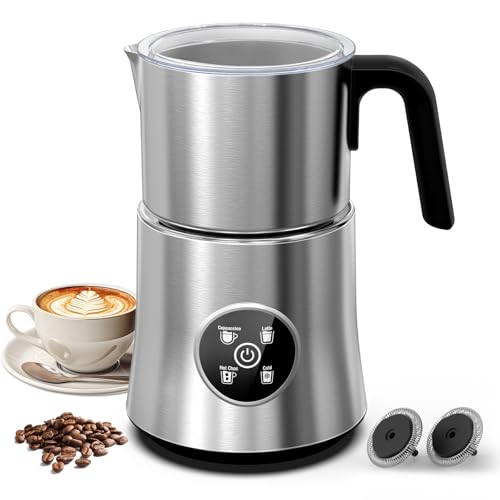
The SIMPLETASTE electric frother heats milk and makes hot thick, hot thin, or cold foam with one knob, while its biggest advantage is the 500ml heating capacity. It suits families and coffee drinkers who want multiple café-style milk drinks at home without using separate appliances.
Pros and Cons
Pros
- Four operating modes cover hot foam, thin foam, heated milk, and cold foam in one appliance.
- The stainless steel jug is designed for regular use and includes a spare whisk.
- A removable jug and detachable whisk simplify washing with soapy water or a dishwasher.
- The 500ml heating capacity is useful when preparing milk for several people.
Cons
- The 500ml capacity applies to heating, while frothing is limited to 250ml.
- Milk is maintained at approximately 65°C, so it is not intended for boiling-hot milk.
The Best Deals This Week*
-
Instant Pot MagicFroth 9-in-1 Milk Frother, 17 oz
$49.99
($64.99)Save $15.00 -
Automatic Electric Milk Frother and Steamer
$55.99
($69.99)Save $14.00 -
Make Cappuccino and Latte Foam at Home
$42.97
($49.97)Save $7.00
*Deals are selected by our commerce team
Instant Pot MagicFroth 9-in-1 Milk Frother, 17 oz, Stainless Steel

Editors' Favorite
Color: Stainless Steel Size: Standard Dimensions: 7.4 x 6 x 6.6 Inches Weight: 2.2 Pounds Product Group: Kitchen Binding: Kitchen
Shop NowPSIIDAN Automatic Electric Milk Frother and Steamer with Hot and Cold Foam
Great Value
Color: Stainless Steel Size: large Product Group: Kitchen
Shop NowSIMPLETASTE Make Cappuccino and Latte Foam at Home: SIMPLETASTE 4-in-1 Milk Frother and 500ml Steamer
SIMPLETASTE
Make Cappuccino and Latte Foam at Home: SIMPLETASTE 4-in-1 Milk Frother and 500ml Steamer
The SIMPLETASTE electric frother heats milk and makes hot thick, hot thin, or cold foam with one knob, while its biggest advantage is the 500ml heating capacity. It suits families and coffee drinkers who want multiple café-style milk drinks at home without using separate appliances.
$42.97 at AmazonColor: Dark Blue Size: Large Product Group: Kitchen Binding: Kitchen
Shop NowCasimhu Electric Milk Frother 4-in-1 Foam Maker, Hot Cold Foam, 10.6 oz

Color: Light Silver Size: small Dimensions: 5.91 x 5.91 x 7.4 inches Weight: 1.99 pounds Product Group: Kitchen
Shop NowAdorever Milk Frothing Pitcher, 8.5oz/12oz/20oz/32oz/50oz/66oz Milk Frother Cup Stainless Steel, Espresso Accessories, Milk Steaming Pitchers Coffee Cappuccino Latte Art Barista Milk Jug Cup with Art Pen,12oz

Adorever
Milk Frothing Pitcher, 8.5oz/12oz/20oz/32oz/50oz/66oz Milk Frother Cup Stainless Steel, Espresso Accessories, Milk Steaming Pitchers Coffee Cappuccino Latte Art Barista Milk Jug Cup with Art Pen,12oz
$7.99 at AmazonColor: A Silver Size: 12 Ounces Dimensions: 3 x 3 x 3.5 inches Product Group: Kitchen Binding: Kitchen
Shop Now



Write Your Review
No reviews yet. Be the first to share your experience!