

Every meal prep container set looks the same in a product photo: a tidy tower of clear boxes with colored lids and a piece count printed on the corner. What decides whether you are still using it next spring is chemical and mechanical — which glass or polymer the body is made from, how the lid clamps down, and whether the bodies stack into the shelf you actually have. Almost none of that shows up in the photos, and much of it is missing from the box copy too.
So here are the numbers that decide it: thermal shock differentials, empty weights, gasket cycle counts, shelf footprints. They predict which set survives a year of daily use and which ends up at the back of a cupboard with a bowed lid.
Borosilicate, Soda-Lime, Polypropylene and Tritan Are Four Different Products
Borosilicate glass carries boron oxide in the melt, which lowers its thermal expansion enough to tolerate a temperature differential of roughly 300 to 400°F. That is the whole argument for it: a container can leave a 38°F fridge and go straight into a preheated oven without the walls fighting themselves. Nothing else in this category does that.
Soda-lime is what most inexpensive sets labeled simply “glass” actually are, usually tempered for impact. Tempering helps when you drop one and does very little for heat. Soda-lime handles a differential closer to 100 to 140°F, so a cold container going into a 375°F oven must absorb about 335°F of change. That mismatch, not a defect, sits behind nearly every story of a container cracking mid-reheat.
Polypropylene, recycling code 5, is the lightweight default. It reheats to about 250°F, which covers the microwave and rules out the oven, stains from turmeric and long-simmered tomato, and hazes over somewhere around 40 to 60 dishwasher cycles as detergent and heat etch the surface. Tritan copolyester costs two to three times as much, resists staining far better and stays clear through hundreds of washes, but it is not oven-safe at any temperature. Paying up for clarity is reasonable; paying up expecting oven duty is not.
The Weight Math Almost Nobody Runs
A 3-cup borosilicate container with its lid weighs 1.1 to 1.5 lb empty. Five of them, a normal week of lunches, is 6 to 7 lb of packaging before any food goes in; load them and you are carrying 11 or 12 lb. The polypropylene equivalent is 0.2 to 0.3 lb each, so the same five come to about a pound and a quarter.
Walking a bag from a car to a desk, that gap is academic. On a bike, a train, or a fifteen-minute walk, glass is the wrong answer no matter how long it lasts. The clean resolution is two purchases: six to eight glass pieces that stay home for fridge, freezer and oven work, and four or five light bodies that travel.
Lids Do the Sealing, and the Gasket Is the Wear Part
Four-flap locking lids are the mechanism worth money. A silicone gasket seated around the perimeter compresses as the flaps snap over the rim, and a good one holds soup inverted. Expect 500 to 1000 cycles before the silicone takes a permanent set, stops springing back, and starts weeping at the corners — two to four years at one use per weekday. Snap-on lids without gaskets rely on friction alone and find the seam the first time a bag tips.
Screw-thread lids seal best of the three and are slow, three or four turns each and prone to cross-threading when you are portioning twelve containers on a Sunday. Whether the gasket lifts out for cleaning matters more than it sounds: a molded-in gasket traps oil and spice residue in a crevice no sponge reaches, and by month four every lid in the drawer smells faintly of curry regardless of what is in it.
What Actually Happens in the Microwave and the Oven
Glass heats food evenly from all sides and absorbs plenty of energy itself, so after three minutes the rim can run 40 to 60°F hotter than the contents — enough to need a towel while the middle is still lukewarm. Plastic does the opposite. Microwaves pass through the polymer, the food heats, the walls stay handleable.
Plastic’s failure mode is local rather than general. Fat in a sauce can reach 300°F or more in a small hot spot, well past the roughly 250°F polypropylene tolerates, and the base softens and dishes until it no longer sits flat or seals. Read the label narrowly: “microwave safe” claims only that the container will not fail, not that food heats well in it. It also assumes a vented lid — seal a full container, run it four minutes, and steam pressure pops the flaps.
Stacking Geometry and Fridge Shelf Economics
Footprint decides fit, not volume. A rectangle puts its whole outline on the shelf, while a round container of equal capacity leaves dead crescents at every corner and wastes 20 to 30% more shelf area apiece. Four rectangles will fill a 14-inch-deep shelf run that three round bodies of the same volume cannot.
Bodies that nest empty are convenient; bodies that stack when full are what you need. Uniform footprints in two or three heights let a loaded 3-cup sit square on a loaded 6-cup, while tapered walls and mixed shapes turn a stack into a lean. Lids need their own plan, since twelve do not nest inside twelve bodies; filed upright in a shallow bin they stop being a shuffling pile.
Reading a Piece Count Honestly
A 24-piece set is 12 containers and 12 lids. Do that division before comparing counts, then ask which sizes the twelve actually are, because padded sets bulk the number out with 0.5-cup and 1-cup pieces nobody portions a meal into. The sizes that earn their space are around 2 cups for a side, 3 to 4 cups for a single entree with a starch, and one or two 6 to 8 cup bodies for batch soup or grains.
A working week looks more like five 3-to-4 cup containers, two 2-cup and one 8-cup than a twelve-piece assortment of everything. Compartment trays are a separate decision rather than an upgrade. Dividing a 3-cup footprint into a 1.5-cup well and two 0.75-cup wells keeps dressing off greens, but dividers add corners a sponge skips, and you cannot fill one side generously and leave another empty — a tray commits you to a three-part meal every time.
What Fails First, and How to Buy Against It
Bodies outlast lids. Glass bodies die from a single drop and otherwise last years; plastic bodies haze and stain long before they crack. Lids warp, flaps snap off, gaskets flatten. That makes replacement-lid availability a real buying criterion, and most sets fail it — proprietary rim geometry, no spares sold, one broken flap retiring a perfectly good body. Brands that stock lids and gaskets as spare parts earn their premium.
Top-rack-only plastic degrades faster than the phrase implies. The bottom rack sits near the heating element, where surface temperatures run past what a 250°F body tolerates at its thin points, and one careless load can bow a lid enough to break its seal for good. Washing plastic on the top rack and skipping heated dry roughly doubles its useful life.
The most common way meal prep ends is not breakage. It is two half-sets from different brands sharing one cupboard, rims that do not match, and a five-minute search every Sunday. Pick one footprint family, buy enough of it to cover a full week plus two spares, and add only within that line. Eight matched pieces beat twenty mismatched ones.
Is borosilicate worth paying extra for over a tempered soda-lime set?
If you reheat in the oven or move food from freezer to heat, yes, and the reason is the 300 to 400°F thermal shock tolerance against 100 to 140°F for soda-lime. That gap is the difference between putting a 38°F container into a 375°F oven and not being able to. If you only ever use the fridge and the microwave, tempered soda-lime does the job for meaningfully less. The trap is a set advertised only as “glass” at a borosilicate price, since unmarked glass is almost always soda-lime. Look for the word borosilicate in the specifications, not a vague claim about heat resistance.
How can I tell whether a plastic set is polypropylene or Tritan before buying?
Polypropylene is stamped with recycling code 5 inside a triangle on the base, usually with PP beneath it, and it has a slightly waxy, semi-translucent look. Tritan is a branded copolyester, so sellers name it outright; if a listing never says Tritan, assume it is not. Weight is another tell, since a Tritan body feels closer to a thin drinking glass than to a yogurt tub. Price separates them too: Tritan sets typically run two to three times a polypropylene set of the same count. If a listing is vague on both counts, treat it as polypropylene and expect staining and clouding after 40 to 60 dishwasher cycles.
Does cloudy or stained plastic mean a container needs replacing?
Cloudiness is surface etching from detergent and heat, and staining is pigment sitting in the top layer of the polymer; neither means the container has stopped being usable. The signs that do call for retirement are mechanical. A base that has dished or bowed until it will not sit flat, a gasket that has flattened and lets liquid weep at the corners, and fine crazing near the rim where the flaps clamp are all terminal. A lid that no longer snaps with resistance has lost its seal and will leak in a bag whatever it looks like. Replace the failed part if the brand sells spares, and the body only once it has deformed or cracked.

Meal Prep Storage Made Simple: Bentgo Prep 20-Piece 1-Compartment Reusable Containers (Mint)
The Bentgo Prep set delivers ten 4-cup single-compartment trays with embossed measurement marks, making portioned meal prep faster and more consistent for the week ahead. It suits home cooks, gym-goers, and busy professionals who batch-cook lunches and want a microwave, freezer, and dishwasher-safe system without disposable plastics.
Pros and Cons
Pros
- Ten matching trays plus ten custom-fit lids cover a full week of single-entree meals for one or two people.
- Built-in measurement embossing inside the tray supports calorie tracking and portion-controlled eating plans.
- Trays handle freezer storage, microwave reheating, and dishwasher cleaning, covering the full meal-prep cycle.
- Mint colorway and clear lids make stacked containers easy to identify at a glance in a packed fridge.
Cons
- Lids must be hand-washed for best results, which adds a step compared with fully dishwasher-safe sets.
- Single-compartment design means sauces and sides mix together unless you add separate small containers.
KOMUEE
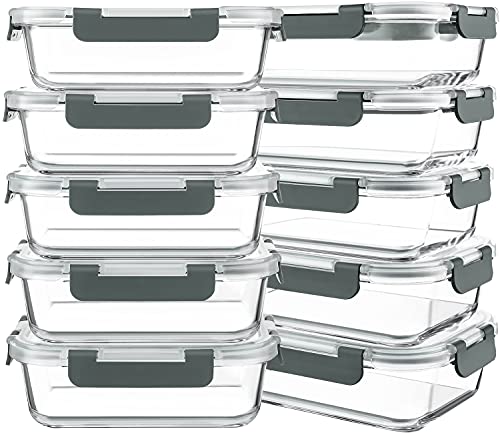
Meal Prep and Leftover Storage: KOMUEE 10-Pack 30 oz Glass Containers with Lids
KOMUEE 30 oz glass containers organize meal prep and leftovers while letting you move food from the refrigerator to the microwave or oven, then to the table. They suit meal preppers, office-lunch users, and families who want reusable containers with portion-friendly capacity and leak-resistant lids.
Pros and Cons
Pros
- Borosilicate glass supports refrigerator-to-oven, microwave, and table use.
- Ten containers and ten lids provide substantial capacity for batch meal preparation.
- Snap-lock lids with silicone seals help prevent leaks and spills.
- Glass does not absorb food stains or smells and can be cleaned in the dishwasher.
Cons
- The plastic lids should be removed before using the containers in the oven, microwave, or dishwasher.
- Every container is 30 oz, so the set does not offer multiple sizes for different portions.

Vtopmart
Meal Prep Glass Storage Containers: Vtopmart 5-Pack 22oz Set with Snap Airtight Lids
This 5-pack of 22oz borosilicate glass containers handles meal prep, leftovers, and lunches with hinged snap lids that keep soups and sauces from leaking into your bag. Buyers cooking weekly meal preps or packing office lunches will appreciate the oven, microwave, freezer, and dishwasher compatibility in one set.
Pros and Cons
Pros
- Four-way compatibility across oven, microwave, freezer, and dishwasher cuts down on the variety of storageware you need.
- The flip-open hinged lid design is faster to seal than four-corner snap lids when packing meals in a hurry.
- 22oz size hits the sweet spot for a single adult lunch portion of protein, grain, and vegetables.
- Borosilicate construction handles thermal shock better than standard soda-lime glass during freezer-to-oven transitions.
Cons
- Lids are plastic rather than glass, so the gasket and hinges will wear faster than the glass base over years of use.
- Lids must be removed before oven or microwave use, which adds a step compared to fully oven-safe lid systems.
The Best Deals This Week*
-
Meal Prep and Leftover Storage
$43.99
($47.99)Save $4.00 -
Dealusy 10 Sets 36 oz & 12 oz Glass Food Storage
$33.98
($39.99)Save $6.01 -
Liuruiyu 10 Pack Glass Food Storage Containers
$24.99
($29.99)Save $5.00
*Deals are selected by our commerce team
Meal Prep Storage Made Simple: Bentgo Prep 20-Piece 1-Compartment Reusable Containers (Mint)
Meal Prep Storage Made Simple: Bentgo Prep 20-Piece 1-Compartment Reusable Containers (Mint)
The Bentgo Prep set delivers ten 4-cup single-compartment trays with embossed measurement marks, making portioned meal prep faster and more consistent for the week ahead. It suits home cooks, gym-goers, and busy professionals who batch-cook lunches and want a microwave, freezer, and dishwasher-safe system without disposable plastics.
$12.53 at AmazonEditors' Favorite
Capacity: 2 Pounds Item Dimensions L x W x H: 8.7"L x 6"W x 2.3"H Package Quantity: 1 Item Weight: 1.3 Pounds Item Volume: 4 Cups Unit Count: 10 Count Size: 8.5 Inch x 5.7 Inch x 2.2 Inch Material Type: Food-safe materials (No PFAS, BPA, Vinyl, Lead, or PVC) Material Features: BPA Free, Dishwasher Safe, Reusable Is the item dishwasher safe?: Yes Material Type Free: BPA Free Product Care Instructions: Dishwasher Safe, Freezer Safe, Hand Wash Only, Microwave Safe Is the item microwaveable?: Yes Brand Name: Bentgo Recommended Uses For Product: Cereal, Fruit, Salad Item Form: Box Global Trade Identification Number: 00817387023450 UPC: 817387023450 Best Sellers Rank: #138 in Kitchen & Dining (See Top 100 in Kitchen & Dining) #9 in Food Container Sets ASIN: B08CVTY9FS Customer Reviews: 4.6 4.6 out of 5 stars (16,417) 4.6 out of 5 stars Other Special Features of the Product: Durable, Microwave Safe Closure Type: Snap Color: Mint Container Shape: Rectangular Brand: Bentgo Material: Food-safe materials (No PFAS, BPA, Vinyl, Lead, or PVC) Material Feature: BPA Free, Dishwasher Safe, Reusable
Shop NowKOMUEE Meal Prep and Leftover Storage: KOMUEE 10-Pack 30 oz Glass Containers with Lids
KOMUEE
Meal Prep and Leftover Storage: KOMUEE 10-Pack 30 oz Glass Containers with Lids
KOMUEE 30 oz glass containers organize meal prep and leftovers while letting you move food from the refrigerator to the microwave or oven, then to the table. They suit meal preppers, office-lunch users, and families who want reusable containers with portion-friendly capacity and leak-resistant lids.
$43.99 at AmazonGreat Value
Color: Gray Size: 30 oz (100 centiliters) Dimensions: 7.79921259047 x 5.70078739576 x 2.49999999745 inches Weight: 0.2645547144 Pounds Product Group: Kitchen Binding: Kitchen
Shop NowDealusy 10 Sets 36 oz & 12 oz Glass Food Storage Containers with lids, Gray

Color: Gray Size: 12 ounces Dimensions: 8 x 6.2 x 2.8 inches Product Group: Kitchen
Shop NowLiuruiyu 10 Pack Glass Food Storage Containers with Lids, Meal Prep Containers, Airtight Bento Boxes with Leak Proof Locking for Microwave, Oven, Freezer and Dishwasher, BPA Free

Liuruiyu
10 Pack Glass Food Storage Containers with Lids, Meal Prep Containers, Airtight Bento Boxes with Leak Proof Locking for Microwave, Oven, Freezer and Dishwasher, BPA Free
$24.99 at AmazonColor: 10 Pack-(12.5&35.8oz) Size: 12.5oz to 35.8oz Dimensions: 1 x 1 x 1 inches Product Group: Kitchen Binding: Tools & Home Improvement
Shop NowVtopmart Meal Prep Glass Storage Containers: Vtopmart 5-Pack 22oz Set with Snap Airtight Lids
Vtopmart
Meal Prep Glass Storage Containers: Vtopmart 5-Pack 22oz Set with Snap Airtight Lids
This 5-pack of 22oz borosilicate glass containers handles meal prep, leftovers, and lunches with hinged snap lids that keep soups and sauces from leaking into your bag. Buyers cooking weekly meal preps or packing office lunches will appreciate the oven, microwave, freezer, and dishwasher compatibility in one set.
$23.99 at AmazonCapacity: 1.4 Pounds Item Dimensions L x W x H: 6.65"L x 4.84"W x 2.09"H Package Quantity: 5 Item Volume: 2.75 Cups Unit Count: 5.0 Count Size: 22oz Material Type: Glass Material Features: Food Grade Is the item dishwasher safe?: Yes Product Care Instructions: Microwave Safe, Oven Safe, Freezer Safe, Dishwasher Safe Is the item microwaveable?: Yes Lid Material: Plastic Color: Grey Container Shape: Rectangular Brand Name: Vtopmart Recommended Uses For Product: Meal Prep Item Form: Box Manufacturer: Vtopmart Specific Uses For Product: Meal Prep Included Components: glass containers Best Sellers Rank: #150 in Kitchen & Dining (See Top 100 in Kitchen & Dining) #6 in Food Container Sets ASIN: B0D7P6XKNP Customer Reviews: 4.6 4.6 out of 5 stars (3,704) 4.6 out of 5 stars Other Special Features of the Product: Air Tight Closure Type: Snap Food Storage Container Airtightness: Airtight Brand: Vtopmart Material: Glass Material Feature: Food Grade
Shop Now



Write Your Review
No reviews yet. Be the first to share your experience!