

A big flat skillet is one of those purchases that feels obvious until the pan is sitting on your stove doing half the job you hoped for. The idea is sound: more surface area means more chicken thighs seared at once, a full batch of vegetables that actually browns instead of steaming, and enough room to finish a family dinner in one pass. The trouble is that a 12-to-14-inch pan behaves differently from the 10-inch skillet most people learned to cook on, and the specs that matter change along with the size.
Most disappointing large pans are not bad products. They are the wrong match for a particular kitchen, bought on surface area alone. Here are the five mistakes that come up most often, followed by a short walk-through to run before you spend the money.
The pan-to-burner mismatch that quietly ruins searing
The first mistake is the one nobody notices in the store: buying a pan wider than the heat source that has to feed it. A standard home burner spreads its flame or element across roughly six inches. Set a 14-inch pan on top of it and the heat rises through the center while the outer two or three inches of the cooking surface stay noticeably cooler. You end up with a hot ring in the middle and a cold rim, which is the exact opposite of what a large pan is supposed to give you.
You feel this the moment you try to sear. Food in the center browns fast, food near the edge sweats and turns gray, and you spend the whole time shuffling pieces inward. Induction only warms the footprint that touches the element, so the mismatch there can be sharper still. Before buying, match the pan diameter to what your strongest burner can genuinely cover. A 12-inch pan on a powerful burner is more useful than a 14-inch pan that only ever heats its middle. If your heart is set on true griddle width, a two-burner oval works, but only if your cooktop supports bridging across two elements; otherwise you are just heating one end.
Weight and balance decide whether you can actually cook in it
The second mistake is treating a large pan like a bigger version of the small one and ignoring what it weighs when full. The empty numbers on a product page hide the real problem. A 14-inch tri-ply stainless pan can weigh five or six pounds on its own, and a comparable cast-iron piece at that diameter often tops eight pounds before a single ingredient goes in. Load it with a pound of protein and a splash of stock and you are lifting something close to ten pounds off a hot burner with one arm.
This is where a helper handle earns its place. A large pan with only a single long handle acts like a lever; the far side is heavy, the near side is your wrist, and pouring or moving it to the oven becomes a genuinely awkward maneuver. A short loop handle on the opposite side lets you use two hands and keeps the pan from tipping as you carry it across the kitchen. If you have any wrist or grip trouble, weight should rank near the top of your list, and a slightly smaller stainless pan may serve you far better than a heavy cast-iron slab you dread taking off the shelf.
Why nonstick stops making sense at 14 inches
The third mistake is assuming that whatever worked in a small nonstick pan scales up without a catch. Nonstick coatings are wonderful for eggs and delicate fish, but they carry a temperature ceiling. Push most of them past about 500 degrees Fahrenheit and the coating begins to break down, and a wide pan sitting over a high flame reaches that range faster than people expect, especially around the hot center ring described earlier. The larger the pan, the more likely you are to run it hard for searing, which is precisely the job nonstick handles worst.
There is also a durability angle. A big nonstick surface takes more abuse from spatulas, stacking, and scrubbing, and every scratch shortens its life. If your main reason for going large is browning meat, crisping a full tray of vegetables, or building a fond for a pan sauce, stainless steel or carbon steel is the honest choice at this size. Carbon steel gives you a slick, seasoned surface that tolerates real heat, and it weighs less than cast iron. Keep the large nonstick for the specific low-heat jobs it was made for, like a batch of scrambled eggs for a full table, and do not ask it to sear.
Flared or straight walls change what the pan actually does
The fourth mistake is picking the wrong wall shape, usually without realizing there was a choice to make. Two profiles dominate at this size and they are built for different work. Flared, low, sloping walls open the surface up, let steam escape quickly, and make it easy to slide a turner under food or tip the contents out onto a plate. That fast evaporation is what gives you browning and a good fond, so this shape is the one you want for searing and for anything where you are chasing crisp edges rather than liquid.
Straight, taller walls do the opposite job. They hold more volume, contain splatter, and keep liquid from sloshing over the rim, which makes them right for shallow-frying in an inch of oil, simmering a large sauce, or braising something that needs a little depth. Buyers who want to sear often end up with tall straight walls that trap steam and leave meat pale, while buyers who wanted to shallow-fry pick flared walls and watch the oil creep toward the edge. Decide which task you will do most and let the wall shape follow, because a large pan is too big and too heavy to be the one you fight against every night.
The oven, the drawer, and the lid you cannot find
The last mistake is forgetting the pan has to live somewhere and sometimes go into the oven. A 14-inch pan with its handle can run past 20 inches end to end, and many standard 30-inch ranges have interior widths that make that a tight or impossible fit, especially with the pan turned to angle it in. Measure your oven’s interior before you buy if you plan to finish roasts or frittatas in one, and check whether the handle material stays oven-safe at the temperatures you use.
Storage is the quieter version of the same problem. A pan this size rarely fits a normal pot drawer, so it often ends up on a hanging rack, in the oven itself, or leaning in a cabinet where it scratches its neighbors. Lids are the other overlooked detail: makers offer far fewer lids at 14 inches than at 10 or 12, and a large pan without a matching lid loses its ability to steam, braise, or hold heat covered. If a lid matters to you, confirm one exists in that exact diameter before committing, rather than assuming you can track down a universal one later.
A quick pre-buy walk-through
Run through this in your head before you check out. Start with your burner: what is the widest circle of real heat it produces, and does the pan you are eyeing stay inside that circle. Then pick it up, or find its full weight, and be honest about lifting that loaded with one hand or two. Match the material to your main job, stainless or carbon steel if you sear and brown, nonstick only if you cook gently in volume. Choose flared walls for browning and evaporation or straight walls for frying and sauces, based on what you cook most nights. Finally, measure your oven and your storage space, and confirm a lid exists if you need one. A large flat pan that clears those five tests is a pan you will reach for constantly; one that fails even a couple tends to sit in the cabinet after the novelty fades.
Questions buyers ask
What size large flat pan is best for a standard home stove?
For most home cooktops, a 12-inch pan hits the sweet spot between capacity and even heating. It gives you clearly more room than a 10-inch skillet while still sitting mostly within the reach of a strong burner, so the surface heats consistently rather than leaving a cold rim. Step up to 14 inches only if you have a high-output burner, a bridging two-burner cooktop, or you routinely cook for a crowd and accept that the edges will run cooler. If you are unsure, the safer buy is the 12-inch, since a pan you can heat fully beats a bigger one you cannot. Confirm it fits your oven and storage before you size up.
Should a large flat pan be stainless steel, cast iron, or nonstick?
It depends on what you cook, but for a large pan the answer leans toward stainless or carbon steel more than it would for a small one. Those materials handle the high heat that searing and browning need, and they hold up to metal tools and heavy use across a wide surface. Cast iron sears beautifully but becomes genuinely heavy past 12 inches, often over eight pounds empty, which makes a 14-inch version hard to maneuver when loaded. Nonstick is the weakest choice at this scale because a wide pan run hot can pass the roughly 500-degree point where the coating degrades. Pick nonstick only if your large-pan job is gentle and high-volume, like eggs for a full table.
Why does food cook unevenly in my large flat pan?
Uneven cooking in a big pan almost always traces back to the burner underneath it. A six-inch heat source cannot warm a 14-inch surface evenly, so the center runs hot while the outer inches stay cool, and food near the edge steams instead of browning. A thicker, fully clad base helps by spreading heat outward, and preheating the pan longer than you would a small one lets the temperature even out before food goes in. You can also rotate pieces from the edge to the center partway through, or simply cook in the middle zone and treat the rim as a holding area. If it happens constantly, the pan is probably wider than your burner can support, and a smaller diameter will cook more evenly.

SENSARTE
12-Inch Nonstick Crepe Pan for Easy Pancakes, Tortillas, Dosas and More
The SENSARTE 12-inch crepe pan cooks crepes, pancakes, tortillas and similar foods with little oil, while its Swiss ILAG granite coating helps prevent sticking. It suits home cooks who want an induction-compatible, lightweight pan with a wooden spreader for easier batter distribution.
Pros and Cons
Pros
- Its lightweight 2.5-pound design makes flipping crepes and moving the pan around the kitchen easier.
- The half-inch side helps contain batter while keeping crepe flipping manageable.
- The stay-cool Bakelite handle improves handling during stovetop cooking.
- The pan supports a broad range of foods, including crepes, pancakes, hoe cakes, tortillas and onigiri.
Cons
- The oven-safe temperature is limited to 302°F, restricting high-temperature oven use.
- The shallow half-inch side may offer less containment for thicker batters or foods with more liquid.

UmiteChef
Commercial Half Sheet Baking Pans for Cookies and Roasting - UmiteChef 18x13 Aluminum Set (2-Pack)
These 18-gauge aluminum sheet pans heat 30% faster than steel and resist warping up to 500°F, delivering evenly browned cookies and roasted vegetables without burnt bottoms. Home bakers who want restaurant-quality results and easy cleanup should choose these over thinner pans that warp after a few uses.
Pros and Cons
Pros
- Heats quickly and evenly across the entire surface, eliminating hot spots that burn cookie edges while leaving centers undercooked.
- Heavy 18-gauge thickness stays rigid under the weight of a full chicken or vegetables without bending or buckling.
- Reinforced rolled edges provide safe grip points and add structural strength that prevents rim warping over time.
Cons
- Bare aluminum reacts with acidic foods like tomatoes and vinegar, causing harmless discoloration that some users find unsightly.
- Dishwasher use causes oxidation that darkens the finish, requiring hand-washing to maintain the original silver appearance.
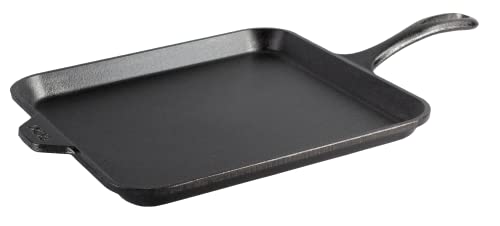
Lodge
11-Inch Square Cast Iron Griddle for Pancakes, Eggs & Bacon - Lodge Seasoned Cast Iron Cookware
This 11-inch square Lodge griddle gives you a flat, edge-to-edge cast iron cooking surface that holds steady heat for pancakes, eggs, bacon, and tortillas without hot spots. Buy it if you cook breakfast for a household and want one pan that moves from stovetop to oven to campfire and lasts for decades.
Pros and Cons
Pros
- Heavy cast iron holds and radiates heat evenly, giving pancakes and bacon consistent browning across the whole surface.
- Square shape uses more of the burner and cooktop footprint than a comparable round griddle.
- Oven, grill, and campfire safe, so it handles cornbread and camp breakfasts as well as weekday eggs.
- Repairable finish means a stripped or rusted surface can be re-seasoned at home rather than replaced.
Cons
- Cast iron is heavy, and the short handle means you will want two hands and a mitt to move it when hot.
- It needs hand washing and drying right away, and the factory seasoning takes several cooks before it releases eggs reliably.
SENSARTE
Easy Crepes and Pancakes: SENSARTE 10-Inch Nonstick Granite Crepe Pan
The SENSARTE 10-inch crepe pan cooks crepes, pancakes, tortillas, and similar foods with little oil, while its shallow rim simplifies flipping. It suits home cooks who need lightweight all-stovetop cookware, including induction, with quick, even heating.
Pros and Cons
Pros
- Its 2-pound design makes flipping crepes and moving the pan around the kitchen easier.
- The heat-resistant Bakelite handle stays cooler during stovetop cooking.
- The nonstick coating is free of intentionally added PFOA.
- The pan works across all major cooktop types, including induction.
Cons
- The 302°F oven-safe limit restricts high-temperature oven finishing.
- The shallow sides favor crepes and pancakes but are less suitable for foods requiring deep walls.

Vayepro
17-Inch Double-Burner Ceramic Griddle for Pancakes, Eggs, Bacon and Indoor or Outdoor Cooking
The Vayepro 17-inch griddle spans two burners to cook larger batches, while its reinforced aluminum base helps resist warping under high heat. It suits families, campers and home cooks who want lightweight cookware with ceramic nonstick release on gas or electric stoves.
Pros and Cons
Pros
- The double-burner size provides useful space for family breakfasts and multi-item meals.
- The PTFE- and PFOA-free ceramic coating supports easier food release with less oil.
- The reinforced aluminum construction combines low weight with added resistance to heat-related warping.
- Dishwasher compatibility makes post-meal cleanup more convenient.
Cons
- It is not compatible with induction cooktops.
- A two-burner griddle may be too large for compact stovetops or limited storage space.
The Best Deals This Week*
-
SENSARTE 12-Inch Nonstick Crepe Pan for Easy
$29.99
($37.99)Save $8.00 -
Commercial Half Sheet Baking Pans for Cookies
$19.99
($24.99)Save $5.00 -
Easy Crepes and Pancakes
$25.98
($33.99)Save $8.01 -
Vayepro 17-Inch Double-Burner Ceramic Griddle
$31.96
($45.99)Save $14.03
*Deals are selected by our commerce team
SENSARTE 12-Inch Nonstick Crepe Pan for Easy Pancakes, Tortillas, Dosas and More
SENSARTE
12-Inch Nonstick Crepe Pan for Easy Pancakes, Tortillas, Dosas and More
The SENSARTE 12-inch crepe pan cooks crepes, pancakes, tortillas and similar foods with little oil, while its Swiss ILAG granite coating helps prevent sticking. It suits home cooks who want an induction-compatible, lightweight pan with a wooden spreader for easier batter distribution.
$29.99 at AmazonEditors' Favorite
Color: Gray Size: 12 Inch Dimensions: 8 x 12 x 0.5 inches Product Group: Kitchen Binding: Kitchen
Shop NowUmiteChef Commercial Half Sheet Baking Pans for Cookies and Roasting - UmiteChef 18x13 Aluminum Set (2-Pack)
UmiteChef
Commercial Half Sheet Baking Pans for Cookies and Roasting - UmiteChef 18x13 Aluminum Set (2-Pack)
These 18-gauge aluminum sheet pans heat 30% faster than steel and resist warping up to 500°F, delivering evenly browned cookies and roasted vegetables without burnt bottoms. Home bakers who want restaurant-quality results and easy cleanup should choose these over thinner pans that warp after a few uses.
$19.99 at AmazonGreat Value
Brand Name: Umite Chef Model Number: Umite Chef01 Unit Count: 1.0 Count Best Sellers Rank: #905 in Kitchen & Dining (See Top 100 in Kitchen & Dining) #5 in Baking & Cookie Sheets ASIN: B0CMQFKM1F Customer Reviews: 4.6 4.6 out of 5 stars (2,937) 4.6 out of 5 stars Color: Natural Material Type: Aluminum Is the item dishwasher safe?: No Material Type Free: BPA Free, Chemical Free, PTFE Free Size: 18x13in Item Dimensions L x W x H: 1"L x 1"W x 1"H Item Weight: 1 Pounds Material: Aluminum Brand: Umite Chef Product Dimensions: 1"L x 1"W x 1"H Is Dishwasher Safe: No Number of Items: 2
Shop NowLodge 11-Inch Square Cast Iron Griddle for Pancakes, Eggs & Bacon - Lodge Seasoned Cast Iron Cookware
Lodge
11-Inch Square Cast Iron Griddle for Pancakes, Eggs & Bacon - Lodge Seasoned Cast Iron Cookware
This 11-inch square Lodge griddle gives you a flat, edge-to-edge cast iron cooking surface that holds steady heat for pancakes, eggs, bacon, and tortillas without hot spots. Buy it if you cook breakfast for a household and want one pan that moves from stovetop to oven to campfire and lasts for decades.
$24.97 at AmazonColor: Black Size: 17.3" x 11" x 1.8" Dimensions: 17.25 x 11 x 1.81 Inches Weight: 5.9 Pounds Product Group: Kitchen Binding: Kitchen
Shop NowSENSARTE Easy Crepes and Pancakes: SENSARTE 10-Inch Nonstick Granite Crepe Pan
SENSARTE
Easy Crepes and Pancakes: SENSARTE 10-Inch Nonstick Granite Crepe Pan
The SENSARTE 10-inch crepe pan cooks crepes, pancakes, tortillas, and similar foods with little oil, while its shallow rim simplifies flipping. It suits home cooks who need lightweight all-stovetop cookware, including induction, with quick, even heating.
$25.98 at AmazonColor: Gray Size: 10 Inch Dimensions: 8 x 10 x 0.5 inches Weight: 1.8959754532 Pounds Product Group: Kitchen Binding: Kitchen
Shop NowVayepro 17-Inch Double-Burner Ceramic Griddle for Pancakes, Eggs, Bacon and Indoor or Outdoor Cooking
Vayepro
17-Inch Double-Burner Ceramic Griddle for Pancakes, Eggs, Bacon and Indoor or Outdoor Cooking
The Vayepro 17-inch griddle spans two burners to cook larger batches, while its reinforced aluminum base helps resist warping under high heat. It suits families, campers and home cooks who want lightweight cookware with ceramic nonstick release on gas or electric stoves.
$31.96 at AmazonColor: Black Size: 17 Inch Dimensions: 16.9 x 10.24 x 1 inches Weight: 2.93 pounds Product Group: Kitchen Binding: Kitchen
Shop Now




Write Your Review
No reviews yet. Be the first to share your experience!