

A kitchen can opener is one of the few tools in a drawer that does something genuinely mechanical, and it varies more than most people expect. Two of them can produce completely different results on the same can of tomatoes, and the difference has nothing to do with price. It comes down to where the cut happens.
Once you understand the mechanism, the choice more or less makes itself. What matters is the cutting wheel, the toothed gear that pulls the can along, the gearing that decides how hard you work, and whether the cutting head can be rinsed clean. Everything else on the packaging is decoration. This walks through each part in turn.
Two Different Cuts, Two Different Results
Two fundamentally different ways to open a can exist, and the difference explains most of what people like or dislike about the opener they own. A traditional opener drives a wheel down through the top of the lid, just inside the rim, then rolls it around. That is fast and the tool is small, but it leaves a sharp burr on two surfaces at once: the outer edge of the removed lid and the inner lip of the can you are now reaching into. It also pushes the lid down into the contents.
A side-cut opener, sometimes sold as a safety opener, clamps onto the rim and severs the seam on the side wall instead. The lid comes away whole and the edge left behind is folded seam metal rather than a fresh cut, so nothing sharp is exposed and the lid can sit back on the can to cover leftovers. The trade is that a side cut is slower and the tool is bulkier. Ring-pull cans, common now, reduce how often you need a tool but not the need for one, and a torn ring pull carries the same burr.
The Cutting Wheel Is Not a Blade
People sharpen their can openers, and it never helps. The cutting wheel is not a knife and it does not slice. It works by localised plastic deformation: the wheel presses into thin tinplate hard enough along a narrow line that the metal fails and fractures. The steel is pushed apart rather than cut apart. That is why a wheel with a visibly rounded profile still opens cans perfectly well, and why running a stone along one removes the hardened surface you actually want to keep.
Wheels are usually hardened carbon steel or stainless, roughly three quarters of an inch across on a hand tool. Hardened carbon holds its shape well but spots with rust if left wet; stainless resists corrosion and suits anything living in a damp drawer. The real failure mode is not dullness. It is a groove worn into the circumference where the wheel has run against thousands of rims, and once that groove is deep enough the wheel rides in it and skips instead of tracking forward. A skipping wheel is a worn wheel, and sharpening will not bring it back.
The Feed Gear Does the Real Work
The cutting wheel gets the attention and the feed gear does the labour. This is the toothed drive wheel that bites the underside of the rim and pulls the can past the cutter as you turn the key. Without it the wheel sits in one spot. Tooth profile and hardness decide whether an opener works confidently or slips, and slipping is the complaint behind most openers thrown away. A thick double seam on a large fruit can, or a rim with a small dent from transport, is enough to defeat a soft or shallow-toothed gear.
On inexpensive openers the feed gear goes first. The teeth round over, they stop biting, and the tool spins freely while the can sits still. There is no repair and nothing to tighten. Look for deep, distinct teeth in hardened steel rather than shallow serrations in soft plated metal, and check the pivot holding the two jaws feels tight, since play there lets gear and wheel drift out of alignment under load. Plastic gear housings crack under the force a stubborn can demands.
Gearing, Handles and Hands That Hurt
How hard an opener is to use is set by simple mechanics. A longer turning key and a lower gear ratio mean more revolutions to get around the can but less force per turn. A short key and a higher ratio finish faster and demand more from your fingers. Neither is better in the abstract; it depends on the hands doing the turning. With grip strength to spare, fewer turns is convenient. Without it, the extra turns are a bargain.
Butterfly keys, the small flat wings on classic openers, are compact, but they load the whole job onto a pinch grip between thumb and forefinger. That is the weakest grip most people have and the first affected by arthritis. Large oversized knobs, an inch and a half to two inches across, let you wrap a whole hand around the key and turn from the wrist, and the difference is not subtle. For painful hands the specifications worth reading are a large knob, long lever handles that multiply your squeeze on the jaws, and soft grips at least an inch in diameter.
The Specification Nobody Prints
Every cut drags the wheel and the feed gear straight through whatever is inside the can. Tomato, tuna oil, condensed soup. Both parts then sit in a housing full of recesses, beside a pivot, until the next time. If the cutting head cannot be held under a running tap and scrubbed, residue stays there between uses. This is not fussiness; it is the least visible and most legitimate hygiene problem in the drawer, and it is worse on an opener used twice a week than one used daily.
Some designs solve it. Openers whose cutting head detaches from the handles let you clean the wheel and gear directly, and fully dishwasher-safe models with solid one-piece handles come out clean without effort. Riveted assemblies with hollow tubular handles do not, because water gets in and does not get out. Corrosion starts in the same places: chrome-plated steel chips at the welds and rusts outward from the joint, fast in a drawer near a sink. Solid stainless bodies with stainless heads cost more and are what survives. Rinse and dry after use either way.
Electric Openers and What They Cost You
An electric opener removes the effort completely, and for someone with real dexterity limits that is a meaningful gain rather than a luxury. Press down and the motor does everything, including holding the lid on a magnet so it never drops into the food. The costs come with the motor: a housing that cannot go near water, a permanent footprint of five or six inches on the counter, and a cord. Most cut from the top, so the burr on lid and can remains.
They are also less tolerant than a hand tool. Very large catering cans, tall or irregular shapes, and cans with a shallow or damaged rim defeat the clamping mechanism, and no electric model does anything useful with a pop-top can. Hardest of all, the cutting assembly is the most difficult part of any opener to clean, tucked under a plastic head that usually does not come apart. Where that head detaches and goes in the dishwasher, the model is worth paying more for.
Matching the tool to the person is straightforward from here. Choose a side cut if sharp lids bother you or you want the lid back on the can. Choose a good top cut for speed and for a crowded drawer. Choose a large-knob geared model if hand strength is limited, and an electric if dexterity limits are genuine. In every case prefer a detachable or dishwasher-safe cutting head, because that decides whether the tool stays clean.
Does a safety can opener really leave no sharp edge?
Essentially yes, and the reason is geometric rather than a claim about quality. A side-cut opener separates the seam on the side wall, so the metal left exposed is folded double-thickness seam rather than a fresh fracture line. Both the lid and the can rim come away smooth enough to handle without care. You should still treat any opened can with respect, because a badly seated cut or a dented rim can produce an irregular edge. The added benefit is that the lid stays whole and can sit back on the can.
Why has my can opener stopped gripping the can?
Almost always the feed gear rather than the cutting wheel. That toothed drive wheel bites the underside of the rim to pull the can around, and once the teeth have rounded over they skate across the metal instead of catching it. Check them under a light: if the points look flattened or polished, the tool is finished. The other possibility is a worn groove in the cutting wheel, which lets it ride in its own track and skip forward. A loose pivot gives similar symptoms by letting wheel and gear fall out of alignment.
Can I sharpen the cutting wheel on a can opener?
There is nothing to sharpen. The wheel opens a can by pressing hard enough on a narrow line that thin tinplate fractures, which is deformation rather than slicing, so the rounded profile you see is doing what it is meant to do. Taking a stone or file to it removes the hardened surface and shortens its life. If the opener has stopped working, look instead for a worn groove around the wheel edge or rounded teeth on the feed gear. A wash of the head and a drop of food-safe oil at the pivot fixes more openers than sharpening.
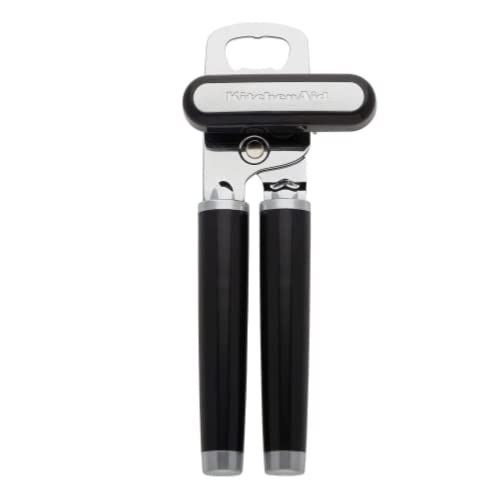
KitchenAid
Open Cans and Bottles Easily with the KitchenAid Classic Multifunction Can Opener
The KitchenAid Classic Multifunction Can Opener opens cans smoothly with a razor-sharp stainless steel wheel and includes a built-in bottle opener. It suits everyday kitchens and users with limited hand strength because its oversized knob and soft ergonomic handles improve grip and control.
Pros and Cons
Pros
- The stainless steel cutting wheel is designed for easy piercing and smooth slicing.
- The oversized knob and soft handles make manual operation more comfortable.
- The integrated bottle opener adds useful functionality without adding another tool.
- The black KitchenAid design provides a straightforward, dedicated kitchen tool for regular use.
Cons
- The manual design still requires users to turn the knob by hand.
- The product data does not specify its size, weight, or dishwasher-safety details.

Zulay Kitchen
Open Cans with Less Strain: Zulay Kitchen Heavy Duty Stainless Steel Manual Can Opener
This manual can opener opens cans with less hand strain, with soft, slip-resistant handles providing its biggest advantage: better control. It suits home cooks who want a durable stainless steel opener with a built-in bottle opener.
Pros and Cons
Pros
- Stainless steel blades are tested through rigorous quality controls for dependable can opening.
- Soft, slip-resistant handles reduce strain while improving grip.
- The top doubles as a convenient bottle opener.
- The manual design works without batteries or electrical power.
Cons
- Hand washing is recommended for long-lasting performance, so it is less convenient than a dishwasher-safe tool.
- The product listing does not specify its size or weight, making storage fit and heft difficult to assess.

Cuisinart
Hands-Free Can Opening: Cuisinart Electric Can Opener with One-Touch Operation
The Cuisinart Electric Can Opener opens cans with one-touch, hands-free operation, reducing manual effort during meal preparation. Seniors and anyone who wants an easy kitchen can opener should consider it because the automatic function helps reduce strain.
Pros and Cons
Pros
- One-touch operation simplifies can opening.
- The nonslip base adds stability during use.
- Automatic operation helps reduce strain for seniors and users with limited hand strength.
- Cuisinart provides an established kitchen-appliance brand name.
Cons
- The product data does not specify its materials, dimensions, or weight.
- The automatic design may take more counter space than a manual can opener.
The Best Deals This Week*
-
Open Cans with Less Strain
$12.99
($14.99)Save $2.00 -
Hands-Free Can Opening: Cuisinart Electric Can
$19.95
($29.95)Save $10.00 -
Heavy-Duty Commercial Manual Crank Can
$19.99
($22.99)Save $3.00
*Deals are selected by our commerce team
KitchenAid Open Cans and Bottles Easily with the KitchenAid Classic Multifunction Can Opener
KitchenAid
Open Cans and Bottles Easily with the KitchenAid Classic Multifunction Can Opener
The KitchenAid Classic Multifunction Can Opener opens cans smoothly with a razor-sharp stainless steel wheel and includes a built-in bottle opener. It suits everyday kitchens and users with limited hand strength because its oversized knob and soft ergonomic handles improve grip and control.
$14.99 at AmazonEditors' Favorite
Color: Black Size: 8.34-Inch Dimensions: 8.34 x 3.54 x 2.3 inches Weight: 0.28 pounds Product Group: Kitchen Binding: Kitchen
Shop NowZulay Kitchen Open Cans with Less Strain: Zulay Kitchen Heavy Duty Stainless Steel Manual Can Opener
Zulay Kitchen
Open Cans with Less Strain: Zulay Kitchen Heavy Duty Stainless Steel Manual Can Opener
This manual can opener opens cans with less hand strain, with soft, slip-resistant handles providing its biggest advantage: better control. It suits home cooks who want a durable stainless steel opener with a built-in bottle opener.
$12.99 at AmazonGreat Value
Color: Black Size: Comfy Grip Product Group: Kitchen
Shop NowKitchenAid Classic Multifunction Can Opener and Bottle Opener Easy to Use, Razor Sharp Stainless Steel Cutting Wheel, Soft Ergonomic Handles, Empire Red

KitchenAid
Classic Multifunction Can Opener and Bottle Opener Easy to Use, Razor Sharp Stainless Steel Cutting Wheel, Soft Ergonomic Handles, Empire Red
$14.99 at AmazonColor: Empire Red Size: 8.34-Inch Dimensions: 8.34 x 3.54 x 2.3 inches Weight: 0.75 pounds Product Group: Kitchen Binding: Kitchen
Shop NowCuisinart Hands-Free Can Opening: Cuisinart Electric Can Opener with One-Touch Operation
Cuisinart
Hands-Free Can Opening: Cuisinart Electric Can Opener with One-Touch Operation
The Cuisinart Electric Can Opener opens cans with one-touch, hands-free operation, reducing manual effort during meal preparation. Seniors and anyone who wants an easy kitchen can opener should consider it because the automatic function helps reduce strain.
$19.95 at AmazonColor: Black Size: Black Dimensions: 4.47 x 4.62 x 9.35 inches Weight: 0.000625 Pounds Product Group: Kitchen Binding: Kitchen
Shop NowNUFR Heavy-Duty Commercial Manual Crank Can Openers,Rubber-Coated Long Handles

Color: Black Size: Large Dimensions: 2.28 x 2.28 x 8.85 Inches Weight: 0.87 pounds Product Group: Kitchen Binding: Kitchen
Shop Now








Write Your Review
No reviews yet. Be the first to share your experience!