

A juicer slow press is a slow-speed squeezing juicer, often called a masticating or cold press juicer, that crushes produce with a rotating auger instead of shredding it with a fast spinning blade. The slower motion usually means drier pulp, quieter operation and juice that holds its color longer in the fridge.
This guide explains how slow pressing works, how it differs from centrifugal juicing, what to look for, and how to care for whatever you pick. The products below are real listings from our database, and we’ll be upfront about which ones are slow-press alternatives and which aren’t.
How a slow press juicer actually works
Inside a slow press juicer, a screw-shaped auger turns at a low speed, commonly well under 100 revolutions per minute. Produce gets pushed against a mesh screen, crushed and squeezed. Juice runs out one side and dry pulp leaves the other.
That’s the whole idea. Less heat from friction, less air whipped into the juice, and more liquid pulled from each carrot or handful of kale. Because the motion is gentle, slow juicers also handle leafy greens and wheatgrass better than fast machines do. If greens are your main goal, our guide to the best juicer for leafy greens covers what matters there.
The simplest slow-press tool is your own hand. A wooden reamer squeezes citrus halves with no motor at all. It isn’t an auger machine, but it follows the same principle of low speed and steady pressure. The Sieral set of 2 beech wood citrus reamers is a manual option for lemons, limes and oranges, and it’s a sensible pick if citrus is all you juice. Its handheld design is easy to hold, and the listing mentions home, bar and cafe use.

Sieral
Hand Juicing Lemons and Limes Without a Gadget: Sieral 2-Pack Beech Wood Citrus Reamer
This two-pack of beech wood reamers extracts juice from lemons, limes, oranges, and grapefruit by inserting the cone into a halved fruit and twisting, and because the wood is inert it adds no metallic or plastic taste to the juice. It suits home cooks, bartenders, and cafe staff who juice a few fruits at a time and want a tool that rinses clean and stores in a drawer.
Pros and Cons
Pros
- Handles the full citrus range from small limes to grapefruit with the same cone.
- Sanded smooth with clean edges and no burrs, so it does not catch on pith or skin.
- Untreated beech takes wood burning well, making it a workable base for personalized kitchen gifts.
- No electricity, batteries, or assembly required, so it is ready the moment you halve a fruit.
Cons
- Wood cannot go in the dishwasher and needs to be dried after each rinse, or it will stain and eventually crack.
- There is no built in bowl or seed strainer, so you need a separate dish and will have to fish out pips.
Sieral Hand Juicing Lemons and Limes Without a Gadget: Sieral 2-Pack Beech Wood Citrus Reamer
Sieral
Hand Juicing Lemons and Limes Without a Gadget: Sieral 2-Pack Beech Wood Citrus Reamer
This two-pack of beech wood reamers extracts juice from lemons, limes, oranges, and grapefruit by inserting the cone into a halved fruit and twisting, and because the wood is inert it adds no metallic or plastic taste to the juice. It suits home cooks, bartenders, and cafe staff who juice a few fruits at a time and want a tool that rinses clean and stores in a drawer.
$8.99 at AmazonEditors' Favorite
Color: Wood Color Dimensions: 0 x 0 x 0 inches Product Group: Kitchen Binding: Kitchen
Shop NowSlow press versus centrifugal juicers
The other common type is the centrifugal juicer. It grinds produce against a fast spinning basket and flings juice out through a strainer. It’s quick and usually cheaper. It’s also louder and tends to leave wetter pulp.
Speed and prep time
Centrifugal models win here. A wide feed chute lets you drop in whole apples or large chunks of produce without much cutting. Slow press machines typically have narrower chutes, so you’ll chop more and feed more slowly. Plan on a few extra minutes of prep before each batch.
Yield, noise and texture
Slow press juicers generally extract more from leafy greens and soft fruit, and they run quieter. Centrifugal juicers suit firm produce like apples and carrots, and the juice often has a bit more foam. Neither type is right for everybody. It comes down to what you juice and how much patience you have in the morning.
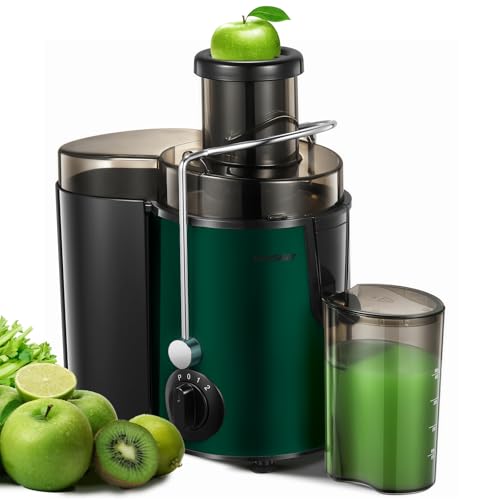
To be clear, the next product is a centrifugal juicer, not a slow press. The HOUSNAT Centrifugal Juicer has a 65MM wide chute for whole fruit and vegetables, which is exactly the convenience that slow presses trade away. It’s listed at $42.99 with a 4.4 rating in our database. Treat it as an alternative if speed matters more than squeezing out every last drop.
HOUSNAT
Whole Fruit and Vegetable Juicing Without Pre-Cutting: HOUSNAT Centrifugal Juicer with 65mm Wide Chute and 304 Stainless Steel Filter
The HOUSNAT centrifugal juicer feeds whole apples, carrots, and cucumbers through a 65mm chute, so the chopping step that slows most morning juicing disappears. It fits households that want fresh juice on a weekday schedule and want food grade 304 stainless steel touching acidic produce every day.
Pros and Cons
Pros
- The wide feed chute removes the pre-cut step for apples, pears, and cucumbers, which is the biggest time cost in daily juicing.
- Food grade 304 stainless steel holds up to acidic juice better than coated or lower grade metal parts.
- HOUSNAT states up to 45 percent more vitamin and mineral extraction, aimed at buyers juicing for nutrition rather than volume alone.
- A sharp blade paired with a precision filter targets lower pulp carryover without a separate straining step.
Cons
- Centrifugal spinning whips air and mild heat into the juice, so it separates faster and should be drunk the same day rather than stored like cold press juice.
- The listing does not publish motor wattage, pulp bin capacity, or noise level, leaving performance on hard beets and ginger unverified before purchase.
HOUSNAT Whole Fruit and Vegetable Juicing Without Pre-Cutting: HOUSNAT Centrifugal Juicer with 65mm Wide Chute and 304 Stainless Steel Filter
HOUSNAT
Whole Fruit and Vegetable Juicing Without Pre-Cutting: HOUSNAT Centrifugal Juicer with 65mm Wide Chute and 304 Stainless Steel Filter
The HOUSNAT centrifugal juicer feeds whole apples, carrots, and cucumbers through a 65mm chute, so the chopping step that slows most morning juicing disappears. It fits households that want fresh juice on a weekday schedule and want food grade 304 stainless steel touching acidic produce every day.
$42.99 at AmazonEditors' Favorite
Color: Dark green Size: 12.2*7.48* 11.81in Dimensions: 7.4 x 14.5 x 12.9 Inches Weight: 5.84 pounds Product Group: Kitchen
Shop NowWhat to look for before you buy
Whether you land on a slow press or a faster machine, a few features decide how often the juicer actually gets used. Easy cleanup wins. Quiet helps too.
Feed chute size
A wide chute saves prep time. Narrow chutes are common on slow press models, so check the opening before you buy if you hate chopping. A 65MM opening like the HOUSNAT’s is wide enough for many whole fruits, while most slow press chutes are noticeably smaller.
Cleaning effort
Count the parts. Fewer pieces and a cleaning brush in the box mean you’ll rinse the juicer right after use. If cleanup takes longer than juicing, the machine ends up in a cabinet. Rinse mesh screens under running water before the pulp dries on them.
Power and speed
Wattage tells you little about slow press performance, since the motor is built for torque rather than speed. For centrifugal models, wattage matters more. The QCen Juicer Machine lists 800W with a wide mouth feed chute, which points to a fast, high-power design.
Again, that QCen unit is centrifugal, not a slow press. It’s priced at $42.49 with a 4.4 rating. We’re including it because many shoppers searching for slow press juicers end up comparing against budget centrifugal models like this one.

QCen
Fast Whole-Fruit Juicing at Home: QCen 800W Centrifugal Juicer with 3-Inch Wide Mouth Feed Chute
This 800W centrifugal juicer extracts juice from whole apples, carrots, and celery through a 3-inch feed chute, so most produce goes in without chopping. It suits busy households that want a morning glass of fresh juice in minutes rather than the slower grind of a cold press setup.
Pros and Cons
Pros
- Handles hard produce like carrots, apples, and celery at high speed without pre-cutting into small sticks.
- Dual speed control matches the setting to soft berries or fibrous roots instead of forcing one speed on everything.
- The filter basket lifts out by the edge and the housing separates for fast cleanup between batches.
- Built-in safety lock and thermal cutoff reduce the risk of misuse and motor burnout.
Cons
- Continuous runs are capped at five minutes, and a triggered overheat cutoff needs a 15-minute cooldown before restarting.
- Low-water-content produce is off the menu, so leafy greens and wheatgrass are better handled by a masticating juicer.
QCen Fast Whole-Fruit Juicing at Home: QCen 800W Centrifugal Juicer with 3-Inch Wide Mouth Feed Chute
QCen
Fast Whole-Fruit Juicing at Home: QCen 800W Centrifugal Juicer with 3-Inch Wide Mouth Feed Chute
This 800W centrifugal juicer extracts juice from whole apples, carrots, and celery through a 3-inch feed chute, so most produce goes in without chopping. It suits busy households that want a morning glass of fresh juice in minutes rather than the slower grind of a cold press setup.
$42.49 at AmazonEditors' Favorite
Color: Green Size: 800W Dimensions: 13.7 x 12.01 x 7.76 inches Product Group: Kitchen
Shop NowCommon mistakes with slow juicing
Most problems come from rushing. Feeding produce too quickly can jam an auger. Skipping the cutting step on fibrous items like celery leads to strings wrapping around the screw. And don’t forget to alternate soft and hard produce, because soft fruit helps push harder ingredients through more evenly.
Another mistake is expecting a slow juicer to behave like a blender. It separates the fiber instead of keeping it. If you want smoothies as well, our look at the best blender and juicer options is a better place to start.
Then there’s storage. Fresh juice from a slow press often lasts longer than centrifugal juice, but it still belongs in a sealed glass container in the fridge. Drink it within a day or two for the best flavor. Don’t leave it on the counter.
Choosing a juicer for your budget and goals
If you’re juicing for a specific goal, match the machine to the job. People planning a juice cleanse often want a quiet, high-yield machine they can run daily, and our best juicer for juice cleanse page walks through that. If health is the main driver, see the best juicer for health roundup.
On a tighter budget? The best budget juicer and best juicer for under $100 list pages show what’s realistic at each price. If you only squeeze citrus, the best juicer for lemons guide may save you from buying an expensive machine you don’t need.
It’s a judgment call. A manual reamer set costs $8.99 at the listed price, a centrifugal unit sits around $42 to $43, and true slow press machines usually cost more than both. Set your budget first, then decide how much counter space and cleanup time you can spare.
When to move up to a true slow press
If you juice greens most days, drink juice in volume, or hate the foam and noise of fast machines, a real slow press is worth saving for. If you juice a couple of times a month, a simpler tool will do the job and won’t take up counter space.
Think about your routine honestly. Will you really chop produce at 7 a.m.? Will you wash six parts afterward? A cheaper machine you use three times a week beats a premium one that collects dust. Our best juicer for juicing page page is a good next stop when you’re ready to compare full-size models.
One more habit worth building: wash the auger and screen right after every batch, and let all parts air dry before you reassemble. Dried pulp is hard to scrub off, and trapped moisture can leave a stale smell. A narrow brush reaches the mesh holes much better than a sponge. Check the seals and rubber parts every few months for wear, and replace anything that looks cracked or stretched so juice doesn’t leak.
FAQ
What is a slow press juicer?
A slow press juicer, also called a masticating or cold press juicer, uses a slowly turning auger to crush and squeeze produce. It runs at a lower speed than centrifugal juicers, which generally means quieter operation and drier pulp.
Is a slow press juicer better than a centrifugal juicer?
It depends on what you juice. Slow press machines tend to do better with leafy greens and soft produce, while centrifugal models are faster and handle whole firm fruit more easily. Pick based on your habits, not hype.
Are wooden citrus reamers a kind of slow press?
Not in the machine sense. A reamer is a manual tool that squeezes citrus by hand, so you control the pressure and speed. It’s a practical option when you only juice lemons, limes or oranges.
Does juice from a slow press last longer?
Often it does, because less air is mixed in during juicing. Still, store it in a sealed container in the fridge and drink it within a day or two. Fresh juice has no preservatives.
How much does a juicer cost?
It varies widely. In our database, a two-piece wooden reamer set is listed at $8.99 and the two centrifugal models at about $42 to $43. Dedicated slow press machines generally cost more than those.







Write Your Review
No reviews yet. Be the first to share your experience!