

A juicer machine masticating style squeezes produce slowly with a single rotating auger, instead of shredding it with a fast spinning blade. That slow crush is why people choose it for leafy greens, carrots and apples. It’s also why these machines cost more and run slower than the basic kind.
This guide explains how a masticating juicer works, who it suits, what to watch for when you buy one, and where a simple citrus juicer is the smarter pick. We’ve researched the product listings rather than claiming kitchen time with them, so every spec below comes from the listing titles.
How a masticating juicer works
Inside the machine, a screw-shaped auger turns at low speed and pushes produce against a screen. Juice goes one way, pulp the other. Because the auger turns slowly, there’s less heat and less air whipped into the juice. Makers often call this “cold press” or “slow” juicing, and you’ll see both phrases on product pages.
Centrifugal juicers do the opposite. A flat blade spins fast and flings pulp outward. They’re quick and usually cheaper. They also tend to leave wetter pulp and handle leafy greens poorly. A masticating machine is the usual recommendation if greens, wheatgrass or herbs are the point of buying one. For that use case, our best juicer for leafy greens roundup goes deeper.
One masticating option in our product database is the ACOQOOS 3-in-1 Cold Press Juicer. Its listing describes a 6.5 inch mega chute for whole fruit, a slow masticating design, a sorbet and nut milk function, a BPA free build and a 100 oz hopper. It’s listed in Oxide Gray at about $79.98, with a 4.8 rating.

ACOQOOS
Whole-Fruit Cold Press Juicer with Sorbet & Nut Milk Maker: ACOQOOS 3-in-1 Slow Masticating Juicer, 6.5" Chute, 100 OZ Hopper
This slow masticating juicer runs at 60 RPM and takes whole fruits through a 6.5-inch chute, so you skip chopping and still get bone-dry pulp with no foam. Buy it if you want one machine that handles morning juice, frozen fruit sorbet, and dairy-free nut milk without three separate appliances on the counter.
Pros and Cons
Pros
- Whole-fruit feeding and a 100 OZ hopper let you juice a full batch with almost no hands-on time.
- Slow 60 RPM pressing delivers high yield with dry pulp and no separation or foam on top.
- One machine covers juice, sorbet, and nut milk, all in BPA-free food-grade parts.
- Dishwasher-safe components and a cleaning brush keep daily maintenance short.
Cons
- Hard pits and seeds still have to be removed before juicing, so stone fruit needs prep despite the whole-fruit chute.
- The gravity hopper works best when you layer soft greens on the bottom and heavy produce on top, which takes some learning.
ACOQOOS Whole-Fruit Cold Press Juicer with Sorbet & Nut Milk Maker: ACOQOOS 3-in-1 Slow Masticating Juicer, 6.5" Chute, 100 OZ Hopper
ACOQOOS
Whole-Fruit Cold Press Juicer with Sorbet & Nut Milk Maker: ACOQOOS 3-in-1 Slow Masticating Juicer, 6.5" Chute, 100 OZ Hopper
This slow masticating juicer runs at 60 RPM and takes whole fruits through a 6.5-inch chute, so you skip chopping and still get bone-dry pulp with no foam. Buy it if you want one machine that handles morning juice, frozen fruit sorbet, and dairy-free nut milk without three separate appliances on the counter.
$79.98 at AmazonEditors' Favorite
Color: Grey Size: 6.5'' Grey Dimensions: 7.95 x 9.53 x 14.8 inches Weight: 8.69 pounds Product Group: Kitchen
Shop NowWhat a masticating juicer is good at
Leafy greens and herbs
Spinach, kale, parsley and wheatgrass are thin and fibrous. A fast blade tends to push them around. A slow auger grips and presses them. If green juice is your plan, see the best juicer for green juice and the best juicer for wheatgrass guides.
Hard produce like carrots and apples
Dense produce works well because the auger has time to press it. Expect to cut larger items into pieces unless the feed chute is wide. A wide chute, like the 6.5 inch one on the ACOQOOS listing, means less chopping before you start.
Extras beyond juice
Some slow machines also make frozen fruit sorbet or nut milk. The ACOQOOS listing names both. That’s handy if you want one appliance to do more, though you should check the manual for what attachments and fruit types the maker supports.
Where a masticating juicer falls short
Speed is the big one. Slow means slow. A batch takes longer than with a centrifugal machine, and you’ll often feed produce in smaller handfuls. Cleanup also matters. An auger, a screen and a pulp container are more parts to rinse than a simple reamer.
Price is the other factor. Masticating machines usually sit above the cheapest juicers. If your budget is tight, read our best budget juicer and best juicer for under 100 guides before deciding.
When a citrus juicer is the better tool
Here’s a point worth stating plainly. A citrus juicer is not a masticating juicer. It presses halves of oranges, lemons and limes against a reamer. It can’t handle carrots or kale. But if you mostly want orange or lemon juice, it’s cheaper, faster and easier to clean.
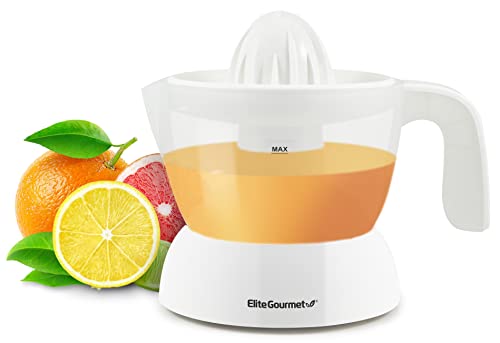
The Elite Gourmet ETS-411 Electric Citrus Juicer is a good example of this other category. The listing describes a compact 30 watt motor, a 16 oz capacity and a white finish, at about $17.39 with a 4.8 rating. It’s an alternative for citrus only, not a masticating machine.
Elite Gourmet
Fresh Citrus Juice in Seconds: Elite Gourmet ETS-411 Electric Citrus Juicer with 16 oz Pitcher, 30-Watt
The Elite Gourmet ETS-411 uses a 30-watt auto-reversing reamer to press juice straight from oranges, lemons, and limes into a built-in 16-ounce pitcher with an integrated pulp and seed strainer. It suits small kitchens, dorms, apartments, and RVs where counter space is tight but daily fresh juice still matters.
Pros and Cons
Pros
- The pouring spout and handle are molded into the juicing container, so you juice and serve from the same vessel.
- Dishwasher-safe detachable parts keep sticky citrus residue from building up in the reamer and strainer.
- At 30 watts and compact size, it draws little power and stores easily in a cabinet between uses.
- Elite Gourmet backs it with US-based phone, email, and live chat support.
Cons
- The 30-watt motor and single reamer size are built for citrus only, so it cannot handle apples, carrots, or leafy greens.
- A 16-ounce capacity means you will empty the pitcher partway through juicing for a family or a large batch.
Elite Gourmet Fresh Citrus Juice in Seconds: Elite Gourmet ETS-411 Electric Citrus Juicer with 16 oz Pitcher, 30-Watt
Elite Gourmet
Fresh Citrus Juice in Seconds: Elite Gourmet ETS-411 Electric Citrus Juicer with 16 oz Pitcher, 30-Watt
The Elite Gourmet ETS-411 uses a 30-watt auto-reversing reamer to press juice straight from oranges, lemons, and limes into a built-in 16-ounce pitcher with an integrated pulp and seed strainer. It suits small kitchens, dorms, apartments, and RVs where counter space is tight but daily fresh juice still matters.
$17.39 at AmazonEditors' Favorite
Color: White Size: 16 ounce Dimensions: 8.2 x 6.7 x 5.57 inches Weight: 1.3 pounds Product Group: Kitchen Binding: Kitchen
Shop NowChoosing between the two types
Ask what you’ll juice most. Mostly greens, carrots and apples? Pick a masticating machine. Mostly oranges and lemons? A citrus juicer does it for less. For lemons in particular, our best juicer for lemons page is worth a look.
Capacity is another sorting question. The Luukmonde Electric Citrus Juicer is listed with a 1.2L large volume, a powerful motor and an LED working lamp, made for orange, lemon, lime and grapefruit, at about $23.99 and rated 4.8. It’s another citrus alternative if you juice for a few people at once. Again, it isn’t a slow auger juicer.

LUUKMONDE
Electric Citrus Juicer for Fresh Orange Juice Daily: LUUKMONDE 1.2L Squeezer with Dual Cones and LED Indicator
This electric citrus juicer presses oranges, lemons, limes, and grapefruit at low speed into a 1.2L measured jug, so the juice never heats up and keeps its vitamins and enzymes intact. Buy it if you juice for a family or host brunches and want a full pitcher in one session without hand-squeezing or refilling a small cup.
Pros and Cons
Pros
- Large 1.2L capacity with measurement markings suits families and party-sized batches.
- Dual cone sizes cover the full citrus range from lime to grapefruit.
- Simple few-part construction disassembles quickly and goes in the dishwasher.
- BPA-free, FDA-compliant materials backed by a 12-month guarantee.
Cons
- It only handles citrus, so you will still need a separate juicer for apples, carrots, or leafy greens.
- The 1.2L jug and wide base take up more counter or cabinet space than a compact single-serve squeezer.
LUUKMONDE Electric Citrus Juicer for Fresh Orange Juice Daily: LUUKMONDE 1.2L Squeezer with Dual Cones and LED Indicator
LUUKMONDE
Electric Citrus Juicer for Fresh Orange Juice Daily: LUUKMONDE 1.2L Squeezer with Dual Cones and LED Indicator
This electric citrus juicer presses oranges, lemons, limes, and grapefruit at low speed into a 1.2L measured jug, so the juice never heats up and keeps its vitamins and enzymes intact. Buy it if you juice for a family or host brunches and want a full pitcher in one session without hand-squeezing or refilling a small cup.
$23.99 at AmazonEditors' Favorite
Color: black Dimensions: 6.299212592 x 7.87401574 x 9.055118101 inches Weight: 2.2 pounds Product Group: Kitchen Binding: Kitchen
Shop NowCommon mistakes when buying
People often buy on price alone, then find the machine can’t do what they wanted. Others skip the feed chute size and end up chopping everything into tiny pieces. A few overlook cleanup time, and the juicer ends up in a cabinet.
Another mistake is expecting a juicer to replace a blender. Juice removes most fiber. If you want whole-fruit drinks, the best blender and juicer guide covers combination options. And if you’re comparing models across the board, best juicer for juicing is a good starting point.
Basic care for a slow juicer
Rinse the auger and screen right after use, before pulp dries. Use the small brush that ships with many models for the screen mesh. Check the manufacturer’s instructions on which parts are dishwasher safe. Don’t assume.
Questions to ask before you buy
How much counter and cabinet space do you have?
Slow juicers are usually taller and heavier than a handheld reamer. A 100 oz hopper sounds generous, but it also means a bigger body. Measure the spot where it will live. If it has to be lugged out of a cabinet every time, you’ll probably use it less.
How often will you juice?
Daily juicers benefit from a wide chute and easy cleanup, because small annoyances add up fast. Someone who juices twice a month may be happier with a compact citrus unit. Be honest about your habits. A cheap machine you use beats an expensive one that gathers dust.
What will you do with the pulp?
Masticating machines leave drier pulp, which you can fold into muffins, broth or compost. Wetter pulp from fast machines is less useful. It’s a small detail, but it changes how much of your produce actually ends up in the glass.
How long will the juice keep?
Fresh juice is best the same day. Slow juicing adds less air, so the juice may separate more slowly, but it still isn’t shelf stable. Store it in a sealed glass jar in the fridge and drink it within a day or so. Don’t treat it like store-bought juice.
A simple way to decide
Start with your produce list. Write down what you’d juice in a normal week. If greens, carrots, celery and apples dominate, a masticating model fits. If oranges and lemons dominate, go citrus. If it’s a mix, think about whether you’d rather own one versatile machine or two cheap, simple ones. Both approaches work, and the second costs less than you might expect.
Then check the practical points: chute width, parts to wash, capacity and the warranty terms on the listing. Those matter more over a year than a single headline feature.
Getting more from your produce
Wash everything well before it goes in. Cut hard items like carrots and apples into pieces that fit the chute, and alternate soft and hard produce so the auger doesn’t clog. Leafy greens go in more easily when you roll them into a tight bundle or feed them between firmer pieces such as apple or cucumber.
Go slow and let the machine do the work. Pushing hard on the pusher rarely speeds things up. It just strains the motor. If juice seems thin or pulp comes out wet, feed less at a time. Those two habits make most slow juicers run better, whichever brand you own.
FAQ
What is a masticating juicer?
It’s a juicer that crushes and presses produce with a slow turning auger. It runs at a lower speed than a centrifugal juicer, which is why it’s often called a slow or cold press juicer.
Is a masticating juicer better than a centrifugal one?
It depends on what you juice. Masticating machines suit greens, wheatgrass and hard produce. Centrifugal ones are faster and usually cheaper. Neither is right for everyone.
Can a masticating juicer make nut milk or sorbet?
Some can. The ACOQOOS listing in our database names a sorbet and nut milk function. Check the maker’s manual for what it supports before you rely on it.
Is a citrus juicer a masticating juicer?
No. A citrus juicer presses fruit halves on a reamer. It’s great for oranges and lemons, but it won’t work on carrots or leafy greens.
How much does a masticating juicer cost?
Prices vary widely. The one masticating model we list is around $80, while basic citrus juicers start under $20. For more options, see the best juicer for the price guide.








Write Your Review
No reviews yet. Be the first to share your experience!