

A juicer cold pressed is a machine that squeezes produce slowly with a rotating auger instead of shredding it with a fast spinning blade. The slow squeeze is why people say it keeps more flavor, makes less foam and leaves drier pulp. It’s also why cold press models cost more and run slower than the budget centrifugal kind.
This guide explains what “cold pressed” really means, who benefits from one, how to use it, and what to watch for when you shop. We also point to three juicers from the HomeWhisk product database, one of them a true cold press listing, so you can see how the price range looks.
What “cold pressed” actually means
The name is a little misleading. Nothing is chilled. A cold press juicer, sometimes called a slow or masticating juicer, turns an auger at a low speed, often well under 100 rotations per minute, and crushes produce against a screen. A centrifugal juicer spins a flat blade at thousands of rotations per minute and flings the pulp out. The slow method creates less friction and, in theory, less heat and less air mixed into the juice.
What does that mean in a glass? Usually a smoother, denser juice with less froth on top, and one that tends to separate more slowly in the fridge. Brands often claim juice keeps for 48 to 72 hours. Treat that as a manufacturer claim. Fresh juice is best the same day, and that’s true for every type of machine.
One of the machines we reviewed fits this category by its own listing. The EanOruus is sold as a 3-in-1 cold press juicer in Bright White, and it’s the one product here that names the cold press method in its title.

EanOruus
Family Juicing and Sorbet Maker: EanOruus 3-in-1 Cold Press Juicer
The EanOruus 3-in-1 cold press juicer makes juice, frozen fruit sorbet, and nut milk, while its 6.5-inch chute reduces produce preparation. It suits families and meal preppers who want large-batch capacity with fewer refills.
Pros and Cons
Pros
- Its 3-in-1 design makes juice, frozen fruit sorbet, and homemade nut milk.
- The wide feed chute and 100-ounce hopper streamline large-batch preparation.
- The brushless AC motor is built for consistent performance with fibrous ingredients.
- The bright white finish suits modern kitchen designs.
Cons
- The extra-large hopper and wide chute require substantial counter or storage space.
- The product data does not specify its materials, dimensions, or weight, making fit and portability harder to assess.
EanOruus Family Juicing and Sorbet Maker: EanOruus 3-in-1 Cold Press Juicer
EanOruus
Family Juicing and Sorbet Maker: EanOruus 3-in-1 Cold Press Juicer
The EanOruus 3-in-1 cold press juicer makes juice, frozen fruit sorbet, and nut milk, while its 6.5-inch chute reduces produce preparation. It suits families and meal preppers who want large-batch capacity with fewer refills.
$199.99 at AmazonEditors' Favorite
Color: Bright White Size: Extra Large Dimensions: 13.7 x 7.48 x 17.4 Inches Weight: 12.13 Pounds Product Group: Kitchen
Shop NowCold press vs centrifugal juicers
Speed is the big trade. A centrifugal machine can finish a glass in under a minute and usually accepts whole apples through a wide chute. A cold press machine takes longer and often needs you to cut produce into smaller pieces. If you juice every morning before work, that matters.
Where cold press wins
Leafy greens, wheatgrass and herbs are the classic cases. A fast blade tends to fling leaves around, while an auger can press them. If your goal is green juice, a slow machine usually gets more out of each bunch. Our best juicer for green juice and best juicer for leafy greens roundups cover that in more depth.
Where centrifugal wins
Price and speed. You can find a capable centrifugal machine for a fraction of the cost of a cold press unit, and cleanup is often quicker because there are fewer narrow parts. If you want a low-cost start, see our best budget juicer list.
Who should buy a cold press juicer
Buy one if you juice several times a week, drink a lot of greens, or care about the texture of the juice. Skip it if you juice once a month, hate cleanup or only want orange juice. Be honest about the habit. A pricey machine that lives in a cabinet saves nobody any money.
Counter space and noise matter too. Slow machines are generally quieter, though sizes vary by model, and most are taller than a toaster. Check the footprint on the listing before you order.
A lower-cost whole fruit option
Not everyone wants to spend close to $200. The HOUSNAT Juicer Machine is listed for whole fruit and vegetables with a 3 speed setting, and it was priced at $37.99 in our database. To be clear, its listing doesn’t call it a cold press, so think of it as an alternative for shoppers who want to try juicing before moving up to a slow machine. Multiple speed settings are typical of fast juicers, which suit harder produce at one speed and softer produce at another.
The trade-off is the same one described above. You get speed and a lower price, but you shouldn’t expect the dry pulp or the low foam of an auger design. For budget ranges, the best juicer for under $100 page lays out more choices.
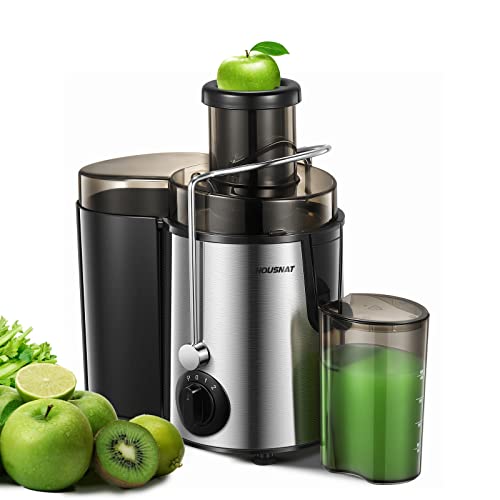
HOUSNAT
Fast Whole-Fruit Juicing for Busy Kitchens: HOUSNAT Juicer Machine with 3 Speeds
The HOUSNAT juicer turns whole fruits and vegetables into fresh juice in about 10 seconds, with a 65 mm feed chute that reduces prep work. It suits busy households seeking quick, moderate-use juicing with adjustable speeds for soft and hard produce.
Pros and Cons
Pros
- The wide feed chute accepts larger pieces, limiting preparation before juicing.
- Adjustable speeds handle soft fruits, hard vegetables, and short pulse boosts.
- A stainless steel filter, anti-corrosion blades, and cleaning brush support routine maintenance.
- The foam protector and recipe guide add convenience for new juicers.
Cons
- It is designed for light to moderate use, such as four to five juicing sessions per week.
- The motor may need a 15-minute cooling period if it overheats.
HOUSNAT Fast Whole-Fruit Juicing for Busy Kitchens: HOUSNAT Juicer Machine with 3 Speeds
HOUSNAT
Fast Whole-Fruit Juicing for Busy Kitchens: HOUSNAT Juicer Machine with 3 Speeds
The HOUSNAT juicer turns whole fruits and vegetables into fresh juice in about 10 seconds, with a 65 mm feed chute that reduces prep work. It suits busy households seeking quick, moderate-use juicing with adjustable speeds for soft and hard produce.
$37.99 at AmazonEditors' Favorite
Color: Silver Size: 12.2*7.48* 11.81in Dimensions: 7.4 x 14.5 x 12.9 Inches Weight: 5.84 pounds Product Group: Kitchen Binding: Kitchen
Shop NowHow to use a cold press juicer well
Good habits make any juicer work better. Follow these steps, and check your own manual for model-specific details.
Prep the produce
Wash everything, trim bruised spots and cut pieces to fit the chute. Alternate soft and hard items. A handful of spinach pushed through followed by a chunk of apple or carrot helps clear the screen. Peel citrus and anything with a bitter or waxy rind.
Feed slowly
Let the auger do the work. Pushing hard can jam the machine and doesn’t speed anything up. If the juice looks wet and the pulp is still damp, run the pulp through a second time.
Clean right away
Rinse the screen and auger as soon as you finish. Dried pulp is the hardest thing to remove. Use the brush that comes with the unit, and avoid anything abrasive on the fine mesh.
A citrus press is a different tool
If most of your juicing is lemons, limes and oranges, you may not need an auger machine at all. The Breville 800CPXL Citrus Press Pro is a stainless steel citrus juicer, not a cold press, listed at $279.95 in our database. It’s built for citrus alone, so it won’t handle carrots or kale. Our best juicer for lemons page has a wider look at that style.
It costs more than the other two machines here. That’s the point to weigh. A dedicated press makes sense for a household that goes through a lot of citrus, and not much sense otherwise.
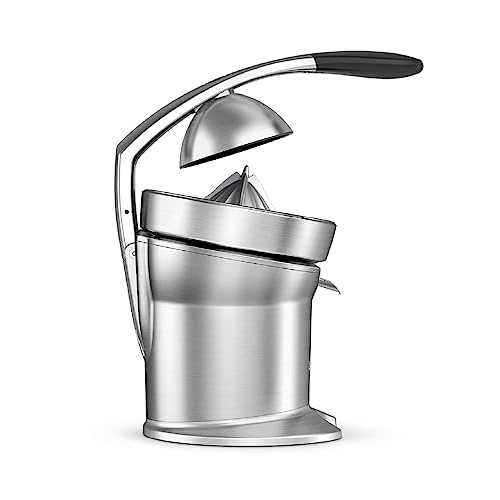
Breville
Effortless Citrus Juicing for Fresh Juice: Breville 800CPXL Citrus Press Pro
The Breville 800CPXL Citrus Press Pro extracts juice from lemons, limes, oranges, and grapefruits with a power-assisted lever and Quadra-Fin cone, reducing pressing effort. It suits frequent citrus juice makers who want durable stainless steel construction, drip control, and dishwasher-safe removable parts.
Pros and Cons
Pros
- The power-assisted lever makes citrus pressing easier than manual squeezing.
- The Quadra-Fin cone handles a broad range of citrus fruit sizes.
- The durable die-cast stainless steel construction resists corrosive citric acid.
- The juice collector, filter, cone, and fruit dome are dishwasher safe.
Cons
- This electric citrus press requires a 110 to 120 volt outlet, so it is not suitable for use without access to household power.
- The one-year limited warranty is relatively short for a durable countertop appliance.
Breville Effortless Citrus Juicing for Fresh Juice: Breville 800CPXL Citrus Press Pro
Breville
Effortless Citrus Juicing for Fresh Juice: Breville 800CPXL Citrus Press Pro
The Breville 800CPXL Citrus Press Pro extracts juice from lemons, limes, oranges, and grapefruits with a power-assisted lever and Quadra-Fin cone, reducing pressing effort. It suits frequent citrus juice makers who want durable stainless steel construction, drip control, and dishwasher-safe removable parts.
$279.95 at AmazonEditors' Favorite
Color: Brushed Stainless Size: One Size Dimensions: 10.31 x 7.6 x 14.02 inches Weight: 10.6 Pounds Product Group: Kitchen Binding: Kitchen
Shop NowWhat to check before you buy
Start with the produce you actually plan to juice. Hard roots like carrots and beets need a strong motor, while soft fruit such as berries and grapes can clog a screen if you feed too much at once. Read the listing for the motor description, the chute size and the number of parts that need washing. Fewer parts usually means faster cleanup, and cleanup is the main reason people stop juicing.
Capacity and size
Look at the pulp bin and juice jug sizes. A small jug is fine for one person. A family will want something bigger, or will be refilling it often. Measure your cabinet too, since some machines stand taller than a standard shelf allows.
Price and ongoing cost
The upfront price is only part of the cost. Produce adds up fast, since a single glass can take several carrots or a large bunch of greens. Add in the time you’ll spend washing and cutting. If a $40 machine gets you juicing for a month, you’ll learn quickly whether a $200 upgrade makes sense. Think of the first purchase as a trial run.
Warranty and support
Auger machines have moving parts that wear. A clear warranty period and easy access to replacement screens and gaskets can matter more than a small difference in features. Check what the seller offers on the listing page.
Common mistakes to avoid
The first mistake is expecting miracles. Juice isn’t a cure for anything, and it lacks the fiber of whole fruit. If health is the driver, our best juicer for health guide is a better place to start, and a doctor is a better source for medical advice.
The second is buying on a “cold press” label alone. Check the listing details, the capacity and the cleanup parts. The third is overloading it. Small batches work better. And the last: storing juice too long. Drink it fresh, or keep it sealed and cold for a short time.
FAQ
Is a cold press juicer worth the extra money?
It depends on how often you juice. If you make juice several times a week, especially from greens, the extra yield and smoother texture can justify the price. For occasional use, a cheaper machine is usually enough.
Does cold pressed juice keep more nutrients?
Makers say the slow process limits heat and oxidation, but results vary by produce and storage. We haven’t seen proof in the product listings, so treat the claim as marketing unless a source backs it up.
Are cold press juicers hard to clean?
They have more small parts than a citrus press, so rinse right after use. A cleaning brush helps a lot. Most users find it takes a few minutes once it becomes routine.
Can I juice leafy greens in any juicer?
You can try, but fast centrifugal machines often leave wet pulp behind. Slow auger machines are generally better at leaves. Rolling greens into a tight bundle helps in either type.
How long does fresh juice last?
Drink it as soon as you can. If you need to store it, use a sealed container in the fridge and finish it within a day or two. Some makers claim longer, but flavor fades fast.







Write Your Review
No reviews yet. Be the first to share your experience!