

TL;DR — Yes, enameled cookware is safe for everyday cooking. The enamel is a glass coating (vitrified porcelain) fused to a cast iron or steel core at high temperature; it’s chemically inert, contains no PTFE or PFOA, and doesn’t react with acidic foods the way bare metal can. The main safety caveats are old or imported vintage pieces that may carry lead or cadmium in the glaze, and chipped enamel that exposes the metal underneath. Buy from reputable brands, avoid cooking on badly chipped enamel, and it’s one of the safest surfaces in the kitchen. For related picks, see our best cookware sets guide.
The HomeWhisk editorial team researches kitchen equipment by analyzing manufacturer specifications, material science, and aggregated user reviews from major retailers and communities like Reddit r/cookware and r/castiron. Our recommendations are based on how these materials actually behave, not on marketing.

Concern about enameled cookware usually comes from a reasonable place: people have heard about nonstick chemicals, lead in old dishes, or worry that a chip makes a pot dangerous. Enameled cookware — think a Le Creuset or Lodge Dutch oven — sits in a different category from both nonstick and bare metal, and understanding what the coating is made of answers most of the safety question directly. This guide covers what enamel is, what the real risks are, and how it compares to bare cast iron. For product picks, see our best cookware sets and best nonstick cookware guides.
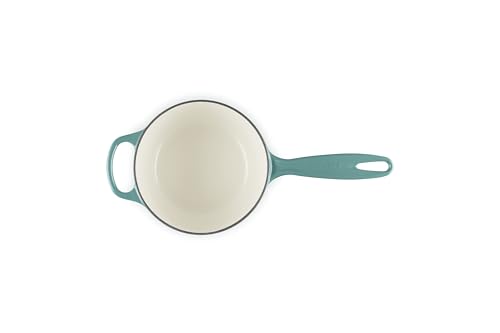
Le Creuset
Versatile Enameled Cast Iron Cooking Set: Le Creuset Signature 5-Piece Riviera
The Le Creuset Signature 5-piece set delivers even heating and strong heat retention for everyday stovetop and oven cooking without seasoning. It suits cooks who want durable, easy-clean cookware across all cooktops and value ergonomic handling.
Pros and Cons
Pros
- Works on all cooktops and is oven-safe up to 500°F.
- Enameled cast iron provides dependable heat distribution and retention without seasoning.
- Ergonomic handles make lifting the cookware easier.
- The set includes light-colored interiors for monitoring food and a performance-focused black satin skillet interior.
Cons
- The 500°F oven-safety limit may not suit recipes requiring higher temperatures.
- Cast iron construction can make lifting and storing the cookware more demanding than lighter materials.
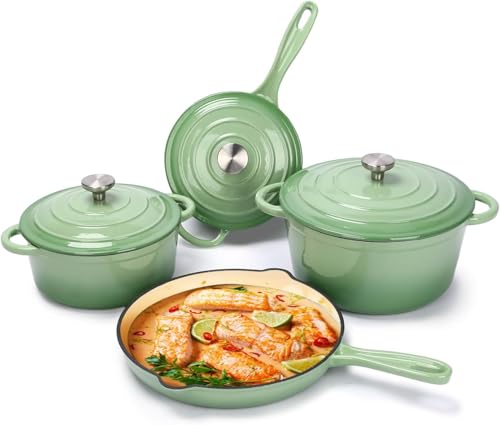
Hisencn
Braising, Searing, and Baking in One Kit: Hisencn 7-Piece Enameled Cast Iron Dutch Oven Set in Green
This seven-piece enameled cast iron set covers braising, searing, sauces, and oven roasting with a 4.8-quart Dutch oven, 2.8-quart Dutch oven, 2-quart saucepan, and 10.25-inch skillet, all rated to 550°F and safe on induction. It suits home cooks building a full cast iron kitchen at once instead of buying pieces individually, especially anyone who wants enamel that wipes clean rather than raw iron that needs seasoning.
Pros and Cons
Pros
- The 4.8-quart and 2.8-quart Dutch oven pairing handles both family batch cooking and small side dishes.
- Raised interior lid pattern drips condensation back onto the food, which helps braises stay moist during long cooks.
- The skillet has spouts on both sides, so pan sauces and rendered fat pour without running down the side.
- Works on gas, electric, induction, and ceramic cooktops, so it moves with you if your kitchen changes.
Cons
- Enameled cast iron is heavy, and a filled 4.8-quart Dutch oven is a two-handed lift that may not suit cooks with wrist or grip limitations.
- The enamel rules out metal utensils and aggressive scrubbing, so chipping is a real risk if the set gets handled roughly.

DishDelight
Enameled Cast Iron Dutch Oven Set for Braising and Bread Baking - DishDelight 7 Piece Induction Cookware Set, Red
This seven piece enameled cast iron set covers milk pot, saucepan, shallow fry and deep fry duties in one collection, with thick cast iron walls that hold heat long enough to braise, simmer and bake bread without temperature swings. It suits home cooks moving away from thin nonstick who want PFOA and PFAS free pans that go from induction burner straight to the dinner table.
Pros and Cons
Pros
- Cast iron core delivers even heating and long heat retention for braising, simmering and Dutch oven bread.
- Enameled surface avoids the seasoning and rust maintenance that bare cast iron demands.
- Set covers small milk pot through deep frying pan, replacing several mismatched pieces at once.
- Works on induction as well as gas, electric and ceramic cooktops.
Cons
- Cast iron is heavy, and the larger Dutch oven will be difficult to lift and pour for anyone with wrist or grip limitations.
- The listing does not publish individual piece dimensions or capacities, so matching pot sizes to your burners and storage space takes guesswork.

MAISON ARTS
Enameled Cast Iron Cookware for Braising, Searing and Slow Cooking: MAISON ARTS 7 Piece Set in Red
This seven piece enameled cast iron set covers a 9.5 inch frying pan, 2 quart sauce pan, 3 quart wok and 5.5 quart casserole with lids, giving you even, retained heat across searing, braising and slow cooking without any PFAS, PFOA or PFOS coating. Buy it if you cook full meals on gas, electric or induction and want oven safe pans that move from stovetop to oven in one piece.
Pros and Cons
Pros
- Four cooking vessels plus three lids cover frying, saucework, stir frying and braising in one purchase.
- Enamel surface is non reactive, so acidic sauces and long simmers will not pick up a metallic taste.
- Oven safe construction lets you brown on the burner and finish under heat without transferring food.
- Even heat distribution across the thick cast iron body reduces hot spots and scorching during long cooks.
Cons
- Cast iron is heavy, and the filled 5.5 quart casserole takes two hands to lift in and out of the oven.
- Metal utensils can chip the enamel, so you are limited to wood or silicone tools on every piece.
Le Creuset Versatile Enameled Cast Iron Cooking Set: Le Creuset Signature 5-Piece Riviera
Le Creuset
Versatile Enameled Cast Iron Cooking Set: Le Creuset Signature 5-Piece Riviera
The Le Creuset Signature 5-piece set delivers even heating and strong heat retention for everyday stovetop and oven cooking without seasoning. It suits cooks who want durable, easy-clean cookware across all cooktops and value ergonomic handling.
Check price on AmazonThis five-piece Le Creuset set brings a Dutch oven, saucepan, and skillet together for stovetop-to-oven cooking with even heat and strong retention.
Light interiors help monitor food in the Dutch oven and saucepan, while the skillet's black satin enamel supports higher surface temperatures.
Enameled cast iron provides durable construction without seasoning. Ergonomic handles improve lifting, and the cookware works on all cooktops.
Oven use is limited to 500°F, so it may not suit recipes requiring higher temperatures.
Best for cooks seeking a durable, ready-to-use cookware set for varied stovetop and oven meals.
Hisencn Braising, Searing, and Baking in One Kit: Hisencn 7-Piece Enameled Cast Iron Dutch Oven Set in Green
Hisencn
Braising, Searing, and Baking in One Kit: Hisencn 7-Piece Enameled Cast Iron Dutch Oven Set in Green
This seven-piece enameled cast iron set covers braising, searing, sauces, and oven roasting with a 4.8-quart Dutch oven, 2.8-quart Dutch oven, 2-quart saucepan, and 10.25-inch skillet, all rated to 550°F and safe on induction. It suits home cooks building a full cast iron kitchen at once instead of buying pieces individually, especially anyone who wants enamel that wipes clean rather than raw iron that needs seasoning.
Check price on AmazonA seven-piece enameled cast iron set for cooks who own a skillet or a stockpot but lack the heavy, heat-holding pots that braises, no-knead bread, and slow-simmered sauces actually need.
The 4.8-quart Dutch oven handles a whole chicken or a batch of short ribs, while the 10.25-inch skillet sears steaks and moves straight into a 550°F oven to finish.
Cast iron cores under five layers of ceramic enamel resist cracking and chipping, with stainless steel lid knobs and perforated handles sized for oven mitts.
The weight is real: expect a substantial lift when the large Dutch oven is full, and expect to use wood or silicone utensils to protect the enamel.
Best for home cooks furnishing a kitchen from scratch or upgrading from thin nonstick to cookware that browns properly.
DishDelight Enameled Cast Iron Dutch Oven Set for Braising and Bread Baking - DishDelight 7 Piece Induction Cookware Set, Red
DishDelight
Enameled Cast Iron Dutch Oven Set for Braising and Bread Baking - DishDelight 7 Piece Induction Cookware Set, Red
This seven piece enameled cast iron set covers milk pot, saucepan, shallow fry and deep fry duties in one collection, with thick cast iron walls that hold heat long enough to braise, simmer and bake bread without temperature swings. It suits home cooks moving away from thin nonstick who want PFOA and PFAS free pans that go from induction burner straight to the dinner table.
Check price on AmazonA seven piece enameled cast iron collection built for cooks who want one set that sears, simmers, braises and bakes instead of separate specialty pans.
Heat retention is the standout: thick cast iron walls hold temperature through long braises and Dutch oven bread bakes, and the pots carry heat to the table for serving.
Enamel over cast iron means no seasoning, no rust, and no PFOA or PFAS. The tradeoff is weight, which is normal for the material.
Piece dimensions and capacities are not listed, so confirm sizes against your cooktop and cabinet space before ordering.
Best for home cooks replacing worn thin nonstick who cook slow braises, soups and no knead bread.
MAISON ARTS Enameled Cast Iron Cookware for Braising, Searing and Slow Cooking: MAISON ARTS 7 Piece Set in Red
MAISON ARTS
Enameled Cast Iron Cookware for Braising, Searing and Slow Cooking: MAISON ARTS 7 Piece Set in Red
This seven piece enameled cast iron set covers a 9.5 inch frying pan, 2 quart sauce pan, 3 quart wok and 5.5 quart casserole with lids, giving you even, retained heat across searing, braising and slow cooking without any PFAS, PFOA or PFOS coating. Buy it if you cook full meals on gas, electric or induction and want oven safe pans that move from stovetop to oven in one piece.
Check price on AmazonA seven piece enameled cast iron set built for cooks who want one set that sears, simmers and braises instead of separate specialty pans.
The 5.5 quart casserole browns meat on the burner and moves straight into the oven for a low, slow finish. The 9.5 inch frying pan holds heat for a hard sear.
Cast iron body with enamel glaze inside and out, sized at 9.5 inch pan, 2 quart sauce pan, 3 quart wok and 5.5 quart casserole, with lids on the last three.
The weight is real. Every piece is heavier than aluminum or stainless equivalents, which matters if lifting a full pot is difficult for you.
Best for home cooks who braise, stew and bake often and want a non reactive, coating free surface across the whole set.
What Enameled Cookware Actually Is
To judge whether it’s safe, you have to know what the surface is made of — and it’s not a chemical nonstick coating at all.
Enamel (also called porcelain enamel or vitreous enamel) is glass. It’s a powdered mix of silica and mineral oxides sprayed or dipped onto a metal base, then fired in a furnace at roughly 800°C (about 1,470°F). At that temperature the powder melts and fuses into a smooth, glass-hard coating chemically bonded to the metal. The core underneath is almost always cast iron (for Dutch ovens and skillets) or steel (for lightweight pots and canners).
This matters because glass is inert. It doesn’t react with food, doesn’t leach into acidic sauces, and contains no PTFE, PFOA, or “forever chemicals” — those belong to the nonstick (Teflon) family, which is an entirely different technology. That single fact resolves the most common worry: enameled cookware is not nonstick cookware, and none of the PFAS concerns around nonstick apply to it.
The Pros: Why People Choose Enameled Cast Iron
Enameled cast iron combines the strengths of cast iron with the convenience of a stable, non-reactive surface.
- Excellent heat retention and even cooking. The heavy cast iron core holds and distributes heat steadily, which is why enameled Dutch ovens are the standard for braises, stews, bread baking, and low simmers.
- Non-reactive surface. Unlike bare cast iron, the glass enamel lets you cook tomatoes, wine, citrus, and vinegar without any metallic taste or damage to a seasoning layer — because there is no seasoning to protect.
- No seasoning required. You skip the whole maintenance ritual of bare cast iron. Wash it, dry it, done.
- Versatile and oven-safe. Most enameled cast iron is oven-safe to high temperatures (commonly 400–500°F depending on the knob and brand) and works on induction, gas, and electric.
- Long-lived. A quality piece can last decades and is often handed down.
For a household that wants one do-everything pot, enameled cast iron is a frequent top recommendation. Our best cookware sets and best copper cookware guides cover where it fits alongside other materials.
The Cons: Where Enamel Falls Short
No material is perfect, and enamel’s weaknesses are worth knowing before you buy.
- It’s heavy. A cast iron core plus enamel makes these pots genuinely heavy — a large Dutch oven full of food is a two-hand lift.
- The enamel can chip or crack. Dropping it, thermal shock (cold water into a screaming-hot pot), or metal utensils banging the rim can chip the glass. A chip exposes the metal core.
- It’s not truly nonstick. Enamel is smoother than bare metal but proteins and sugars still stick, especially at high heat. It’s not a replacement for a best nonstick cookware pan for eggs.
- Price. Premium enameled cast iron is expensive, though budget brands like Lodge now offer solid options.
- High-heat limits. Sustained very high heat and empty preheating can damage the enamel and discolor light-colored interiors.
None of these are safety problems in normal use — they’re practical trade-offs. The chip issue is the one with a safety angle, covered next.
Is a Chipped Enamel Pot Still Safe?
This is the most-searched safety question, and the honest answer is: it depends on where and how bad the chip is.
A small chip on the outside or the rim is cosmetic. The exposed cast iron may develop surface rust, but it isn’t a health hazard, and you can keep using the pot.
A chip on the interior cooking surface is different. Once the glass is broken there, the bare metal is exposed to food and can rust or leach small amounts of iron (harmless for most people, but it affects taste). The bigger concern is that loose enamel fragments could flake into food — glass shards are the real risk, not a slow chemical one. If the interior enamel is actively chipping, flaking, or has cracks spidering across the cooking surface, most manufacturers recommend retiring the pot from cooking use. A single tiny interior chip with no loose material is a judgment call; widespread flaking is a clear stop.
The takeaway: outside chips, keep using; interior chips with any loose or spreading damage, replace.
The Real Safety Concern: Lead and Old Glazes
The genuine safety issue with enamel isn’t the coating concept — it’s which piece you own.
Modern enameled cookware from reputable brands sold in the US and EU must meet strict limits on lead and cadmium leaching, and quality manufacturers formulate glazes to be food-safe. This is well controlled for current mainstream products.
The risk sits with vintage, antique, decorative, or cheaply imported pieces. Older enamelware (and some imported or artisanal glazes) could contain lead or cadmium in the colorants, especially bright reds, oranges, and yellows, and especially on decorative ware never intended for cooking. Acidic foods and high heat accelerate any leaching. If you have an old or unlabeled enamel pot, treat it as decorative unless you can verify it’s food-safe, or test it with a home lead swab. For everyday buying, sticking to established brands sidesteps this concern entirely. Our best cookware sets, best moka pot, and best camping cookware guides all favor reputable manufacturers for exactly this reason.
Frequently Asked Questions
Is it healthy to cook in enameled cast iron?
Yes. The enamel is an inert glass coating with no PTFE, PFOA, or other nonstick chemicals, and it doesn’t react with acidic foods. From a health standpoint it’s one of the safer cooking surfaces available, provided the piece is from a reputable modern manufacturer and the interior enamel is intact. Unlike bare cast iron, it won’t add significant iron to your food, which is a plus for most people. The only real cautions are avoiding badly chipped interiors and steering clear of unverified vintage or decorative enamelware that could contain lead in the glaze.
Is enameled cast iron nonstick?
No, not in the way a Teflon pan is. Enamel is a smooth glass surface, so it releases food better than bare metal and cleans easily, but proteins, eggs, and sugary sauces will still stick, especially over high heat or without enough fat. Enameled cast iron excels at braising, searing, simmering, and baking — not at cooking a delicate omelet. If you want a true nonstick surface for eggs and low-fat cooking, pair your Dutch oven with a dedicated nonstick pan; see our best nonstick cookware guide.
Is enameled cast iron safe if it’s chipped?
It depends on the location. A chip on the exterior or rim is cosmetic and safe to keep using, though the exposed iron may rust. A chip on the interior cooking surface is more serious: the concern is loose glass fragments flaking into food, plus the bare metal rusting. A single tiny interior chip with no loose material is a judgment call, but if the interior enamel is actively flaking or cracking across the cooking area, retire the pot from food use. When in doubt, don’t cook on visibly deteriorating interior enamel.
Is enameled cast iron oven-safe?
Yes, enameled cast iron is oven-safe, which is a big part of its appeal for braises and no-knead bread. The limiting factor is usually the lid knob rather than the pot itself — older phenolic or plastic knobs may be rated only to around 375–400°F, while metal or upgraded knobs allow 450–500°F or higher. Check your specific model’s rating. Avoid thermal shock: don’t move a hot pot straight into cold water or a cold pot into a very hot oven, since sudden temperature swings can crack the enamel over time.
Which is better, cast iron or enameled cast iron?
Neither is universally better; they suit different jobs. Bare cast iron takes and holds a seasoning layer, develops a naturally slick surface, adds a little dietary iron, tolerates very high heat and open flame, and costs less — but it reacts with acidic foods and needs maintenance. Enameled cast iron skips seasoning, handles acidic dishes freely, cleans easily, and looks good at the table, but it’s pricier and can chip. Many cooks own both: bare cast iron for searing and cornbread, enameled for braises, stews, and tomato-based dishes. See our best cookware sets guide for building a rounded kit.
How do I care for enameled cookware to keep it safe?
Let the pot cool before washing to avoid thermal shock, then hand-wash with warm soapy water and a soft sponge or brush. For stuck-on food or interior staining, simmer water with a little baking soda rather than scraping with metal. Use wooden, silicone, or nylon utensils to protect the glass surface, and don’t preheat empty on high heat, which can crack or discolor the enamel. Avoid dropping it and don’t stack pieces bare against each other. Treated this way, quality enameled cookware stays intact and safe for many years.
The Bottom Line
Enameled cookware is safe for everyday cooking. The enamel is inert glass fused to a metal core — no PTFE, no PFOA, no reactivity with acidic food — which makes it one of the more reassuring surfaces in the kitchen. The two things to watch are practical, not exotic: don’t cook on interior enamel that’s actively chipping or flaking (glass fragments, not chemistry, are the risk), and avoid unverified vintage or decorative enamelware that could carry lead or cadmium in the glaze. Buy from a reputable modern brand, use gentle utensils and no thermal shock, and enameled cast iron will serve for decades. For picks across materials, see our best cookware sets, best nonstick cookware, and best copper cookware guides.



Write Your Review
No reviews yet. Be the first to share your experience!