

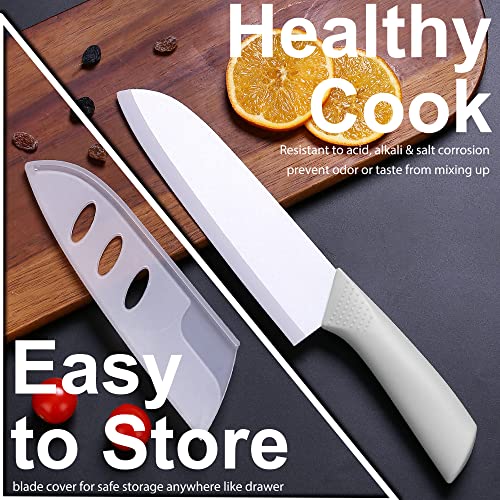
TL;DR — Yes, a ceramic santoku knife is safe to use and safe for food. Kitchen ceramic blades are made from zirconium dioxide (zirconia), an inert, non-porous, non-reactive material that doesn’t leach chemicals, rust, or hold onto odors or flavors. The real safety concern isn’t toxicity — it’s brittleness. Ceramic blades are extremely hard but chip or snap if you twist them, cut frozen food or bone, or drop them. Used correctly on soft produce and boneless proteins, they’re hygienic and hold an edge far longer than steel. For a versatile everyday blade, see our best santoku knife guide.
The HomeWhisk editorial team researches kitchen equipment by analyzing manufacturer specifications, material properties, and aggregated owner reviews from major retailers and communities like Reddit r/chefknives and r/Cooking. “Is a ceramic santoku knife safe?” comes up because the blades look and feel unusual — bright white or black, glassy, and startlingly light. The honest answer is that they’re safe in the ways people worry about (chemicals, food contact) and require caution in a way they often don’t expect (physical durability). Here’s the full picture.

Rynal
Ceramic Santoku Chef's Knife for Effortless Chopping & Slicing - Rynal 7 Inch with Sheath Cover
The Rynal 7-inch ceramic santoku slices fruits, vegetables, and boneless meats with a pure zirconia blade that stays sharp for years without resharpening. Buy it if you want a lightweight, rust-free knife for daily produce prep or an easy gift for a home cook.
Pros and Cons
Pros
- Pure zirconia ceramic holds its edge far longer than steel blades.
- Lightweight design and balanced handle make repetitive slicing comfortable.
- Non-reactive ceramic surface is ideal for organic and baby food prep.
- Included sheath and gift case make it easy to store and gift.
Cons
- Ceramic blade cannot handle hard, frozen, or bone-in foods and can chip if twisted or pried.
- Requires careful handling since side force can crack the thin blade.

Vos
Ceramic Knives for Everyday Veg and Fruit Prep: Vos 2-Piece Set with 5.5" Santoku and 4.5" Utility Knife
This two-knife ceramic set pairs a 5.5-inch santoku and a 4.5-inch utility blade for slicing vegetables, fruit, and boneless proteins without leaving a metallic taste on food. It suits home cooks who prep produce daily and want zirconia blades that hold an edge without regular sharpening.
Pros and Cons
Pros
- Two blade sizes cover most produce prep without needing a full block set.
- Rust-free and stain-resistant construction holds up to frequent washing, including the dishwasher.
- Included covers protect the edges and make drawer storage safer.
- Gift-box packaging makes it usable as-is for housewarmings or wedding registries.
Cons
- Ceramic blades chip or snap if twisted, dropped, or used on bones and frozen food, so they cannot replace a steel chef's knife.
- The 5.5-inch santoku is shorter than a standard 8-inch chef's knife, which slows down large-batch chopping.

Cutqiz
Ceramic Santoku for Slicing Vegetables and Fruit Without Browning: Cutqiz 5.5" Zirconia Knife with Sheath
This 5.5-inch zirconia ceramic santoku handles vegetables, fruit, and boneless proteins with an edge rated to stay sharp roughly ten times longer than steel. It suits home cooks who prep a lot of produce and want a blade that won't rust, react with acidic foods, or brown delicate cuts.
Pros and Cons
Pros
- Zirconia ceramic edge retention far outlasts standard steel kitchen knives.
- Rounded tip and heel reduce the chance of accidental punctures during handling and storage.
- Ergonomic anti-slip resin handle keeps control steady when hands are wet from washing produce.
- Arrives in a presentation box with a matched sheath, making it giftable straight out of the package.
Cons
- Ceramic is brittle and can chip or snap if used on bones, frozen food, or dropped on a hard floor.
- Resharpening requires a diamond sharpener or professional service, since standard steels and pull-through sharpeners won't work.
Rynal Ceramic Santoku Chef's Knife for Effortless Chopping & Slicing - Rynal 7 Inch with Sheath Cover
Rynal
Ceramic Santoku Chef's Knife for Effortless Chopping & Slicing - Rynal 7 Inch with Sheath Cover
The Rynal 7-inch ceramic santoku slices fruits, vegetables, and boneless meats with a pure zirconia blade that stays sharp for years without resharpening. Buy it if you want a lightweight, rust-free knife for daily produce prep or an easy gift for a home cook.
Check price on AmazonThis is a 7-inch ceramic santoku built for everyday chopping, slicing, mincing, and dicing of fruits, vegetables, and boneless meats.
Its pure zirconia blade offers higher hardness than steel, so it stays sharp for years and needs no sharpening during normal use.
The 0.06-inch blade weighs only 0.22 lbs and pairs with a 5-inch resin handle featuring an antislip finger bolster for steady control.
The blade is not made for hard, frozen, or bone-in foods, and side pressure can crack it.
Best for home cooks who mainly prep produce and want a light, rust-free everyday knife.
Vos Ceramic Knives for Everyday Veg and Fruit Prep: Vos 2-Piece Set with 5.5" Santoku and 4.5" Utility Knife
Vos
Ceramic Knives for Everyday Veg and Fruit Prep: Vos 2-Piece Set with 5.5" Santoku and 4.5" Utility Knife
This two-knife ceramic set pairs a 5.5-inch santoku and a 4.5-inch utility blade for slicing vegetables, fruit, and boneless proteins without leaving a metallic taste on food. It suits home cooks who prep produce daily and want zirconia blades that hold an edge without regular sharpening.
Check price on AmazonA two-piece ceramic knife set built for produce prep, solving the metallic taste and odor transfer that steel blades leave on fruit, tomatoes, and onions.
Zirconia blades hold a razor edge through hundreds of prep sessions, so daily slicers avoid the constant honing a steel knife demands.
The 5.5-inch santoku and 4.5-inch utility blade weigh far less than steel equivalents, reducing wrist strain, and each comes with a protective sheath.
Ceramic is brittle: avoid bones, frozen items, and prying or twisting motions, or the blade can chip.
Best for home cooks who prep vegetables and fruit daily and want a light, low-maintenance companion to their steel knives.
Cutqiz Ceramic Santoku for Slicing Vegetables and Fruit Without Browning: Cutqiz 5.5" Zirconia Knife with Sheath
Cutqiz
Ceramic Santoku for Slicing Vegetables and Fruit Without Browning: Cutqiz 5.5" Zirconia Knife with Sheath
This 5.5-inch zirconia ceramic santoku handles vegetables, fruit, and boneless proteins with an edge rated to stay sharp roughly ten times longer than steel. It suits home cooks who prep a lot of produce and want a blade that won't rust, react with acidic foods, or brown delicate cuts.
Check price on AmazonA 5.5-inch santoku made from white zirconia ceramic, built for cooks who slice large volumes of produce and dislike re-sharpening steel every few weeks.
The ceramic edge is rated to stay sharp roughly ten times longer than steel, and because it's non-reactive, sliced fruit and acidic vegetables won't brown or taste metallic.
The blade pairs with a resin anti-slip handle and a molded sheath. At 5.5 inches with a deep blade profile, it's light in hand and gives enough knuckle clearance for board work.
Ceramic will not survive bones, frozen items, or twisting cuts, and a drop onto tile can chip or break the blade outright.
Best for home cooks doing heavy vegetable and fruit prep who want a low-maintenance second knife alongside a steel chef's knife.
What Ceramic Kitchen Knives Are Actually Made Of
Ceramic knife blades are not the same ceramic as a coffee mug. They’re made from zirconium dioxide (ZrO₂), commonly called zirconia — a technical ceramic that is powdered, pressed under high pressure, and fired (sintered) at temperatures around 1,400–1,500°C into a dense, extremely hard blade. The result sits around 8.2 to 8.5 on the Mohs hardness scale, second only to diamond among common materials and far harder than the hardened steel in a typical chef’s knife.
That hardness is the whole appeal. A ceramic edge holds its sharpness roughly ten times longer than a standard stainless blade because it resists the microscopic rolling and dulling that steel suffers. The material is also completely inert: it will not rust, corrode, or react with acids. This is why manufacturers like Kyocera pioneered them for tasks where metallic taste or discoloration matters, such as slicing tomatoes, apples, or herbs. For steel comparisons across tasks, our best chef knife and best santoku knife guides cover the trade-offs.
Is Ceramic Safe for Food Contact?
On the toxicity question, ceramic knives are among the most inert tools in the kitchen. Food-grade zirconia is:
- Non-porous — the fired surface has essentially no pores for bacteria, juices, or oils to penetrate, so the blade doesn’t harbor microbes the way a scored plastic board or a cracked wooden handle can.
- Non-reactive — it doesn’t leach metal ions. Cutting acidic foods like lemons, onions, or tomatoes produces no metallic taste and no discoloration, a genuine advantage over reactive carbon-steel blades.
- Odor- and stain-resistant — because nothing absorbs into the surface, garlic and onion smells rinse away rather than lingering.
There is no credible evidence that zirconia blades transfer harmful substances to food under normal kitchen use. The material is the same family used in dental crowns and medical implants precisely because it’s biocompatible and stable. So for the “will this hurt me or my food” version of the question, a ceramic santoku is safe.
The Real Safety Issue: Brittleness and Chipping
Here is where “safe” needs nuance. The same hardness that keeps a ceramic edge sharp also makes it brittle. Hard materials resist deformation but have low fracture toughness — they don’t bend, so under lateral or shock force they chip or shatter instead.
In practice, that means a ceramic santoku can fail if you:
- Twist or pry with the blade — for example, levering apart a squash or popping open a jar lid.
- Cut through bone, frozen food, or hard rinds — chicken bones, frozen berries, or a hard winter squash can chip the edge instantly.
- Cut on a hard surface — glass, granite, or stone countertops. Always use a wood or plastic board.
- Drop it — a fall onto a tile floor can snap the tip or crack the blade.
A chipped ceramic edge is the genuine hazard: a fragment can end up in food, and a cracked blade can fail mid-cut. This is why ceramic knives are best treated as specialists for straight, downward slicing of soft foods — vegetables, fruit, boneless chicken, fish fillets, cheese — rather than all-purpose workhorses. For bone-in butchery or heavy prep, a steel best boning knife or best chef knife is the safer choice, and crusty bread calls for a serrated best bread knife regardless of material.
Ceramic vs. Steel Santoku: Choosing the Safer Tool for the Job
The santoku shape — a flatter edge and a rounded, sheepsfoot tip — is designed for push-cutting and precise slicing, which happens to suit ceramic’s strengths well. But the material changes how you should use it.
A steel santoku flexes slightly, tolerates the occasional bone or frozen edge, and can be sharpened on a whetstone at home. A ceramic santoku stays sharper far longer and never reacts with food, but demands discipline: soft foods only, careful storage, and no prying. Weight is another factor — ceramic blades are dramatically lighter, which some cooks love for reducing fatigue and others find makes the knife feel less controlled through dense produce.
If you want one knife to do everything safely, steel is more forgiving. If you want a razor-sharp slicer for produce and boneless proteins that never needs frequent honing, ceramic earns its place. Many cooks keep both. Our best santoku knife and best knife sets guides cover balanced options, and a best fillet knife handles flexible fish work that a rigid ceramic blade can’t.
How to Use and Store a Ceramic Knife Safely
Because the risk is physical, safe handling is about protecting the edge:
- Cut only on wood or plastic boards, never glass, stone, or metal.
- Slice straight down; avoid twisting, scraping, or using the blade as a lever.
- Reserve it for soft foods — produce, boneless meat, fish, cheese, bread that isn’t hard-crusted.
- Store it protected in a blade guard, sheath, magnetic strip, or slotted block so the edge can’t knock against other tools.
- Hand wash and dry rather than trusting a dishwasher, where the blade can bang into racks or cutlery and chip.
Follow those rules and a ceramic santoku is both safe and remarkably low-maintenance.
Frequently Asked Questions
Are ceramic knives toxic or unsafe for food?
No. Kitchen ceramic blades are made from zirconium dioxide, an inert, non-porous, food-grade material that doesn’t rust, corrode, react with acids, or leach chemicals into food. It’s from the same family of ceramics used in dental crowns and medical implants because it’s biocompatible and stable. Cutting acidic foods like tomatoes or lemons produces no metallic taste or discoloration. The material poses no toxicity concern under normal use — the only real hazard is physical chipping if the blade is misused.
Can a ceramic santoku knife chip or break?
Yes, and this is its main limitation. Zirconia is extremely hard (about 8.2–8.5 on the Mohs scale) but brittle, meaning it resists bending and instead chips or cracks under twisting, impact, or lateral force. Cutting bone, frozen food, or hard rinds, prying with the blade, cutting on stone or glass, or dropping it can all cause damage. A chipped edge can shed fragments into food. Used for straight downward slicing of soft foods on a wood or plastic board, it holds up well.
What foods should you not cut with a ceramic knife?
Avoid anything hard, frozen, or bone-in: chicken and meat bones, frozen fruit or vegetables, hard winter squash, and dense rinds. Also avoid using the blade to pry, twist, or scrape. Ceramic excels at soft produce, herbs, boneless chicken, fish fillets, and cheese, where its long-lasting sharpness and non-reactive surface shine. For bones and heavy work, use a steel chef’s or boning knife instead, and for crusty bread use a serrated blade.
How do you sharpen a ceramic knife?
Not with ordinary steel-knife tools. Because ceramic is harder than steel, standard whetstones and pull-through steel sharpeners won’t cut it. Sharpening requires a diamond-coated sharpener or a purpose-built electric ceramic sharpener, and many owners send blades back to the manufacturer for professional sharpening. The upside is you’ll rarely need to: a ceramic edge stays sharp roughly ten times longer than steel, so sharpening may only come up once every year or two with normal home use.
Are ceramic knives dishwasher safe?
Manufacturers often list them as dishwasher-safe on the material alone, since zirconia won’t rust or corrode. In practice, hand washing is safer. Inside a dishwasher the blade can shift and strike the rack, cutlery, or dishes, and any impact risks chipping the brittle edge. Detergent and heat won’t harm the ceramic, but the physical knocking will. Rinse it by hand, dry it, and store it in a guard or block to protect the edge.
Is a ceramic santoku a good everyday knife?
It depends on how you cook. As a dedicated slicer for produce, boneless proteins, and cheese, it’s excellent — light, razor-sharp for a very long time, and completely non-reactive. As a single do-everything knife, it’s less ideal because it can’t handle bones, frozen food, or prying, and it needs careful storage. Many cooks pair a ceramic santoku for soft-food prep with a steel chef’s knife for heavy tasks, getting the strengths of both without asking either to do the wrong job.
The Bottom Line
A ceramic santoku knife is safe: made from inert, non-porous, food-grade zirconia, it won’t rust, react with acids, leach chemicals, or harbor bacteria, and it holds a keen edge far longer than steel. The caution that matters is mechanical, not chemical — the blade’s extreme hardness makes it brittle, so it chips or breaks under twisting, impact, or contact with bone, frozen food, or hard surfaces. Treat it as a precision slicer for soft foods, cut only on wood or plastic, store it protected, and hand wash it, and it’s a safe, hygienic, low-maintenance tool. For cooks who want one knife that tolerates everything, steel is more forgiving; many keep both. See our best santoku knife, best chef knife, and best knife sets guides to choose.




Write Your Review
No reviews yet. Be the first to share your experience!