

HomeWhisk earns commission from qualifying purchases made through links on this page. We research picks from specifications and owner reviews; we do not test products ourselves.
TL;DR — Yes, ceramic cookware is generally considered non-toxic. The ceramic (sol-gel) coating is free of PTFE, PFOA, PFAS, lead, and cadmium, and doesn’t release fumes when overheated like traditional nonstick can. The main caveat is that ceramic coatings wear out faster than other nonstick, so they lose their nonstick over a couple of years. It’s a popular non-toxic nonstick alternative. The HomeWhisk team compared ceramic against other coatings. For picks, see our best ceramic cookware set non toxic guide.
The HomeWhisk editorial team researches kitchen equipment by analyzing manufacturer specifications, coating composition, and aggregated user reviews from major retailers and cooking communities. Our recommendations are based on what the products actually deliver, not what brands promise.

Ceramic cookware is marketed heavily as the “non-toxic” alternative to traditional nonstick, and many people want to know if that’s real. Here’s the honest answer. For picks, see our best ceramic cookware set non toxic guide.

Save $11.90
Pros & Cons
Pros
- Free of Teflon, PFAS, PFOA, lead, and cadmium for cooks avoiding traditional non-stick coatings.
- Removable handles make the set stackable and oven ready, a real advantage in RVs, campers, and small apartments.
- Induction compatible in addition to gas, electric, and ceramic, so it works in almost any kitchen.
- Backed by a replacement or resolution offer if the set does not perform as expected.
Cons
- The manufacturer recommends low to medium heat only, so high-heat searing and aggressive browning are off the table.
- Ceramic non-stick surfaces typically lose slickness faster than PTFE coatings, so expect a shorter usable life than a comparable Teflon set.
Details
An 18-piece ceramic cookware set for cooks who want to drop Teflon and PFAS coatings without buying pieces one at a time.
The detachable locking handles are the standout: pans stack flat in a cabinet and go straight from burner to oven or grill.
A heavy-duty base handles induction along with gas, electric, and ceramic cooktops, and the ceramic surface releases food on minimal oil.
The tradeoff is heat: low to medium only, which rules out hard searing and shortens the coating’s life if ignored.
Best for health-focused home cooks and RV or small-kitchen owners who need a full set that stores in a compact stack.
Cooking Tips
Keep the burner at low to medium. Ceramic transfers heat fast, so a medium flame browns chicken and eggs as well as high heat would on steel.
Add a thin film of oil even though the surface releases dry. It protects the ceramic and improves browning on proteins.
Confirm the handle is locked before lifting a full pot, and let pans cool before washing so thermal shock does not dull the coating.
Pros & Cons
Pros
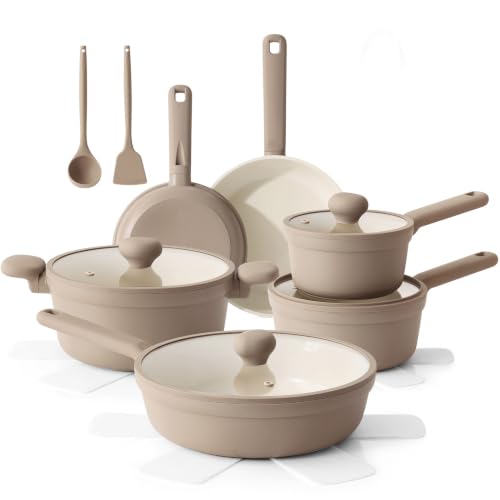
- The 17-piece assortment covers common tasks with two frying pans, two saucepans, a sauté pan, and a stock pot.
- The coating is free of intentionally added PFAS, PTFE, PFOA, PFOS, APEO, lead, and cadmium.
- Stay-cool ergonomic handles and lid knobs improve comfort during stovetop cooking.
- The lightweight cast aluminum body heats quickly while resisting deformation.
Cons
- The handles must be removed before placing the cookware in an oven.
- The set includes several pieces, so it requires more cabinet space than a basic pan set.
Details
This cookware set combines 17 pieces for frying, sautéing, simmering, and stock-pot cooking, solving the need for one coordinated collection of everyday pans.
Ceramic nonstick surfaces support easier food release, while cast aluminum heats quickly and evenly for more controlled cooking.
The set includes 8-inch and 9.5-inch frying pans, 1.5-quart and 2.5-quart saucepans, an 11-inch sauté pan, and a 4.7-quart stock pot.
It works on all stovetops and is oven safe to 500°F, but the handles must be removed before oven use.
Best for households wanting versatile, nontoxic ceramic cookware across multiple daily cooking tasks.
Cooking Tips
Use the smaller frying pan for eggs or single servings, the larger skillet for family portions, and the sauté pan for meals requiring extra surface area.
Match the saucepans to portion size, and use the stock pot for soups, pasta, and batch cooking.
Remove the handles before oven use, then clean the cookware in the dishwasher or by hand using its rivet-free design.

Save $40.00
Pros & Cons
Pros
- Works on induction, gas, and electric cooktops, so the set moves with you if your kitchen changes.
- Wipe-and-rinse cleanup handles most meals, with dishwasher tolerance available when you are short on time.
- The beige and white finish stays presentable enough to bring the pan straight to the table.
- Lightweight forged aluminum construction keeps the larger skillets manageable for one-handed tossing and pouring.
Cons
- The brand recommends hand washing to preserve the coating, which makes the dishwasher rating more of a fallback than a daily habit.
- Ceramic nonstick coatings generally lose slickness faster than traditional PTFE surfaces, so expect a shorter service life than a comparably priced hard-anodized set.
Details
A four-piece ceramic nonstick set for cooks who want to drop PFAS, PTFE, and PFOA coatings without giving up easy food release on eggs and fish.
The forged aluminum body with a thickened base targets hot spots, so crepes and pancakes brown evenly instead of scorching at the center. Oven safety to 842 degrees F allows stovetop-to-oven searing and finishing.
Sizes run 8, 9.5, and 11 inches with one shared lid. Handles are precision-pressed stainless steel, double riveted, and stay cool during burner cooking. Aluminum construction keeps weight low for daily lifting.
Hand washing is recommended despite the dishwasher rating, so plan on sink cleanup if you want the coating to last.
Best for home cooks replacing worn nonstick pans who want a non-toxic coating, multiple sizes, and induction compatibility in one purchase.
Cooking Tips
Keep ceramic on low to medium heat. The coating releases food without help, and high burner settings shorten its nonstick life faster than anything else you can do.
Add a thin film of oil or butter even though the pan does not require it. It protects the surface and improves browning on chicken skin and steak crust.
Let pans cool before washing. Cold water on a hot ceramic surface can warp thin aluminum and crack the coating, so rinse only after the pan reaches room temperature.

Pros & Cons
Pros
- The removable handle system is the standout feature, enabling compact nesting storage that works in cramped apartment kitchens.
- Oven-safe to 550°F gives more cooking flexibility than most ceramic sets in this category.
- Silicone sealing lids rated down to -100°F mean pots double as refrigerator storage without transferring food to separate containers.
- Bundled silicone utensils including a turner, ladle, and locking tongs round out the set so it is ready to use immediately.
Cons
- Handles are rated to 410°F but the manufacturer recommends removing them during cooking to extend their lifespan, which adds a step to every use.
- With zero reviews at launch, real-world durability of the ceramic coating under daily use remains unverified.
Details
The Chef Power 19-piece set solves two problems at once: toxic nonstick coatings and kitchen storage overload, using a detachable handle system and ceramic surfaces free of PFAS, PTFE, and PFOA.
The ceramic nonstick coating bonds to both interior and exterior surfaces, so food releases without oil and cleanup requires minimal scrubbing even after high-heat cooking.
Pieces include a 1.5 QT and 3.2 QT saucepan, 3.4 QT stockpot, 9-inch and 11-inch frying pans, multiple lids, two detachable handles, and three silicone utensils plus four pot protectors.
The detachable handles are rated to 410°F but should be removed during cooking for longevity, which is a minor workflow adjustment buyers should factor in.
Best for small-space home cooks who want a complete, toxin-free cookware setup without dedicating an entire cabinet to storage.
Cooking Tips
Preheat pans on medium rather than high heat. Ceramic nonstick reaches cooking temperature faster than stainless steel, and starting lower protects the coating over time.
Use the sealing lids to finish braised dishes in the oven up to 350°F, then move directly to the refrigerator for next-day storage without transferring to another container.
Detach the handles before placing pots in the oven above 410°F and reattach at the table for serving. This also lets you stack pans inside the oven simultaneously when cooking multiple dishes.
What Ceramic Cookware Is (and Isn’t)
Understanding what “ceramic cookware” means clears up the safety question, because it’s often misunderstood.
Ceramic coated cookware (the common type) is metal cookware (usually aluminum) coated with a ceramic-based nonstick surface made from a silica/sol-gel material (derived from sand). This is what most “ceramic cookware” refers to — it’s a nonstick coating, but a different chemistry from traditional PTFE (Teflon) nonstick. The ceramic coating provides food release without PTFE or related chemicals.
Important distinction — it’s not solid ceramic. Ceramic-coated cookware isn’t made of solid ceramic (like a clay pot); it’s metal with a thin ceramic nonstick layer. (Pure ceramic/clay cookware like some baking dishes exists separately and is also generally inert/non-toxic.) When people ask about “ceramic cookware,” they almost always mean ceramic-coated nonstick pans.
Why it’s marketed as non-toxic: the ceramic coating doesn’t contain PTFE, PFOA, or PFAS (“forever chemicals”) — the compounds associated with traditional nonstick concerns. It’s also typically free of lead and cadmium. This PTFE-free, PFAS-free composition is the basis of the “non-toxic” claim, and it’s a genuine chemical difference from traditional nonstick. Our best ceramic cookware set non toxic guide covers reputable brands.
So ceramic cookware is a metal pan with a sand-derived nonstick coating that avoids the “forever chemicals” of traditional nonstick — the core of why it’s considered non-toxic.
Is It Actually Non-Toxic? The Honest Answer
Here’s the balanced verdict on ceramic cookware’s safety.
Yes, ceramic cookware is generally considered non-toxic and safe:
- No PTFE, PFOA, or PFAS: it’s free of the “forever chemicals” linked to traditional nonstick concerns — the main reason people seek it out. See our are-nonstick-pans-safe guide for context on traditional nonstick.
- No lead or cadmium: reputable ceramic cookware is free of these heavy metals (though very cheap or old imported ceramics could be a concern — buy reputable brands).
- Doesn’t release fumes when overheated: unlike PTFE nonstick (which can release fumes at very high temperatures ~500°F+), ceramic coatings are more heat-stable and don’t off-gas the same way, a genuine safety advantage.
- Non-reactive: doesn’t react with acidic foods.
The caveats to be honest about:
- Buy reputable brands: the “non-toxic” quality depends on the manufacturer using clean materials. Reputable brands are transparent about being free of PTFE, PFOA, PFAS, lead, and cadmium; very cheap unknown brands are less certain. Look for those disclosures.
- “Non-toxic” claims are largely marketing terms (not strictly regulated), so verify the specific free-of claims rather than trusting the word alone.
- The bigger practical issue is durability, not toxicity (see next section) — ceramic is safe but wears out.
The bottom line on safety: ceramic cookware from a reputable brand is genuinely non-toxic and a safe choice, free of the “forever chemicals,” heavy metals, and high-heat fumes associated with traditional nonstick concerns. It’s a legitimate non-toxic nonstick option. Just buy from transparent, reputable brands and verify the free-of claims. See our are-ceramic-cookware-sets-safe and best non-toxic cookware guides.
The Real Trade-Off: Durability
The honest weakness of ceramic cookware isn’t safety — it’s how long it lasts. This is the key thing to know.
Ceramic nonstick coatings wear out faster than other nonstick. The ceramic coating’s nonstick performance typically degrades within 1-3 years of regular use — often faster than traditional PTFE nonstick. As it wears, food starts sticking, and the pan loses the easy release that was its main appeal. This is the most common complaint about ceramic cookware.
Why it wears: the ceramic coating is more prone to losing its nonstick properties over time and with heat exposure, and it can be sensitive to high heat and abrasion.
How to make ceramic cookware last longer:
- Use low to medium heat — high heat degrades the coating faster.
- No metal utensils — use silicone, wood, or nylon to avoid scratching.
- Hand-wash gently — avoid the dishwasher and abrasive scrubbers.
- Avoid cooking spray — sprays can build up and damage the coating; use a little oil or butter instead.
- Don’t overheat empty or thermal-shock (no cold water on a hot pan).
- Store carefully — protect the surface from scratches (pan protectors).
Even with good care, expect ceramic nonstick to eventually wear and need replacing — it’s somewhat of a consumable, like all nonstick. See our how-often-to-replace-nonstick guide.
The practical takeaway: ceramic cookware is a safe, non-toxic choice, but you’re trading some durability for that non-toxic, forever-chemical-free surface. If avoiding PTFE/PFAS matters to you, ceramic is worth it despite the shorter lifespan; if durability matters most, stainless steel or cast iron (coating-free, last forever) are alternatives. Choose based on your priority. Our best ceramic cookware set non toxic and best non-toxic cookware guides cover options.
Frequently Asked Questions
Is ceramic cookware non-toxic?
Yes, generally. Ceramic-coated cookware uses a sand-derived (sol-gel) nonstick coating that’s free of PTFE, PFOA, and PFAS (“forever chemicals”), and reputable brands are also free of lead and cadmium. It doesn’t release fumes when overheated the way traditional PTFE nonstick can. This makes it a genuine non-toxic nonstick option and the main reason people choose it. Buy from reputable, transparent brands that disclose being free of these chemicals, since “non-toxic” is a marketing term — verify the specific free-of claims rather than trusting the word alone.
Is ceramic cookware safer than Teflon (nonstick)?
It avoids the specific concerns people have about traditional nonstick. Ceramic coatings contain no PTFE, PFOA, or PFAS, and they don’t release fumes at high temperatures the way PTFE nonstick can (PTFE can off-gas above ~500°F). That said, modern PTFE nonstick is PFOA-free and considered safe when used properly and intact. So ceramic is a good choice if you specifically want to avoid PTFE/PFAS entirely, while modern traditional nonstick is also considered safe within normal use. Ceramic’s edge is being forever-chemical-free; its downside is wearing out faster.
How long does ceramic cookware last?
Typically 1-3 years of regular use before the nonstick performance noticeably degrades and food starts sticking — often a shorter lifespan than traditional PTFE nonstick. This durability is ceramic’s main weakness (not safety). You can extend its life by using low-medium heat, avoiding metal utensils and cooking sprays, hand-washing gently, and not overheating or thermal-shocking it. Even well cared for, ceramic nonstick eventually wears out and needs replacing, like all nonstick coatings. If you want cookware that lasts indefinitely, stainless steel or cast iron are better.
Is ceramic cookware actually solid ceramic?
Usually not. Most “ceramic cookware” is metal (typically aluminum) coated with a thin ceramic-based nonstick layer — it’s ceramic-coated, not solid ceramic. This is what people mean by ceramic cookware for stovetop use. Solid ceramic or clay cookware (like some baking dishes and pots) exists separately and is also generally inert and non-toxic, but it’s different from the ceramic-coated nonstick pans marketed for everyday cooking. When evaluating “ceramic cookware,” know you’re almost always dealing with a ceramic nonstick coating over metal.
How do I make ceramic cookware last longer?
Use low to medium heat (high heat degrades the coating), avoid metal utensils (use silicone, wood, or nylon), hand-wash gently (skip the dishwasher and abrasive scrubbers), avoid cooking sprays (which build up and damage the coating — use a little oil or butter instead), don’t overheat the empty pan or thermal-shock it, and store it protected from scratches. These habits slow the wear that eventually degrades ceramic nonstick. Even with good care, expect it to wear out over a few years, but proper use meaningfully extends its useful life.
Is cheap ceramic cookware safe?
Reputable ceramic cookware is safe, but very cheap or unknown-brand ceramic cookware is less certain — the “non-toxic” quality depends on the manufacturer using clean materials free of PTFE, PFOA, PFAS, lead, and cadmium. Reputable brands are transparent about these free-of claims; cheap unbranded or old imported ceramics may not be, and could theoretically contain heavy metals in the glaze. To be safe, buy from established, transparent brands that clearly disclose their coating is free of those substances. Don’t rely on the word “ceramic” or “non-toxic” alone from unknown sellers.
Related buying guides: best cookware sets, best copper cookware and best nonstick cookware set.
The Bottom Line
Ceramic cookware is generally non-toxic and a safe choice: its sand-derived nonstick coating is free of PTFE, PFOA, and PFAS (“forever chemicals”), plus lead and cadmium in reputable brands, and it doesn’t release high-heat fumes like traditional nonstick can. That makes it a legitimate non-toxic nonstick option — just buy from transparent, reputable brands and verify the free-of claims, since “non-toxic” is a marketing term. The real trade-off isn’t safety but durability: ceramic coatings wear out faster (typically 1-3 years), so you trade longevity for the forever-chemical-free surface. If avoiding PTFE/PFAS matters most, ceramic is worth it; if durability matters most, consider stainless steel or cast iron. See our best ceramic cookware set non toxic and best non-toxic cookware guides.



Write Your Review
No reviews yet. Be the first to share your experience!